What is the Best Product Launch Strategy in 2026?
The best product launch strategy is a multi-phased, data-driven framework that prioritizes community engagement and product-market fit (PMF) verification before a wide market release. In 2026, this typically involves a three-stage appr...
The best product launch strategy is a multi-phased, data-driven framework that prioritizes community engagement and product-market fit (PMF) verification before a wide market release. In 2026, this typically involves a three-stage approach: a momentum-building pre-launch, a targeted "Big Bang" or "Rolling" execution, and a post-launch retention phase focused on rapid iteration based on user feedback.
Contents
Successful product launches no longer rely solely on massive advertising spends. Instead, they leverage precision-targeted messaging, community-led growth, and seamless user onboarding to ensure that the initial traction translates into long-term market share. Whether you are launching a SaaS platform, a consumer packaged good, or a niche service, the "best" strategy is the one that aligns your unique value proposition with the specific psychological triggers of your target audience.
Understanding the Core Pillars of a Successful Launch
Before selecting a specific strategy, it is essential to understand the foundational elements that support every successful go-to-market (GTM) plan. In the current 2026 landscape, the margin for error has narrowed as consumer attention spans have fractured across decentralized platforms.
Defining Product-Market Fit (PMF)
Product-Market Fit is the degree to which a product satisfies a strong market demand. Launching without PMF is the primary reason most new products fail. To verify PMF, companies must move beyond internal assumptions and conduct rigorous external testing. This involves "smoke tests," landing page demand verification, and deep interviews with early adopters. If your product does not solve a "bleeding neck" problem—an urgent, painful issue for the user—no amount of marketing spend will sustain it after the initial launch hype fades.
Identifying the Ideal Customer Profile (ICP)
A common mistake is attempting to launch to "everyone." The best strategies focus on a hyper-specific Ideal Customer Profile. In 2026, this goes beyond basic demographics like age or location. It includes psychographics, technographics (the tools they already use), and "job-to-be-done" frameworks. By narrowing your focus, you can tailor your messaging so specifically that it resonates deeply with a small group of influential users who will then act as the vanguard for your broader market entry.
Establishing the Unique Value Proposition (UVP)
Your UVP is a clear statement that explains how your product solves customers' problems, delivers specific benefits, and tells the ideal customer why they should buy from you and not from the competition. In a saturated market, your UVP must be easily communicable in under five seconds. If a potential user cannot understand why your product is different or better than their current solution immediately, the launch will likely struggle to gain organic momentum.
The Three-Phase Launch Framework
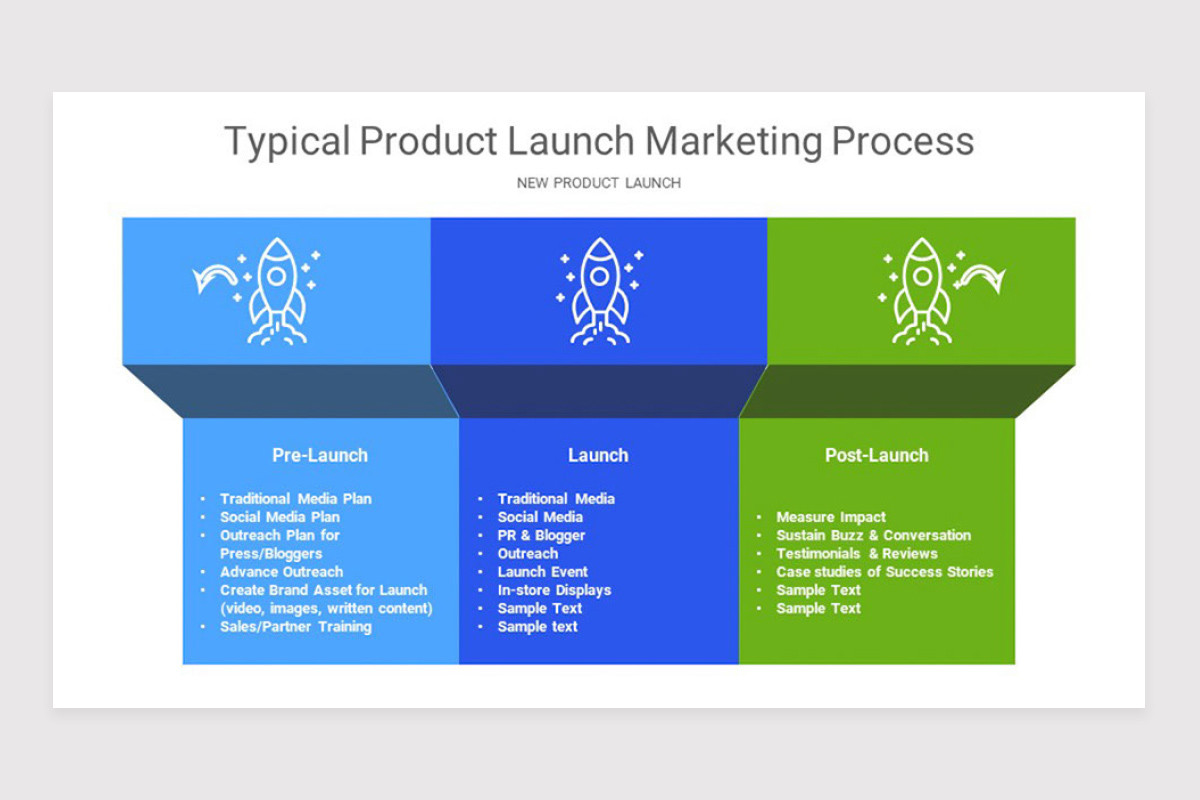
A robust product launch is not a single day; it is a timeline. Splitting the process into three distinct phases allows for better resource allocation and risk management.
Phase 1: Pre-Launch and Market Education
The pre-launch phase is arguably the most critical. Its goal is to build a "waitlist" of eager customers and create an aura of exclusivity or necessity.
- Content Teasers: Utilize short-form video and interactive "behind-the-scenes" content to pique interest.
- Beta Testing and Early Access: Invite a select group of influencers or power users to test the product. This creates social proof and allows you to catch technical bugs before the public sees them.
- Waitlists and Gamification: Use referral mechanics where users can move up a waitlist by inviting friends. This lowers your Customer Acquisition Cost (CAC) before you’ve even spent a dollar on traditional ads.
Phase 2: The Launch Event and Execution
This is the execution of your primary GTM strategy. Depending on your business model, this might look like a "Big Bang" launch where all channels go live at once to create a surge in the cultural zeitgeist, or a "Rolling Launch" that slowly opens the doors to different segments.
- Omni-channel Saturation: Ensure your messaging is consistent across your website, social media, email lists, and partner channels.
- High-Touch Onboarding: The first five minutes of a user's experience with your product determine whether they stay. Ensure the onboarding process is frictionless.
- Live Engagement: In 2026, live-streamed launch events and interactive Q&A sessions are standard for building trust and humanizing the brand.
Phase 3: Post-Launch Analysis and Iteration
The launch does not end when the "Buy Now" button goes live. The weeks following the launch are for stabilization and scaling.
- Feedback Loops: Use automated surveys and in-app feedback tools to understand where users are getting stuck.
- KPI Tracking: Monitor metrics such as Daily Active Users (DAU), churn rate, and Net Promoter Score (NPS).
- Feature Iteration: Be prepared to ship updates daily or weekly based on the data you receive. The "best" product at launch is rarely the one that survives the first year; the one that adapts fastest does.
Comparison of Modern Launch Strategies
Choosing the right strategy depends on your budget, product type, and risk tolerance. The following table compares the most effective strategies utilized in 2026.
| Strategy | Best For | Primary Advantage | Main Risk |
|---|---|---|---|
| Product-Led Growth (PLG) | SaaS, Apps, Digital Tools | High scalability and low sales overhead by letting the product sell itself. | Requires a highly intuitive product; high initial development cost. |
| Community-Led | Niche products, Developer tools, Enthusiast brands | Built-in brand loyalty and high organic "word-of-mouth" reach. | Extremely slow to build; requires genuine, non-promotional engagement. |
| The Big Bang Launch | Consumer Electronics, Movies, Major Retail | Creates immediate massive awareness and "FOMO" (Fear Of Missing Out). | High burn rate; if the product has bugs, the reputation damage is instant. |
| Influencer-Centric | Fashion, Beauty, Lifestyle Goods | Leverages established trust and targeted reach of niche creators. | Dependence on external personalities; risk of "influencer fatigue." |
| The Stealth/Rolling Launch | B2B Enterprise, High-end Services | Allows for deep refinement and "under-the-radar" scaling before competitors react. | Missing out on early public hype and massive initial traffic spikes. |
Key Channels for Maximum Visibility in 2026
To execute these strategies, you must meet your audience where they live. The digital landscape in 2026 is dominated by a mix of traditional search and decentralized "dark social" networks.
- Search Engine Optimization (SEO): Even with the rise of AI-driven search, ranking for high-intent keywords remains the most cost-effective way to drive long-term traffic. Your strategy should include a "content moat" of educational articles that solve problems related to your product.
- Dark Social (Slack, Discord, Telegram): A significant portion of product discovery now happens in private groups. Successful brands seed these communities with value rather than just links.
- Collaborative Influencer Marketing: Moving beyond simple "shoutouts," the best 2026 launches involve co-creation. Influencers are given a stake or a "founder's edition" version of the product to promote, making their endorsement more authentic.
- Paid Media with Attribution AI: While traditional ads are more expensive, AI-driven attribution models in 2026 allow marketers to see exactly which touchpoint led to a conversion, allowing for real-time budget shifting to the most profitable channels.
Common Pitfalls to Avoid
Even the most well-funded launches can fail if they fall into these common traps.
- Ignoring the "Aha! Moment": If your product is complex, users may drop off before they experience its value. Your strategy must prioritize getting the user to their first "win" as quickly as possible.
- Over-Promising and Under-Delivering: In an era of instant public reviews, a product that doesn't live up to its marketing hype will be destroyed by negative social proof within hours. It is always better to "under-promise and over-deliver."
- Neglecting Customer Support: A surge in new users inevitably leads to a surge in support tickets. If your support team isn't scaled for the launch, the resulting frustration can lead to high churn rates that negate your acquisition gains.
- Focusing on Vanity Metrics: High website traffic and social media likes are irrelevant if they don't convert into paying customers or active users. Focus on "North Star" metrics that actually correlate with business growth.
Frequently Asked Questions
What is the most cost-effective product launch strategy?
The most cost-effective strategy is usually Product-Led Growth (PLG) combined with Community-Led marketing. By building a product that inherently encourages sharing or provides value in a free tier (Freemium), you turn your users into your marketing department. This reduces the need for expensive paid advertising and focuses resources on product excellence.
How far in advance should I start planning a launch?
For most significant products, planning should begin 6 to 12 months before the target launch date. This provides enough time for market research, several rounds of beta testing, and the creation of a robust content library. Attempting to "rush" a launch in under three months often leads to missed bugs and uncoordinated marketing efforts.
Is the "Big Bang" launch still effective in 2026?
Yes, but primarily for companies with established brand equity or significant capital. For a Big Bang launch to work in 2026, it requires simultaneous saturation across multiple platforms to overcome the "noise" of the internet. For smaller startups, a rolling or "staged" launch is often more effective and less risky.
How do I measure the success of a product launch?
Success should be measured against pre-defined KPIs such as Customer Acquisition Cost (CAC), Activation Rate (the percentage of users who perform a key action), and Week 1 Retention. Comparing these numbers against industry benchmarks from organizations like Gartner or Harvard Business Review can provide context for your performance.
Should I launch on platforms like Product Hunt or Kickstarter?
These platforms are excellent for gaining early traction and social proof, but they are not a complete strategy. They should be treated as distribution channels within a larger framework. Use them to gather your first 1,000 "true fans," then use that momentum to branch out into broader market segments.
Final Recommendation
The "best" product launch strategy in 2026 is one that is iterative and customer-centric. Avoid the temptation to view the launch as a single finish line. Instead, treat it as the starting gun for a continuous cycle of learning and improvement. Start with a deep understanding of your customer, build a community before you build the hype, and ensure your product delivers on its promise from the very first click.
By focusing on Product-Led Growth and maintaining a strict feedback-loop post-launch, you can ensure that your product doesn't just make a splash, but builds a lasting presence in the market.
Image Gallery