Life Insurance Paid by Employer Tax Rules: IRC Section 79, Imputed Income, and Business Deductions
Employer-paid life insurance is generally tax-free to employees up to $50,000 of group term coverage under Internal Revenue Code (IRC) Section 79. Coverage exceeding $50,000 generates taxable imputed income for the employee based on IR...
Employer-paid life insurance is generally tax-free to employees up to $50,000 of group term coverage under Internal Revenue Code (IRC) Section 79. Coverage exceeding $50,000 generates taxable imputed income for the employee based on IRS Table I premium rates. Employers can typically deduct premium payments as standard business expenses, provided the business is not a policy beneficiary.
Contents
IRC Section 79 and the $50,000 Tax Exclusion
Under Internal Revenue Code Section 79, the Internal Revenue Service (IRS) provides a tax exclusion for employer-paid group term life insurance up to a policy face value of $50,000. For an employee receiving $50,000 or less in group term life coverage funded entirely by their employer, the value of those premiums is completely excluded from the employee's gross income for federal tax purposes.
To qualify for this tax-exempt treatment under Section 79, an insurance plan must satisfy four core conditions:
- General Death Benefit: The policy must provide a general death benefit that is excludable from gross income under IRC Section 101(a).
- Group of Employees: Coverage must be extended to a group of employees defined by factors related to employment (such as union membership, job classification, or length of service).
- Carried Directly or Indirectly by Employer: The policy must be provided by the employer or an entity acting on the employer's behalf.
- Formula-Based Coverage: The amount of coverage must be determined by a formula that precludes individual selection (such as a flat dollar amount or a uniform multiple of annual salary).
If employer-paid group coverage exceeds $50,000, the cost of the coverage above $50,000—minus any post-tax contributions made by the employee—is treated as taxable income. This benefit is classified as a non-cash fringe benefit subject to specific tax withholding rules.
Total Group Coverage - $50,000 Exclusion Threshold = Taxable Excess Coverage
Note: Tax rules discussed in this guide reflect U.S. federal tax law administered by the Internal Revenue Service (IRS). Tax obligations can vary based on individual circumstances and state tax codes. Consult a certified public accountant (CPA) or qualified tax attorney for professional guidance regarding corporate benefits and tax compliance.
Calculating Imputed Income: IRS Table I Premium Rates
When an employer provides group term life insurance in excess of $50,000, the taxable value is not based on the actual premium the employer pays to the insurance carrier. Instead, the IRS requires employers to calculate imputed income using a standardized uniform premium table known as IRS Table I, published in IRS Publication 15-B (Employer's Tax Guide to Fringe Benefits).
Imputed income represents the fair market value of the additional insurance benefit received by the employee. It is calculated monthly based on the employee's age on the last day of the calendar year.
IRS Table I Monthly Premium Cost Rates
The following table displays the IRS Table I rates per $1,000 of excess group term life insurance coverage per month:
| Age Bracket | Monthly Cost per $1,000 of Excess Coverage |
|---|---|
| Under 25 | $0.05 |
| 25 to 29 | $0.06 |
| 30 to 34 | $0.08 |
| 35 to 39 | $0.09 |
| 40 to 44 | $0.10 |
| 45 to 49 | $0.15 |
| 50 to 54 | $0.23 |
| 55 to 59 | $0.43 |
| 60 to 64 | $0.66 |
| 65 to 69 | $1.27 |
| 70 and older | $2.06 |
Step-by-Step Imputed Income Calculation Example
Consider a 48-year-old employee whose employer provides $150,000 in group term life insurance coverage paid entirely by the business.
- Subtract the Tax-Free Threshold: Deduct $50,000 from the total coverage amount.$$$150,000 - $50,000 = $100,000 \text{ excess coverage}$$
- Determine Units of $1,000: Divide the excess coverage by $1,000.$$$100,000 / $1,000 = 100 \text{ units}$$
- Locate the IRS Table I Rate: For a 48-year-old employee, the monthly rate is $0.15 per $1,000.
- Calculate Monthly Imputed Income: Multiply the units by the monthly rate.$$100 \times $0.15 = $15.00 \text{ per month}$$
- Calculate Annual Taxable Income: Multiply the monthly value by 12 months.$$$15.00 \times 12 = $180.00 \text{ annual imputed income}$$
In this scenario, $180.00 is added to the employee's gross taxable wages for the year.
Tax Withholding and Payroll Reporting Requirements
Employer-provided imputed income for group term life insurance is subject to specific payroll tax rules:
- FICA Taxes (Social Security and Medicare): Imputed income is subject to Social Security (6.2%) and Medicare (1.45%) tax withholding. Employers must withhold these taxes from the employee's regular cash wages.
- Federal Income Tax (FIT): Imputed income is subject to federal income tax, but employers are not required to withhold income tax on this amount, though they may choose to do so. The employee must report the full imputed income amount on their tax return.
- Form W-2 Reporting: Employers must report the total annual imputed income on the employee's Form W-2 in Box 1 (Wages, tips, other compensation), Box 3 (Social Security wages), Box 5 (Medicare wages), and in Box 12 using Code C.
Employer Tax Rules: Deductions, Exclusions, and Nondiscrimination Rules
For businesses, offering life insurance as an employee benefit carries specific tax deductibility advantages and compliance requirements under federal tax law.
Deductibility of Insurance Premiums for Employers
Under IRC Section 162(a), an employer can generally deduct the full cost of premiums paid for employee group life insurance as a standard business expense. However, this deduction is subject to strict statutory limitations governed by IRC Section 264(a)(1).
An employer cannot deduct premium payments if the company is directly or indirectly a beneficiary of the life insurance policy. If the business is named as the beneficiary—such as in key person life insurance arrangements—the premiums paid by the employer are non-deductible expense items.
Non-Discrimination Requirements Under IRC Section 79(d)
To retain tax-favored status for key employees and highly compensated employees (HCEs), an employer-sponsored group term life insurance plan must satisfy strict non-discrimination tests defined under IRC Section 79(d).
A plan is considered discriminatory if it favors key employees regarding eligibility to participate or the type and amount of benefits available. Key employees generally include corporate officers earning above statutory indexed thresholds, 5% owners, or 1% owners earning over $150,000.
If a group term life plan discriminates in favor of key employees:
- Key employees lose the benefit of the $50,000 tax exclusion under Section 79.
- Key employees must include in their taxable gross income the greater of the actual premium paid by the employer or the calculated IRS Table I cost for all coverage provided, including the first $50,000.
- Non-key employees retain their $50,000 tax exclusion and standard Table I imputed income treatment.
Specialized Employer-Paid Coverage & Tax Implications
Beyond standard group term policies, employers often implement specialized executive policies, permanent life coverage, or dependent coverage. Each arrangement carries distinct tax rules.
- Employer-Paid Coverage Types
- Group Term Life Insurance (IRC Sec. 79): Up to $50k tax-free; excess taxable via Table I
- Permanent / Whole Life Insurance: Full premium paid is taxable income to employee
- Employer-Owned Life Insurance (IRC Sec. 101(j)): Requires Notice & Consent; death benefit tax treatment
- Dependent Group Term Life: Tax-free if <= $2,000 (de minimis); excess makes full cost taxable
Permanent Life Insurance (Whole Life or Universal Life)
Unlike group term life insurance, permanent life policies (such as whole life or universal life) accumulate cash value. IRC Section 79 tax exemptions apply strictly to term coverage.
If an employer pays premiums for a permanent life insurance policy owned by the employee:
- The full cost of the policy premium paid by the employer is taxable income to the employee in the year paid.
- The payments are subject to full income tax withholding, FICA taxes, and FUTA taxes.
- The employer can deduct the premium payments as compensation expense under IRC Section 162, provided the total compensation package is reasonable.
Employer-Owned Life Insurance (EOLI) and IRC Section 101(j)
When businesses purchase life insurance policies on key employees or executives where the company is the beneficiary (Key Person Insurance), the transaction is governed by IRC Section 101(j).
Under Section 101(j), proceeds from employer-owned life insurance policies are treated as taxable income to the corporation unless specific written notice and consent requirements are satisfied before the policy is issued:
- Written Notice: The employee must be notified in writing that the employer intends to insure the employee's life and the maximum face amount for which the employee could be insured.
- Written Consent: The employee must provide written consent to being insured and to the continuation of coverage after employment terminates.
- Informed Beneficiary Status: The employee must be informed in writing that the employer will be an ultimate beneficiary of any insurance proceeds.
If an employer fails to meet these notice and consent requirements prior to policy issuance, any death benefits received by the company above the cumulative premiums paid will be subject to corporate income tax.
Dependent Group Life Insurance Rules
Employers may offer group term coverage for an employee's spouse or dependent children. The tax rules governing dependent life insurance differ from primary employee coverage:
- De Minimis Fringe Benefit: Under IRS Notice 89-110, if the face value of dependent life insurance provided by the employer does not exceed $2,000, the cost of the coverage is considered a tax-free de minimis fringe benefit under IRC Section 132.
- Coverage Exceeding $2,000: If dependent coverage exceeds $2,000, the entire taxable cost of the insurance (calculated using IRS Table I rates based on the spouse's or dependent's age), minus any after-tax employee contributions, is included in the employee's gross income. The $50,000 tax exclusion does not apply to dependent coverage.
Tax Treatment of Death Benefits for Beneficiaries
In most standard employer-paid group life insurance plans, the proceeds paid upon the employee's death receive favorable tax treatment.
Tax-Free Payouts Under IRC Section 101(a)
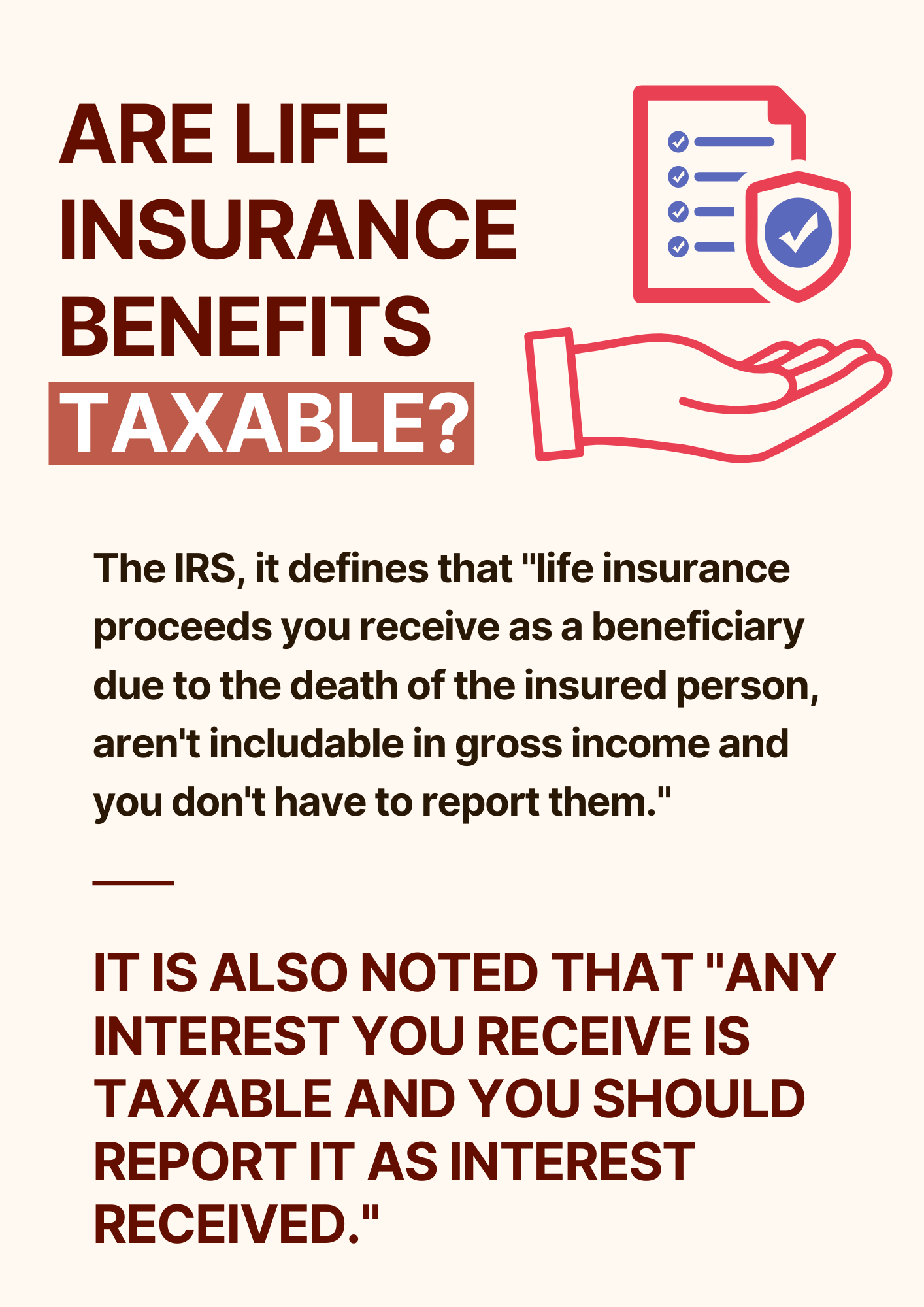
Under IRC Section 101(a), lump-sum death benefit payouts paid to an employee's designated beneficiaries (such as a spouse, child, or trust) are generally 100% exempt from federal income tax. Beneficiaries do not report the lump-sum insurance proceeds as taxable income on their federal tax returns.
Exceptions to Death Benefit Tax Exclusions
While the principal proceeds are tax-exempt, specific exceptions can introduce tax liabilities:
- Interest on Installment Payouts: If a beneficiary elects to receive death benefit proceeds in installment payments rather than a lump sum, any interest earned on the unpaid principal balance held by the insurer is fully taxable as ordinary income.
- Transfer-For-Value Rule: If a life insurance policy or rights to a policy are sold or transferred for valuable consideration, a portion of the death benefit may lose its tax-free status under IRC Section 101(a)(2).
- Non-Compliant Employer-Owned Policies: If an employer-owned policy fails the notice and consent requirements of IRC Section 101(j), the death benefit paid to the employer becomes taxable to the business to the extent it exceeds the premiums paid.
Employer Compliance Checklist and Best Practices
To maintain compliance with IRS regulations and prevent unexpected tax liabilities for both the organization and its workforce, employers should adhere to the following procedural operational steps:
- Verify Plan Qualification under IRC Section 79: Ensure group policies use objective coverage formulas (e.g., 1x or 2x annual salary) and do not allow individual coverage customization that invalidates group status.
- Audit IRS Table I Calculations Annually: Update payroll software to reflect employee age changes as of December 31 of each tax year to ensure accurate imputed income calculations.
- Execute Section 101(j) Notice and Consent Forms: Prior to underwriting or issuing any employer-owned key person policies, obtain signed, written consent from insured employees.
- Conduct Section 79(d) Non-Discrimination Testing: Perform annual non-discrimination testing to verify that key executives are not receiving disproportionate tax-favored coverage compared to rank-and-file workers.
- Report Correctly on Form W-2: Confirm that payroll processes correctly populate Box 1, Box 3, Box 5, and Box 12 (Code C) for employees with coverage exceeding $50,000.
Frequently Asked Questions
Is employer-paid life insurance taxable to the employee?
Employer-paid group term life insurance is tax-free to the employee for coverage up to $50,000. Any coverage provided above $50,000 generates taxable imputed income, which is calculated using IRS Table I rates and reported on the employee's Form W-2.
How is imputed income reported on IRS Form W-2?
Imputed income for group term life insurance coverage exceeding $50,000 is included in Form W-2 Box 1 (Wages, tips, other compensation), Box 3 (Social Security wages), and Box 5 (Medicare wages). It is also listed separately in Box 12 under Code C.
Can an employer deduct life insurance premiums paid for employees?
Yes, an employer can deduct life insurance premiums paid on behalf of employees as a business expense under IRC Section 162. However, under IRC Section 264, premiums are non-deductible if the employer is directly or indirectly a beneficiary of the policy.
What happens if an employee pays part of the premium for excess life coverage?
If an employee makes post-tax payroll contributions toward group term life insurance, their total annual contributions are subtracted from the calculated IRS Table I imputed income. Only the remaining net amount is added to the employee's gross taxable income.
Are life insurance death benefits taxable to the employee's beneficiary?
Lump-sum death benefits paid from employer-provided life insurance policies to an employee's designated beneficiaries are generally exempt from federal income tax under IRC Section 101(a). However, any interest earned on deferred installment payouts is taxable.
Final Recommendations for Employers and Benefit Administrators
Managing employer-paid life insurance requires ongoing alignment between benefit plan design, executive planning, and payroll compliance.
Employers should review coverage formulas annually to ensure compliance with IRC Section 79 group rules and non-discrimination requirements under Section 79(d). Payroll systems must automatically recalculate Table I imputed income whenever employees shift age brackets or receive salary increases that raise policy values above the $50,000 limit. Finally, when implementing specialized executive arrangements or key person policies, legal and finance teams must secure signed Section 101(j) written consents prior to policy issuance to protect the tax-free status of insurance proceeds.
Image Gallery