Understanding the Effects of a Bad Credit Rating in 2026
A bad credit rating—typically defined as a FICO score below 580—functions as a significant financial barrier that extends far beyond simple loan denials. It results in substantially higher interest rates, larger security deposits for e...
A bad credit rating—typically defined as a FICO score below 580—functions as a significant financial barrier that extends far beyond simple loan denials. It results in substantially higher interest rates, larger security deposits for essential utilities, increased insurance premiums, and restricted access to housing and specific employment opportunities, making basic financial stability more expensive and difficult to maintain.
Contents
The Structural Impact of a Subprime Credit Profile
In 2026, the distinction between "prime" and "subprime" credit remains a defining factor in an individual’s economic mobility. A credit rating is essentially a numerical representation of risk. When a credit report contains a history of late payments, high credit utilization, or public records like bankruptcies and tax liens, the resulting low score signals to institutions that the individual is a "high-risk" borrower.
The effects of a bad credit rating are both direct and indirect. Direct effects include the immediate rejection of credit applications or the offer of credit under predatory terms. Indirect effects are more insidious, influencing aspects of life that many do not initially associate with credit, such as the ability to secure a mobile phone contract or the cost of protecting one's vehicle. As financial technology continues to evolve, the algorithms used by lenders have become more sophisticated, often incorporating "trended data" which looks at the trajectory of your debt management over time, making a consistently bad rating even more impactful than a single isolated mistake.
Higher Costs of Borrowing and Risk-Based Pricing
The most immediate financial consequence of a bad credit rating is the implementation of risk-based pricing. Lenders do not have a single interest rate for all customers; instead, they scale the Annual Percentage Rate (APR) based on the borrower’s creditworthiness. For those with bad credit, this "interest rate tax" can amount to hundreds of thousands of dollars over a lifetime.
Mortgages and Real Estate
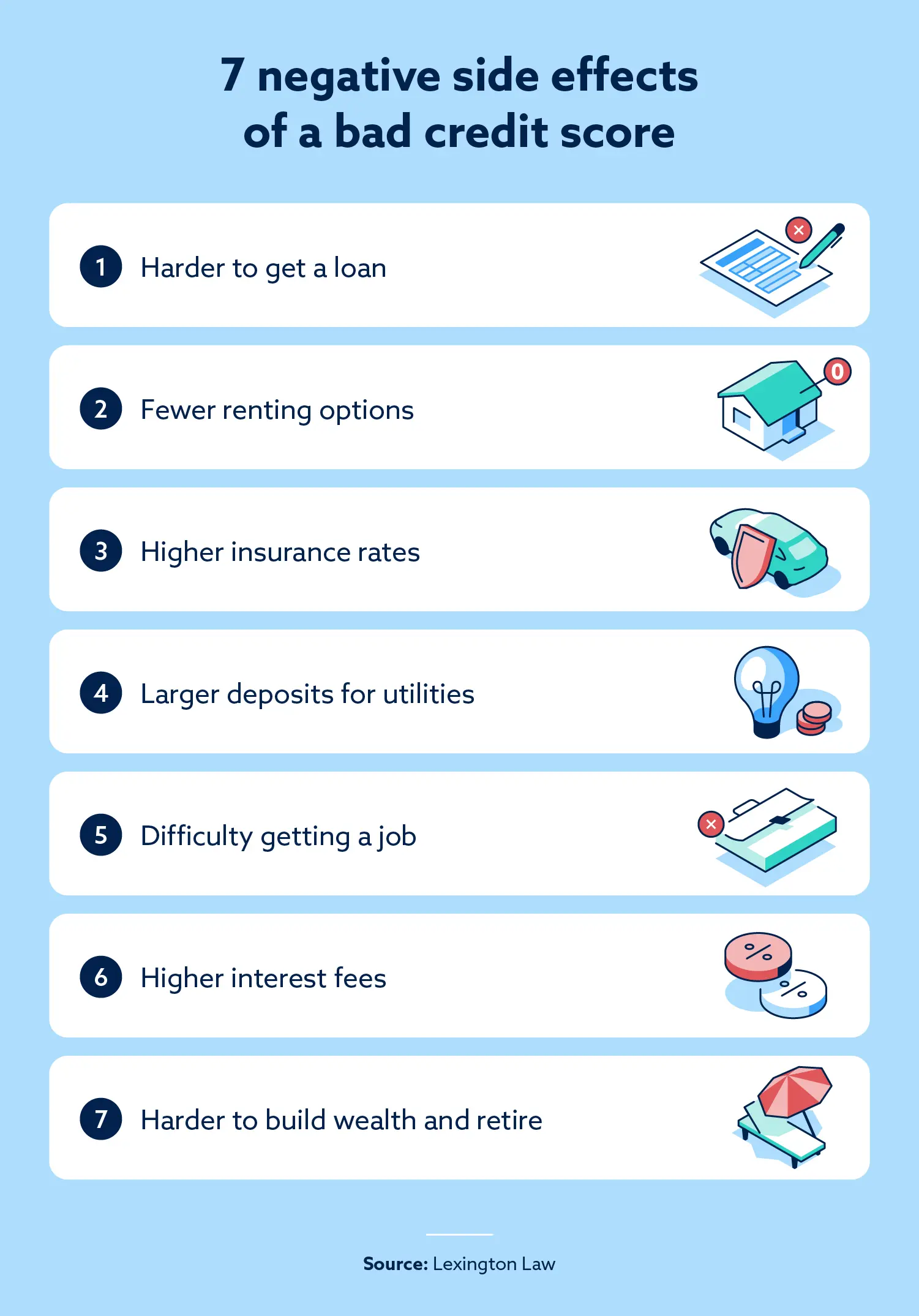
Securing a mortgage with a score below 620 is exceptionally difficult. While FHA loans (Federal Housing Administration) provide some pathways for those with scores as low as 500–580, the requirements for down payments increase significantly. In 2026, a borrower with a 760 score might secure a 30-year fixed mortgage at a competitive market rate, while a borrower with a 580 score may face rates 2% to 3% higher, or be required to provide a 10% to 20% down payment that they cannot afford.
Auto Loans and Transportation
Automobile financing is often the first place consumers feel the sting of a bad credit rating. "Buy Here, Pay Here" dealerships often target subprime borrowers with interest rates exceeding 20%. Over a 60-month loan on a $25,000 vehicle, the difference between a 4% APR and an 18% APR results in nearly $10,000 in additional interest payments. This diverts capital away from savings or debt reduction, creating a cycle of poverty where the individual pays more for the same asset than a wealthy peer.
Housing Obstacles and Rental Barriers
For many, the most devastating effect of a bad credit rating is the inability to secure safe, affordable housing. In competitive rental markets, landlords use credit scores as a primary screening tool to predict the likelihood of a tenant defaulting on rent or facing eviction.
A bad credit rating can lead to:
- Automatic Application Denial: Many corporate-owned apartment complexes have strict "hard floors" for credit scores. An application with a score below 600 may be automatically rejected by the software before a human ever sees it.
- Increased Security Deposits: If a landlord does agree to rent to someone with poor credit, they often mitigate their risk by requiring a double or triple security deposit. This creates a high "entry cost" for housing that can trap individuals in substandard living conditions.
- The Need for a Co-signer: Borrowers may be forced to find a guarantor or co-signer with good credit to take legal responsibility for the lease, which can strain personal relationships and limit independence.
Impact on Utilities and Service Contracts
A bad credit rating affects the basic infrastructure of a household. Utility companies (electricity, water, natural gas) and telecommunications providers often perform a "soft" or "hard" credit pull when a new service is requested.
Under the Fair Credit Reporting Act (FCRA), utilities are permitted to use credit data to determine if a security deposit is required. Consumers with bad credit are frequently required to pay deposits ranging from $100 to $500 just to turn on the lights or set up internet service. While these deposits are typically refundable after 12 months of on-time payments, the upfront cost can be a major hurdle for families moving into a new home. Furthermore, the best "0% down" deals on the latest smartphones in 2026 are reserved for those with prime credit, leaving subprime consumers to pay the full retail price upfront.
Employment and Professional Limitations
It is a common misconception that employers see your actual credit score; in reality, they view a modified version of your credit report. In 2026, many employers—particularly in the financial services, government contracting, and law enforcement sectors—use credit checks as part of the background screening process.
The rationale is that individuals under extreme financial duress may be more susceptible to bribery, theft, or lapses in judgment. While some states have restricted the use of credit checks for employment, many still allow it for positions that involve fiduciary responsibility or access to sensitive data. A bad credit rating characterized by significant unpaid collections or high debt-to-income ratios can lead to the withdrawal of a job offer, effectively capping an individual's career growth due to past financial struggles.
Insurance Premiums and "Credit-Based Insurance Scores"
In most U.S. states, insurance companies use "credit-based insurance scores" to help determine the cost of auto and homeowners insurance. Actuarial data suggests a correlation between credit management and the likelihood of filing an insurance claim.
If you have a bad credit rating, you could pay significantly more for the exact same insurance coverage as someone with excellent credit. This is not a reflection of your driving record but of your financial history. In some cases, the "credit penalty" on an insurance premium can exceed 50%, adding hundreds of dollars to annual living expenses. Organizations like the National Association of Insurance Commissioners (NAIC) provide resources on how these scores are calculated and the regulations governing them in different jurisdictions.
Comparative Costs: Good Credit vs. Bad Credit (2026 Projections)
The following table illustrates the hypothetical financial impact of a bad credit rating on common consumer expenses, based on standard 2026 market spreads.
| Expense Category | Prime Credit (740+) | Subprime Credit (580-) | Estimated "Credit Penalty" |
|---|---|---|---|
| 30-Year Mortgage ($350k) | ~6.2% APR | ~8.5% APR | ~$550 more per month |
| Auto Loan ($30,000) | ~5.0% APR | ~17.5% APR | ~$190 more per month |
| Credit Card APR | 18.0% (with rewards) | 29.9% (no rewards) | 11.9% higher interest |
| Utility Deposit | $0 | $200 - $400 | Upfront cash requirement |
| Auto Insurance (Annual) | $1,800 | $2,900 | $1,100 additional per year |
| Apartment Lease | Standard Deposit | 2x Deposit + Co-signer | High barrier to entry |
Psychological and Lifestyle Constraints
The effects of a bad credit rating are not merely financial; they are psychological. The constant fear of application rejection leads to "credit anxiety," where individuals avoid seeking better opportunities because they assume they will be turned down. This can result in staying in a predatory job, a dangerous neighborhood, or an unreliable vehicle because the "friction" of moving or upgrading is too high due to their credit profile.
Furthermore, a bad credit rating limits your ability to respond to emergencies. When an unexpected medical bill or car repair arises, those with good credit can utilize low-interest credit lines or personal loans. Those with bad credit are often forced toward payday lenders or title loans, which carry interest rates that can exceed 400% annually, further entrenching the cycle of debt.
Strategic Actions for Managing and Improving Credit
Understanding the effects is the first step toward mitigation. The Consumer Financial Protection Bureau (CFPB) emphasizes that credit ratings are not permanent.
- Verify Accuracy: Under federal law, you are entitled to a free credit report from each of the three major bureaus—Experian, Equifax, and TransUnion—via AnnualCreditReport.com. In 2026, these are available weekly. Disputing inaccuracies is the fastest way to see an improvement.
- Utilization Management: Credit utilization (the amount of debt you use compared to your limits) accounts for 30% of your FICO score. Keeping this below 10% can lead to rapid score increases.
- Secured Credit Products: For those with very low scores, "secured" credit cards require a cash deposit that serves as your limit. These report to the bureaus and help rebuild the "payment history" component of your score, which is the most influential factor (35%).
- Credit Builder Loans: These are specialized products where the loan amount is held in a bank account while you make payments. Once the loan is "paid off," the funds are released to you, and the history of on-time payments is reported to the bureaus.
Frequently Asked Questions
How long does a bad credit rating last? Most negative information, such as late payments, foreclosures, and Chapter 13 bankruptcies, remains on your credit report for seven years. Chapter 7 bankruptcies stay for ten years. However, the impact of these items diminishes over time as newer, positive information is added to your file.
Does checking my own credit score hurt my rating? No. When you check your own score, it is considered a "soft inquiry," which has no impact on your credit rating. Only "hard inquiries," which occur when a lender reviews your credit for a loan application, can cause a temporary dip in your score.
Can I get a job if I have a bad credit rating? Yes, in most cases. Most employers do not check credit. For those that do, they are looking for specific red flags like unpaid financial judgments or extreme levels of debt that might pose a security risk. In many states, employers must provide you with a copy of the report if they intend to use it against you.
Is it possible to "repair" credit quickly? Legitimate credit repair is a slow process of proving accuracy and building a consistent payment history. Any service promising to "delete" accurate negative information or "boost your score 100 points in a week" is likely a scam. The most effective "quick" fix is identifying and removing fraudulent accounts or reporting errors.
Will my bad credit affect my spouse? Credit scores are individual. Your bad credit rating does not automatically lower your spouse's score. However, if you apply for a joint mortgage or a joint credit card, your low score will be factored into the decision and may lead to a denial or a higher interest rate for the couple.
Recommendation for Next Actions
If you are currently experiencing the effects of a bad credit rating, your immediate priority should be to stabilize your current accounts to prevent further damage. Ensure that all active accounts are paid on time, even if it is only the minimum payment. Simultaneously, request your free credit reports from the three major bureaus to ensure no fraudulent activity is suppressing your score. For professional guidance, consider contacting a non-profit credit counseling agency, which can help you establish a Debt Management Plan (DMP) and provide educational resources for long-term recovery.
Image Gallery