Botox for Spasmodic Dysphonia: A Comprehensive Guide to Treatment and Results (2026)
Botox injections are currently the gold-standard treatment for spasmodic dysphonia, a neurological voice disorder characterized by involuntary spasms in the laryngeal muscles. By blocking the release of acetylcholine at the neuromuscul...
Botox injections are currently the gold-standard treatment for spasmodic dysphonia, a neurological voice disorder characterized by involuntary spasms in the laryngeal muscles. By blocking the release of acetylcholine at the neuromuscular junction, Botox temporarily weakens the specific muscles responsible for vocal "breaks" or "breathiness." This allows patients to achieve a more fluid, stable voice, with therapeutic effects typically lasting between three and six months per session.
Contents
Understanding Spasmodic Dysphonia and the Role of Botox
Spasmodic dysphonia (SD) is a form of focal dystonia, a neurological condition where the brain sends incorrect signals to the muscles—in this case, those of the larynx (voice box). While there is currently no permanent cure for SD as of 2026, botulinum toxin (Botox) has remained the primary clinical intervention for over three decades due to its efficacy in symptom management.
Botox, or onabotulinumtoxinA, works by interrupting the communication between nerves and muscles. In a healthy larynx, muscles contract and relax in a coordinated fashion to produce speech. In an individual with SD, these muscles undergo sudden, involuntary contractions. By injecting tiny, controlled doses of the toxin into the affected laryngeal muscles, physicians can dampen these spasms. This does not fix the underlying neurological cause, but it effectively manages the physical manifestation, allowing for clearer communication.
Types of Spasmodic Dysphonia and Specific Treatment Approaches
Treatment protocols for Botox vary significantly depending on the subtype of spasmodic dysphonia diagnosed. Because different muscles control the opening and closing of the vocal folds, the injection site must be precise to be effective.
Adductor Spasmodic Dysphonia (AdSD)
AdSD is the most common form, accounting for approximately 80% to 90% of cases. In this variant, the vocal folds slam together involuntarily, causing the voice to sound strained, strangled, or interrupted by "breaks."
- Injection Site: The thyroarytenoid (TA) or lateral cricoarytenoid (LCA) muscles.
- Mechanism: Botox weakens these "closer" muscles, preventing them from squeezing too tightly.
- Outcome: The voice becomes smoother, though there is often a temporary period of breathiness immediately following the injection.
Abductor Spasmodic Dysphonia (AbSD)
AbSD is rarer and involves the vocal folds being pulled apart involuntarily. This results in "breathiness" or moments where the voice drops to a whisper during speech, especially when moving from a voiceless consonant to a vowel (like in the word "pie").
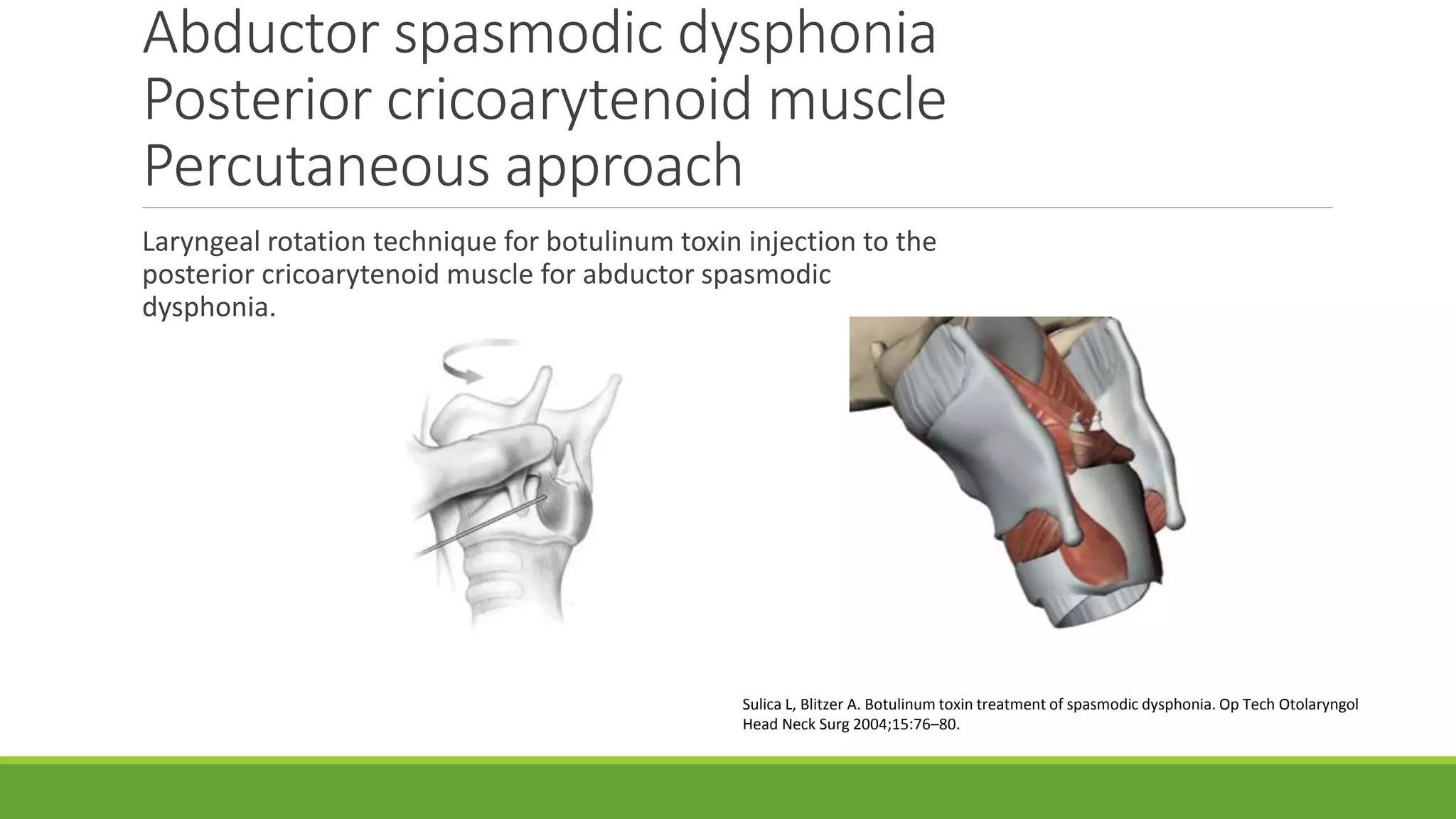
- Injection Site: The posterior cricoarytenoid (PCA) muscles.
- Mechanism: The PCA is the only muscle that opens the vocal folds. Injecting it is technically more challenging and usually requires a different anatomical approach.
- Outcome: By weakening the "opener" muscles, the vocal folds stay closer together, reducing the frequency of breathy voice breaks.
Mixed Spasmodic Dysphonia
Some patients exhibit symptoms of both types. Treatment usually focuses on the more dominant symptom first. Clinicians often start by treating the adductor component to see how the voice stabilizes before addressing the abductor component in subsequent sessions.
The Procedure: What to Expect During Botox Injections
Undergoing Botox for SD is an outpatient procedure that typically takes less than 15 to 20 minutes. It is performed by a specialized otolaryngologist (Ear, Nose, and Throat doctor) or a laryngologist, often in collaboration with a speech-language pathologist.
Preparation and Local Anesthesia
While some physicians use a topical anesthetic spray to numb the skin or the nasal passage, many patients undergo the procedure without significant anesthesia because the needles used are very fine. The patient is usually seated upright or slightly reclined.
Guidance Methods
Precision is critical. To ensure the needle is in the correct muscle, doctors use one of two primary methods:
- Electromyography (EMG) Guidance: This is the most common method. The injection needle acts as an electrode. As the patient performs vocal tasks (like saying "e-e-e" or sniffing), the EMG machine captures the electrical activity of the muscles. A loud "crackle" or visual spike on the monitor confirms the needle is in the overactive muscle.
- Fiberoptic Laryngoscopy: A thin, flexible camera is passed through the nose to view the vocal folds from above. This allows the doctor to see the needle enter the muscle in real-time.
The Injection
Once the muscle is localized, a small amount of Botox (measured in "units") is injected. Depending on the patient's history and the severity of the SD, the doctor may inject one side of the larynx (unilateral) or both sides (bilateral). Bilateral injections are common for AdSD, while AbSD often requires staggered unilateral injections to prevent breathing difficulties.
Benefits and Success Rates
The primary benefit of Botox for SD is a significant improvement in the quality of life. For many, the "vocal effort"—the physical strain required to force words out—is greatly reduced. According to the National Institute on Deafness and Other Communication Disorders (NIDCD), Botox injections provide significant relief for up to 90% of patients with Adductor SD.
Success is measured by:
- Voice Fluidity: A reduction in the "staccato" or jerky nature of speech.
- Duration of Effect: A successful dose provides 3 to 4 months of stable voice.
- Ease of Communication: Patients report less fatigue and social anxiety related to speaking.
Potential Side Effects and Management
Botox for SD is safe, but it involves a trade-off. Because the treatment works by inducing a mild, controlled weakness in the laryngeal muscles, the voice often goes through a predictable cycle.
- The Breathy Phase (Week 1–2): Immediately after the injection, the muscles may be "too weak," leading to a very breathy or whispered voice. This is especially common in AdSD treatment.
- The Sweet Spot (Week 3–12): This is the period of peak therapeutic benefit where the voice sounds most natural and effort is minimal.
- The Waning Phase (Week 13+): As the Botox wears off, the spasms gradually return, signaling the need for a follow-up appointment.
Managing Dysphagia
A common side effect is dysphagia, or difficulty swallowing. When the laryngeal muscles are weakened, they may not close the airway as efficiently during swallowing. Patients may experience "coughing fits" when drinking thin liquids (like water). To manage this, doctors recommend taking smaller sips or tucking the chin to the chest while swallowing during the first week post-injection.
Cost and Insurance Considerations in 2026
As of 2026, Botox for spasmodic dysphonia is widely recognized as a medically necessary procedure rather than a cosmetic one. However, the costs can be substantial without proper coverage.
| Expense Category | Estimated Cost (Pre-Insurance) | Frequency |
|---|---|---|
| Botox Medication | $600 – $1,200 (per vial) | Every 3–4 months |
| Specialist Fee (Laryngologist) | $300 – $700 | Per procedure |
| EMG Guidance Fee | $200 – $500 | Per procedure |
| Facility/Clinic Fee | $150 – $400 | Per visit |
Total Estimated Cost per session: $1,250 – $2,800.
Insurance Verification: Most major insurers, including Medicare and private PPO/HMO plans, cover Botox for SD. It is essential to ensure the clinic uses the correct ICD-10 code (G24.8, Other Dystonia) and CPT codes for the injection and EMG guidance. Many manufacturers also offer patient assistance programs or "savings cards" to help cover co-pays for the medication itself.
Comparison: Adductor vs. Abductor Treatment
| Feature | Adductor SD (AdSD) | Abductor SD (AbSD) |
|---|---|---|
| Voice Sound | Strained, strangled, "broken" | Breathy, whispered, "dropping out" |
| Muscle Targeted | Thyroarytenoid (TA) | Posterior Cricoarytenoid (PCA) |
| Injection Complexity | Moderate (Anterior approach) | High (Requires rotating larynx) |
| Initial Side Effect | Weak, breathy voice | Possible shortness of breath on exertion |
| Effectiveness | Highly predictable (80-90% success) | Variable (approx. 60-70% success) |
Long-term Management and Follow-up Care
Successful management of SD with Botox is an iterative process. It rarely results in a "perfect" dose on the first attempt. Patients must work closely with their medical team to find the "sweet spot"—the dose that maximizes voice quality while minimizing the duration of breathiness and swallowing issues.
The Importance of Voice Therapy
While Botox addresses the physical spasms, voice therapy is a crucial adjunctive treatment. A speech-language pathologist can teach "easy onset" techniques and breath management. These skills help the patient maximize the "sweet spot" period and maintain better communication even as the Botox begins to wear off. Research consistently shows that combining Botox with targeted voice therapy leads to higher patient satisfaction than Botox alone.
Tracking Results
In 2026, many patients use mobile apps or vocal journals to track their "voice days." By recording when the voice is breathy, when it is optimal, and when the spasms return, they provide the laryngologist with the data needed to adjust units (dosage) for the next session. Even a change of 0.5 units can make a significant difference in the side-effect profile.
Frequently Asked Questions
Does the Botox injection hurt?
The sensation is often described as a sharp pinch or pressure in the neck. Because the needle is extremely thin, the pain is brief. Most patients find the procedure much less uncomfortable than they initially anticipated, and the entire process of needle insertion usually lasts less than 60 seconds.
How long does it take for Botox to start working?
Unlike a cosmetic injection which may take days to show results, the effect on the voice usually begins within 24 to 72 hours. However, the voice often gets "worse" (breathier) before it gets "better" (stable). Full stabilization typically occurs around the 10-to-14-day mark.
Are there any permanent risks?
The effects of botulinum toxin are temporary. Any side effects, such as a breathy voice or swallowing difficulty, will resolve as the medication is metabolized by the body. There are no documented cases of permanent laryngeal muscle damage from repeated, long-term use of Botox for SD when administered by a trained professional.
Can I become immune to Botox?
While rare, some patients develop antibodies to onabotulinumtoxinA over many years, making the treatment less effective. In such cases, physicians may switch to alternative formulations, such as incobotulinumtoxinA (Xeomin) or rimabotulinumtoxinB (Myobloc), which have different molecular structures and may bypass the immune response.
Is Botox safe during pregnancy?
Most laryngologists advise against Botox injections during pregnancy and breastfeeding due to a lack of comprehensive clinical data. Patients should discuss their family planning with their specialist to coordinate treatment pauses if necessary.
Practical Recommendations
For those recently diagnosed with spasmodic dysphonia or considering Botox for the first time, the following steps are recommended:
- Consult a Laryngologist: Not all ENT doctors specialize in SD. Seek a laryngologist who has specific expertise in neurological voice disorders and performs EMG-guided injections regularly.
- Coordinate with a Speech Pathologist: Ensure your treatment plan includes voice therapy to optimize the mechanical benefits of the Botox.
- Prepare for the "Breathy Phase": If you have major speaking engagements, schedule your injections at least three weeks prior to ensure you are in your "sweet spot" during the event.
- Verify Insurance Early: Work with your doctor’s office to secure prior authorization, as the high cost of the medication can lead to unexpected out-of-pocket expenses if not pre-cleared.
Image Gallery