Understanding the Search Index: How Search Engines Organize the Web
A search index is a massive, highly optimized database maintained by search engines like Google or Bing that stores information about billions of web pages. When a user enters a query, the search engine queries this index—not the live...
A search index is a massive, highly optimized database maintained by search engines like Google or Bing that stores information about billions of web pages. When a user enters a query, the search engine queries this index—not the live internet—to retrieve and rank relevant results in milliseconds.
Contents
The Core Mechanics of How a Search Index Works
At its fundamental level, a search index operates similarly to the index found at the back of a textbook. Instead of reading every page of a book to find a specific term, a reader checks the index to find the exact page numbers. Similarly, when web crawlers discover content across the internet, they parse the code, analyze the text, media, and metadata, and log these elements into a structured digital catalog.
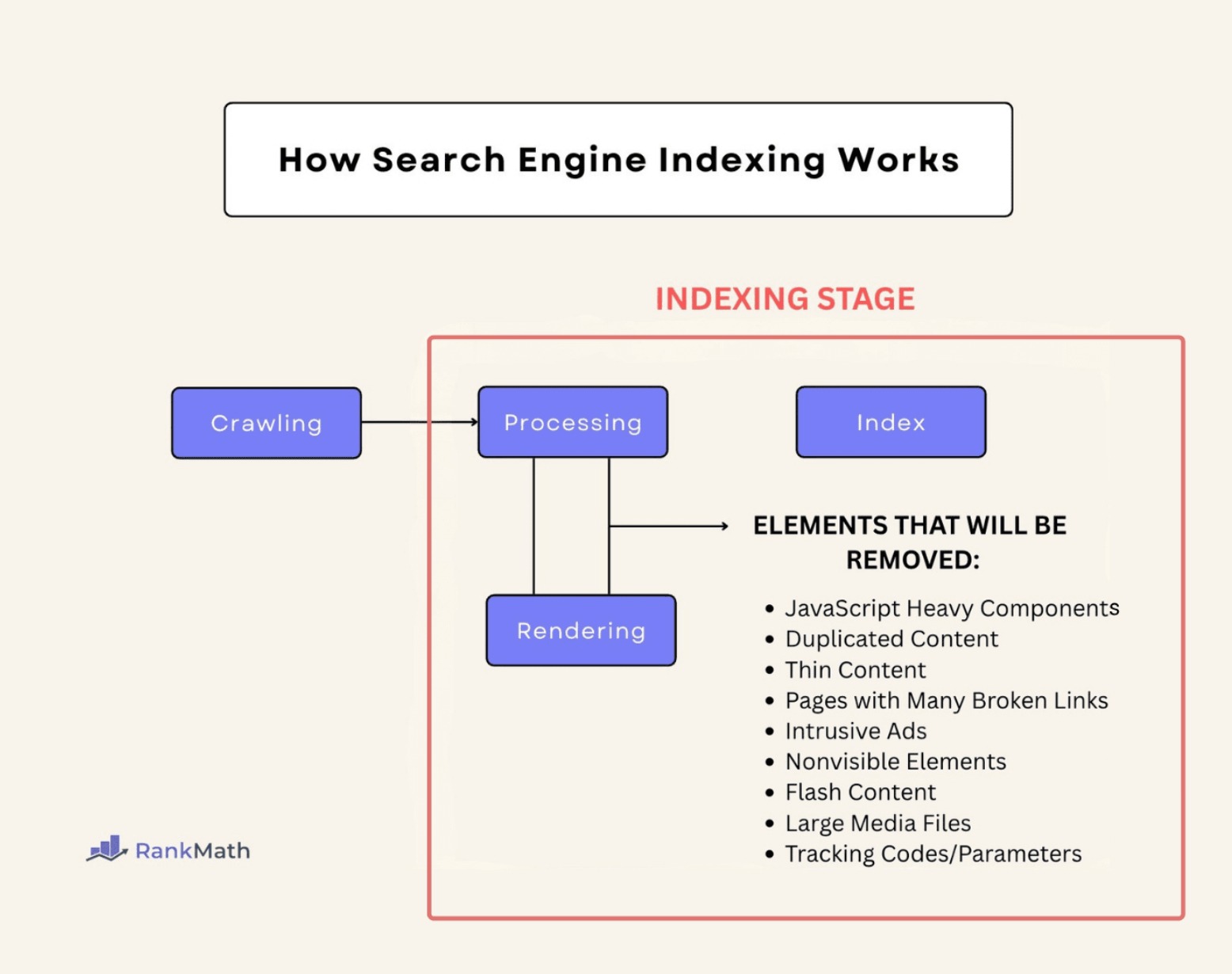
The process from raw web page to a queryable entry relies on three primary phases: crawling, rendering, and indexing.
- Crawling: Automated bots, often called spiders, traverse the web by following internal and external hyperlinks from known seed URLs to discover new or updated content.
- Rendering: Search engines execute the underlying JavaScript and CSS of a discovered page to interpret the content exactly as a human user sees it in a browser.
- Indexing: The parsed data is categorized, compressed, and stored in inverted indices. An inverted index maps specific words and entities directly to the documents that contain them, enabling instantaneous lookup speeds.
| Phase | Primary Function | Key Technical Consideration |
|---|---|---|
| Crawling | Discovering URLs and downloading raw HTML files. | Crawl budget, server response codes (200, 404, 503), robots.txt directives. |
| Rendering | Processing DOM structures and executing client-side scripts. | Resource blocking, lazy-loading implementation, Core Web Vitals. |
| Indexing | Storing parsed data into a searchable database structure. | Canonical tags, noindex directives, duplicate content management. |
Technical Architecture of Modern Search Indices
Modern search indices do not simply store raw text strings; they utilize advanced data structures designed for distributed computing and lightning-fast retrieval. Understanding these structures helps web developers and technical SEO professionals optimize site architecture for maximum crawl and index efficiency.
Inverted Indices and Tokenization
The backbone of information retrieval is the inverted index. During ingestion, a search engine breaks text down into individual tokens through a process called tokenization. Stop words (such as "and", "the", "or") are often stripped away, and terms are normalized through stemming or lemmatization (e.g., reducing "running", "ran", and "runs" to the root base "run"). The index then maps these normalized tokens to a list of document IDs along with positional metadata, allowing the engine to evaluate proximity and context.
Distributed Storage and Datacenters
Due to the sheer scale of the web, a single database cannot hold all indexed documents. Search engines distribute index data across massive clusters of servers located in data centers globally. Sharding and replication techniques ensure that queries are handled concurrently by multiple nodes, ensuring high availability and minimal latency even during traffic spikes.
Prerequisites and Signals for Successful Indexing
Not every page discovered by a crawler makes it into the search index. Search engines employ strict quality filters to conserve storage and compute resources, prioritizing pages that offer unique, accessible value.
- Crawl Accessibility: Pages must be reachable via standard HTTP requests and clear internal linking structures, free from restrictive robots.txt blocks.
- Canonical Consistency: Clear canonical tags must point to the primary version of a document to prevent index bloat caused by parameterized URLs or duplicate syndication.
- Mobile-First Compatibility: Because search engines utilize mobile-first indexing, the mobile variant of a page must feature equivalent content, structured data, and metadata compared to its desktop counterpart.
- Information Quality: Pages lacking original substance, or those flagged as thin content, spam, or security risks, are routinely excluded from the index entirely.
Common Indexing Issues and Troubleshooting Strategies
Even well-optimized websites frequently encounter roadblocks that prevent search engines from adding new pages to their indices. Diagnosing these errors requires leveraging diagnostic suites like Google Search Console and analyzing server logs.
1. Discovery and Crawl Bottlenecks
If search bots never visit a page, it cannot be indexed. This typically stems from orphan pages (pages with no internal links pointing to them) or an inefficient site architecture that exhausts the site's crawl budget.
- Remedy: Audit internal linking trees, ensure critical pages are no more than three clicks away from the homepage, and submit an up-to-date XML sitemap.
2. Accidental Noindex Directives
A frequent configuration error involves leaving meta robots tags set to noindex or HTTP X-Robots-Tag headers active in production environments after staging migrations.
- Remedy: Inspect source code and HTTP response headers to ensure indexing directives are explicitly set to
index, followon target landing pages.
3. JavaScript Rendering Failures
When crucial text, links, or product details are rendered exclusively via client-side JavaScript without server-side rendering (SSR) or dynamic rendering fallbacks, crawlers may abandon the page before the content fully materializes.
- Remedy: Use URL inspection tools to view the rendered HTML and confirm that all primary content elements are visible to the crawler in the initial response.
Comparative Analysis: Indexing vs. Ranking
A common misconception in digital optimization conflates being indexed with ranking well. These are distinct operational phases managed by separate algorithmic subsystems.
| Feature | Search Indexing | Search Ranking |
|---|---|---|
| Definition | The inclusion and cataloging of a document within the search engine database. | The evaluation and ordered sorting of indexed documents in response to a specific query. |
| Primary Goal | Data storage, retrieval readiness, and structural categorization. | Relevance matching, authority scoring, and user intent fulfillment. |
| Prerequisites | Crawlability, indexability, clean code, and absence of blocking directives. | High-quality content, strong backlink profiles, positive user experience metrics, and topical authority. |
| Status Check | Verified via URL inspection tools or site search operators. | Monitored via position tracking software and search performance reports. |
Frequently Asked Questions About the Search Index
How do I check if my web page is in the search index?
You can check if a specific page is indexed by pasting the exact URL into the search engine's URL inspection tool or by performing a manual query using the site operator (e.g., site:yourdomain.com/page-url) directly in the search bar. If the page appears in the search results, it is successfully indexed.
Why is my new page not showing up in the search index?
New pages may take anywhere from a few hours to several weeks to be discovered, crawled, and indexed, depending on site authority, crawl frequency, and internal linking structure. You can accelerate this process by requesting indexing manually through the search engine's webmaster tools.
What does index bloat mean for a website?
Index bloat occurs when a search engine indexes thousands of low-value, duplicate, or useless pages—such as session IDs, thin tag archives, or faceted navigation URLs—which dilutes crawl efficiency and can negatively impact overall organic performance.
Can a page be crawled without being indexed?
Yes, a search engine can crawl a page, read its contents, and intentionally choose not to add it to the index if it detects duplicate content, low information value, or conflicting directives such as a noindex tag.
How often do search engines update their index?
Major search engines update their index continuously in real-time or near-real-time for high-authority, frequently updated sites, while less dynamic websites are re-crawled and re-indexed on a scheduled basis determined by algorithmic priority models.
Maximizing Index Efficiency for Optimal Visibility
Ensuring that your web properties are efficiently processed and stored within the search index is the foundational prerequisite for sustainable organic visibility. By prioritizing clean technical architecture, maintaining robust server responses, and eliminating barriers to crawler rendering, you provide search engines with seamless access to your content. Regularly audit your indexing status through official webmaster dashboards to identify anomalies early, ensuring your digital assets remain fully accessible to the modern search ecosystem.
Image Gallery