Lender Recognition of Income from Life Insurance Proceeds: Guidelines and Requirements
Lenders generally recognize life insurance proceeds as qualifying income only if they are distributed as a structured annuity or recurring payment with a documented 3-year continuity. While lump-sum death benefits are typically classif...
Lenders generally recognize life insurance proceeds as qualifying income only if they are distributed as a structured annuity or recurring payment with a documented 3-year continuity. While lump-sum death benefits are typically classified as assets for down payments or reserves, they do not qualify as effective monthly income for debt-to-income (DTI) calculations unless converted into a regular, guaranteed distribution.
Contents
In the complex landscape of mortgage and commercial lending, the distinction between "wealth" and "income" is a critical hurdle for borrowers. When a beneficiary receives a life insurance payout, the immediate instinct is to view that capital as a boost to their borrowing power. However, from the perspective of a 2026 underwriter, capital is not the same as cash flow. To successfully use life insurance proceeds to qualify for a loan, a borrower must navigate specific regulatory guidelines established by entities like Fannie Mae, Freddie Mac, and the FHA.
The Fundamental Distinction: Assets vs. Qualifying Income
The first step in understanding lender recognition is distinguishing how the money is held and distributed. Lenders categorize financial resources into two primary buckets: assets and income.
Life Insurance Proceeds as Assets
For the vast majority of beneficiaries, life insurance is paid out as a single, tax-free lump sum. In the eyes of a lender, this is a "liquid asset." It is invaluable for satisfying requirements for a down payment, closing costs, or "reserves" (the number of months of mortgage payments you have in the bank after the loan closes). However, a $500,000 lump sum sitting in a savings account does not lower your Debt-to-Income (DTI) ratio. Because it is a finite pool of money that is not automatically replenished, lenders do not count it as monthly income to offset your debts.
Life Insurance Proceeds as Qualifying Income
To be "recognized" as income, the proceeds must be structured to mimic a salary or a pension. This usually occurs when the beneficiary chooses a "settlement option" other than a lump sum, such as a life income option or a fixed-period annuity. If the insurance company is contractually obligated to pay the borrower $3,000 per month, that figure can often be added to the borrower’s "gross monthly income," significantly increasing the maximum loan amount they can afford.
The Three-Year Continuity Rule
As of 2026, the standard for nearly all conforming and government-backed loans is the 3-year continuity requirement. Lenders are not just interested in whether you have money today; they are interested in whether you will have it for the foreseeable future.
For life insurance proceeds to be recognized as income, the borrower must provide documented evidence that the payments will continue for at least 36 months from the date of the mortgage application.
- Verification of Duration: The lender will require a copy of the settlement agreement or a letter from the insurance company stating the frequency, amount, and remaining duration of the payments.
- Evidence of Receipt: Lenders typically want to see that the borrower has already started receiving these payments. Usually, a history of 1 to 12 months of receipt is required to prove the "stability" of the income source, though some automated underwriting systems (AUS) may allow for less if the contract is ironclad.
- Depletion Analysis: If the payments are drawn from a finite fund (like a fixed-period annuity), the underwriter will perform a "depletion analysis." If the fund is projected to run out in 30 months, the income will be disqualified entirely for the purposes of the loan application, even if the monthly amount is substantial.
Regulatory Guidelines for Major Loan Types
Different loan programs have nuanced ways of handling life insurance income. Understanding these helps in selecting the right product for your financial situation.
Fannie Mae and Freddie Mac (Conforming Loans)
Conforming lenders follow strict Selling Guides (such as Fannie Mae B3-3.1-01). They treat life insurance annuities similarly to trust income or pension distributions. The key is that the income must be "stable, predictable, and likely to continue." If the life insurance payout is part of a structured settlement from a legal claim, additional documentation regarding the legal nature of the payout may be required.
FHA Loans
The Federal Housing Administration (FHA) is often more flexible with "non-traditional" income sources. Under the HUD 4000.1 Handbook, life insurance proceeds can be recognized if they are part of an established annuity. FHA underwriters are specifically trained to look at "Other Sources of Effective Income." However, the 3-year rule still applies. FHA also allows for a wider range of documentation to prove the consistency of the receipt.
VA Loans
For veterans and active-duty service members, the VA focuses on "Residual Income." While they follow the same general 3-year continuity standards, they may be more inclined to consider the "net" impact of a large life insurance asset on the borrower's overall financial health, even if it isn't strictly "income."
The "Gross-Up" Advantage for Tax-Exempt Income
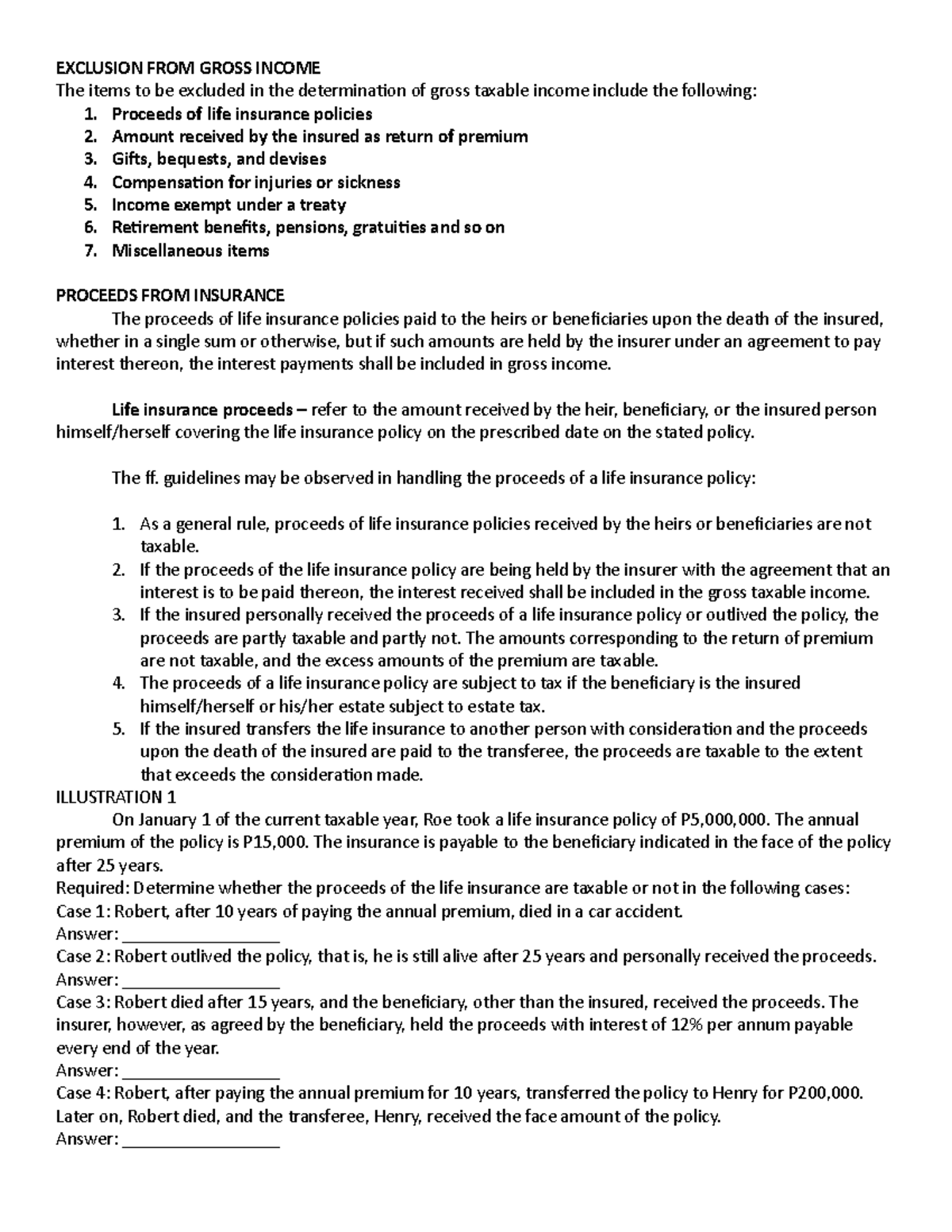
One of the most significant benefits of using life insurance proceeds as income is their tax status. Under IRS Section 101(a)(1), life insurance death benefits are generally not subject to federal income tax.
Lenders recognize that $1,000 of tax-free income is more valuable than $1,000 of taxable salary. To create a level playing field during the DTI calculation, underwriters are often permitted to "gross up" the tax-exempt portion of the income.
- Standard Gross-Up: Lenders typically add 25% to the non-taxable income.
- The Calculation: If you receive $4,000 a month tax-free from a life insurance annuity, the lender may treat it as $5,000 of gross income ($4,000 x 1.25).
This "grossing up" can be the difference between a loan approval and a denial, as it artificially lowers the DTI ratio to reflect the borrower's true purchasing power.
Documentation Requirements for Underwriting
When applying for a loan where life insurance proceeds are a primary income source, the "paper trail" is the most critical component. In 2026, most of this is handled via digital verification, but the underlying documents remain the same.
| Document Required | Purpose |
|---|---|
| Final Settlement Option Letter | Proves the payout structure (annuity vs. lump sum) and the exact monthly amount. |
| Insurance Policy Contract | Establishes the legal obligation of the carrier to pay the beneficiary. |
| Proof of 3-Year Continuity | A statement showing the end date of the payments or a "life expectancy" clause. |
| Bank Statements (Last 2-6 Months) | Verifies that the insurance company is actually making the deposits. |
| IRS Form 1099-R (if applicable) | Used to determine if any portion of the payment (such as interest) is taxable. |
Alternative: Using Proceeds for "Asset Depletion" Loans
If your life insurance proceeds are a lump sum and you cannot (or do not want to) convert them into an annuity, you may still be able to use them as "income" through a specialized product called an Asset Depletion Loan.
In this scenario, the lender takes the total value of your liquid assets (including the insurance payout), subtracts a "haircut" (usually 10-30% for market volatility, though less for cash-heavy life insurance proceeds), and divides the remainder by a set number of months (often 360). The resulting number is "recognized" as your monthly income.
- Example: You have a $1,200,000 life insurance payout. The lender ignores $200,000 for safety and divides $1,000,000 by 360 months. They "recognize" $2,777 per month as qualifying income, even though you aren't actually withdrawing it.
This is a common strategy for high-net-worth individuals or retirees who have significant capital but low traditional employment income.
Common Pitfalls and Lender Overlays
Even if you meet the federal guidelines, individual banks often have "overlays"—internal rules that are stricter than Fannie Mae or FHA standards.
- The "Vested" Requirement: Some lenders will not recognize annuity income until you have received it for at least six full months, regardless of what the contract says.
- The Insurance Company Rating: Lenders may refuse to recognize income from an insurance carrier that has a low financial strength rating (e.g., below an A- from A.M. Best). They want to ensure the company paying you will still be solvent in three years.
- Foreign Policies: If the life insurance policy was issued by a foreign company or paid in a foreign currency, many US-based lenders will disqualify the income due to exchange rate volatility and difficulty in verifying the legal standing of the contract.
FAQs
Can I use a life insurance payout for my down payment?
Yes. Lump-sum proceeds are highly acceptable for down payments. You will need to provide the "Closing Statement" or "Claim Settlement" from the insurance company and a bank statement showing the funds being deposited into your account to satisfy anti-money laundering (AML) "source of funds" requirements.
Does the lender care about the cause of death of the insured?
Generally, no. Underwriters focus on the financial validity of the payout. However, if the payout is being contested in court or if there is a "slayer rule" investigation (where the beneficiary is a suspect), the lender will freeze the application until legal clearance is provided.
What if my life insurance payments are only guaranteed for two years?
Under standard conforming guidelines, this income will be excluded from your DTI calculation. You cannot use it to qualify for the loan because it does not meet the 3-year continuity rule. In this case, you might consider using the funds to pay off existing debts to lower your DTI manually.
Can I "gross up" the income if it's only partially tax-free?
Yes. If a portion of your payment is taxable interest and the rest is tax-free principal, the lender will only apply the 125% gross-up factor to the tax-free portion. You will need to provide tax returns or a 1099-R to help the underwriter distinguish between the two.
Is the "gross-up" automatic?
No. While permitted by guidelines, the borrower or their loan officer must often explicitly request it and provide the necessary tax documentation to prove the income is non-taxable.
Practical Recommendation
If you are relying on life insurance proceeds to qualify for a mortgage in 2026, do not take a lump sum until you have consulted with a mortgage professional. If you need that money to count as income, you may need the insurance company to structure it as a 5-year or 10-year certain annuity before the "settlement option" is finalized. Once you accept a lump sum, it is much harder to convert it back into "recognized income" for underwriting purposes than it is to start with a structured distribution.
Image Gallery