How Mazda Skyactiv-D Reshapes Diesel Efficiency
Mazda reshaped diesel efficiency by introducing an ultra-low 14.0:1 compression ratio in its Skyactiv-D engines, contrasting sharply with conventional diesel ratios exceeding 16.0:1. This approach optimizes air-fuel mixing, lowers comb...
Mazda reshaped diesel efficiency by introducing an ultra-low 14.0:1 compression ratio in its Skyactiv-D engines, contrasting sharply with conventional diesel ratios exceeding 16.0:1. This approach optimizes air-fuel mixing, lowers combustion temperatures, cuts harmful emissions without complex aftertreatment, and uses lightweight aluminum components to reduce internal mechanical friction and overall vehicle mass.
Contents
The Core Breakthrough: Rethinking Compression Ratios
For decades, automotive engineers considered high compression ratios essential to diesel engine performance. Traditional diesel engines rely on compression ratios between 16.0:1 and 18.0:1—or even higher—to generate sufficient thermal heat within the cylinder to auto-ignite atomized diesel fuel. While high compression guarantees reliable ignition under cold operating conditions, it introduces fundamental physical disadvantages that compromise overall efficiency and clean combustion.
In high-compression environments, diesel fuel is injected into compressed air that has already reached extremely high temperatures and pressures. The fuel ignites almost instantly upon exiting the injector nozzles, before it has adequate time to mix uniformly with oxygen. This incomplete air-fuel mixing creates localized combustion hot spots exceeding 1,800°C, which rapidly generate Nitrogen Oxides ($\text{NO}_x$). Concurrently, oxygen-starved pockets within the cylinder produce excessive unburned hydrocarbons and fine soot (particulate matter).
- Traditional Diesel Combustion (High Compression ~18.0:1):
- High Pressure/Temp
- Premature Ignition
- Localized Hotspots
- High NOx + Soot
- Mazda Skyactiv-D Combustion (Low Compression ~14.0:1):
- Lower Pressure/Temp
- Extended Ignition Delay
- Homogeneous Mix
- Clean Combustion
Mazda defied industry consensus by dropping the compression ratio of the Skyactiv-D engine to 14.0:1—the lowest compression ratio among mass-production passenger diesels at its launch. Lowering the compression ratio extends the ignition delay, giving the diesel fuel crucial extra milliseconds to thoroughly mix with intake air before auto-ignition occurs.
This homogeneous air-fuel mixture burns uniformly across the combustion chamber. Peak combustion temperatures drop below the threshold where thermal $\text{NO}_x$ forms rapidly, while the elimination of fuel-rich zones drastically minimizes soot production.
Overcoming Cold-Start and Misfire Challenges
While a 14.0:1 compression ratio delivers clean combustion when the engine is warm, low compression creates a severe operational obstacle: inadequate cylinder heat during cold weather starts. At sub-zero ambient temperatures, a low-compression cylinder cannot generate the heat necessary to auto-ignite standard diesel fuel, leading to misfires, rough idling, and complete start failures.
Mazda overcame this physical limitation by combining advanced fuel injection hardware with variable exhaust valve timing:
- Multi-Hole Piezoelectric Injectors: Skyactiv-D engines utilize high-pressure common-rail systems equipped with multi-hole piezo injectors capable of executing up to nine precise injection events per combustion cycle. During a cold start, these injectors deliver minute pre-injections of atomized fuel to incrementally raise cylinder temperature before the primary power injection takes place.
- Exhaust Variable Valve Lift (VVL): Mazda incorporated Variable Valve Lift on the exhaust side. Immediately after engine start-up, the exhaust valves open slightly during the intake stroke. This action recirculates hot, freshly burned exhaust gas back into the combustion chamber—a process known as internal Exhaust Gas Recirculation (EGR). Re-aspirating warm exhaust gas raises the intake air temperature, stabilizing cylinder pressure and ensuring consistent auto-ignition even in freezing conditions.
Weight Reduction and Mechanical Friction Optimization
Beyond chemical combustion efficiency, lowering the compression ratio unlocked massive structural advantages across the engine's mechanical design. Traditional diesels must endure extreme internal cylinder pressures—often exceeding 200 bar—requiring heavy cast-iron engine blocks, reinforced steel crankshafts, and thick-walled pistons.
- SKYACTIV-D WEIGHT & FRICTION:
- 14.0:1 Low Compression: Reduced Internal Peak Cylinder Pressures
- Aluminum Block Casting: 25% Reduction in Engine Block Mass
- Lighter Pistons & Rods: 25% Lower Reciprocating Mass & Reduced Friction
Because the Skyactiv-D's maximum cylinder pressure is lower than that of conventional high-compression diesels, Mazda engineers re-engineered the engine components with lighter materials:
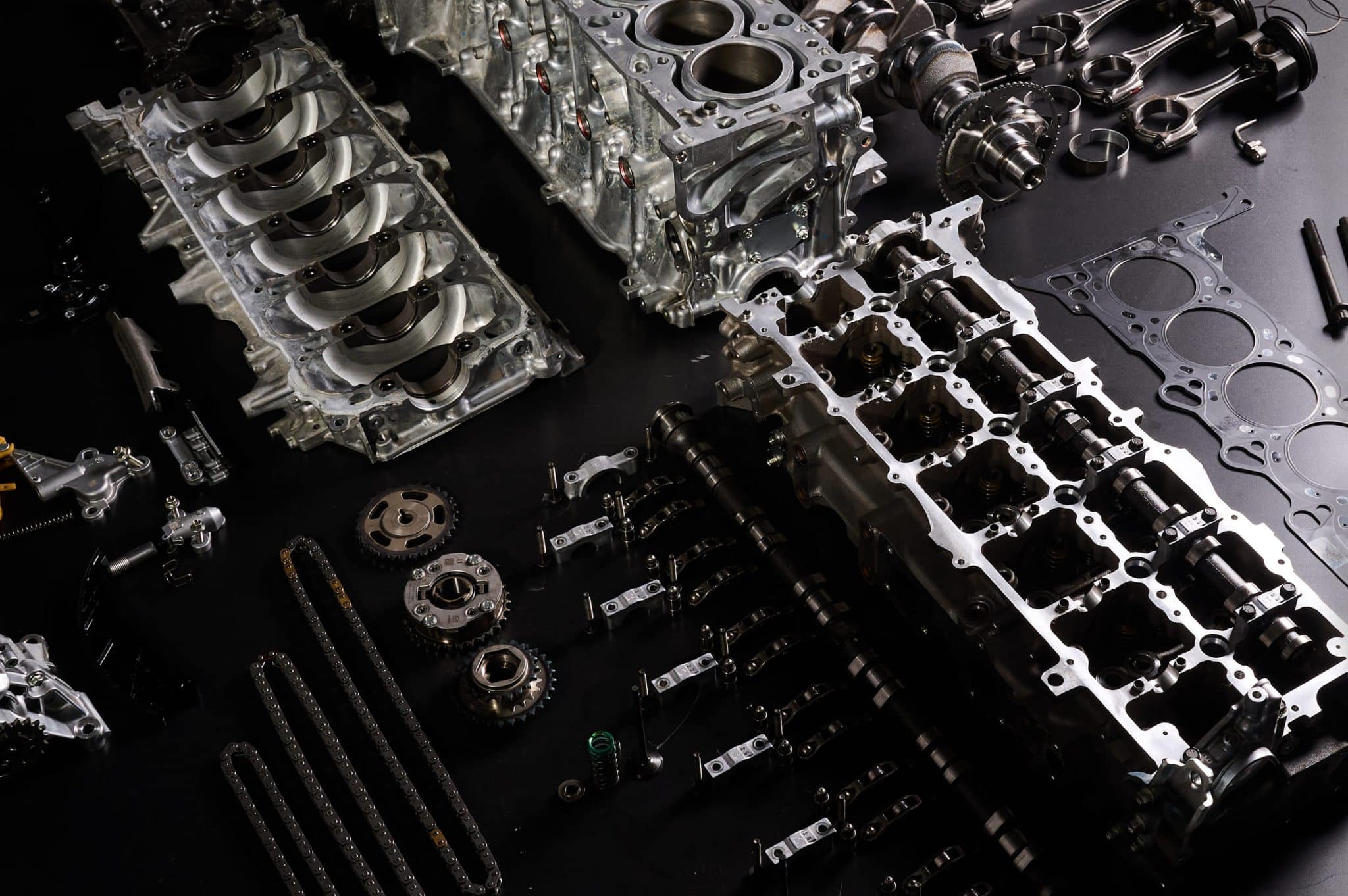
- Aluminum Cylinder Block: Mazda replaced the traditional cast-iron block with a lightweight aluminum alloy block, cutting engine weight by roughly 25 percent compared to previous Mazda diesel designs.
- Reciprocating Mass Reduction: Pistons, connecting rods, and crankshaft counterweights were downsized and streamlined. The moving mass of reciprocating components was reduced by approximately 25 percent.
- Friction Minimization: Lower reciprocating mass reduces lateral piston skirt thrust against cylinder walls, allowing engineers to lower tension on piston rings and optimize journal bearing surfaces. Overall internal mechanical friction fell by roughly 20 percent, approaching the low friction levels of a comparable petrol engine.
Sequential Twin Turbocharging and Air Flow Architecture
To maximize torque output and driver responsiveness across a broad RPM range, Mazda paired the low-compression architecture with a two-stage sequential twin turbocharger system in its 2.2-liter Skyactiv-D engines.
| Engine RPM Range | Active Turbocharger | Operational Benefit |
|---|---|---|
| Low (1,000–2,000) | Small High-Pressure Turbo | Immediate boost, zero lag |
| Mid (2,000–3,000) | Small + Large Turbos Operating | Smooth transition, rising torque |
| High (3,000+ RPM) | Large Low-Pressure Turbo | Maximum airflow & top-end power |
The sequential system utilizes a small high-pressure turbocharger and a large low-pressure turbocharger:
- Low-RPM Operation: At low engine speeds, exhaust energy flows directly into the small turbocharger. Its low rotational inertia allows it to spool almost instantly, delivering quick boost response and eliminating the lag traditionally associated with diesel engines.
- Mid-to-High RPM Operation: As engine speed and exhaust volume increase, control valves progressively route exhaust gas to the larger turbocharger. At high speeds, the large turbo handles air intake duties, ensuring the engine maintains linear power delivery up to 5,500 RPM without choking.
Optimized intake manifold geometry and charge-air intercooling further lower intake air temperatures, increasing air density inside the cylinder and boosting overall volumetric efficiency.
Technical Comparison: Skyactiv-D vs. Conventional Diesels
The engineering choices behind Mazda's low-compression philosophy directly influence performance metrics, emissions management, and physical components:
| Technical Parameter | Conventional Diesel Engine | Mazda Skyactiv-D Engine (2.2L / 3.3L) |
|---|---|---|
| Compression Ratio | 16.0:1 to 18.5:1 | 14.0:1 (2.2L) / 15.2:1 (e-Skyactiv D 3.3L) |
| Cylinder Block Material | Cast Iron (Heavy Duty) | Aluminum Alloy |
| Peak Cylinder Pressure | Very High (~180–220+ bar) | Moderate (~130–150 bar) |
| Internal Engine Weight | Baseline (100%) | ~25% Lighter |
| Reciprocating Friction | High (Heavy pistons/rings) | ~20% Lower Friction |
| Ignition Timing | Advanced (Before TDC to ensure light-off) | Optimal (At or near Top Dead Center) |
| $\text{NO}_x$ Generation | High (Requires heavy SCR/AdBlue aftertreatment) | Minimal (Met Euro 6 without SCR in early 2.2L) |
| Redline Limit | Low (~4,000 to 4,500 RPM) | High (~5,000 to 5,500 RPM) |
Evolution to e-Skyactiv D and Modern Mild-Hybrid Systems
As emissions legislation tightened globally, Mazda evolved its diesel strategy by introducing the e-Skyactiv D 3.3-liter inline-six cylinder engine. This engine builds on the core principles of low-compression combustion while integrating modern electrical assistance and advanced combustion chamber shaping.
Distribution-Controlled Exhaust Gas Recirculation (DCP-CI)
The 3.3-liter inline-six utilizes Egg-Shaped Combustion Chambers and Distribution-Controlled Partial Premixed Compression Ignition (DCP-CI). The unique piston crown geometry splits the injected fuel into two distinct zones within the combustion bowl. This dual-stage ignition strategy broadens the ultra-efficient combustion window across a wider speed and load range, achieving thermal efficiency exceeding 40 percent.
48V M Hybrid Boost Integration
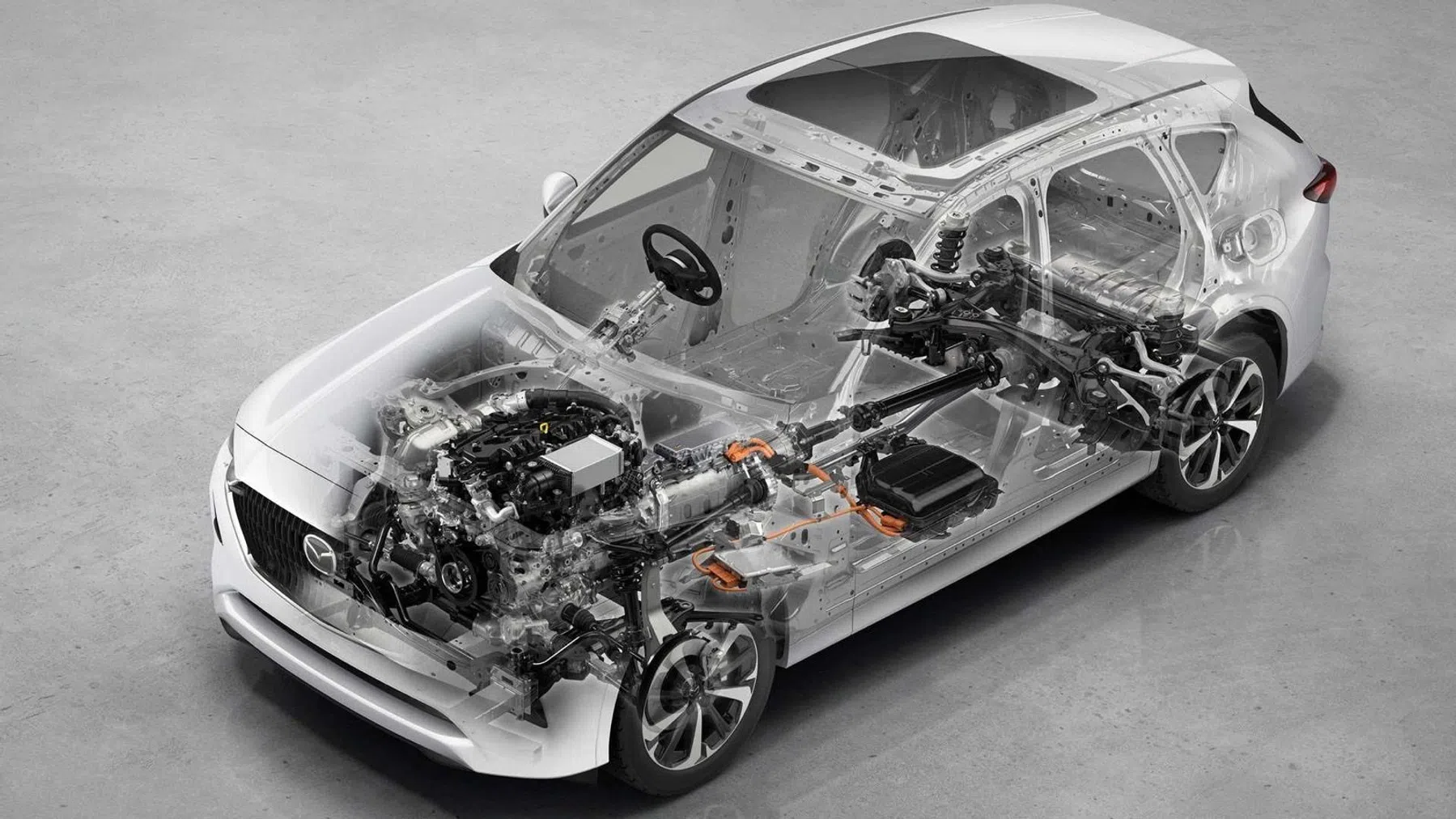
The e-Skyactiv D features Mazda's 48-volt mild-hybrid system. An electric motor mounted between the engine and the automatic transmission assists during off-the-line acceleration and low-speed crawling. By supplying instant electric torque before turbo boost builds, the hybrid system offloads high-stress demand from the engine, further lowering fuel consumption and tailpipe carbon dioxide ($\text{CO}_2$) emissions.
Ownership Considerations: Maintenance, DPF, and Oil Dilution
While the Skyactiv-D design delivers fuel economy and strong driving dynamics, owners must adhere to specific maintenance practices to preserve engine longevity and prevent common diesel-specific operational issues.
Understanding DPF Regeneration and Oil Dilution
To comply with global emissions standards, Skyactiv-D vehicles feature a Diesel Particulate Filter (DPF) that traps remaining soot. Periodically, the engine control unit (ECU) initiates DPF regeneration by executing post-injection fuel pulses to heat the exhaust stream and burn off collected soot.
Short-Trip Impact: If a vehicle is driven primarily on short, low-speed city trips, the engine may fail to reach the temperatures required to complete DPF regeneration. Unburned fuel injected during incomplete regenerations can wash down the cylinder walls and mix with engine oil in the sump.
Managing Fuel Dilution: Over time, repeated interrupted regenerations lead to oil dilution (fuel raising the oil level). Mazda dipsticks feature a distinct "X" mark above the full line. If the oil level reaches the "X" mark, the engine oil and filter must be replaced immediately to prevent premature bearing wear or runaway engine risks.
Dipstick Oil Level Indicators:
- MIN
- MAX
- X (Immediate Oil Change Required)
Carbon Accumulation in Intake Passages
Like most direct-injected diesel engines utilizing Exhaust Gas Recirculation (EGR), Skyactiv-D engines circulate inert exhaust gas back through the intake manifold to lower combustion temperatures. Over high mileage (typically above 80,000 miles / 130,000 km), oily vapors from the crankcase ventilation system mix with soot particles in the EGR gas. This mixture forms sticky carbon deposits inside the intake valves, manifold channels, and MAP (Manifold Absolute Pressure) sensors.
Symptoms of intake carbon buildup include:
- Sluggish throttle response at low RPM.
- Unexplained drops in fuel efficiency.
- Rough idling or engine hesitation during light acceleration.
- Periodic illumination of the Check Engine light related to air-flow discrepancies.
Periodic mechanical cleaning or specialized media-blasting (such as walnut shell blasting) of intake ports restores original airflow dynamics and efficiency.
Best Practices for Maintaining Skyactiv-D Efficiency
To maximize reliability and retain fuel economy in a Skyactiv-D powered vehicle, drivers should follow these maintenance guidelines:
- Use Approved Low-SAPS Motor Oil: Always use high-grade engine oil meeting the specific low-SAPS (Sulphated Ash, Phosphorus, and Sulphur) specification mandated by Mazda (such as ACEA C3 or C5 grades depending on model year). Low-SAPS oils prevent metallic ash build-up that permanently plugs the DPF.
- Incorporate regular Highway Journeys: Ensure the vehicle undergoes a sustained 20-to-30 minute highway drive at elevated speeds at least once every few weeks. This allows the ECU to complete automatic DPF regeneration cycles cleanly.
- Inspect Fuel and Vacuum Lines: The complex twin-turbo control solenoid systems rely on intact vacuum hoses. Periodically check vacuum lines and intercooler hoses for cracks, oil mist leakage, or loose clamps.
- Replace Fuel Filters at Recommended Intervals: High-pressure piezo injectors operate under immense hydraulic pressure with extremely tight tolerances. Contaminated fuel accelerates nozzle wear, altering spray patterns and undermining combustion efficiency.
- Monitor Vacuum Pump and Oil Strainer: Early 2.2L Skyactiv-D models require regular inspection of the engine oil strainer (pickup screen) in the oil pan. Excessive carbon buildup washed into the oil can clog the screen, restricting oil pressure to critical engine bearings and turbocharger shafts.
Frequently Asked Questions
How does Mazda Skyactiv-D achieve low emissions without AdBlue in earlier models?
Early 2.2-liter Skyactiv-D engines avoided Selective Catalytic Reduction (SCR) systems and AdBlue (diesel exhaust fluid) injection by preventing $\text{NO}_x$ and soot from forming during the combustion phase itself. The 14.0:1 compression ratio lowers peak flame temperatures below the threshold where thermal $\text{NO}_x$ is generated, while extended air-fuel mixing eliminates soot-forming rich zones. Later, larger engines like the 3.3L e-Skyactiv D added SCR systems to meet even stricter global regulatory standards.
What makes Skyactiv-D different from conventional diesel engines?
The defining difference is its low compression ratio (14.0:1 compared to 16.0:1–18.5:1 in traditional diesels). This design allows Mazda to use a lightweight aluminum engine block, reduce internal reciprocating mass by 25 percent, lower mechanical friction by 20 percent, and optimize ignition timing near Top Dead Center without heavy detonation knocks.
What causes oil dilution in Mazda Skyactiv-D engines?
Oil dilution occurs when uncombusted diesel fuel enters the crankcase during active Diesel Particulate Filter (DPF) regeneration. If a vehicle is turned off frequently mid-regeneration, or driven primarily on short city routes, the injected fuel used to heat the exhaust fails to vaporize and instead washes down the cylinder walls into the oil pan. Regular highway driving and monitoring the dipstick's "X" mark help manage this issue.
Can Skyactiv-D engines rev higher than standard diesels?
Yes. Thanks to lightweight aluminum pistons, reduced reciprocating mass, optimized ignition timing, and sequential twin turbocharging, 2.2-liter Skyactiv-D engines freely rev up to 5,200–5,500 RPM. Traditional cast-iron diesel engines generally taper off power and hit redlines around 4,000 to 4,500 RPM.
What type of motor oil is required for a Mazda Skyactiv-D?
Skyactiv-D engines require specialized low-SAPS engine oil (typically 0W-30 or 5W-30 meeting ACEA C3/C5 or Mazda Original Oil Supra/Ultra DPF specifications). Using standard non-low-SAPS oil creates non-combustible ash deposits that permanently block the DPF, leading to premature exhaust failure.
Final Recommendation: Is Skyactiv-D Right for You?
Mazda's Skyactiv-D technology successfully proved that diesel engines could be lightweight, responsive, clean, and efficient without relying entirely on complex aftertreatment systems. By solving the physics of low-compression combustion, Mazda delivered an engine that revs like a petrol engine while maintaining the high torque and long-range range of a diesel.
For high-mileage commuters, towing applications, and highway drivers, a well-maintained Skyactiv-D or modern e-Skyactiv D engine offers exceptionally high thermal efficiency and driver engagement. To ensure long-term reliability, prospective and current owners must prioritize correct low-SAPS oil selection, complete periodic highway drives for DPF health, and periodically inspect intake pathways for carbon buildup.
Image Gallery