Black Adam: Why the Antagonist Might Be the Real Star of the Film
Black Adam shifts the traditional superhero paradigm by reframing the "villainous" archetype as a necessary protector. While Sabbac serves as the literal antagonist, the film’s true magnetism lies in Teth-Adam’s refusal to follow heroi...
Black Adam shifts the traditional superhero paradigm by reframing the "villainous" archetype as a necessary protector. While Sabbac serves as the literal antagonist, the film’s true magnetism lies in Teth-Adam’s refusal to follow heroic conventions. His ruthless efficiency and moral complexity provide a compelling center that frequently outshines the standardized heroics of the Justice Society.
Contents
The Paradigm Shift of the Anti-Hero in the DC Universe
By 2026, the landscape of cinematic comic book adaptations has undergone a significant transformation, moving away from the binary "good vs. evil" structures of the early 2010s. Within this evolution, the 2022 film Black Adam remains a pivotal case study. The central thesis of the film is not just the introduction of a powerful new entity, but the exploration of why an "antagonistic" force—one that uses lethal violence and ignores international law—might actually be the most compelling character on screen.
When we discuss the "antagonist" in Black Adam, we must navigate a dual interpretation. On one hand, there is the literal villain, Sabbac (Ishmael Gregor), who represents the existential threat to the world. On the other hand, for a large portion of the film’s narrative, Teth-Adam himself acts as the antagonist to the Justice Society of America (JSA). It is this friction between Adam's ancient, brutal sense of justice and the JSA's modern, restrained heroism that cements him as the true "star," even when he is positioned as the narrative’s primary disruptor.
The character’s appeal stems from his status as a "disruptor." In a genre often criticized for formulaic third acts, Teth-Adam’s willingness to bypass due process and eliminate threats permanently provides a visceral satisfaction that traditional heroes cannot offer. This makes the "villainous" protagonist the focal point of every scene he occupies.
Teth-Adam: A Protagonist with Antagonist DNA
Teth-Adam is not a hero in the conventional sense. He does not wear a mask to protect a secret identity, nor does he subscribe to the "no-kill" rule that governs icons like Batman or Superman. His origins in Kahndaq are rooted in grief and rage, born from the loss of his family and the oppression of his people.
The Ruthlessness of Kahndaq’s Champion
The film establishes Teth-Adam's power scale early on, but it is his application of that power that separates him from his peers. He views the world through a lens of survival and retribution. When the JSA arrives to "contain" him, they are framed as outsiders imposing their Western morals on a nation that has been neglected by heroes for centuries. This framing forces the audience to side with the "antagonist" against the "heroes."
The "star" quality here is derived from authenticity. Teth-Adam does not pretend to be something he is not. He is a weapon of mass destruction aimed at those who would enslave his homeland. This clarity of purpose makes him more magnetic than the JSA, who often appear bogged down by bureaucratic ethics and the fear of their own power.
The Literal Antagonist: Marwan Kenzari as Sabbac
While Black Adam dominates the moral gray area, Ishmael Gregor/Sabbac serves as the quintessential dark mirror. Played by Marwan Kenzari, Ishmael represents the logical extreme of Kahndaq’s trauma—a man who seeks the power of the six demons (Satan, Aym, Belial, Beelzebub, Asmodeus, and Crateis) to achieve a different kind of liberation.
Sabbac is essential because he justifies Teth-Adam’s brutality. Without a truly demonic, irredeemable villain, Teth-Adam’s methods might seem unnecessarily harsh. However, when faced with an ancient evil that intends to raise hell on Earth, the audience realizes that the "nice" heroes of the JSA are ill-equipped for the task. This makes the literal antagonist the catalyst that proves why we need a champion who is willing to cross the line.
Comparison of Power Dynamics and Philosophies
| Feature | Black Adam (Teth-Adam) | Justice Society (JSA) | Sabbac (Ishmael Gregor) |
|---|---|---|---|
| Source of Power | Egyptian Gods (Shazam) | Technology / Nature / Magic | Demonic Pact (Six Demons) |
| Moral Code | Retributive Justice | De-escalation & Containment | Total Domination |
| Primary Goal | Protect Kahndaq | Maintain Global Order | Rule as King of the Dead |
| Lethality | High (Unrestricted) | Low (Non-lethal focus) | Absolute (Malevolent) |
| Public Perception | Local Hero / Global Threat | Recognized Peacekeepers | Existential Terror |
Why the JSA Functions as the "Antagonist" to Teth-Adam’s Story
From the perspective of the citizens of Kahndaq, the Justice Society—led by Hawkman and Doctor Fate—are not the rescuers. They are the interlopers. This is a crucial element in why the traditional "good guys" often feel like the secondary players in this narrative.
- Hypocrisy of Interference: The JSA only arrives when a "meta-human" threat appears, having ignored the decades of occupation by Intergang. This makes their moral posturing feel hollow compared to Teth-Adam’s direct action.
- Conflict of Styles: Hawkman’s insistence on "heroes don’t kill" creates a repetitive friction that highlights Teth-Adam’s efficiency. Every time Hawkman stops Adam from killing a mercenary, the mercenary usually goes on to endanger more civilians.
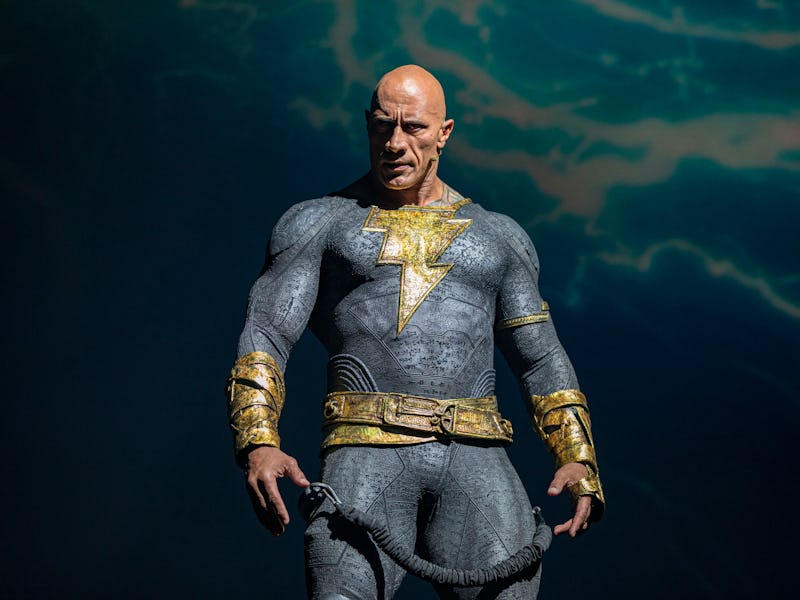
- The Star Factor: Dwayne Johnson’s presence as Black Adam is designed to be immovable. By making the JSA his ideological opponents, the film elevates him to a "god-tier" status where he is essentially the protagonist of his own story but the antagonist to the established world order.
The Cinematic Craft: Visualizing the "Villain"
The direction by Jaume Collet-Serra emphasizes the terrifying nature of Black Adam’s abilities. The cinematography often mimics horror tropes when Teth-Adam is in pursuit of Intergang soldiers—using lightning to turn humans to ash in a way that feels more like a slasher film than a traditional superhero romp.
This aesthetic choice is deliberate. By making the "star" look and act like a monster, the film taps into a different kind of audience engagement. We are fascinated by his power because it is unrestrained. In the "throne room" sequence and the final confrontation with the JSA, the visual language reinforces that Teth-Adam is the center of gravity; everything and everyone else revolves around his decision to either destroy or save the world.
The Role of Intergang and the Crown of Sabbac
Intergang, the high-tech criminal syndicate occupying Kahndaq, serves as the grounded antagonist. Their presence provides the political backdrop necessary for Teth-Adam’s return. The Crown of Sabbac, an artifact forged from "Eternium," acts as the MacGuffin that bridges the gap between the mundane corruption of Intergang and the supernatural threat of the literal antagonist.
The complexity of these multiple layers of antagonism—Intergang (political), the JSA (ideological), and Sabbac (spiritual)—ensures that Teth-Adam is constantly tested. His status as the "star" is solidified because he is the only entity capable of navigating all three levels of conflict simultaneously. He dismantles the political threat, challenges the ideological threat, and ultimately destroys the spiritual threat.
Retrospective Analysis: The Film’s Legacy in 2026
Four years after its release, Black Adam is viewed as a bridge between the old DCEU and the modern DCU era. While the cinematic universe has shifted toward new directions under different leadership, the discourse surrounding Teth-Adam remains relevant. The film proved that there is a significant appetite for characters who occupy the "antagonist" space but act as the primary viewpoint character.
The "star" of the film isn't just a person; it is the concept of unapologetic power. In an era where audiences are increasingly skeptical of institutional "heroes," a character who stands outside the system to protect those the system forgot remains a powerful archetype. The literal antagonist, Sabbac, served his purpose as a high-stakes obstacle, but it was Teth-Adam’s transformation from a vengeful spirit into a king who refuses the throne that truly captured the imagination.
Frequently Asked Questions
Is Black Adam considered a villain or a hero?
In the context of the DC universe, Black Adam is primarily classified as an anti-hero or an anti-villain. He protects his homeland of Kahndaq with absolute ferocity, but his willingness to kill and his disregard for international law often put him in direct conflict with the Justice League and the Justice Society of America.
Who is the literal antagonist in the Black Adam movie?
The primary antagonist is Ishmael Gregor, who transforms into the demonic entity Sabbac. He is the leader of Intergang and seeks the Crown of Sabbac to gain the powers of hell. Unlike Black Adam, whose violence is directed toward protection and vengeance, Sabbac’s goals are purely destructive and malevolent.
Why does the Justice Society fight Black Adam?
The Justice Society of America (JSA) views Black Adam as a "loose cannon" with the power to destabilize global security. Their mission is to maintain order and ensure that meta-humans do not execute prisoners or act as judge, jury, and executioner. This creates a fundamental ideological clash with Adam’s "Old World" style of justice.
Does Black Adam have any weaknesses?
While nearly invulnerable, Black Adam is susceptible to magical attacks of a high order and Eternium, a rare mineral found in Kahndaq that can pierce his skin and dampen his powers. Additionally, his connection to the wizard's power can be severed if he is forced to say the word "Shazam" against his will, though this is difficult to achieve.
How does Sabbac compare to Black Adam in terms of power?
Sabbac is roughly equal to Black Adam in raw physical strength and durability. However, Sabbac draws his power from six demons, granting him hellfire manipulation and a demonic physiology that differs from Adam’s divinely granted Egyptian powers. It ultimately takes the combined efforts of Teth-Adam and the JSA to stop him.
Final Practical Recommendation
For those revisiting Black Adam or studying the evolution of the anti-hero, focus on the Kahndaqi perspective. The film is most effective when viewed as a story about a neglected nation finally finding a champion who doesn't answer to external powers. To understand why the "antagonist" is the star, one must look past the lightning and muscles and examine the political and social vacuum Teth-Adam fills. Whether you view him as a hero or a threat depends entirely on where you are standing when he lands.
For more information on the official lore and character history, visit the Official DC Black Adam Page. You can also view the full cast and production details on IMDb.
Image Gallery