5 Real Miranda Rights Examples and Their Lasting Legal Implications
Miranda rights are a set of constitutional protections that law enforcement must communicate to individuals in custody before a custodial interrogation begins. These rights ensure that any statements made by a suspect are voluntary and...
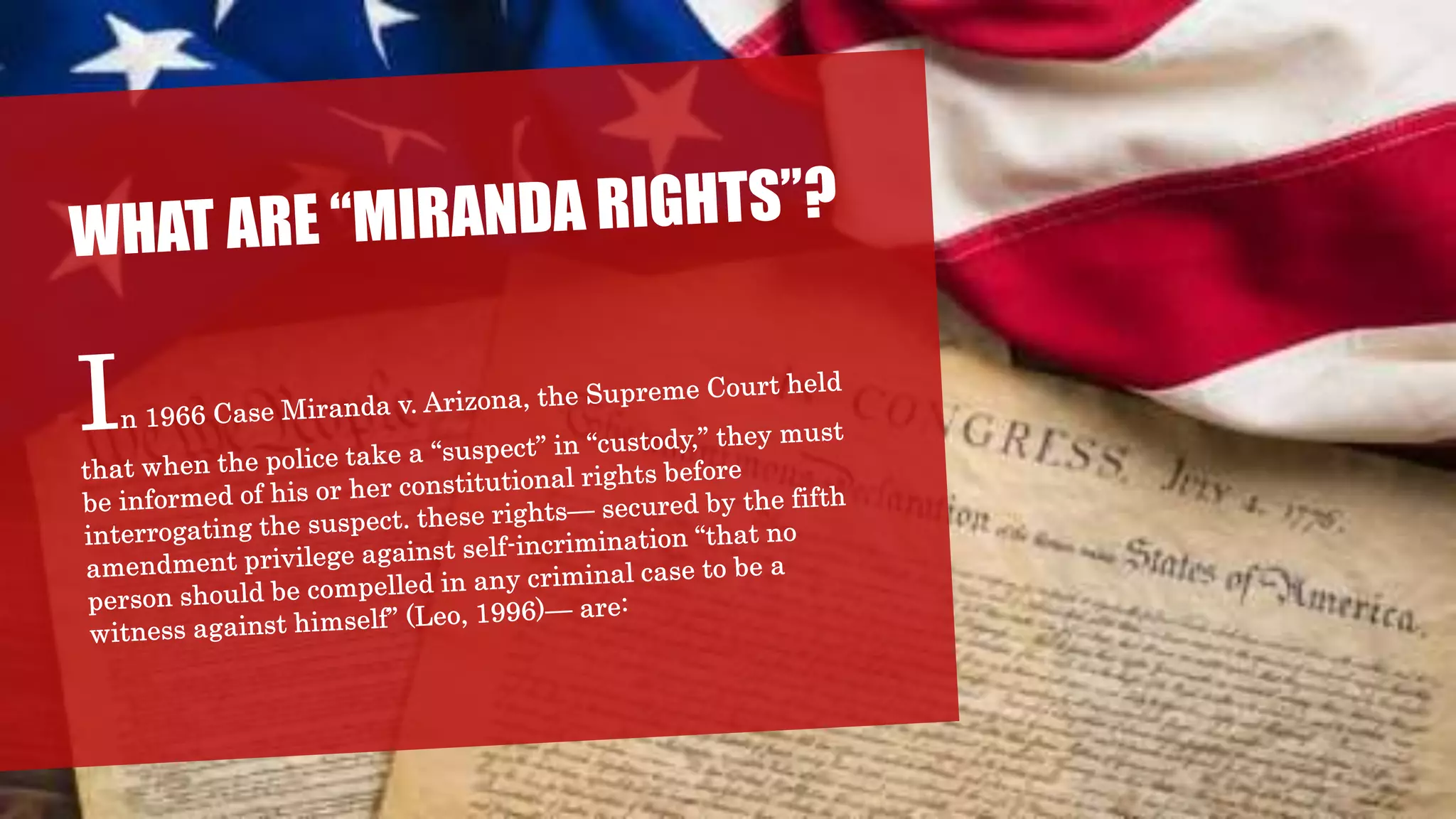
Miranda rights are a set of constitutional protections that law enforcement must communicate to individuals in custody before a custodial interrogation begins. These rights ensure that any statements made by a suspect are voluntary and that the suspect is aware of their Fifth Amendment right against self-incrimination and their Sixth Amendment right to an attorney.
Contents
Understanding how these rights operate in the real world requires looking beyond the standard warning script. Over the decades, the U.S. Supreme Court has refined what "custody" means, when warnings are required, and what happens when the rules are ignored. In 2026, these precedents remain the bedrock of American criminal procedure, shaping how evidence is gathered and whether it can be used in a court of law.
1. Miranda v. Arizona (1966): The Landmark Origin
The most significant example of Miranda rights is the case that created them. In 1963, Ernesto Miranda was arrested in Phoenix, Arizona, in connection with the kidnapping and rape of an 18-year-old woman. After a two-hour interrogation, he signed a written confession. However, at no point did the police inform him that he had the right to remain silent or the right to have an attorney present during questioning.
The Legal Conflict
The core issue was whether a confession obtained through interrogation without a prior warning of rights could be considered voluntary. The Fifth Amendment protects individuals from being "compelled in any criminal case to be a witness against himself." The Supreme Court had to decide if the inherently coercive environment of a police station required specific procedural safeguards to protect this right.
The Implications
The Court’s 5-4 ruling established that the "atmosphere and environment of incommunicado interrogation" is naturally intimidating. To offset this, police must now deliver the famous Miranda warning. If they fail to do so, any evidence obtained—even a full confession—is generally inadmissible in the prosecution's case-in-chief. This case shifted the burden of proof regarding voluntariness from the defendant to the state, requiring the government to prove that the defendant knowingly and intelligently waived their rights.
2. New York v. Quarles (1984): The Public Safety Exception
Miranda rights are not absolute, as demonstrated in New York v. Quarles. In this case, police officers pursued a rape suspect into a supermarket. Upon catching him, they discovered he was wearing an empty shoulder holster. Before reading him his rights, an officer asked where the gun was. The suspect pointed to some empty cartons and said, "The gun is over there."
The Legal Conflict
The defendant argued that because he was in handcuffs (custody) and being questioned without a Miranda warning, his statement and the gun itself should be suppressed. The state argued that the immediate danger posed by a missing firearm in a public place created a necessity that outweighed the procedural requirement of the Miranda warning.
The Implications
The Supreme Court established the Public Safety Exception. This ruling means that if police ask questions prompted by a reasonable concern for public safety, the responses are admissible even without a prior Miranda warning. This has significant implications for modern law enforcement, particularly in cases involving active shooters, hidden explosives, or discarded weapons in high-traffic areas. It recognizes that the protection of the individual's privilege against self-incrimination must occasionally yield to the immediate need to protect the public from harm.
3. Berkemer v. McCarty (1984): Defining "Custodial Interrogation"
One of the most common questions regarding Miranda rights is whether they apply to routine traffic stops. In Berkemer v. McCarty, a highway patrol officer pulled over a driver for weaving. The driver failed a field sobriety test and, when asked if he had used intoxicants, admitted to consuming beer and marijuana. He was never Mirandized during the roadside stop.
The Legal Conflict
The driver sought to suppress his statements, arguing that he was "in custody" the moment he was pulled over and was not free to leave. He contended that any questioning after the stop required a Miranda warning.
The Implications
The Supreme Court ruled that Miranda warnings are required for all custodial interrogations, regardless of the severity of the offense (including misdemeanors). However, it clarified that a routine traffic stop does not constitute "custody" for Miranda purposes. Because traffic stops are brief, public, and less coercive than a station-house interrogation, the police are not required to read rights during the initial investigation. Miranda only "triggers" once a person's freedom of movement is restricted to the degree associated with a formal arrest. This distinction is vital for millions of police-citizen interactions every year.
4. Edwards v. Arizona (1981): The "Bright-Line" Rule on Counsel
Miranda rights include the right to an attorney. Edwards v. Arizona examined what happens when a suspect invokes that right but is later questioned again. Robert Edwards was arrested for robbery and murder. After being informed of his rights, he stated, "I want an attorney before making a deal." The questioning stopped. However, the next morning, two different detectives came to the jail and resumed questioning, eventually obtaining a confession.
The Legal Conflict
The state argued that Edwards had voluntarily waived his rights the second time because he agreed to talk after being read his rights again. The defense argued that once a suspect asks for a lawyer, all questioning must cease until a lawyer is present.
The Implications
The Court created a "bright-line rule": once a suspect invokes their right to counsel, police cannot re-initiate interrogation until a lawyer is made available or the suspect themselves re-initiates communication. This protection is much stronger than the right to remain silent; while police can sometimes return to ask about a different crime after a suspect stays silent, they generally cannot return at all once a suspect asks for a lawyer. This ensures that the state cannot "wear down" a suspect who has clearly asked for legal protection.
5. Salinas v. Texas (2013): The Requirement to Explicitly Invoke
A more recent and controversial example of Miranda's reach is Salinas v. Texas. In this case, Genovevo Salinas was a suspect in a double murder. He was not in custody and went to the police station voluntarily to answer questions. During the interview, the police asked if his shotgun would match the shells found at the scene. Salinas went silent, looked at the floor, and showed signs of nervousness.
The Legal Conflict
At his trial, the prosecutor used Salinas's silence as evidence of guilt, arguing that an innocent person would have denied the claim. Salinas argued that he had a Fifth Amendment right to remain silent and that his silence should not be used against him, even though he hadn't been arrested or Mirandized.
The Implications
The Supreme Court ruled that the Fifth Amendment does not establish a complete right to remain silent; rather, it establishes a right against compelled self-incrimination. Because Salinas was not in custody and had not been "compelled" to speak, he was required to explicitly invoke his right to remain silent. By simply staying quiet without saying "I am exercising my Fifth Amendment rights," his silence became admissible evidence. This case serves as a stern warning: if you are not under arrest, you must verbalize your intent to remain silent to gain the constitutional protection.
Summary Comparison of Key Miranda Cases
The following table summarizes the different facets of Miranda rights as defined by these landmark cases.
| Case Name | Primary Legal Issue | Key Outcome | Impact on Law Enforcement |
|---|---|---|---|
| Miranda v. Arizona | Admissibility of unwarned confessions. | Established the Miranda Warning. | Must read rights before custodial interrogation. |
| New York v. Quarles | Danger to the public vs. procedural rights. | Created "Public Safety Exception." | Can question without warnings in emergencies. |
| Berkemer v. McCarty | Application to traffic stops. | Routine stops are not "custody." | No warnings needed for roadside DUI questions. |
| Edwards v. Arizona | Re-interrogation after asking for a lawyer. | Created a "Bright-Line" prohibition. | Police cannot re-start questioning once counsel is requested. |
| Salinas v. Texas | Use of silence during voluntary questioning. | Silence requires explicit invocation. | Silence can be used as evidence if not in custody. |
The Broader Implications for the Legal System
The implications of these examples extend into nearly every facet of the criminal justice system in 2026. The evolution of Miranda rights reflects a continuous balancing act between individual liberties and the state’s interest in effective law enforcement.
The "Fruit of the Poisonous Tree"
While a Miranda violation usually results in the suppression of the specific statement made, the legal doctrine of "fruit of the poisonous tree" is more complex here. In many jurisdictions, physical evidence (like a weapon or drugs) found because of an un-Mirandized statement may still be admissible, even if the statement itself is thrown out. This is a crucial distinction that differentiates Miranda violations from Fourth Amendment (search and seizure) violations.
Knowing and Intelligent Waivers
For a waiver of Miranda rights to be valid, it must be "knowing, intelligent, and voluntary." This means the suspect must understand the language used and the consequences of speaking. In modern practice, this often involves police using pre-printed forms in multiple languages and recording the reading of rights to prevent claims of coercion or misunderstanding later in court.
The Definition of "Interrogation"
Interrogation isn't just direct questioning. The courts have defined it as any words or actions by the police that they should know are reasonably likely to elicit an incriminating response. This prevents officers from using psychological ploys or "staged" conversations to get a suspect to talk without technically asking a question.
FAQ: Common Questions About Miranda Rights
Do police have to read me my rights immediately upon arrest?
No. Police are only required to read Miranda rights if they intend to conduct a custodial interrogation. If you are arrested but the police do not ask you any questions, they do not have to read you your rights. However, any spontaneous statements you make ("I shouldn't have done that!") can still be used against you.
What happens if the police forget to read my rights?
If you are in custody and being interrogated and the police fail to read your rights, your statements will likely be suppressed (excluded) from evidence. This does not mean your case will be dismissed automatically. If the prosecution has other evidence (fingerprints, witnesses, surveillance video), they can still proceed with the trial.
If I start talking, can I change my mind and stop?
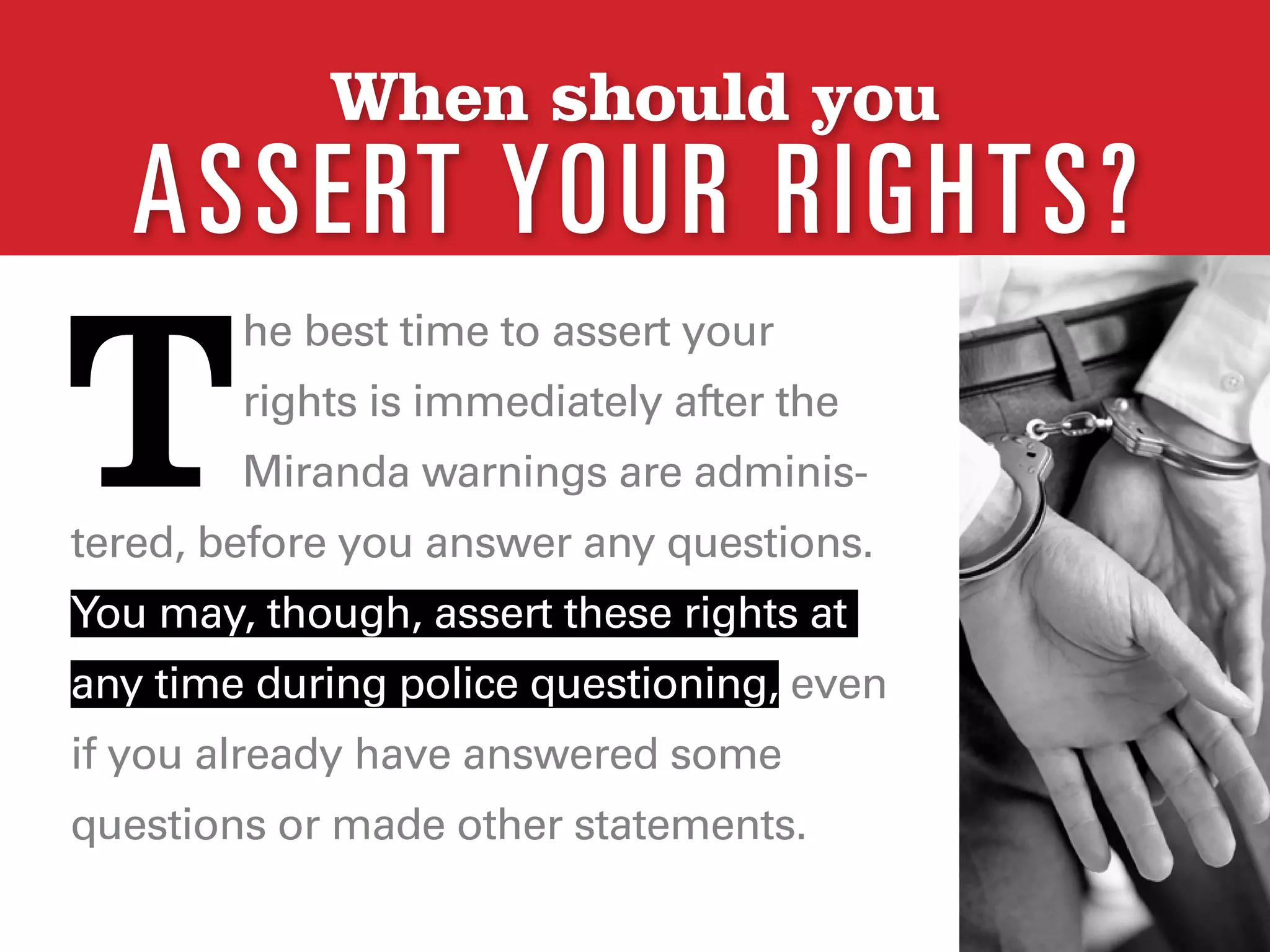
Yes. You can invoke your Miranda rights at any time during an interrogation, even if you have already answered several questions or signed a waiver. Once you state that you wish to remain silent or want an attorney, the police must stop the interrogation immediately.
Can my silence be used against me if I haven't been arrested?
Based on Salinas v. Texas, yes. If you are talking to the police voluntarily and are not in custody, your silence in response to a question can be used as evidence of guilt unless you explicitly state that you are invoking your Fifth Amendment rights.
Does the Miranda warning have to be read exactly as it appears on TV?
There is no "magic script" required by the Supreme Court. While most departments use a standardized card to ensure accuracy, the legal requirement is simply that the "substance" of the rights is conveyed clearly. The suspect must understand they have the right to silence, that statements can be used against them, and that they have a right to an attorney (including a court-appointed one).
Practical Recommendation for Interacting with Law Enforcement
If you find yourself in a situation where you are being questioned by law enforcement, the most effective way to protect your constitutional rights is to be explicit and consistent.
If you are not under arrest, you are generally free to leave. If you are unsure, ask, "Am I free to go?" If the answer is no, or if you are formally placed in custody, clearly state: "I am invoking my Fifth Amendment right to remain silent, and I want to speak with an attorney."
Once you have made this statement, do not engage in "small talk" or attempt to explain your side of the story until your legal counsel is present. As seen in Edwards v. Arizona and Salinas v. Texas, ambiguity often works in favor of the prosecution, while a clear invocation provides the strongest legal shield available under the Constitution.
Image Gallery