Why Term Life Insurance No Medical Exam Still Costs More
Term life insurance without a medical exam is more expensive because insurers must compensate for the increased uncertainty regarding an applicant's health. Without physical vitals or blood work, the insurance company assumes a higher...
Term life insurance without a medical exam is more expensive because insurers must compensate for the increased uncertainty regarding an applicant's health. Without physical vitals or blood work, the insurance company assumes a higher mortality risk and applies a "convenience premium" to cover potential undisclosed or undiagnosed medical conditions.
Contents
For decades, the medical exam—complete with blood draws, urinalysis, and blood pressure checks—was the "gold standard" of life insurance underwriting. As we navigate the insurance landscape in 2026, technology has streamlined the application process, yet the fundamental math of risk remains unchanged. When you opt out of a medical exam, you are essentially asking an insurer to make a high-stakes financial bet with less information. To protect their solvency and pay out future claims, insurers charge higher premiums to everyone in the "no-exam" pool to offset the few high-risk individuals who inevitably slip through the digital screening process.
The Mathematical Reality of Mortality Risk
The primary reason no-exam term life insurance costs more is the concept of mortality risk. Insurance is a business of pooling risks. In a traditional fully underwritten policy, the insurer uses a medical exam to place you into a specific risk class, such as "Preferred Best" or "Standard." If your labs are perfect, you get the lowest rates because the insurer has objective proof that you are healthy.
In the no-exam world, specifically with Simplified Issue policies, that precision is lost. The insurer cannot distinguish between someone who is perfectly healthy and someone who has high cholesterol or early-stage hypertension that hasn't yet triggered a prescription record. Because they cannot see the "hidden" health markers, they price the policy as if the applicant has average or slightly below-average health. Essentially, healthy applicants in no-exam pools end up subsidizing the costs for those with undiagnosed issues.
By 2026, data analytics have improved, but they still cannot replicate the diagnostic depth of a metabolic panel. Until an algorithm can perfectly predict internal organ function without a blood sample, the "uncertainty tax" will remain a permanent fixture of no-exam pricing models.
Adverse Selection: The Insurer’s Greatest Fear
Insurance companies are deeply concerned with adverse selection. This is a phenomenon where individuals who know they are at a higher risk of death are more likely to seek out insurance policies that do not require a medical exam.
If someone recently discovered a lump or has been feeling unexplained chest pains, they might intentionally avoid a medical exam to secure coverage before a formal diagnosis appears on their medical record. Insurers are well aware of this incentive. To protect themselves from a surge of high-risk policyholders who are "gaming the system," they raise the baseline price for all no-exam products. This ensures that even if they take on several high-risk individuals, the higher premiums collected from the entire group will cover the anticipated claims.
Data Replacement vs. Clinical Evidence
While you may not meet with a nurse, "no exam" does not mean "no investigation." In 2026, insurers rely heavily on digital footprints to assess risk. This process is known as algorithmic underwriting. They typically pull data from several key sources:
- MIB Group (formerly Medical Information Bureau): A central database where insurers share coded information about previous insurance applications and medical conditions.
- Prescription History Reports (Rx): Databases like Milliman IntelliScript or LexisNexis Risk Solutions provide a multi-year history of every medication you have been prescribed.
- Motor Vehicle Reports (MVR): Your driving record is a significant indicator of "lifestyle risk." High speeds or DUIs suggest a higher probability of accidental death.
- Electronic Health Records (EHR): With increased interoperability in 2026, many insurers can digitally ping your doctor’s office for recent records.
Despite the breadth of this data, it is reactive rather than proactive. A prescription report tells an insurer you are treating a condition, but it doesn’t tell them how well it is controlled or if you have a new condition that hasn't been treated yet. The medical exam provides a "snapshot in time" of your actual physiological state, which is far more valuable to an actuary than a digital paper trail.
Comparing Policy Types and Pricing Structures
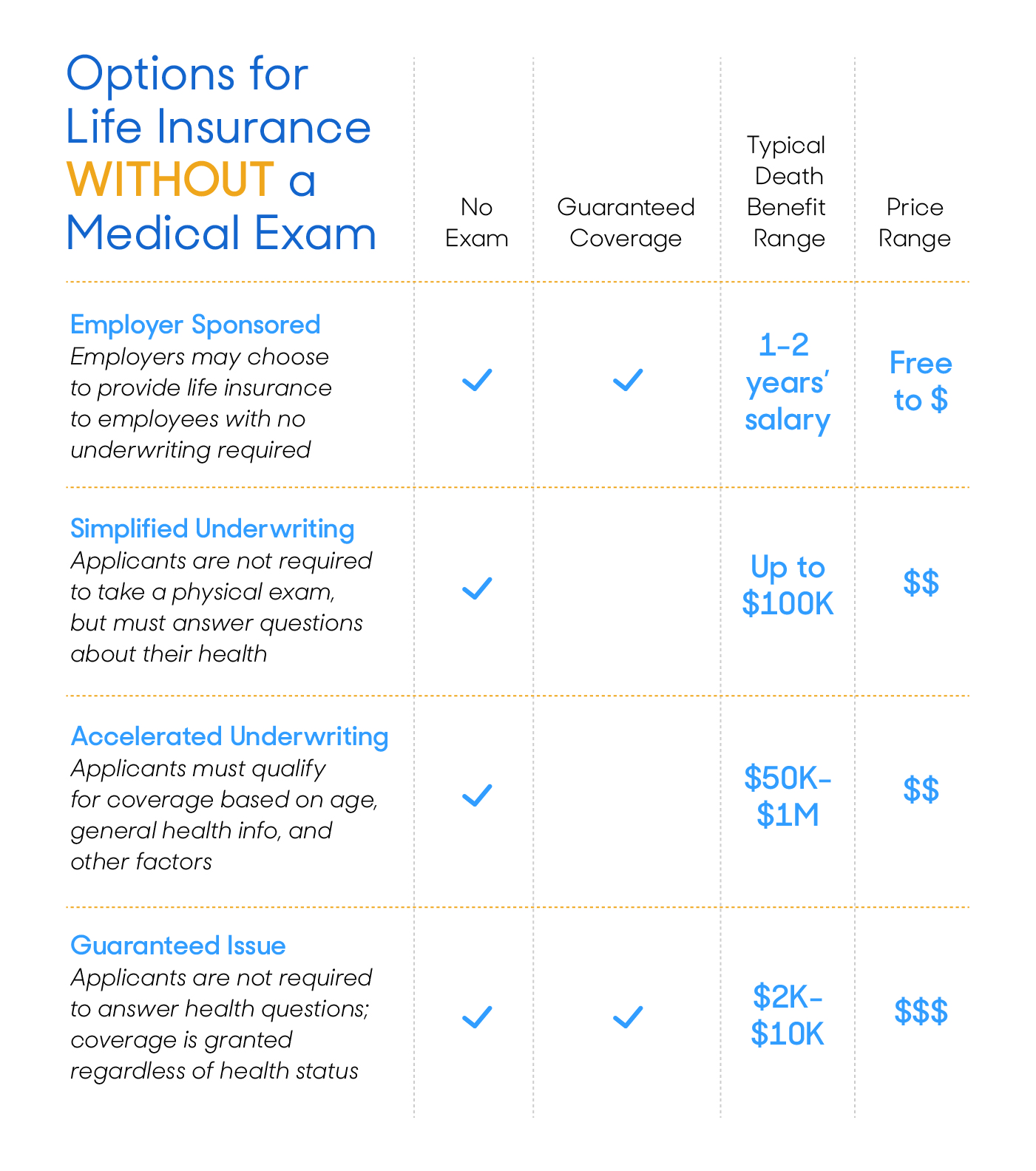
Understanding why costs vary requires distinguishing between the three main types of "no-exam" coverage available in 2026. Not all no-exam policies are priced the same way.
| Policy Type | Underwriting Method | Relative Cost | Target Audience |
|---|---|---|---|
| Fully Underwritten | Full medical exam + labs | Lowest | Healthy individuals seeking high coverage |
| Accelerated Underwriting | Algorithm-based (no exam if healthy) | Low to Mid | Young, very healthy applicants |
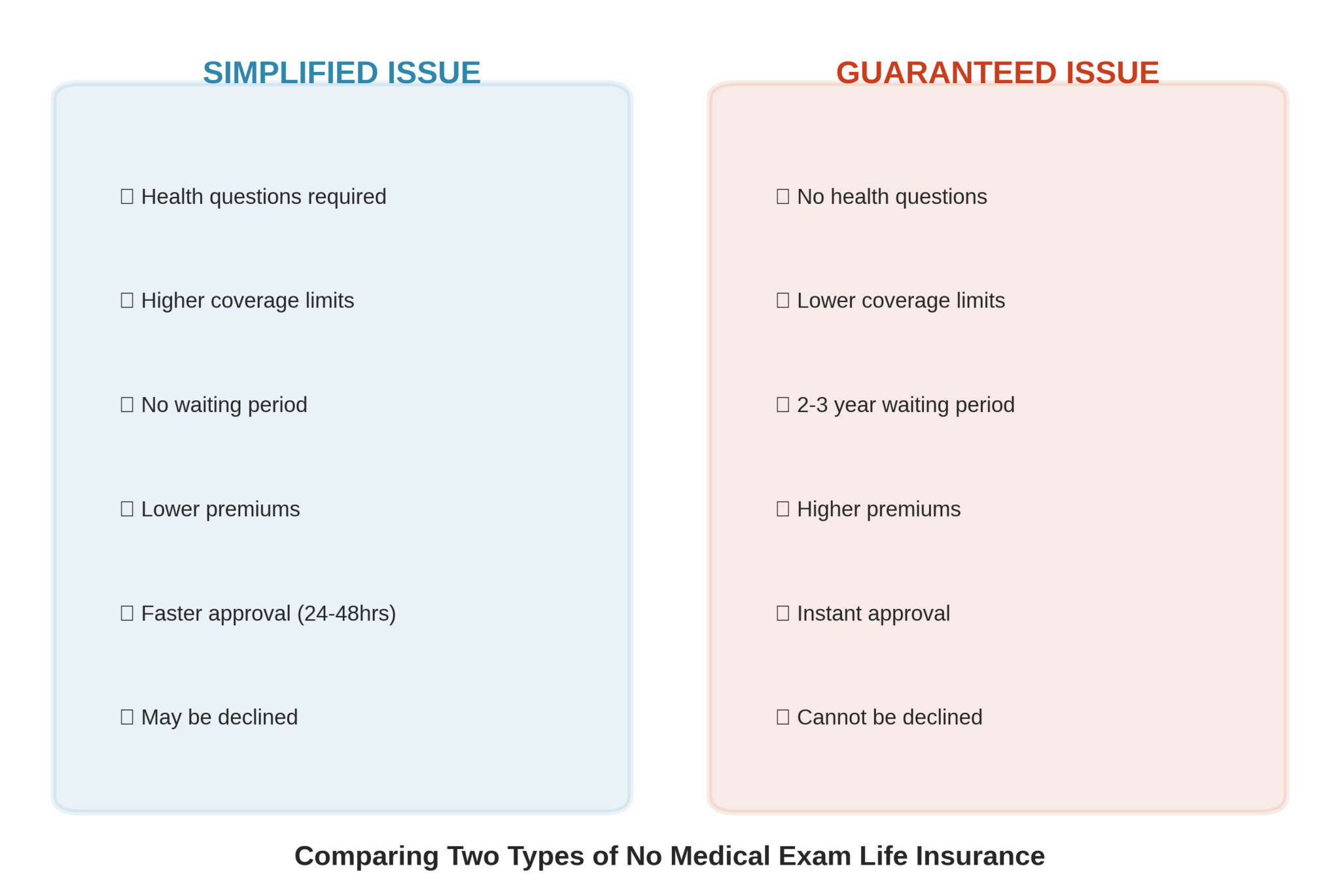
| Simplified Issue | Medical questionnaire + data reports | High | People wanting speed or who dislike needles |
| Guaranteed Issue | No health questions or exam | Highest | Seniors or those with serious chronic illnesses |
Accelerated Underwriting: The 2026 Middle Ground
It is important to note that some "no-exam" policies—specifically Accelerated Underwriting (AU)—can actually be priced similarly to traditional policies. However, these are only available to a small percentage of the population who meet very strict criteria (usually younger than 50 with a clean medical history). If the algorithm sees even one "red flag" in your data, you are often kicked out of the accelerated track and forced to take a medical exam to get the lower rate. If you choose to stay in the no-exam track despite the red flag, the price jumps significantly.
The "Convenience Premium" and Operational Costs
Beyond the risk of death, there is the simple factor of business operations. Providing an instant or near-instant decision requires sophisticated, expensive technology. Insurers invest millions into AI platforms and data access fees to provide a "no-exam" experience.
When a customer chooses a no-exam policy, they are often paying for speed and ease. In a traditional setting, it can take 4 to 8 weeks to secure a policy due to scheduling the examiner and waiting for lab results. A Simplified Issue policy can often be issued in minutes or hours. For many consumers, the extra $20 to $50 per month is a "convenience fee" they are willing to pay to avoid the hassle of a physical and to get their family protected immediately.
Limits on Coverage Amounts
Another reason the cost-per-thousand dollars of coverage is higher for no-exam policies is that insurers cap the Total Death Benefit. You will rarely find a no-exam policy that offers $5 million or $10 million in coverage. Most are capped at $500,000 or $1,000,000.
Because the insurer is limiting their total exposure (the maximum amount they would have to pay out), they cannot benefit from the "economies of scale" found in larger life insurance policies. In life insurance, the "unit price" of coverage typically drops as the face amount increases. By capping the face amount on no-exam products, insurers keep the pricing in a higher bracket.
When Should You Pay the Higher Cost?
While it is true that no-exam term life insurance costs more, there are specific scenarios in 2026 where paying the premium is a logical financial decision:
- Urgent Collateral Requirements: If you are securing a Small Business Administration (SBA) loan or a divorce settlement that requires life insurance immediately, you cannot wait two months for a medical exam.
- Medical Phobias: For individuals with severe needle phobias (trypanophobia) or "white coat syndrome" (where blood pressure spikes in a medical setting), the stress of an exam might lead to inaccurate results that could cause a policy denial anyway.
- Minor Controlled Conditions: If you have a minor health issue that you know might lead to a "Standard" rating regardless, the price difference between a fully underwritten "Standard" policy and a Simplified Issue policy may be negligible.
Frequently Asked Questions
Can I lower my rate later if I decide to take a medical exam?
Generally, no. Most no-exam policies are separate products. If you want a lower rate based on your health, you would typically need to apply for a new, fully underwritten policy and then cancel the no-exam policy once the new one is in force. It is rarely possible to "convert" a high-cost no-exam policy into a low-cost underwritten one without a new application.
Why was I denied a no-exam policy if they don't check my health?
This is a common misconception. "No medical exam" does not mean "no health questions." Simplified Issue policies still require you to answer a series of health questions honestly. If you answer "yes" to having a history of heart disease, stroke, or cancer, the insurer may deny you instantly based on that disclosure or the data found in your prescription history. Only Guaranteed Issue policies bypass health questions entirely.
Does the 2026 technology make no-exam policies any cheaper than they were in 2020?
Slightly. As The National Association of Insurance Commissioners (NAIC) has noted in various reports on big data, the increased accuracy of predictive modeling allows insurers to narrow the price gap for the healthiest applicants. However, for the average person, the "uncertainty gap" still requires a higher premium than a policy backed by physical lab evidence.
Is the death benefit different for no-exam policies?
In a standard term life no-exam policy, the death benefit is the same as any other policy—the full amount is paid out from day one. However, if you are looking at Guaranteed Issue (the most expensive no-exam type), these often have a "graded death benefit." This means if you die within the first two or three years of the policy, your beneficiaries may only receive a refund of premiums plus interest, rather than the full face value.
Are no-exam policies less stable than traditional ones?
No. As long as the insurance carrier is highly rated by agencies like A.M. Best, the policy is just as legally binding and financially secure as a traditional one. The higher cost is purely a function of the underwriting risk, not the quality of the insurance company itself.
Practical Recommendation
If you are in good health and have the time to wait, you should always opt for a fully underwritten medical exam. This will consistently result in the lowest possible premium over the life of the policy, potentially saving you thousands of dollars over a 20 or 30-year term. However, if you have a high-stress lifestyle, need coverage within 24 hours for a legal or business requirement, or have a manageable health condition that makes lab results unpredictable, a no-exam term policy is a valuable tool—provided you are comfortable paying a 15% to 40% premium for the speed and privacy it affords.
Image Gallery