How to Open a Vanguard Roth IRA: Step-by-Step Setup, Rules, and Investment Strategies
To open a Vanguard Roth IRA, visit Vanguard’s official website, select "Open an Account," and choose "Roth IRA." You must provide your Social Security number, employer details, and bank account information for funding. After submitting...
To open a Vanguard Roth IRA, visit Vanguard’s official website, select "Open an Account," and choose "Roth IRA." You must provide your Social Security number, employer details, and bank account information for funding. After submitting your application and transferring funds, select your investments, such as Vanguard index funds or ETFs, to begin tax-free growth.
Contents
Prerequisites and Income Eligibility for a Vanguard Roth IRA
Before initiating an account application with Vanguard, you must verify that you meet the internal revenue tax code criteria for contributing to a Roth IRA. A Roth IRA is an individual retirement account funded with post-tax dollars, offering tax-free growth and tax-free qualified withdrawals in retirement.
Earned Income Requirement
To make a direct contribution, you must have taxable earned income during the tax year. Taxable earned income includes wages, salaries, tips, professional fees, bonuses, and net earnings from self-employment. Non-taxable income sources—such as rental income, interest, dividends, child support, or pension benefits—do not qualify as earned income for IRA contribution purposes.
Contribution Cap Rule Your annual contribution cannot exceed your total earned income for the year. If you earned $4,000 in a given tax year, your maximum Roth IRA contribution for that year is capped at $4,000, regardless of the official federal maximum limit.
Income Phase-Out Limits
Roth IRA eligibility is subject to Modified Adjusted Gross Income (MAGI) thresholds set by the IRS. For the 2026 tax year, the income limits dictate whether you can make a full contribution, a reduced contribution, or no direct contribution at all:
- Single or Head of Household: The MAGI phase-out range begins at $150,000 and ends at $165,000. Earners below $150,000 can contribute up to the full limit ($7,500 under age 50; $8,500 for age 50 and older). Contributions are gradually reduced within the phase-out window and prohibited above $165,000.
- Married Filing Jointly: The phase-out range is $236,000 to $246,000. Full contributions are allowed below $236,000, while direct contributions are phased out entirely once MAGI reaches $246,000.
- Married Filing Separately: The phase-out range is $0 to $10,000. If you lived with your spouse at any time during the year, your contribution capability is severely reduced or eliminated.
High earners exceeding these MAGI thresholds cannot open and fund a standard direct Roth IRA. However, they may utilize a Backdoor Roth IRA strategy by contributing non-deductible funds to a Traditional IRA and subsequently executing a Roth conversion.
Required Documentation and Setup Checklist
Gathering necessary documentation in advance ensures the digital identity verification process executes smoothly without administrative delays or manual secondary reviews by Vanguard's risk management team.
Information Required for Account Registration
- Personal Identification: Your full legal name, permanent residential address (P.O. Boxes are not permitted for primary residence verification), date of birth, and Social Security Number (SSN) or Individual Taxpayer Identification Number (ITIN).
- Employment Details: Current employer name, business address, occupation, and industry sector.
- Financial Account Details: Bank routing number and checking or savings account number to set up an Automated Clearing House (ACH) connection for account funding.
- Identity Verification Credentials: A valid state-issued driver's license, passport, or state ID may be requested if automated credit bureau verification yields a record mismatch.
- Designated Beneficiaries: Primary and contingent beneficiaries' legal names, dates of birth, SSNs, and percentage allocations.
Step-by-Step Guide to Opening a Vanguard Roth IRA
The process of opening an account online typically takes 15 to 20 minutes when all required documentation is readily available.
Step 1: Initiate the Online Application
Navigate to Vanguard’s official website and select the option to open a new account. When prompted to select the source of your funds, choose whether you are funding the account via a new bank transfer, rolling over an existing employer 401(k), or transferring an existing IRA from another brokerage firm. Select Roth IRA as the target account type.
Step 2: Create Account Credentials and Verify Identity
If you are a new Vanguard client, establish a secure username and password, and enable multi-factor authentication (MFA) via an authenticator app or SMS text notification. Input your personal information, contact numbers, and SSN. Vanguard uses automated databases to confirm your identity.
Step 3: Link Your Bank Account for Funding
Provide your bank's routing and account numbers to establish an electronic funds transfer link. Vanguard may perform an instant verification using third-party financial aggregators (such as Plaid) or issue micro-deposits to confirm ownership of the external account.
Step 4: Specify Contribution Amount and Tax Year
Indicate the amount you wish to deposit. Between January 1 and the tax filing deadline (typically April 15) of any calendar year, Vanguard will ask you to specify whether your contribution applies to the prior tax year or the current tax year. Ensure you select the correct designation, as recharacterizing accidental contributions requires formal paperwork.
Step 5: Review and Submit Application
Review the account disclosures, fee schedules, and custodial agreements. Confirm that the beneficiary information is correctly designated. Submit the application to receive your Vanguard account number.
Funding Mechanics and The Settlement Fund Trap
A common mistake made by new investors after opening a Vanguard Roth IRA is assuming that transferring cash into the account completes the investment process.
[Bank Account Transfer] ---> [Vanguard Federal Money Market Fund (VMFXX)] ---> [Manual Allocation to Mutual Funds/ETFs]
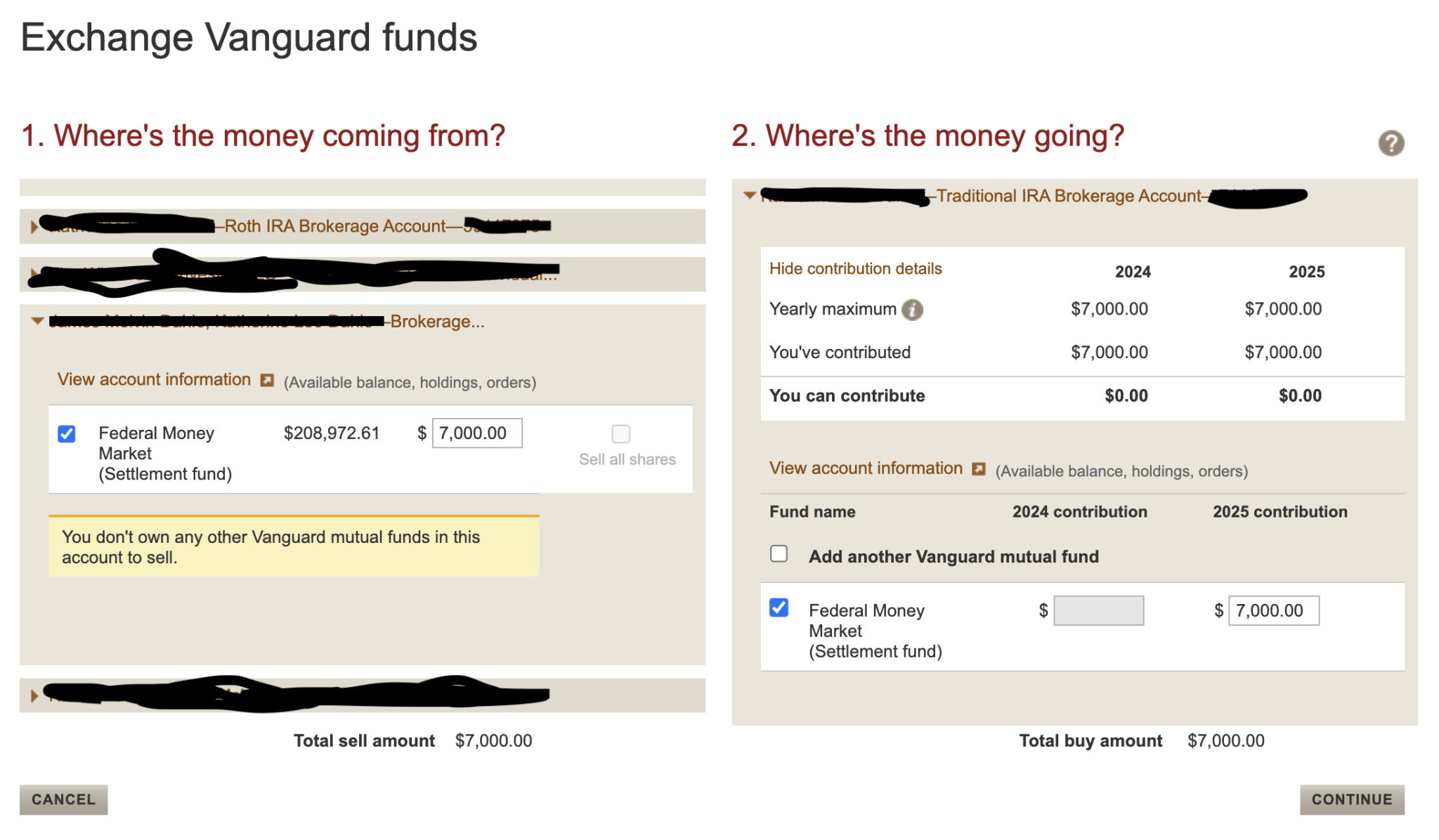
When cash is transferred from your bank into a Vanguard Roth IRA, it defaults into the account's settlement fund: the Vanguard Federal Money Market Fund (VMFXX).
Cash held in VMFXX earns a yield based on short-term interest rates, but it is not invested in long-term capital-growth assets like broad-market index funds or global stock portfolios. If you do not issue explicit purchase instructions, your money will remain indefinitely in the money market fund.
How to Allocate Your Money Market Settlement Balance
- Log into your Vanguard account portal.
- Select Transfers & Investments, then click Buy & Sell.
- Choose Buy Vanguard Funds or Trade Stocks & ETFs.
- Select your Vanguard Roth IRA as the destination account.
- Search for your desired fund ticker symbol (e.g., VTI, VOO, VTTSX).
- Enter the dollar amount from your settlement fund you wish to allocate to the trade and confirm the transaction.
Investment Options and Portfolio Allocation Strategies
Vanguard offers a vast array of index mutual funds, Exchange-Traded Funds (ETFs), actively managed funds, and individual securities. Choosing the right vehicle depends on your desired asset allocation, investment experience, and starting capital.
1. Vanguard Target Retirement Funds (All-in-One Solution)
Target Retirement Funds automatically manage asset allocation based on your planned retirement date. These portfolios follow a "glide path," starting heavily weighted in equities for growth early in your career and gradually shifting toward fixed income (bonds) as you approach retirement.
- Structure: A single mutual fund containing underlying broad-market indexes (Total Stock Market, Total International Stock, Total Bond Market, Total International Bond).
- Minimum Investment: $1,000 initial minimum.
- Best For: Hands-off investors seeking automated rebalancing and simple portfolio management.
2. The Three-Fund Portfolio Strategy (Custom Indexing)
Investors seeking greater control over asset allocation often utilize the classic Three-Fund Portfolio using Vanguard index funds or ETFs:
- U.S. Total Stock Market: Tracks broad domestic equity (e.g., Vanguard Total Stock Market ETF - VTI or Admiral Shares Mutual Fund - VTSAX).
- International Total Stock Market: Tracks equities outside the U.S. (e.g., Vanguard Total International Stock ETF - VXUS or Admiral Shares Mutual Fund - VTIAX).
- U.S. Total Bond Market: Provides fixed-income stability (e.g., Vanguard Total Bond Market ETF - BND or Admiral Shares Mutual Fund - VBTLX).
3. S&P 500 Focus
Investors focused specifically on large-cap U.S. enterprises frequently utilize the Vanguard S&P 500 ETF (VOO) or Vanguard 500 Index Fund Admiral Shares (VFIAX) as a core holding.
Structural Comparison: Vanguard Mutual Funds vs. Vanguard ETFs
Understanding the operational differences between Vanguard Mutual Funds (Admiral Shares) and Vanguard ETFs is critical when constructing your Roth IRA portfolio.
| Feature / Specification | Vanguard Admiral Shares (Mutual Funds) | Vanguard ETFs (Exchange-Traded Funds) |
|---|---|---|
| Minimum Initial Investment | Generally $3,000 per fund ($1,000 for Target Date Funds) | Price of 1 share (or fractional share minimums on digital platforms) |
| Trading Mechanism | Executed once daily at net asset value (NAV) after market close | Traded throughout market hours at market price |
| Automated Recurring Investments | Supported for fixed dollar amounts across any asset | Supported via Vanguard platform automated equity buy settings |
| Expense Ratios | Ultra-low (Typically 0.04% – 0.08%) | Ultra-low (Typically 0.03% – 0.08%) |
| Dividend Reinvestment (DRIP) | Automatic reinvestment options available | Automatic reinvestment options available |
| Conversion Capabilities | Convertible to Vanguard ETF counterpart tax-free | Cannot be converted directly into mutual fund shares |
Critical Rules, Distribution Taxes, and Strategic Pitfalls
Managing a Vanguard Roth IRA requires strict compliance with IRS governing laws to avoid taxes and penalties.
1. The 5-Year Rule for Roth IRAs
The IRS enforces two separate 5-year rules regarding tax-free withdrawals:
- Earnings Withdrawals: To withdraw investment earnings tax-free and penalty-free, the account must be open for at least 5 tax years from your initial contribution, AND you must be at least age 59½ (or meet specific exception criteria like a qualifying first-time home purchase, subject to lifetime caps).
- Conversion Withdrawals: Each Backdoor Roth or Traditional IRA conversion has its own 5-year holding period requirement before converted principal can be withdrawn penalty-free if under age 59½.
2. Contribution vs. Earnings Withdrawal Hierarchy
The IRS applies a favorable ordering rule to distributions from a Roth IRA. Withdrawals are treated as coming from funds in the following sequence:
- Regular Contributions: Can be withdrawn at any time, at any age, tax-free and penalty-free.
- Conversion & Rollover Funds: Distributed on a first-in, first-out (FIFO) basis. Subject to a 10% early distribution penalty if withdrawn within 5 years of conversion unless an exception applies.
- Earnings: Distributed last. Taxable as ordinary income and subject to a 10% penalty if withdrawn prior to age 59½ and without satisfying the 5-year rule.
3. Overcontribution Penalties
If your MAGI exceeds IRS thresholds or if you accidentally contribute more than your earned income limit, you face an excess contribution penalty. The IRS levies a 6% excise tax on the excess amount for every year it remains in the account.
- Remedy: Submit a formal request to Vanguard to execute a Removal of Excess Contribution prior to your tax filing deadline (including extensions). Vanguard will calculate and return the excess principal plus attributable net earnings.
Troubleshooting Common Vanguard Setup Issues
Automated Verification Failed
If Vanguard cannot verify your identity automatically using public databases during application submission, your account will enter a "Pending Review" status.
- Action Required: Log into your secure portal and upload a color copy of your photo ID, utility bill showing your residential address, and a signed Social Security verification form (Form W-9).
Bank Connection Errors
Micro-deposit validation failures occur if bank account details are entered incorrectly or if the name on your external bank account does not match your legal name on the Vanguard profile.
- Action Required: Ensure you are linking an individual or joint checking/savings account where you are a listed account holder. Business bank accounts cannot be linked to personal IRAs.
Order Rejection Due to Settlement Clearing
Attempting to purchase investments immediately after submitting a bank transfer can trigger a "Funds Not Cleared" error message.
- Action Required: While Vanguard often grants immediate trading access on ACH transfers, holds lasting 3 to 7 business days may be applied to newly linked bank accounts before funds are cleared for trade execution.
Frequently Asked Questions
What is the minimum amount required to open a Vanguard Roth IRA?
There is no account opening fee or minimum account balance required to open a Vanguard Roth IRA. However, to purchase specific investments, you must meet the individual security requirements, such as the cost of a single ETF share or $1,000 for a Target Retirement Fund.
How long does it take for a Vanguard Roth IRA to become active?
The online registration process takes roughly 15 minutes. Electronic bank transfers to fund the account typically clear within 2 to 3 business days, after which funds can be allocated directly into market holdings.
Can I transfer an existing 401(k) or IRA from another provider to Vanguard?
Yes. You can execute a direct trustee-to-trustee transfer or rollover from a prior employer's 401(k) or an external brokerage IRA into a Vanguard Roth IRA. Direct transfers avoid tax withholding and reportable tax events.
What happens if I accidentally contribute to a Roth IRA when my income is too high?
If your income exceeds the MAGI limit, you must contact Vanguard to perform a recharacterization of the contribution to a Traditional IRA or request a removal of excess contributions before your tax return deadline to avoid the annual 6% IRS excise penalty.
Is my money locked in a Vanguard Roth IRA until age 59½?
No. You can withdraw your direct contributions at any time, for any reason, without taxes or early withdrawal penalties. However, investment earnings are subject to taxes and a 10% penalty if withdrawn before age 59½ and before satisfying the 5-year rule.
Final Recommendation
Opening a Vanguard Roth IRA provides long-term, tax-efficient growth potential for retirement wealth. To maximize account effectiveness, ensure your annual MAGI complies with IRS guidelines, choose low-cost investments aligned with your risk tolerance, and confirm that transferred funds are explicitly moved out of the VMFXX settlement account and into your target asset allocation.
Image Gallery