Calculating Dia Inches of Pipe: 2026 Guide for Industrial Estimating and Welding Productivity
To calculate dia inches of pipe, multiply the nominal pipe size (NPS) by the number of joints or welds performed on that specific diameter. For example, ten welds on a 6-inch pipe equate to 60 dia-inches. This standardized unit allows...
To calculate dia inches of pipe, multiply the nominal pipe size (NPS) by the number of joints or welds performed on that specific diameter. For example, ten welds on a 6-inch pipe equate to 60 dia-inches. This standardized unit allows project managers and estimators to quantify welding labor, consumables, and project timelines regardless of varying pipe sizes across a system.
Contents
In the 2026 industrial construction landscape, "dia-inches" (often referred to as "inch-dia") remains the gold standard for measuring the volume of work in piping mechanical contracts. Whether you are working in petrochemical refineries, pharmaceutical cleanrooms, or high-pressure steam plants, understanding this metric is critical for accurate budgeting and scheduling. This guide explores the foundational math, the nuanced "weighted" calculations for different schedules, and the digital integration of these metrics into modern Building Information Modeling (BIM) workflows.
The Foundational Definition of Dia-Inches in 2026
At its core, a dia-inch is a normalized unit of measurement used to describe the amount of welding or fabrication required for a piping project. Unlike linear feet, which measures the length of the run, dia-inches measure the "cross-sectional" work. Because a weld on a 24-inch pipe requires significantly more time, filler metal, and shielding gas than a weld on a 2-inch pipe, simply counting the number of welds is insufficient for estimating.
Industry Standardization The use of dia-inches is governed by several professional standards, though primarily used as a commercial labor metric. Organizations like the Pipe Fabrication Institute (PFI) and the American Welding Society (AWS) provide the technical groundwork for weld quality, while the Mechanical Contractors Association of America (MCAA) provides the labor units often applied to these dia-inch calculations.
In 2026, the industry distinguishes between "Raw Dia-Inches" and "Weighted Dia-Inches." Raw dia-inches represent the physical count of diameters, whereas weighted dia-inches account for the complexity, wall thickness (schedule), and material type of the pipe.
The Primary Formula and Step-by-Step Calculation
The calculation is straightforward but requires meticulous record-keeping of the Bill of Materials (BOM) or the isometric drawings. Follow these steps to determine the total dia-inches for a project:
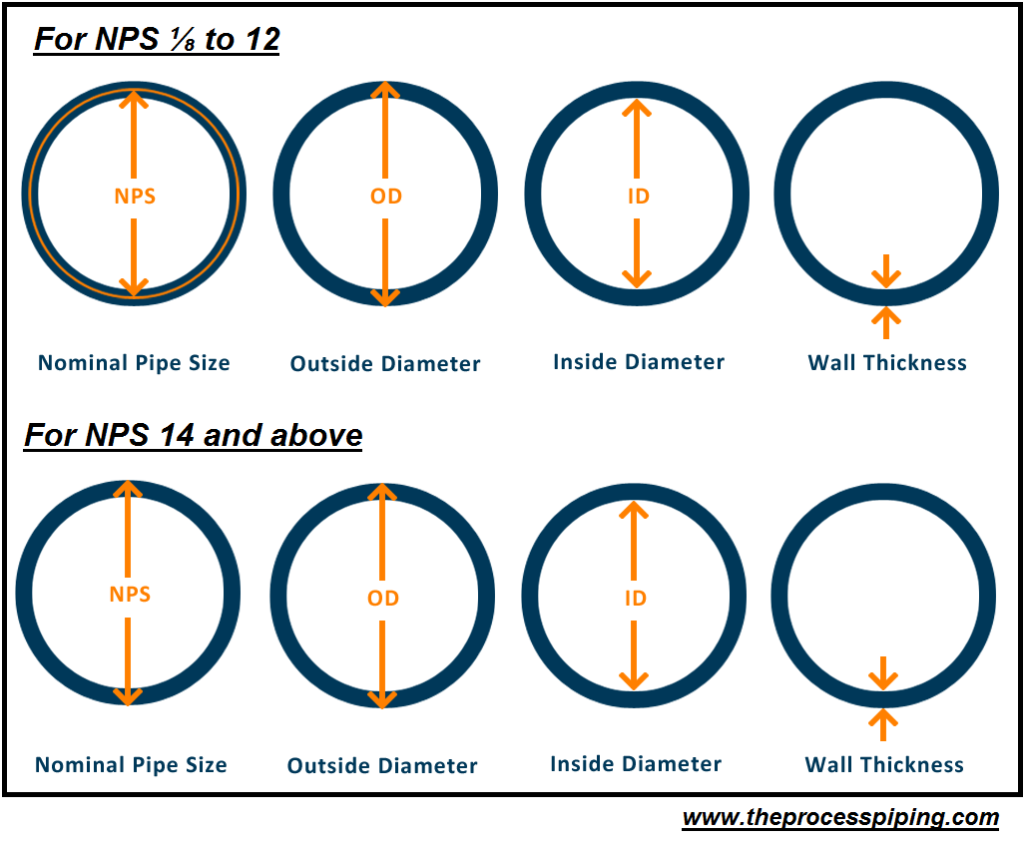
- Identify the Nominal Pipe Size (NPS): Use the nominal diameter, not the actual outside diameter (OD). For instance, even though a 2-inch pipe has an OD of 2.375 inches, you use "2" for the calculation.
- Count the Joints: Determine the total number of butt-welds, socket welds, or flange connections for that specific size.
- Apply the Basic Formula: Total Dia-Inches = NPS × Number of Joints.
- Aggregate the Totals: Sum the results for all different pipe sizes in the system.
For a small spool involving various sizes, the calculation looks like this:
- (4 joints × 2-inch pipe) = 8 dia-inches
- (6 joints × 4-inch pipe) = 24 dia-inches
- (2 joints × 10-inch pipe) = 20 dia-inches
- Total Project Dia-Inches = 52
Weighted Dia-Inches: Accounting for Wall Thickness and Material
While the basic formula works for standard carbon steel Schedule 40 piping, it fails to account for the increased labor required for heavy-wall or exotic materials. In 2026, estimators use "Equivalent Dia-Inches" to normalize labor hours. A weld on a Schedule 160 pipe takes much longer than a Schedule 40 pipe of the same diameter because it requires more passes and more filler material.
Material Complexity Factors Carbon Steel (Standard): 1.0 multiplier. This is the baseline for all labor estimations. Stainless Steel (304/316): 1.3 to 1.5 multiplier. The requirement for back-purging and slower travel speeds increases the "effective" dia-inches. Chrome-Moly (P91/P22): 2.0 to 2.5 multiplier. Pre-heating and post-weld heat treatment (PWHT) requirements significantly expand the labor footprint per diameter inch. High-Nickel Alloys (Inconel/Hastelloy): 3.0+ multiplier. These materials require extreme cleanliness and specialized welding techniques.
To calculate weighted dia-inches, use the formula: Weighted Dia-Inches = (NPS × Number of Joints) × Material Factor × Schedule Factor.
2026 Labor Productivity Benchmarks
In modern fabrication shops, productivity is often measured in "Dia-Inches per Man-Hour" (DI/MH). While these figures fluctuate based on the welding process—such as Gas Tungsten Arc Welding (GTAW) versus Flux-Cored Arc Welding (FCAW)—the following table provides 2026 industry benchmarks for shop and field environments.
| Pipe Material | Pipe Schedule | Welding Process | Shop Productivity (DI/MH) | Field Productivity (DI/MH) |
|---|---|---|---|---|
| Carbon Steel | Sch 40 | GMAW/FCAW | 1.2 - 1.5 | 0.8 - 1.0 |
| Carbon Steel | Sch 80 | SMAW (Stick) | 0.9 - 1.1 | 0.6 - 0.7 |
| Stainless Steel | Sch 10S | GTAW (TIG) | 1.0 - 1.2 | 0.7 - 0.8 |
| Stainless Steel | Sch 40S | GTAW/SMAW | 0.7 - 0.9 | 0.5 - 0.6 |
| P91 Alloy | Heavy Wall | GTAW/SMAW | 0.3 - 0.4 | 0.2 - 0.3 |
These benchmarks assume a standard 2026 8-hour shift and include fit-up time, tacking, welding, and basic cleaning. They do not include Non-Destructive Examination (NDE) or hydro-testing time.
Advanced Considerations: Fittings and Valvometry
A common mistake in dia-inch calculation is forgetting to account for fittings and valves. In a standard piping system, every elbow, tee, or valve creates at least two joints.
- 90-Degree Elbows: Two butt-welds (2 × NPS).
- Tees: Three butt-welds (3 × NPS).
- Flanges: One butt-weld or two socket welds depending on the flange type (Slip-on vs. Weld-neck).
- Reducers: Two welds, but note that the welds are of different diameters. You must calculate one weld at the larger NPS and one at the smaller NPS.
In 2026, advanced estimating software automatically pulls these counts from 3D models, but manual verification remains a required skill for Senior Technical Leads to ensure the software hasn't missed "field fits" or "consumable" joints not shown in the primary model.
The Impact of Automated Welding on Dia-Inch Metrics
As of 2026, the proliferation of orbital welding and robotic cobots in fabrication shops has shifted the dia-inch paradigm. Automated systems can often double or triple the dia-inches produced per man-hour compared to manual welding. However, the setup time for these machines is constant regardless of pipe size.
When estimating for automated systems, the "Dia-Inch" metric is often supplemented by a "Setup Factor." For small diameter piping (under 2 inches), manual welding is often faster due to the high ratio of setup time to actual arc time. For large-bore piping (over 12 inches), automation provides an exponential increase in dia-inch output.
Troubleshooting Common Calculation Errors
Experienced estimators watch for several "red flags" that can skew dia-inch reports and lead to budget overruns or missed deadlines:
- NPS vs. ID/OD Confusion: Using the Internal Diameter (ID) for thick-walled pipe. Always stick to the Nominal Pipe Size for standardized dia-inch reporting.
- Ignoring Branch Connections: Welded-in branch connections (like Olets) should be calculated based on the diameter of the branch, not the header.
- Double-Counting Shop vs. Field: Ensure that welds performed in a fabrication shop are not re-counted in the field dia-inch report. Field dia-inches should only reflect "field welds" (FW) or "tie-ins."
- Schedule Creep: Failing to adjust the multiplier when a project shifts from Schedule 40 to Schedule 80 due to pressure rating changes in the 2026 design phase.
Application in Project Management and Progress Tracking
Dia-inches are not just for the initial bid; they are the primary tool for tracking progress. In 2026, project dashboards typically display:
- Total Contract Dia-Inches: The original scope.
- Issued for Construction (IFC) Dia-Inches: What is currently ready to be built.
- Fabricated Dia-Inches: Progress in the shop.
- Erected/Welded Dia-Inches: Progress in the field.
- Tested/Accepted Dia-Inches: Finalized work after NDE and hydro-testing.
By comparing "Welded Dia-Inches" against "Man-Hours Expended," a project manager can calculate the "Actual Productivity" and forecast the "Estimate at Completion" (EAC). If the project is averaging 0.5 DI/MH but was bid at 0.8 DI/MH, the project is trending toward a labor budget overrun.
Frequently Asked Questions
What is the difference between a dia-inch and a joint-inch?
A dia-inch is the diameter of the pipe, while a "joint-inch" is sometimes used interchangeably but can specifically refer to the linear inches of the weld bead (Circumference). In 2026, most US-based mechanical contractors use dia-inches (NPS) because the math is simpler than calculating circumference ($ \pi \times D $).
How do I calculate dia-inches for a reducer?
For a reducer, you calculate two separate welds based on the two different diameters. If you are joining an 8-inch pipe to a 6-inch pipe using a reducer, you have one 8-inch weld and one 6-inch weld, totaling 14 dia-inches for that fitting installation.
Does the dia-inch calculation change for plastic or HDPE pipe?
The fundamental math (NPS × Joints) remains the same, but the labor factors are vastly different. HDPE fusion welding usually has a higher dia-inch per man-hour rate because the "weld" (fusion) is faster and requires less post-work than high-pressure metallic welding.
Are bolt-ups included in dia-inch totals?
Traditionally, no. Dia-inches are a welding metric. Flanged connections are usually tracked as "Bolt-ups" or "Flange-counts." However, some 2026 estimating frameworks use "Equivalent Dia-Inches" for bolt-ups to normalize the labor of a pipefitter against that of a welder.
How does Schedule 160 affect the dia-inch labor rate?
While the raw dia-inch count is the same (e.g., a 10-inch Sch 160 pipe is still 10 dia-inches), the labor factor is typically 2.5x to 3x higher than Schedule 40. This reflects the massive increase in weld metal volume and the number of passes required to fill the deep bevel.
Should I use dia-inches for small-bore tubing?
For tubing (typically 1/2 inch and smaller), the dia-inch metric becomes less accurate. Most 2026 contractors prefer "per-joint" pricing or "linear-foot" pricing for tubing and instrument air lines, as the diameter is too small to provide a meaningful labor baseline via the dia-inch method.
Final Recommendations for 2026 Estimators
When calculating dia-inches for your next piping project, always maintain a clear distinction between raw counts for material procurement and weighted counts for labor scheduling. Utilize 2026 BIM exports to automate the count, but apply human expertise to the material and environmental factors. For high-stakes projects, such as those involving ASME B31.3 high-pressure components, ensure your dia-inch productivity factors account for the stringent NDE (X-ray) requirements, which can effectively slow down the "welded dia-inches per day" output by 20-30% due to site access and safety clearances.
Image Gallery