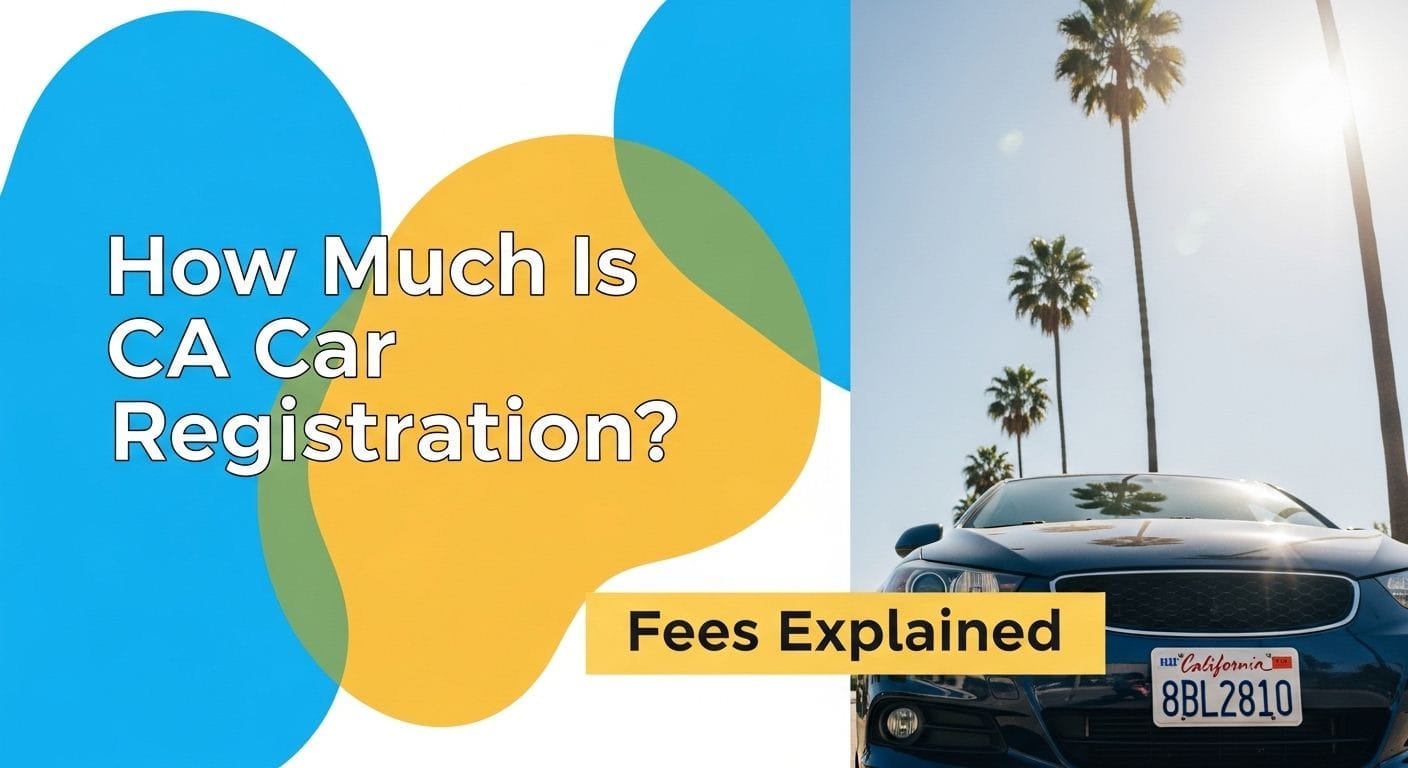
How Much Is Vehicle Registration in California? Fee Breakdown and Costs
Vehicle registration in California typically ranges between $200 and $600 or more per year for standard passenger vehicles. Your exact cost depends heavily on your vehicle’s market value, county of residence, fuel type, and vehicle typ...
Vehicle registration in California typically ranges between $200 and $600 or more per year for standard passenger vehicles. Your exact cost depends heavily on your vehicle’s market value, county of residence, fuel type, and vehicle type. California does not charge a flat rate; instead, it combines a base registration fee with value-based taxes, transportation fees, and local county surcharges.
Contents
Core Components of California Vehicle Registration Fees
Understanding your California Department of Motor Vehicles (DMV) renewal billing requires looking at the itemized charges on your renewal notice or original registration document. California law combines flat administrative costs with percentage-based fees linked to your vehicle's value.
Total Registration Fee = Base Fee + VLF (0.65% x Value) + TIF + Local County Surcharges + Special Vehicle Fees (Smog/ZEV/Weight)
1. Base Vehicle Registration Fee
Every motor vehicle registered in California is subject to a flat base state registration fee. This fee covers basic processing and state administration costs incurred by the California DMV and the California Highway Patrol (CHP). The base registration fee generally stays around $70 to $75, which includes the core registration cost alongside mandatory state regulatory and highway safety fees.
2. Vehicle License Fee (VLF)
The Vehicle License Fee (VLF) accounts for the largest portion of registration costs for newer or higher-value vehicles. Established under the California Revenue and Taxation Code, the VLF is calculated as 0.65% of the vehicle’s purchase price or current market value.
Because the VLF is a property tax assessed on personal property, it depreciates over time according to an 11-year statutory schedule set by state law.
- Year 1 (New Vehicle): 100% of the initial purchase price is taxed at 0.65%.
- Year 2: 90% of the initial purchase price is taxed.
- Year 3: 80% of the initial purchase price is taxed.
- Year 11 and beyond: The vehicle reaches its minimum tax floor (15% of original purchase price).
Because the VLF is legally classified as an ad valorem property tax, taxpayers who itemize deductions on their federal tax returns may be eligible to deduct the VLF portion of their California registration fee.
3. Transportation Improvement Fee (TIF)
Introduced under California Road Repair and Accountability Act (Senate Bill 1), the Transportation Improvement Fee (TIF) provides funding for highway maintenance, transit operations, and road repairs across the state. TIF rates are tiered directly to your vehicle’s current depreciated market value:
- Vehicles valued under $5,000: Approximately $25 – $30
- Vehicles valued $5,000 – $24,999: Approximately $50 – $60
- Vehicles valued $25,000 – $34,999: Approximately $80 – $95
- Vehicles valued $35,000 – $59,999: Approximately $110 – $125
- Vehicles valued $60,000 and above: Approximately $175 – $200+
4. Zero-Emission Vehicle (ZEV) Road Improvement Fee
Because fully electric vehicles do not pay state gas taxes—which traditionally fund California road maintenance—the state imposes an additional Road Improvement Fee on Zero-Emission Vehicles (ZEVs). Applied to all-electric passenger cars and trucks with a model year of 2020 or newer, this annual fee generally ranges from $100 to $120, adjusting annually based on the Consumer Price Index (CPI).
Local Surcharges, Smog Requirements, and Commercial Fees
Beyond state-level assessment, your final vehicle registration total includes regional fees and vehicle-specific requirements.
County District Fees and Air Quality Surcharges
California permits individual counties and local air quality management districts to add surcharges to vehicle registrations within their jurisdictions. These local fees typically add $10 to $35 to your bill and support regional projects such as:
- Local Air Pollution Control District (APCD) emissions initiatives
- Fingerprint identification programs for vehicle theft prevention
- Abandoned vehicle abatement programs
- Emergency call box network maintenance along county corridors
Smog Check and Smog Abatement Fees
Most gasoline-powered vehicles, hybrid vehicles, and diesel vehicles operating in California must comply with state smog inspection regulations:
- Vehicles 8 years old or newer: Exempt from biennial smog inspections. Instead, owners pay an annual $25 Smog Abatement Fee.
- Vehicles older than 8 years: Must undergo a biennial smog check at a certified station. When renewing, owners pay an $8 Smog Transfer/Certification Fee to the DMV in addition to the station's inspection cost.
- Electric vehicles: Fully exempt from both smog checks and smog abatement fees.
Weight Fees for Pickups and Commercial Vehicles
Under California law, pickup trucks—even those used strictly for personal transportation—are categorized as commercial vehicles if they feature an open bed. Consequently, owners must pay a weight fee based on the vehicle’s unladen weight or Gross Vehicle Weight Rating (GVWR). Weight fees range from $24 for light pickups up to several hundred dollars for heavy-duty commercial trucks. Owners can apply for non-commercial "auto" plates only if they permanently install a camper shell or convert the vehicle into a permanently enclosed station wagon configuration.
Comparison of California Registration Scenarios
To help estimate your costs, the table below illustrates fee breakdowns across common vehicle scenarios in California:
| Vehicle Scenario | Base & State Fees | Estimated VLF (0.65%) | TIF & ZEV Fees | Local & Smog Fees | Estimated Total Cost |
|---|---|---|---|---|---|
| New Gas Sedan ($35,000 Value) | ~$75 | ~$227 | ~$115 (TIF) | ~$25 (Smog Abatement) + ~$20 (County) | $462 |
| New Electric SUV ($55,000 Value) | ~$75 | ~$357 | ~$125 (TIF) + ~$108 (ZEV) | ~$0 (No Smog) + ~$20 (County) | $685 |
| 10-Year-Old Sedan ($6,000 Value) | ~$75 | ~$39 | ~$60 (TIF) | ~$8 (Smog Fee) + ~$20 (County) | $202 |
| New Pickup Truck ($45,000 Value) | ~$75 | ~$292 | ~$120 (TIF) | ~$80 (Weight Fee) + ~$45 (County/Smog) | $612 |
| Out-of-State Transfer ($20,000 Value) | ~$75 + ~$27 Title | ~$130 | ~$60 (TIF) | ~$50 (VIN Verification & Local) | $342 |
How to Calculate Your Registration Cost
Because individual costs vary, calculating your exact bill requires checking official state tools or assessing your vehicle’s specific variables.
Using Official California DMV Calculators
The official California DMV Vehicle Fee Calculator allows vehicle owners to calculate exact charges. The DMV provides dedicated online portals for:
- New Vehicle Purchases: Calculates total title, tax, and registration fees when buying from an individual or transferring a title.
- Annual Renewal Estimates: Generates an itemized preview of your upcoming renewal bill using your License Plate Number and Vehicle Identification Number (VIN).
- Out-of-State Vehicle Transfers: Determines upfront conversion fees for vehicles moving into California.
Key Factors Required for an Exact Calculation
To estimate your vehicle registration fee accurately, ensure you have the following information:
- Vehicle Purchase Price / Current Value: Determines your 0.65% VLF rate.
- Original Date of Purchase / Model Year: Determines your position on the 11-year depreciation schedule.
- County of Residence & Zip Code: Determines local air quality and transportation district surcharges.
- Unladen Weight: Necessary if registering a truck, van, or commercial vehicle.
Late Fees and Penalties: What Happens If You Pay Late?
California enforces strict late penalties for missed vehicle registration deadlines. Registration fees are due on or before the expiration date printed on your registration card. If you operate or park a vehicle with expired registration on public streets, law enforcement may issue a citation.
Late penalties apply to both the state registration fee and the Vehicle License Fee, escalating over time:
Late Penalty Scale: - 1 to 10 Days Late: 10% DMV Penalty + $10 CHP Fee - 11 to 30 Days Late: 20% DMV Penalty + $15 CHP Fee - 31 Days to 1 Year: 40% DMV Penalty + $30 CHP Fee - Over 1 Year Late: 80% DMV Penalty + $50 CHP Fee
Penalty Tier Breakdown
- 1 to 10 Days Late: A 10% penalty is added to the uncollected registration fee, plus a 10% penalty on the VLF, along with a flat $10 California Highway Patrol (CHP) late fee.
- 11 to 30 Days Late: The penalty rises to 20% of the registration fee and VLF, plus a $15 CHP late fee.
- 31 Days to 1 Year Late: The penalty jumps to 40% of the registration fee and VLF, plus a $30 CHP late fee.
- More than 1 Year Late: Penalties reach 80% of the base registration fee and VLF, accompanied by a $50 CHP late fee.
Note: Late registration can quickly double your original renewal cost. If you cannot complete a required smog test before your expiration date, pay your registration fees online on time to avoid late financial penalties. The DMV will hold your valid sticker until the smog certification passes.
Exemptions, Discretionary Discounts, and Cost-Saving Steps
While vehicle registration fees are mandatory for most operators, specific exemptions and cost-reduction options exist under California law.
Planned Non-Operation (PNO) Status
If you do not intend to drive, tow, or park your vehicle on any public street or highway during the upcoming registration year, you can file for Planned Non-Operation (PNO) status.
- Filing for PNO status costs approximately $25 to $30, replacing full annual registration fees.
- You must file for PNO status on or before your registration expiration date (or up to 90 days after expiration, subject to late PNO fees).
- Operating a PNO-designated vehicle on a public roadway triggers full registration fees and heavy penalties.
Native American Tribal Exemptions
Under the California Vehicle Code, enrolled members of federally recognized Native American tribes living on tribal land (reservations or rancherias) can apply for a waiver of the Vehicle License Fee (VLF) using DMV Form REG 256A.
Military Fee Exemptions
Non-resident active-duty military personnel stationed in California on military orders can request a waiver of the VLF for their personal vehicles. The service member must remain a legal resident of another state and submit verification from their commanding officer.
Frequently Asked Questions
Why is California vehicle registration higher than in other states?
California charges higher average registration fees because it incorporates an ad valorem property tax (the 0.65% Vehicle License Fee) and dedicated transportation maintenance surcharges (SB 1 TIF) directly into annual registration bills. Many other states collect personal property taxes on vehicles through separate county tax bills rather than bundling them into state motor vehicle registration.
Is the California Vehicle License Fee (VLF) tax-deductible?
Yes, the VLF portion of your registration fee may be tax-deductible if you itemize deductions on your federal income tax return. The flat base registration fee, smog fees, and local county surcharges are not deductible; only the value-based VLF qualifies as an itemized personal property tax. Your DMV renewal notice explicitly breaks out the exact VLF amount for tax accounting purposes.
What happens if I move to California from another state?
New residents must register their out-of-state vehicles with the California DMV within 20 days of establishing residency. You will need to complete an in-person VIN verification (conducted by DMV staff or authorized verifiers), pass a California smog inspection, submit your out-of-state title and registration documents, and pay state transfer fees alongside annual registration costs.
How much does it cost to transfer a car title in California?
Transferring a vehicle title (change of ownership) incurs a basic title transfer fee of approximately $15 to $27. Additionally, the buyer must pay local state sales tax (ranging from 7.25% to 10.25% based on county of residence) on the purchase price, alongside any pro-rated or upcoming registration fees.
How early can I renew my California vehicle registration?
The California DMV mails registration renewal notices approximately 60 days prior to your expiration date. You can pay your registration fees online, by mail, at a DMV self-service kiosk, or in person as soon as you receive your notice.
Recommended Next Steps
If your California registration is due soon:
- Gather your documentation: Locate your Vehicle Identification Number (VIN) and license plate number.
- Check your smog status: Check if your renewal notice requires a smog certificate. If required, visit a licensed California smog check station early.
- Calculate exact fees: Visit the official California DMV Registration Fee Calculator to view an exact itemized statement.
- Pay on time: Pay online or via a DMV kiosk before your deadline to avoid statutory CHP late penalties, even if your smog test is temporarily pending.
Image Gallery