Marine Jobs and ASVAB Scores: A 2026 Career Eligibility Guide
Achieving a specific Marine Corps Military Occupational Specialty (MOS) in 2026 requires meeting minimum Armed Services Vocational Aptitude Battery (ASVAB) score requirements, specifically focusing on your General Technical (GT), Mecha...
Achieving a specific Marine Corps Military Occupational Specialty (MOS) in 2026 requires meeting minimum Armed Services Vocational Aptitude Battery (ASVAB) score requirements, specifically focusing on your General Technical (GT), Mechanical Maintenance (MM), Electronics (EL), and Skilled Technical (ST) composite scores. These scores determine your technical qualification for specific job fields.
Contents
Understanding the ASVAB and Marine Corps Classification
The ASVAB is a standardized test administered by the United States Military Entrance Processing Command (USMEPCOM). It measures your aptitude in four core areas: Arithmetic Reasoning, Word Knowledge, Paragraph Comprehension, and Mathematics Knowledge. In the Marine Corps, these subtests are aggregated into composite scores that serve as the primary gateway for enlistment contracts and job selection.
Your performance on the ASVAB does not just reflect your intelligence; it serves as a predictive metric for how well you will perform in specialized training environments. For the 2026 fiscal year, the Marine Corps maintains rigorous standards for technical fields, particularly in areas like cyber operations, aviation maintenance, and intelligence.
Composite Score Breakdown for Marine Corps MOS
Marine Corps jobs are grouped into occupational fields. To qualify for these fields, you must meet the minimum composite score requirements derived from your ASVAB subtest results. The following table illustrates representative requirements for various technical pathways.
| Occupational Field | Focus Area | Required Composite Score |
|---|---|---|
| Infantry (03xx) | Combat Arms | GT Score: 80 |
| Cyber/Intel (17xx/26xx) | Technical/Signals | GT Score: 110 |
| Aviation Maintenance (6xxx) | Mechanical/Electrical | MM or EL Score: 105 |
| Logistics/Supply (3xxx) | Administrative/Support | GT Score: 90 |
| Motor Transport (35xx) | Mechanical/Technical | MM Score: 95 |
Note: These requirements represent standard minimums for enlistment eligibility. The Marine Corps reserves the right to adjust these thresholds based on current recruitment needs and the quality of the applicant pool in 2026.
How ASVAB Subtests Impact Your Career Options
Your General Technical (GT) score is arguably the most critical metric. It is calculated by combining your Word Knowledge, Paragraph Comprehension, and Arithmetic Reasoning scores. High GT scores open doors to specialized intelligence, linguistic, and officer-pipeline programs.
- General Technical (GT): Heavily influences your eligibility for high-level support, command, and intelligence roles.
- Mechanical Maintenance (MM): Essential for candidates pursuing roles in automotive repair, heavy equipment operation, and vehicle maintenance.
- Electronics (EL): Required for radio repair, ground electronics, and advanced sensor maintenance.
- Skilled Technical (ST): Often used for specialized construction, engineering, and medical-related support fields.
Strategic Planning for Higher Scores
If your initial practice ASVAB scores do not meet the threshold for your desired MOS, you are not permanently barred from those fields. The 2026 recruitment landscape emphasizes preparation.
- Diagnostic Testing: Utilize official Department of Defense practice materials to identify which of the ten subtests are dragging down your composite scores.
- Targeted Study: Spend 70% of your study time on your weakest area. If your Arithmetic Reasoning score is low, focus specifically on algebra and word-problem logic rather than generalized math review.
- Retesting Policy: Speak with your local recruiter regarding the mandatory wait periods for retesting. In 2026, regulations allow for a retest under specific circumstances if you need to boost your score to qualify for a specific contract.
Technical Requirements and Physical Eligibility
While ASVAB scores dictate your intellectual eligibility for a job, physical and security clearances are equally critical. Many jobs with the highest ASVAB requirements, such as those in the 17xx (Cyberspace) or 26xx (Intelligence) fields, also require a Top Secret/Sensitive Compartmented Information (TS/SCI) security clearance.
Security Clearance Prerequisites
Background Investigation: Candidates must demonstrate financial responsibility and lack of significant foreign influence.
Citizenship Status: You must be a United States citizen to qualify for most high-ASVAB MOS fields, as these roles often involve access to classified national security information.
Medical Readiness: Technical aptitude does not bypass physical requirements. Ensure your medical record is disclosed fully to your recruiter, as hidden conditions can lead to disqualification during the MEPS (Military Entrance Processing Station) screening process.
Common Misconceptions Regarding MOS Selection
Many applicants believe that a high score guarantees them their dream job. While a high score provides more options, final placement is based on the "Needs of the Marine Corps."
- The Contract Reality: Most Marines sign for a "PEF" (Program Enlisted For) code rather than a specific 4-digit MOS. You are essentially signing for a field, and your specific MOS within that field is often assigned during your technical school (A-School) training.
- Score Expiration: ASVAB scores are valid for two years. If you delay your enlistment process, ensure your scores remain current to avoid having to retest.
Frequently Asked Questions
What is the minimum ASVAB score required to join the Marine Corps? The official minimum AFQT score to enlist is 31, though the Marine Corps typically seeks higher scores to ensure candidates can successfully navigate the rigorous training pipeline. Achieving a 31 qualifies you for basic service, but it will severely limit your selection of technical MOS fields.
Can I pick my MOS based on my ASVAB scores? You can select a program field based on your scores, but the specific MOS assignment within that field depends on class availability, school performance, and the needs of the service at the time of your training.
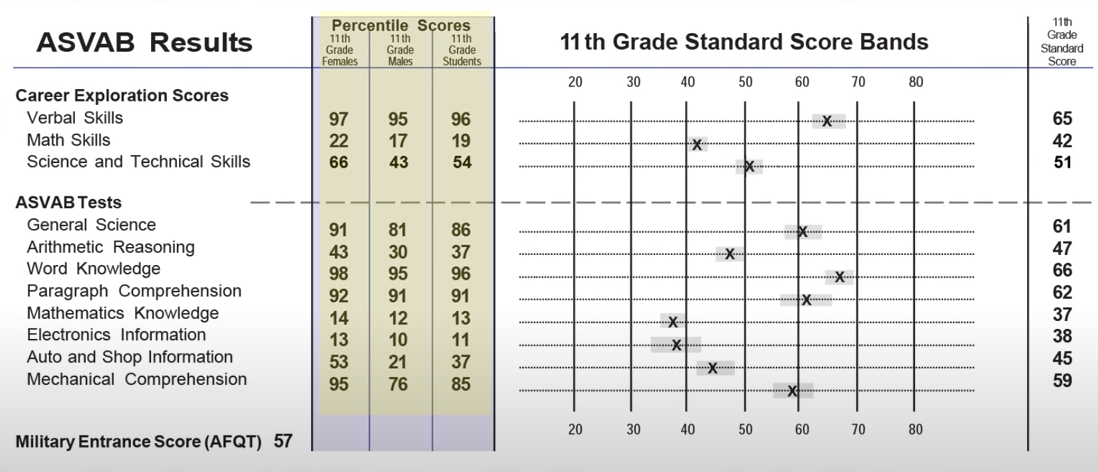
How is the AFQT different from my composite scores? The AFQT (Armed Forces Qualification Test) is a percentile score (1-99) derived from four specific subtests used to determine general enlistment eligibility. Your composite scores (GT, MM, EL, ST) are separate calculations used by individual branches to verify technical aptitude for specific jobs.
Is it possible to receive a waiver for low ASVAB scores? Waivers for ASVAB scores are rare and generally not granted in the same manner as medical or legal waivers. If your score is below the requirement for a specific job, the most effective path is to study and retest to improve your official score.
What should I do if my recruiter suggests an MOS I don't want? Be transparent about your career goals. If your scores qualify you for a higher-technical field, discuss that specifically. If your scores do not qualify you, ask for a clear list of what scores are needed to unlock those career paths.
Next Steps for Your Career
Your path to a successful career as a Marine begins with understanding where you stand academically. Contact a local Marine Corps recruiter to take a formal practice ASVAB (the PiCAT or the full version). Use the feedback from these tests to build a structured study plan. Remember that your score is a reflection of your potential—investing time in your preparation now directly correlates to the quality of the technical training and career opportunities you will have throughout your enlistment.
Image Gallery