Comprehensive Series 7 Content Outline: Master the General Securities Representative Exam
The Series 7 content outline serves as the definitive roadmap for candidates preparing for the General Securities Representative Qualification Examination (GS). As of 2026, the exam remains a "top-off" assessment that focuses heavily o...
The Series 7 content outline serves as the definitive roadmap for candidates preparing for the General Securities Representative Qualification Examination (GS). As of 2026, the exam remains a "top-off" assessment that focuses heavily on investment risk, taxation, equity and debt instruments, packaged products, options, and retirement plans, requiring candidates to demonstrate mastery in making suitable investment recommendations.
Contents
The Series 7 exam, administered by the Financial Industry Regulatory Authority (FINRA), is widely considered the most rigorous entry-level hurdle for professionals in the securities industry. It is designed to ensure that individuals seeking to sell all types of securities products—including corporate stocks, municipal bonds, investment company shares, and variable annuities—possess the requisite knowledge to protect the public interest. Since the restructuring of FINRA exams, the Series 7 has shifted from a broad general knowledge test to a specialized "top-off" exam that assumes a baseline understanding of industry fundamentals.
The Evolution of the Series 7 Exam Structure
In the current 2026 regulatory environment, the Series 7 exam structure is streamlined but intellectually demanding. It consists of 125 scored multiple-choice questions, plus an additional 10 unscored "pretest" questions that are randomly distributed throughout the exam to gather data for future versions. Candidates are allotted three hours and 45 minutes to complete the test.
Unlike the exams of decades past, the modern Series 7 requires the Securities Industry Essentials (SIE) exam as a co-requisite. While a candidate can take the SIE without industry sponsorship, the Series 7 "top-off" requires an individual to be associated with and sponsored by a FINRA-member firm. This two-tier system ensures that while basic industry literacy is accessible to everyone, the authority to provide sophisticated investment advice is reserved for those under the supervision of a regulated entity.
The passing score for the Series 7 is 72%. While this may seem achievable, the depth of the content—particularly regarding complex derivatives and municipal debt—often catches unprepared candidates off guard. The exam is not a test of memorization; it is a test of application, requiring candidates to analyze a customer’s financial profile and apply complex federal securities laws and tax codes to specific scenarios.
Core Content Function 1: Seeks Business for the Broker-Dealer (7%)
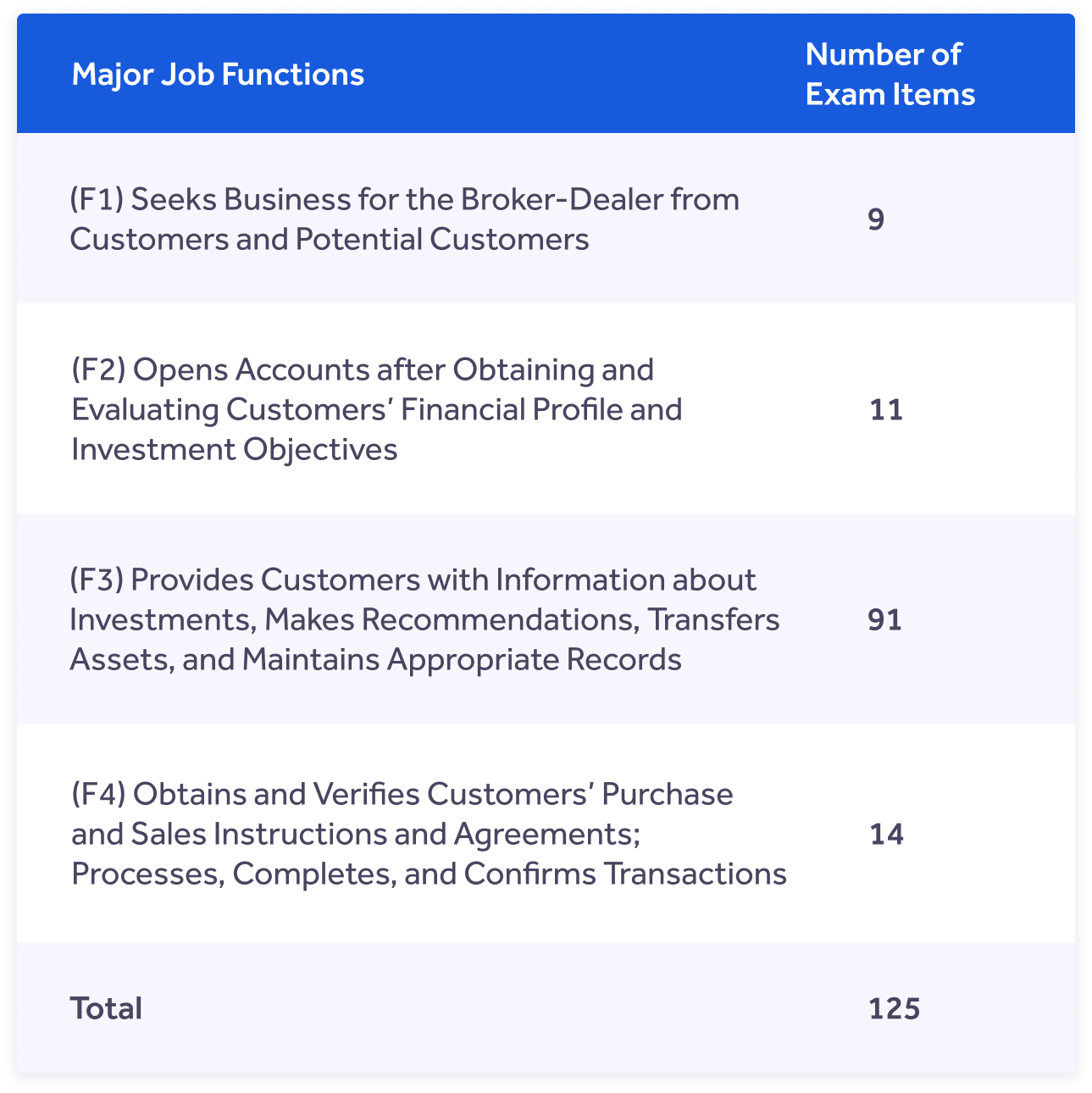
The first section of the Series 7 content outline focuses on the initial stage of the client-advisor relationship: business development. Though it only accounts for approximately 9 questions (7% of the exam), it establishes the legal boundaries for how a representative interacts with the public.
This function covers the rules regarding communications with the public, including the distinctions between retail communications, institutional communications, and correspondence. In 2026, regulatory scrutiny remains high regarding digital communications, social media presence, and "finfluencer" activity. Candidates must understand the filing requirements with FINRA and the internal approval processes required by a firm’s principal.
Furthermore, this section addresses "cold calling" and the Telephone Consumer Protection Act (TCPA). Candidates must be familiar with the National Do-Not-Call Registry and the specific hours during which solicitation is permitted. Mastery of this section ensures that a representative understands how to build a book of business without violating anti-solicitation laws or misleading potential investors through "promissory" language or unsubstantiated claims.
Core Content Function 2: Opening Accounts and Evaluating Profiles (9%)
Function 2, comprising about 11 questions (9% of the exam), transitions from finding clients to onboarding them. This stage is critical for compliance with Anti-Money Laundering (AML) regulations and the Know Your Customer (KYC) rule.
The outline emphasizes the collection of essential data: financial status, tax status, investment objectives, and risk tolerance. Candidates must be able to distinguish between different types of accounts, such as:
- Individual and Joint Accounts: Understanding Rights of Survivorship (JTWROS) vs. Tenants in Common (TIC).
- Corporate and Institutional Accounts: Requiring corporate resolutions and charters.
- Fiduciary and Trust Accounts: Where the legal owner is not the beneficial owner.
- Custodial Accounts: Specifically UGMA and UTMA regulations for minors.
A significant portion of this function is dedicated to Regulation S-P, which governs the privacy of consumer financial information. In an era where data breaches are a constant threat, the Series 7 tests a representative's knowledge of how and when to provide privacy notices and the limitations on sharing non-public personal information with third parties.
Core Content Function 3: Investment Recommendations and Suitability (73%)
Function 3 is the "heart" of the Series 7 exam, accounting for 91 questions (73% of the total). If a candidate fails the exam, it is almost always due to a lack of depth in this specific area. This function covers every major asset class and the critical task of matching those assets to a client's needs.
Equity and Debt Instruments
Candidates must demonstrate an expert-level understanding of common and preferred stocks, including the valuation of preemptive rights and warrants. On the debt side, the exam goes deep into corporate bonds, U.S. Treasuries (T-bills, T-notes, T-bonds), and the complex world of Collateralized Mortgage Obligations (CMOs). Understanding the inverse relationship between interest rates and bond prices is fundamental, as is the ability to calculate current yield, yield to maturity, and yield to call.
Municipal Securities
Municipal bonds are a major pillar of the Series 7. Candidates must understand the differences between General Obligation (GO) bonds, backed by the taxing power of the municipality, and Revenue bonds, backed by specific project earnings. The tax-exempt status of municipal interest at the federal level—and often the state level—makes these products a staple of high-net-worth portfolios, and the exam reflects this importance.
Options and Derivatives
Options strategies represent some of the most technical material on the exam. Candidates must be able to calculate the breakeven point, maximum profit, and maximum loss for:
- Long and Short Calls/Puts
- Protective Puts and Covered Calls
- Spreads (Price and Time spreads)
- Straddles (Buying and selling volatility)
Packaged Products and Retirement Plans
This sub-section covers Mutual Funds, Exchange-Traded Funds (ETFs), Real Estate Investment Trusts (REITs), and Variable Annuities. In 2026, the distinction between active and passive management, as well as the fee structures (A-shares, B-shares, C-shares), remains a high-priority testing area. Additionally, the outline covers the nuances of IRAs, Roth IRAs, 401(k)s, and Keogh plans, particularly regarding contribution limits and Required Minimum Distributions (RMDs).
Core Content Function 4: Processing Transactions and Recordkeeping (11%)
The final function, representing 14 questions (11%), deals with the mechanics of the trade. Once a recommendation is made and accepted, the representative must ensure the trade is executed and settled correctly according to industry standards.
This section covers the different types of orders: Market Orders, Limit Orders, Stop Orders, and Stop-Limit Orders. Candidates must understand "SLoBS over BLiSS" (a common mnemonic for order placement relative to the current market price) and how those orders are adjusted on the ex-dividend date.
Settlement cycles are another critical topic. In accordance with current industry standards, candidates must know that most corporate and municipal trades settle on a T+1 (Trade date plus one business day) basis, while government securities and options settle T+1 as well, following recent regulatory shifts to accelerate the settlement process. This section also explores the role of the Depository Trust & Clearing Corporation (DTCC) and the requirements for trade confirmations and account statements.
Comparison of Series 7 Content Weighting
The following table breaks down the exam's distribution to help candidates prioritize their study hours effectively.
| Exam Function | Primary Focus Area | Number of Questions | Weighting Percentage |
|---|---|---|---|
| Function 1 | Prospecting & Public Communications | 9 | 7% |
| Function 2 | Account Opening & Customer Profiles | 11 | 9% |
| Function 3 | Products, Recommendations & Suitability | 91 | 73% |
| Function 4 | Trade Execution & Recordkeeping | 14 | 11% |
| Total | 125 | 100% |
Regulation Best Interest (Reg BI) and Ethical Standards
A defining characteristic of the 2026 Series 7 exam is the pervasive influence of Regulation Best Interest (Reg BI). This regulation, which elevated the standard of care for broker-dealers beyond the old "suitability" standard, requires representatives to act in the best interest of the retail customer at the time a recommendation is made, without placing the financial or other interest of the firm ahead of the customer.
Candidates are tested on the four component obligations of Reg BI:
- Disclosure Obligation: Providing certain required disclosures before or at the time of the recommendation.
- Care Obligation: Exercising reasonable diligence, care, and skill.
- Conflict of Interest Obligation: Establishing policies to identify and mitigate conflicts.
- Compliance Obligation: Maintaining written policies and procedures to ensure the firm complies with Reg BI.
Ethics and prohibited practices also fall under this umbrella. The exam heavily tests the "shunned" behaviors: churning (excessive trading), front-running, marking the close, backing away, and commingling of funds. Understanding these rules is not just for the exam; it is the foundation of a representative’s legal defense in a highly litigious industry.
Frequently Asked Questions
What is the hardest part of the Series 7 content outline?
Most candidates find Function 3, specifically Options and Municipal Bonds, to be the most difficult. Options require a mathematical mindset and the ability to visualize market movements, while Municipal Bonds involve complex tax rules and unique jargon (e.g., "official statements," "legal opinions," and "muni-to-corporate equivalent yields"). Mastery of these two topics is usually the deciding factor in passing the exam.
Can I take the Series 7 without passing the SIE first?
While you can physically sit for the Series 7 before the SIE if you are sponsored, you will not be fully registered or "Series 7 qualified" until both exams are passed. Most firms require their trainees to pass the SIE first as a prerequisite for their internal Series 7 training programs.
How much time should I dedicate to studying the outline?
For a first-time candidate, 150 to 200 hours of study is the industry recommendation. This typically spans 4 to 8 weeks. Because 73% of the exam is Function 3, candidates should spend at least half of their total study time on investment products and suitability scenarios to ensure they can handle the heavily weighted portion of the test.
Are there math formulas I need to memorize for the Series 7?
Yes. You will need to calculate current yields, dividend payout ratios, price-to-earnings (P/E) ratios, and options breakeven points. You must also understand how to calculate the "parity" price of a convertible bond. However, FINRA provides an on-screen calculator, so the challenge is knowing which formula to apply rather than performing the long-form arithmetic.
What happens if I fail the Series 7 under the current rules?
If you do not pass, you must wait 30 days before your second attempt and another 30 days before your third. If you fail a third time, a mandatory six-month "cooling-off" period applies. This highlights the importance of using the content outline to identify and bridge knowledge gaps during the initial study phase.
Practical Recommendation for Candidates
To successfully navigate the Series 7 content outline, you should adopt a "Function-First" study approach. Begin by securing a deep understanding of the SIE fundamentals, then pivot immediately to Function 3. Do not save options or municipal debt for the end of your study schedule; these are complex topics that require multiple "passes" to achieve fluency.
Utilize practice exams that offer performance tracking by content function. If your scores in Function 3 are below 80%, you are at high risk of failing the actual exam, even if you have perfect scores in Functions 1, 2, and 4. Focus on the logic of suitability—ask yourself why a specific product fits a specific objective (e.g., "Why is a zero-coupon bond suitable for a parent saving for a child's college education in 10 years?"). Mastering the why is the key to conquering the Series 7 in 2026.
Image Gallery