Understanding UI/UIM Property Damage on Auto Insurance
Uninsured/Underinsured Motorist Property Damage (UI/UIM PD) is a specific auto insurance coverage that pays for repairs to your vehicle if it is damaged in an accident where the at-fault driver either has no insurance or carries liabil...
Uninsured/Underinsured Motorist Property Damage (UI/UIM PD) is a specific auto insurance coverage that pays for repairs to your vehicle if it is damaged in an accident where the at-fault driver either has no insurance or carries liability limits that are too low to cover the full cost of your repairs.
Contents
In 2026, as vehicle technology becomes increasingly sophisticated and repair costs continue to climb, understanding this coverage is essential for protecting your financial assets. While liability insurance protects other people from your mistakes, UI/UIM PD is designed to protect you from the financial negligence of others.
The Mechanics of UMPD and UIMPD
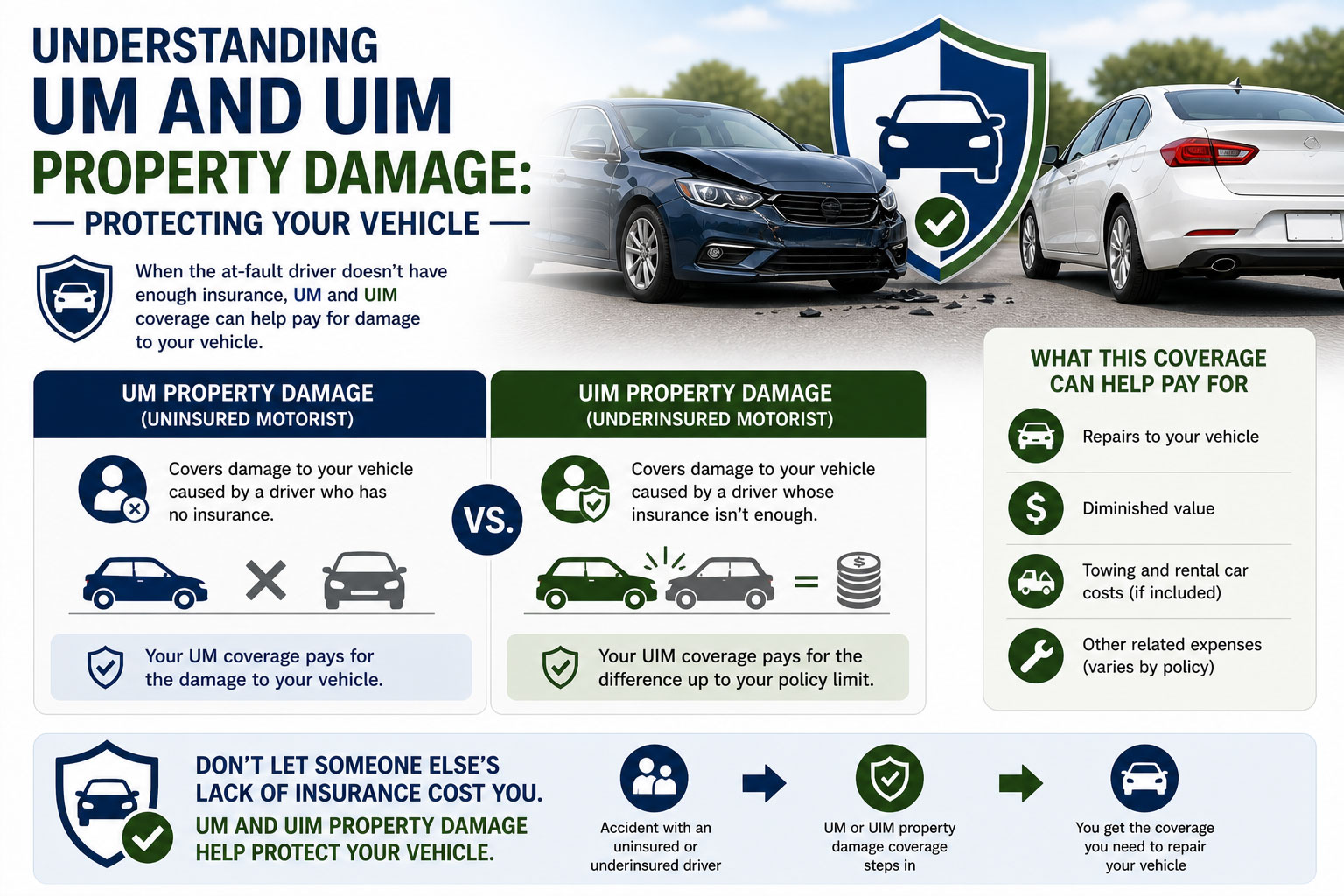
To fully grasp UI/UIM property damage, it is necessary to distinguish between the two components often bundled together: Uninsured Motorist Property Damage (UMPD) and Underinsured Motorist Property Damage (UIMPD). While they serve a similar purpose—compensating you when another party cannot—they trigger under different circumstances.
Uninsured Motorist Property Damage (UMPD)
UMPD applies when you are involved in a collision with a driver who has no active auto insurance policy. Despite mandatory insurance laws in nearly every state, a significant percentage of drivers remain uninsured due to rising premium costs or administrative lapses. UMPD covers the costs to repair or replace your vehicle up to the specific limit you have chosen for this coverage.
In many jurisdictions, UMPD also covers "hit-and-run" incidents where the other driver cannot be identified. However, state laws vary significantly on this; some states require physical contact between the vehicles, while others may require an independent witness to verify that an unidentified third party caused the damage.
Underinsured Motorist Property Damage (UIMPD)
UIMPD is triggered when the at-fault driver has insurance, but their Property Damage Liability (PDL) limits are insufficient to cover the total damage to your vehicle. For example, if a driver carries a state-minimum limit of $10,000 for property damage but causes $25,000 worth of damage to your car, their insurance will pay the first $10,000. Your UIMPD coverage would then kick in to cover the remaining $15,000, up to your own policy limits.
As we move through 2026, this coverage has become more critical because many state-mandated minimum liability limits have not kept pace with the soaring costs of electric vehicle (EV) batteries, advanced driver-assistance systems (ADAS) sensors, and specialized labor rates.
How UI/UIM Property Damage Differs from Collision Coverage
A common point of confusion for policyholders is whether they need UI/UIM PD if they already carry Collision coverage. While both cover damage to your vehicle, they operate differently regarding deductibles, fault, and premiums.
Collision coverage is "no-fault" insurance. It pays for your car’s repairs regardless of who caused the accident. If you back into a pole or hit another car, Collision coverage handles the claim. In contrast, UI/UIM PD is "fault-based." To use this coverage, the other driver must be found legally liable for the accident, and their lack of adequate insurance must be verified.
Key Advantages of UMPD over Collision
- Lower Deductibles: Collision coverage often carries a deductible of $500, $1,000, or more. UMPD frequently features a much lower deductible (often $250) or even a $0 deductible, depending on the state and the provider.
- Premium Impact: In some states, filing a claim under UMPD is viewed more favorably by underwriters than a standard Collision claim because it explicitly establishes that another party was at fault, which may result in less significant premium increases upon renewal.
- Alternative for Older Vehicles: For owners of older vehicles who do not want to pay for full Collision coverage, UMPD can provide a low-cost "safety net" specifically for accidents where they are the victim.
State Variations and Legal Requirements
The availability and requirements for UI/UIM Property Damage are governed by state law, leading to a patchwork of regulations across the country.
- Mandatory States: In states like South Carolina, Maryland, and West Virginia, UMPD is a mandatory part of any auto insurance policy.
- Optional States: In many other states, insurers are required to offer it, but consumers can opt-out in writing.
- Collision Interdependence: In states such as California, you generally cannot purchase UMPD if you already have Collision coverage. Instead, you might purchase "Uninsured Motorist Collision Deductible Waiver" (UCDW), which pays your Collision deductible if an uninsured driver hits you.
- No-Fault States: In "No-Fault" or Personal Injury Protection (PIP) states, the rules for property damage differ from those for bodily injury. Even in these states, the at-fault driver is usually still responsible for vehicle damage, making UMPD relevant.
Comparing Coverage Types: Collision vs. UMPD vs. UIMPD
The following table outlines the functional differences between these three common coverage types as they stand in 2026.
| Feature | Collision Coverage | UMPD | UIMPD |
|---|---|---|---|
| Who is at fault? | Irrelevant (Can be you or them) | Must be the other driver | Must be the other driver |
| Trigger Event | Any collision | Other driver has NO insurance | Other driver has TOO LITTLE insurance |
| Deductible | Usually $500–$1,000+ | Usually $0–$250 | Usually matches UMPD |
| Limit | Actual Cash Value (ACV) | Stated Policy Limit | Stated Policy Limit |
| Hit-and-Run | Covered | Varies by state law | Not applicable (requires identified driver) |
| Cost | High | Low to Moderate | Low to Moderate |
Filing a UI/UIM Property Damage Claim
Filing a claim under these coverages involves a more rigorous verification process than a standard claim. Because the insurance company is essentially stepping into the shoes of the at-fault driver's non-existent insurance, they will require proof of the other party's status.
- Police Report: In almost every scenario involving an uninsured driver, a police report is vital. It serves as the official record of the accident and often includes the officer's determination of fault.
- Identification: You must attempt to get the other driver’s name, contact information, and vehicle details. In the case of UIMPD, you must obtain their insurance policy number and provide evidence that their limits were exhausted.
- Verification of Uninsured Status: Your insurance company will conduct a "coverage search" to confirm the other driver truly lacks insurance. This can sometimes delay the settlement process compared to a Collision claim.
- Damage Assessment: Like any other claim, an adjuster will inspect the vehicle. In 2026, this often involves digital appraisals using AI-assisted photo analysis to expedite the process.
Common Pitfalls and Considerations
When selecting UI/UIM PD limits, many drivers make the mistake of choosing the state minimum. However, in 2026, the average price of a new car exceeds $50,000. If your UIMPD limit is set at $25,000 and your vehicle is totaled by an underinsured driver, you may still face a significant out-of-pocket loss.
Furthermore, be aware of "stacking" rules. In some states, if you have multiple vehicles insured on one policy, you may be able to "stack" the UMPD limits, effectively multiplying your coverage. This is a technical area of insurance law that varies significantly by jurisdiction and should be discussed with a licensed agent.
Frequently Asked Questions
Does UMPD cover my medical bills? No. UMPD specifically covers property damage (your vehicle and sometimes personal property inside it). To cover medical bills resulting from an accident with an uninsured driver, you would need Uninsured Motorist Bodily Injury (UMBI) coverage.
Can I use UMPD for a hit-and-run? This depends entirely on your state. Some states, like Georgia and Washington, allow UMPD claims for hit-and-runs. Others, like Illinois and California, do not allow UMPD for hit-and-runs, requiring you to use Collision coverage instead. Often, there is a requirement that the hit-and-run vehicle must have made physical contact with your car.
Is there a deductible for UIMPD? Yes, usually. However, it is often lower than the deductible for Collision coverage. Some policies are written such that the deductible is waived entirely if the at-fault driver is identified and confirmed to be uninsured.
Why would I pay for UIMPD if I have Collision coverage? The primary reasons are the lower deductible and the potential to avoid a "fault" designation on your claims history. Additionally, if your vehicle's value exceeds your Collision limit or if you want an extra layer of protection for high-value repairs, UIMPD acts as a specialized supplement.
What happens if the damage exceeds my UIMPD limits? If the cost of repairs exceeds both the at-fault driver's liability limits and your own UIMPD limits, you are generally responsible for the difference. You may attempt to sue the at-fault driver personally, but drivers who carry no or low insurance often have few assets to seize, making them "judgment proof."
Practical Recommendation
For most drivers in 2026, the most robust protection strategy is to carry Collision coverage alongside UMPD/UIMPD. This combination ensures that you are protected regardless of who is at fault, while the UI/UIM components provide a mechanism to recover your deductible and ensure full compensation if you are hit by a driver with inadequate limits. Always set your UIMPD limits to match your own Liability limits to ensure consistent protection across all scenarios.
For more information on state-specific insurance requirements, you can consult the National Association of Insurance Commissioners (NAIC) or the Insurance Information Institute (III).
Image Gallery