How to Calculate Saving Interest: A Comprehensive Guide for 2026
Calculating saving interest involves determining the yield on your principal balance over time using either simple or compound interest formulas. While simple interest is calculated only on the initial deposit, most modern accounts use...
Calculating saving interest involves determining the yield on your principal balance over time using either simple or compound interest formulas. While simple interest is calculated only on the initial deposit, most modern accounts use compound interest, where earnings are reinvested to generate additional returns based on the compounding frequency, such as daily or monthly.
Contents
Understanding how to calculate saving interest is a fundamental skill for managing personal wealth and making informed decisions about where to park your cash. In 2026, with the proliferation of high-yield savings accounts (HYSAs) and digital-first banking platforms, the nuances of interest calculation—specifically compounding frequency and Annual Percentage Yield (APY)—have become more critical than ever. Whether you are planning for a short-term goal or long-term capital preservation, knowing the math behind your money ensures you are maximizing your returns.
The Two Primary Methods of Interest Calculation
Interest is essentially the "rent" a financial institution pays you for the privilege of using your deposited funds to issue loans to other customers. There are two distinct ways this rent is calculated: simple and compound.
Simple Interest
Simple interest is the most straightforward method. It is calculated solely on the original principal amount deposited into the account. While simple interest is rarely used for modern savings accounts—which almost exclusively use compounding—it remains a standard in certain short-term loans and specific types of investment certificates.
The formula for simple interest is: I = P × r × t
- I = Total Interest earned
- P = Principal amount (the initial deposit)
- r = Annual interest rate (expressed as a decimal)
- t = Time the money is invested (expressed in years)
For example, if you deposit $10,000 at a simple interest rate of 4% for three years, you would earn $1,200 in interest ($10,000 × 0.04 × 3). At the end of the term, your total balance would be $11,200.
Compound Interest
Compound interest is the standard for the vast majority of savings vehicles in 2026. Unlike simple interest, compound interest is calculated on the principal plus any interest that has already been added to the account. This creates a "snowball effect" where your money grows at an accelerating rate over time.
The formula for compound interest is: A = P(1 + r/n)^(nt)
- A = The future value of the account, including interest
- P = Principal amount
- r = Annual interest rate (decimal)
- n = Number of times interest is compounded per year
- t = Number of years the money is invested
In this equation, the frequency of compounding (n) is the most significant variable under your control. The more frequently interest is compounded, the higher your effective return will be.
The Impact of Compounding Frequency
Compounding frequency refers to how often the bank calculates the interest and adds it back into your balance. In 2026, most competitive HYSAs compound interest daily, though some still use monthly or quarterly schedules.
To illustrate the difference, consider a $20,000 deposit at a 5% annual interest rate over a 5-year period. The table below compares the results across different compounding frequencies:
| Compounding Frequency | Calculation Periods (n) | Final Balance (A) | Total Interest Earned |
|---|---|---|---|
| Annually | 1 | $25,525.63 | $5,525.63 |
| Quarterly | 4 | $25,640.74 | $5,640.74 |
| Monthly | 12 | $25,667.17 | $5,667.17 |
| Daily | 365 | $25,680.12 | $5,680.12 |
As demonstrated, daily compounding results in the highest yield. While the difference between monthly and daily compounding on $20,000 over five years may seem marginal (roughly $13), when scaled to larger balances or longer time horizons, these differences become substantial.
APY vs. APR: Understanding the Difference
When browsing for savings accounts, you will frequently encounter two acronyms: APR (Annual Percentage Rate) and APY (Annual Percentage Yield). For a saver, the APY is the more important figure.
- APR: This is the nominal interest rate. It does not account for the effects of compounding within the year.
- APY: This is the effective rate of return. It reflects the total amount of interest you will earn in one year, taking compounding into account.
Banks are required by the Truth in Savings Act to disclose the APY, as it provides a standardized way for consumers to compare accounts with different compounding frequencies. If two accounts have the same APR but different compounding frequencies, the one that compounds more frequently will have a higher APY.
The APY Calculation Formula
If you know the nominal rate and the compounding frequency, you can calculate the APY yourself to verify a bank's claims: APY = (1 + r/n)^n – 1
Using this formula, if a bank offers a 4.5% interest rate compounded daily, the APY would be approximately 4.60%.
Factors That Influence Your Actual Savings Growth
While the formulas provide a mathematical baseline, several real-world factors will influence the actual amount of money you end up with in your pocket.
1. Recurring Contributions
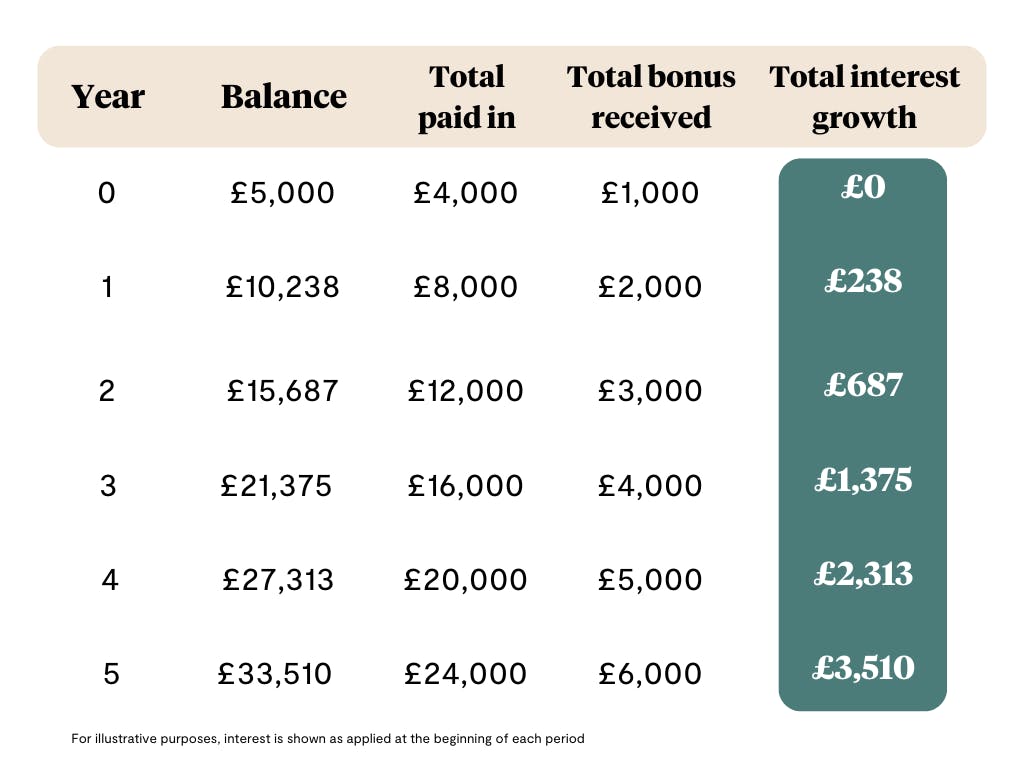
Most savers do not simply deposit a lump sum and leave it. They make "drip" contributions—regular monthly or bi-weekly deposits. Calculating interest with recurring contributions requires a more complex formula known as the "Future Value of an Ordinary Annuity."
When you add money regularly, the interest is calculated on a shifting balance. This is why automated transfers are one of the most effective ways to build wealth; they ensure that the principal ($P$) in your formula is constantly increasing, which in turn increases the interest earned in every subsequent period.
2. Tax Obligations
In many jurisdictions, the interest earned on savings accounts is treated as taxable income. In the United States, for example, banks issue a Form 1099-INT if you earn more than $10 in interest in a year.
To find your "after-tax" yield, you must subtract your marginal tax rate from your earnings. If you earn $1,000 in interest and fall into the 22% tax bracket, you will owe $220 in taxes, leaving you with a net gain of $780. For high-net-worth individuals, this often makes tax-advantaged accounts like Municipal Bonds or specific retirement vehicles more attractive than standard savings accounts.
3. Inflation and the Real Rate of Return
The "nominal" interest rate is what the bank pays you. The "real" interest rate is the nominal rate minus the inflation rate. If your savings account pays 4.5% APY but inflation is running at 3%, your purchasing power is only increasing by 1.5% per year. In 2026, monitoring the Consumer Price Index (CPI) is essential for understanding whether your savings are actually growing in value or just keeping pace with rising costs.
Step-by-Step: How to Manually Calculate Your Interest
If you prefer to verify your bank's statements manually, follow these steps using the compound interest formula:
- Identify your variables: Locate your current balance (P), the annual interest rate as a decimal (r), the compounding frequency (n), and the time period (t).
- Divide the rate by frequency: Calculate r/n. For a 4% rate compounded monthly, this is 0.04 / 12 = 0.00333.
- Add one to the result: (1 + 0.00333) = 1.00333.
- Calculate the exponent: Multiply the frequency by the years (n × t). For one year of monthly compounding, this is 12 × 1 = 12.
- Apply the exponent: Raise your result from Step 3 to the power of the result from Step 4. (1.00333)^12 ≈ 1.04074.
- Multiply by the principal: Multiply this final number by your initial deposit. If you started with $5,000, your new balance is $5,000 × 1.04074 = $5,203.70.
Useful Tools and Short-Cuts
While manual calculation is good for understanding the mechanics, most people in 2026 use digital tools for precision and speed.
- Spreadsheet Functions: In Microsoft Excel or Google Sheets, you can use the FV (Future Value) function. The syntax is
=FV(rate/n, n*t, -payment, -principal). - The Rule of 72: This is a quick mental shortcut to estimate how long it will take for your money to double. Divide 72 by your annual interest rate. At a 6% interest rate, your money will double in approximately 12 years (72 / 6 = 12).
- Online Calculators: Government sites like Investor.gov provided by the SEC offer reliable, ad-free compound interest calculators that allow for recurring monthly additions.
Common Mistakes to Avoid
- Forgetting to Convert Percentages: Always convert the interest rate from a percentage to a decimal (e.g., 5% becomes 0.05) before plugging it into a formula.
- Misidentifying the Time Unit: The variable t must be in years. If you are calculating interest for 6 months, t should be 0.5.
- Ignoring Tiered Interest Rates: Some banks use "tiered" structures where they pay a high rate on the first $10,000 and a lower rate on everything above that. In these cases, you must calculate the interest for each portion of the balance separately.
FAQs
What is the difference between daily and monthly compounding?
Daily compounding calculates interest every day and adds it to the balance, whereas monthly compounding does this once a month. Because daily compounding reinvests your earnings more frequently, it results in a slightly higher total balance over time. Most high-yield accounts in 2026 use daily compounding to offer the most competitive APY.
How do taxes affect my interest earnings?
In the eyes of the IRS and most global tax authorities, interest is considered unearned income. It is typically taxed at your ordinary income tax rate. If you earn significant interest, you may need to make estimated tax payments throughout the year to avoid penalties. Always consult a tax professional or the IRS website for specific guidance.
Can I calculate interest if my rate changes?
Yes, but you must calculate each period separately. If your rate is 4% for the first six months and 5% for the next six, you would calculate the future value of the first six months, then use that total as the "new principal" for the next six months at the higher rate.
Is the APY guaranteed for the whole year?
For standard savings accounts, no. Savings account rates are "variable," meaning the bank can change them at any time based on market conditions or Federal Reserve policy. Only a Certificate of Deposit (CD) typically guarantees a specific interest rate for a fixed term.
Does the principal include my initial deposit only?
In a compound interest formula, the "principal" refers to the starting amount for the specific period being calculated. However, in common usage, the principal is your initial deposit. In a compounding account, your "working principal" grows every time interest is credited.
Practical Recommendation
To maximize your savings in 2026, your first step should be to move funds from a traditional "big bank" savings account (which often pays near-zero interest) to a High-Yield Savings Account (HYSA) that offers daily compounding. Once your account is active, use a compound interest calculator to project your growth over 5, 10, and 20 years. Seeing the long-term impact of compounding often provides the psychological motivation needed to increase your recurring contributions. Finally, always check the APY rather than the nominal rate to ensure you are getting the best possible return on your capital.
Image Gallery