Cornell Graduate Application Guide: 2026 Requirements and Strategic Submission
To successfully navigate the Cornell graduate application process for the 2026-2027 academic cycle, candidates must submit a comprehensive digital dossier through the Cornell Graduate School’s online application portal or specific prof...
To successfully navigate the Cornell graduate application process for the 2026-2027 academic cycle, candidates must submit a comprehensive digital dossier through the Cornell Graduate School’s online application portal or specific professional school systems. Requirements include a baccalaureate degree, academic transcripts, a statement of purpose, and three letters of recommendation. While many programs have moved toward GRE-optional policies for 2026, international students must still demonstrate English proficiency through TOEFL, IELTS, or Duolingo scores.
Contents
Navigating the Cornell Graduate Admissions Landscape in 2026
Cornell University employs a decentralized "Field of Study" system for its graduate programs. Unlike many other institutions where departments hold total control, Cornell’s graduate faculty are organized into fields that often transcend traditional departmental boundaries. This structure allows for significant interdisciplinary flexibility but requires applicants to be highly specific in their application targeting.
In 2026, the application landscape is divided into three primary categories. First is the Graduate School, which oversees most PhD, MA, MS, and professional degrees like the MPS or MFA. Second are the professional schools with independent application systems, including the SC Johnson College of Business, Cornell Law School, and the College of Veterinary Medicine. Third is Cornell Tech in New York City, which utilizes a specialized interface for its technology and entrepreneurship-focused degrees.
Before initiating the application, you must identify your specific "Field of Study." Each field sets its own unique criteria, supplementary requirements, and deadlines. For the 2026 entry term, the Graduate School continues to utilize the Slate application management system, providing a centralized dashboard to track status, recommendation letters, and document uploads.
Core Eligibility and Academic Prerequisites
To be eligible for admission to a graduate program at Cornell in 2026, applicants must hold a bachelor’s degree from an accredited institution or an international equivalent. The admissions committee looks for a strong foundational GPA, typically 3.5 or higher on a 4.0 scale, though Cornell emphasizes a holistic review process that weighs research experience and professional achievements alongside metrics.
Academic Transcript Standards for 2026
Unofficial Submissions For the initial review process, Cornell allows the submission of unofficial digital transcripts. These must be uploaded as PDF files and include the grading scale used by the institution.
Official Verification If an offer of admission is extended and accepted, final official transcripts must be sent directly from the issuing institution’s registrar to the Cornell Graduate School. For international students, these must include the original language documents and a certified English translation if applicable.
Degree Equivalence Cornell follows strict guidelines for international degree equivalency. For example, most three-year bachelor's degrees from Bologna Process-compliant institutions are accepted, while others may require a supplemental WES evaluation.
Strategic Execution of Application Components
The 2026 application requires several distinct narrative documents. Mastery of these components is the difference between a competitive applicant and an admitted student.
The Academic Statement of Purpose (ASOP)
The ASOP is a technical document that should outline your research interests, academic background, and professional goals. For 2026 PhD applicants, this statement must identify specific faculty members whose work aligns with yours. You must demonstrate "fit"—the alignment between your intellectual trajectory and the field’s current resources. Avoid generic praise for Cornell; instead, discuss specific labs, archives, or methodology frameworks available in Ithaca or NYC.
The Personal Statement (Diversity and Inclusion)
Distinct from the ASOP, the Personal Statement is mandatory for many fields in 2026. This essay should focus on your background, your ability to overcome obstacles, and how your unique experiences will contribute to the diversity of perspectives at Cornell. The university remains committed to a diverse graduate community, and this statement is a critical tool for the admissions committee to understand the person behind the grades.
Letters of Recommendation
Cornell requires a minimum of three letters. In 2026, the system is fully digital; you will enter your recommenders' contact information, and they will receive a secure link to upload their assessment. At least two letters should come from faculty members who can attest to your academic rigor and research potential. If you have been in the workforce for several years, one professional letter is acceptable, provided it addresses your analytical capabilities.
Standardized Testing and English Proficiency Standards
As of the 2026 admissions cycle, Cornell University continues to allow individual fields to determine their standardized testing requirements. A significant number of humanities and social science fields have permanently abolished the GRE requirement. However, engineering, physical sciences, and professional programs often still require either the GRE or GMAT.
English Proficiency for International Applicants
International applicants whose native language is not English must provide proof of proficiency. The Cornell Graduate School has strict minimum score requirements for 2026, which are non-negotiable for matriculation.
| Assessment | Minimum Total Score | Minimum Sectional Requirements |
|---|---|---|
| TOEFL iBT | 100 | Writing: 20; Listening: 15; Reading: 20; Speaking: 22 |
| IELTS Academic | 7.0 | Overall Band Score |
| Duolingo English Test | 120 | Total Score |
| TOEFL Essentials | 10 | Overall Band Score |
Exceptions to these testing requirements are only granted if the applicant has earned a degree from an institution in a country where English is the native language (e.g., UK, Australia, Canada, Ireland) or has studied full-time for at least two years in such a country.
Application Portals and Program Categorization 2026
Choosing the correct portal is essential to ensure your data reaches the right committee. Submitting to the wrong portal can result in significant delays or the need to re-pay application fees.
| Program Type | Application Portal | 2026 Application Fee |
|---|---|---|
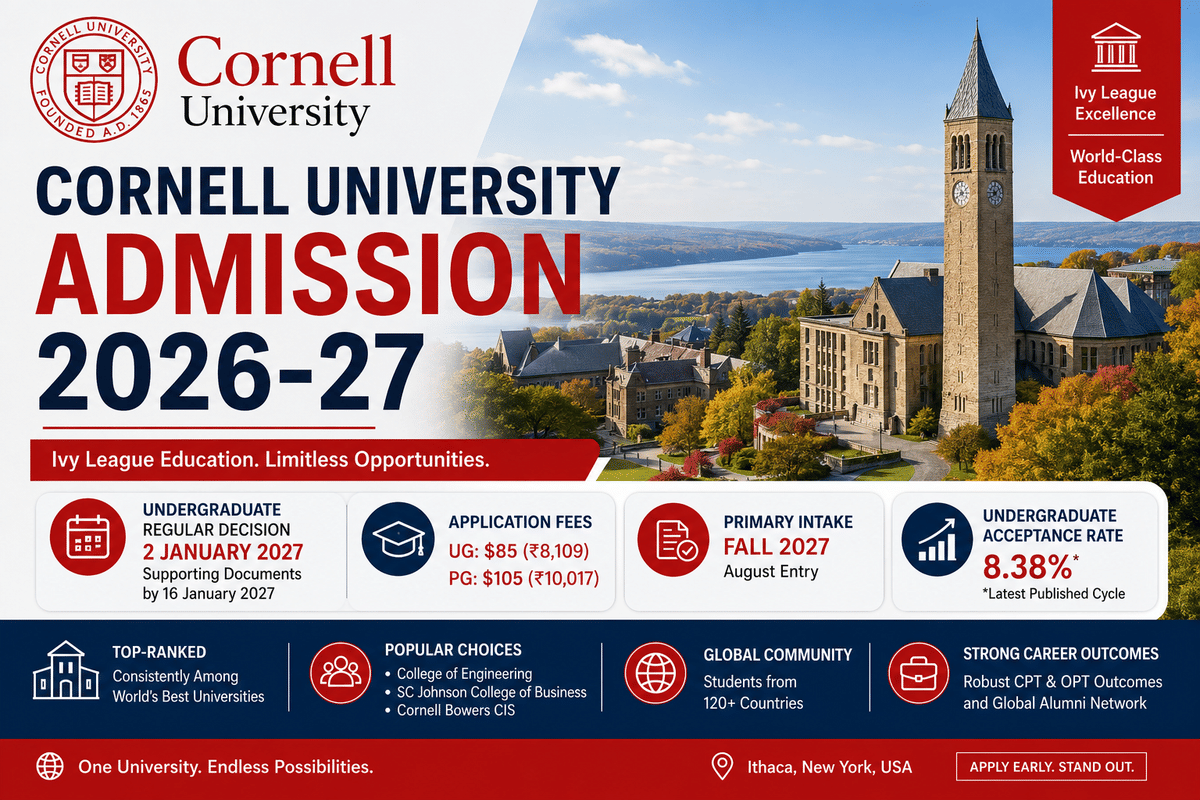
| PhD, MA, MS, MPS, MFA | Cornell Graduate School (Slate) | $105.00 |
| MBA (Two-Year/One-Year) | Johnson School Admissions Portal | $200.00 |
| Juris Doctor (JD) | LSAC (Law School Admission Council) | $85.00 (plus LSAC fees) |
| MD (Medical Degree) | AMCAS (Weill Cornell Medicine) | Varies by AMCAS |
| Cornell Tech (MEng/MBA) | Cornell Tech Specialist Portal | $95.00 |
Timelines and Deadlines for 2026 Entry
For those seeking admission for the Fall 2026 semester, the application window typically opens in September 2025. Deadlines are strictly enforced and vary by field. Missing a deadline usually results in your application being moved to the following year's cycle.
- Priority PhD Deadlines: December 1, 2025 – January 5, 2026. These deadlines are critical for full fellowship consideration.
- Masters (MS/MPS) Deadlines: Generally range from January 15 to March 1, 2026.
- Professional Schools: Often utilize "rounds." Round 1 typically ends in October, Round 2 in January, and Round 3 in March.
- Decision Notifications: Most PhD applicants receive notifications between February and March 2026. Masters applicants typically hear by April.
- Response Deadline: April 15, 2026 (The national Council of Graduate Schools resolution date).
Financial Support and Funding Structures
Cornell provides robust funding for the majority of its PhD students. For the 2026-2027 academic year, a standard PhD funding package includes full tuition coverage, a health insurance subsidy (Cornell Program for Graduate Students), and a living expense stipend.
Types of Graduate Funding at Cornell
Fellowships These are merit-based awards that do not require teaching or research service. They are highly competitive and are often awarded during the initial admission offer.
Graduate Research Assistantships (GRA) GRAs work on specific research projects, usually funded by external grants held by faculty members. The work is typically central to the student's dissertation.
Graduate Teaching Assistantships (TA) TAs assist in the delivery of undergraduate courses. This includes leading discussion sections, grading, and holding office hours.
Professional Degree Financing Most MA, MS, and MPS programs at Cornell are self-funded. Students in these programs typically utilize federal or private loans, though some partial merit scholarships may be available through specific departments.
Common Obstacles and Submission Troubleshooting
Even high-achieving applicants encounter technical or administrative hurdles during the Cornell application process. Addressing these early prevents last-minute submission failure.
- Recommender Email Filters: Often, Cornell’s automated links are flagged as spam. Confirm with your recommenders that they have received the link within 48 hours of you entering their data.
- PDF Formatting Issues: The Slate system can struggle with encrypted or password-protected PDF transcripts. Always "Print to PDF" or flatten files before uploading to remove security layers.
- Application Fee Waivers: Cornell offers waivers for members of specific pipeline programs (e.g., McNair Scholars, Mellon Mays) and those with significant financial hardship. In 2026, waiver requests must be submitted at least one week prior to the application deadline to allow for manual processing.
- Field Selection Errors: Because some fields have similar names (e.g., "Biology" vs. "Biomedical Sciences"), double-check the field code on the Graduate School website before finalizing the application.
FAQ: Cornell Graduate Admissions 2026
Can I apply to more than one graduate program at Cornell? No, Cornell policy generally restricts applicants to one application per year to the Graduate School. You must choose the single field that best aligns with your research goals, though you may indicate interest in related fields within your statement.
Is the GRE required for all Cornell graduate applications in 2026? No, the GRE is now optional or not accepted for a majority of PhD programs at Cornell. However, it remains a requirement for several engineering and business-related masters degrees; check your specific field's requirements page for the 2026-2027 cycle.
What is the minimum GPA required for admission? While Cornell does not set a university-wide minimum GPA, successful applicants typically present a GPA of 3.5 or higher. The admissions committee prioritizes the trend of your grades and your performance in advanced upper-level coursework relevant to your field.
How do I contact a faculty member before applying? Professional etiquette suggests reaching out to faculty in late summer or early fall. Keep your email concise, attach a CV, and clearly articulate how your research interests intersect with their current lab work or publications.
Does Cornell offer an interview as part of the application? Interviews are standard for many PhD fields and professional programs like the MBA. These are typically conducted via Zoom in January or February. For most MA or MS programs, decisions are made solely based on the written application.
Final Strategic Recommendation
The Cornell graduate application for 2026 requires a high degree of technical precision and narrative clarity. Your primary objective is to demonstrate that you possess the specialized skills necessary for advanced research while fitting into the interdisciplinary culture of Cornell’s "Field" system. Begin by finalizing your list of faculty mentors and securing your letters of recommendation at least two months before your earliest deadline. Ensure that every document—from your CV to your Personal Statement—is optimized to show how Cornell’s specific Ithaca or NYC resources are the essential next step in your academic or professional career.
Image Gallery