What Does the Winnie the Pooh Theory Really Say About Mental Health?
The Winnie the Pooh theory suggests that each character in A.A. Milne’s Hundred Acre Wood represents a distinct neurodevelopmental or psychiatric condition, ranging from Generalized Anxiety Disorder to Attention-Deficit/Hyperactivity D...
The Winnie the Pooh theory suggests that each character in A.A. Milne’s Hundred Acre Wood represents a distinct neurodevelopmental or psychiatric condition, ranging from Generalized Anxiety Disorder to Attention-Deficit/Hyperactivity Disorder. Popularized by a 2000 academic paper, the theory serves as an educational framework for recognizing psychological traits, rather than reflecting the author's original literary intent.
Contents
The Origins of the Winnie the Pooh Mental Health Theory
The widespread belief that Winnie the Pooh characters symbolize mental health disorders is not an internet urban legend created out of thin air. Instead, it stems from a seminal paper published in December 2000 in the Canadian Medical Association Journal (CMAJ) titled "Pathology in the Hundred Acre Wood: a neurodevelopmental perspective on A.A. Milne." Authored by pediatrician Dr. Sarah E. Shea and her colleagues, the study examined the behavioral quirks of Milne’s beloved characters through the lens of modern psychiatric diagnostic criteria.
While pop culture often treats this theory as a dark secret embedded within classic children's literature, the original paper was written as a humorous, lighthearted analysis for the journal’s annual holiday issue. The authors used the characters to demonstrate how diagnostic criteria from the Diagnostic and Statistical Manual of Mental Disorders (DSM) could be mapped onto recognizable behavioral patterns.
Over the decades, internet culture stripped away the paper's satirical framing, reinterpreting the study as a definitive psychological blueprint. Understanding what the theory actually says requires separating the clinical definitions used in neurodevelopmental assessments from the popular online interpretations that followed.
Character-by-Character Mental Health Breakdown
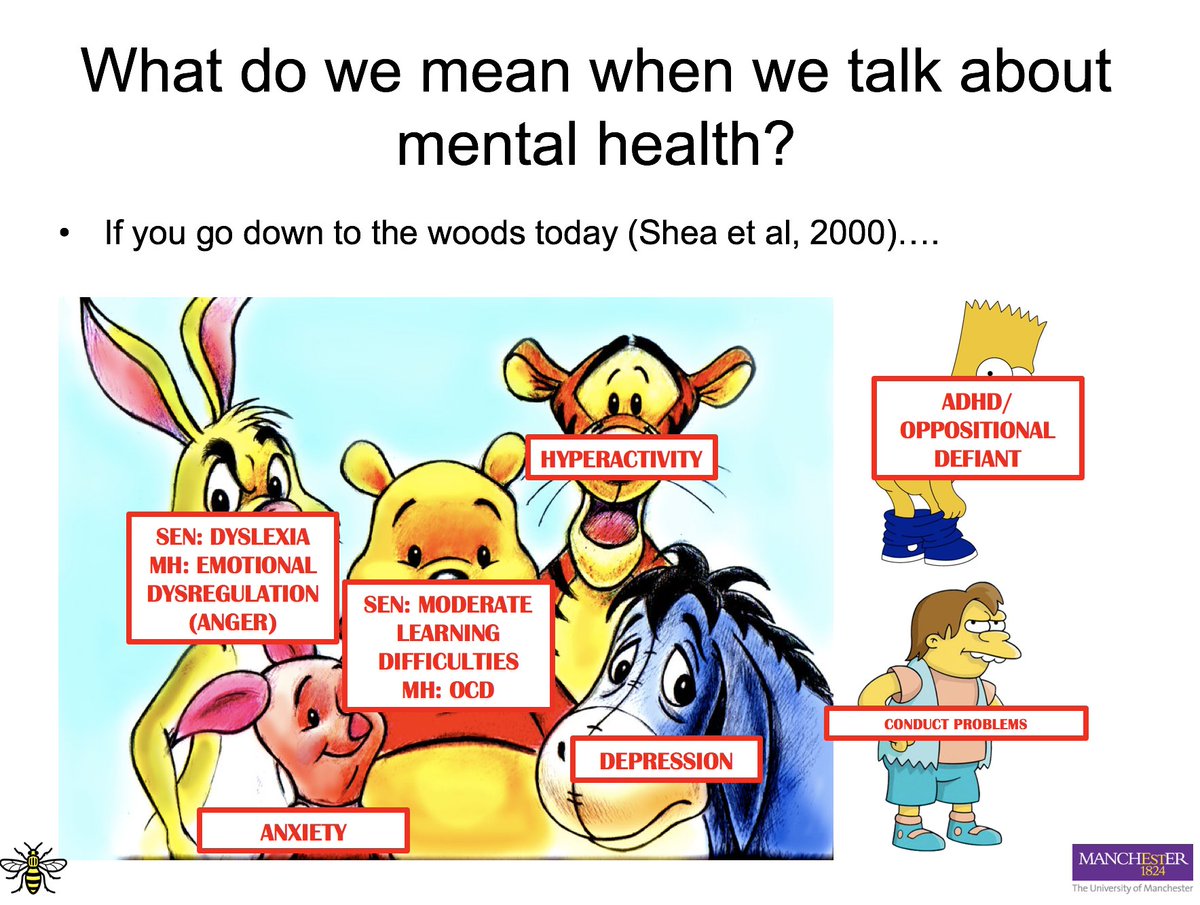
The core of the theory applies modern psychiatric classifications to the distinct personality traits and behavioral patterns displayed by each resident of the Hundred Acre Wood.
Hundred Acre Wood Psychological Map:
- Pooh: ADHD (Inattentive) & Fixated Impulses
- Piglet: Generalized Anxiety Disorder (GAD)
- Tigger: ADHD (Hyperactive-Impulsive)
- Eeyore: Persistent Depressive Disorder (Dysthymia)
- Rabbit: Obsessive-Compulsive Disorder (OCD)
- Owl: Dyslexia & Narcissistic Personality Traits
- Roo: Autism Spectrum & Spatial Unawareness
- Kanga: Social Anxiety & Hyper-Vigilant Caretaking
Winnie the Pooh: Attention-Deficit/Hyperactivity Disorder (Inattentive) and Obsessive Food Fixation
Winnie the Pooh is characterized in the theory as exhibiting Attention-Deficit/Hyperactivity Disorder (ADHD), primarily the inattentive subtype. Pooh frequently displays a short attention span, repetitive wandering, forgetfulness, and cognitive fixation. His classic self-description as a "bear of very little brain" aligns with executive functioning difficulties, such as struggling to follow complex directions or organize thought processes.
Additionally, Pooh demonstrates compulsive behaviors surrounding food, specifically his single-minded obsession with "hunny." He repeatedly puts himself in physical danger—such as climbing tall trees or getting stuck in Rabbit’s doorway—to satisfy immediate cravings, mirroring traits associated with impulse control issues and binge-eating tendencies.
Piglet: Generalized Anxiety Disorder (GAD)
Piglet represents Generalized Anxiety Disorder (GAD). His character is defined by persistent, excessive worry about everyday events and an exaggerated startle response. Piglet frequently exhibits physical symptoms of anxiety, including trembling, stuttering, hiding, and blushing when confronted with minor stressors or unfamiliar situations.
In clinical terms, Piglet lives in a perpetual state of hyper-arousal. He constantly anticipates catastrophe—fearing "heffalumps" or environmental hazards—and requires continuous reassurance from his peers to navigate standard social interactions.
Tigger: ADHD (Hyperactive-Impulsive Type)
While Pooh represents the inattentive presentation of ADHD, Tigger exemplifies ADHD hyperactive-impulsive type. Tigger exhibits extreme physical restlessness, high energy levels, severe impulsivity, and an inability to control his bodily movements. He repeatedly bounces onto others without assessing social boundaries or physical risk.
Tigger frequently engages in dangerous behaviors without considering consequences, such as climbing trees he cannot safely descend. His short attention span and rapid shifts from one activity to another demonstrate classic executive dysfunction related to motor inhibition.
Eeyore: Persistent Depressive Disorder (Dysthymia) or Major Depressive Disorder
Eeyore is the classic representation of Persistent Depressive Disorder (dysthymia) or Major Depressive Disorder. His behavioral traits include a pervasive negative affect, chronic low energy, anhedonia (the inability to experience pleasure), slowness of movement, and an expectation that bad outcomes are inevitable.
Eeyore rarely expresses excitement, frequently comments on his own perceived worthlessness, and maintains a dismal outlook even when surrounded by supportive friends. His chronic sadness is not an acute reaction to a single loss but a baseline psychological state.
Rabbit: Obsessive-Compulsive Disorder (OCD)
Rabbit manifests behaviors consistent with Obsessive-Compulsive Disorder (OCD) alongside obsessive-compulsive personality traits. He requires extreme order, absolute symmetry, and total control over his environment, most clearly visible in his meticulous gardening and rigid daily routines.
When Rabbit’s structure is disrupted—such as when Pooh alters his garden layout or unannounced guests arrive—he exhibits intense irritability, distress, and panic. His compulsions involve constant organizing, counting, and cleaning to ward off environmental chaos.
Owl: Dyslexia and Narcissistic Personality Traits
Owl represents a combination of learning differences and compensatory personality structures. Despite being viewed as the intellectual authority in the Wood, Owl exhibits signs of dyslexia. He regularly misinterprets written words, spells terms incorrectly (such as writing "Tigmatic" or "Wol"), and hides his literacy struggles behind overly complex verbal presentations.
To cover up his academic deficits, Owl uses grandiose language and long-winded stories, exhibiting narcissistic traits to protect his self-esteem and maintain his status as the smartest resident.
Kanga and Roo: Hyper-Vigilance and Autism Spectrum Considerations
Kanga’s behavior reflects high-anxiety caretaking and hyper-vigilance. As a single mother, she displays intense protective behaviors, excessive control over Roo’s movements, and a fixation on safety and sanitation, reflecting secondary anxiety traits.
Roo, on the other hand, exhibits behaviors that some interpreters map to Autism Spectrum Disorder (ASD) or attachment difficulties. He alternates between complete lack of spatial awareness (jumping into dangerous situations without recognizing risk) and intense fixation on remaining inside his mother's pouch or imitating Tigger’s high-energy behaviors.
Christopher Robin: Dissociative Identity Disorder or Imaginative Coping
In extended internet analyses, Christopher Robin is sometimes framed as suffering from Schizophrenia or Dissociative Identity Disorder (DID), with the theory suggesting that all residents of the Hundred Acre Wood are manifestations of his fractured psyche.
However, clinical reviewers and child psychologists emphasize that Christopher Robin’s interactions reflect standard childhood imaginative play, attachment to anthropomorphic toys, and healthy internal monologue development rather than a psychotic break or severe dissociative condition.
Character Analysis vs. Diagnostic Criteria
To clearly evaluate how these fictional behaviors compare to modern medical benchmarks, the following matrix pairs each character with their associated condition and real-world diagnostic context based on the Diagnostic and Statistical Manual of Mental Disorders, Fifth Edition, Text Revision (DSM-5-TR).
| Character | Applied Condition | Key Behavioral Markers | Clinical Context & Assessment |
|---|---|---|---|
| Winnie the Pooh | ADHD (Inattentive Type) & Binge Eating Traits | Impulsivity, short attention, spatial disorientation, compulsive honey consumption | Difficulty sustaining mental effort, ignoring physical risk for reward. |
| Piglet | Generalized Anxiety Disorder (GAD) | Hyper-reactivity, chronic worrying, physical tremors, speech hesitation | Persistent apprehensiveness occurring more days than not about multiple events. |
| Tigger | ADHD (Hyperactive-Impulsive Type) | Motor restlessness, boundary intrusion, risk-seeking bouncing | Inability to engage in quiet activities, intrusive physical behaviors. |
| Eeyore | Dysthymia / Persistent Depressive Disorder | Chronic low mood, flat affect, passive social withdrawal, anhedonia | Depressed mood for most of the day, continuing for extended periods. |
| Rabbit | Obsessive-Compulsive Disorder (OCD) | Rigid routines, compulsion to organize, distress over disorder | Perfectionism that interferes with task completion, excessive control. |
| Owl | Dyslexia & Compensatory Narcissism | Reading/spelling errors, grandiloquent speech, inflation of intellect | Specific learning disorder in reading, paired with protective cognitive defense. |
| Roo | ASD Traits / Attachment Fixation | Unawareness of environmental danger, repetitive hopping, intense fixations | Differences in social-emotional reciprocity and environmental hazards awareness. |
| Kanga | Social Anxiety / Hyper-Vigilant Caretaking | Overprotective hovering, rigid safety enforcement, fear of social exposure | Excessive distress regarding safety and potential threats to dependents. |
Debunking Common Myths: Did A.A. Milne Intend These Allegories?
A common myth across social media claims that author A.A. Milne intentionally created each character to represent a psychological disorder he witnessed in veterans returning from World War I, during which he served as an officer. Historical evidence contradicts this notion completely.
| Myth | Fact |
|---|---|
| Milne designed characters as WWI trauma allegories. | Characters were based on his son's physical stuffed toys. |
| The 2000 CMAJ paper proved characters were clinically sick. | The CMAJ paper was a lighthearted educational satire. |
The Real Inspiration Behind the Stories
A.A. Milne wrote Winnie-the-Pooh (published in 1926) and The House at Pooh Corner (published in 1928) based on the real-life stuffed animals owned by his son, Christopher Robin Milne. The physical characteristics and personalities of Pooh, Piglet, Eeyore, Tigger, and Kanga were direct reflections of how his young son played with his toys in the Ashdown Forest in East Sussex, England.
- Winnie the Pooh was named after a real Canadian black bear named "Winnie" housed at the London Zoo, combined with a swan named "Pooh."
- Eeyore's drooping ears and somber disposition stemmed from the physical wear and tear on Christopher Robin’s stuffed donkey.
- Tigger was introduced later as a physical manifestation of energetic, bouncy animal play.
Milne was a talented humorist and playwright who captured the genuine, unvarnished nature of childhood logic. Children naturally exhibit traits that mirror psychological conditions: they can be hyperactive, fearful, rigid about routines, or prone to mood swings. Milne’s genius lay in capturing these developmental stages without pathologizing them.
Why the Theory Remains Popular in Clinical Psychoeducation
Although the Winnie the Pooh mental health theory was created as satire, it has survived for decades because it serves as an accessible bridge for psychoeducation. Translating complex diagnostic criteria into universally understood literary archetypes helps demystify mental health concepts.
1. Normalizing Mental Health Conversations
Using familiar characters removes the stigma often associated with psychiatric labels. Explaining Generalized Anxiety Disorder through Piglet's experiences allows patients, parents, and students to discuss anxiety without feeling judged or alienated.
2. Demonstrating Community and Acceptance
One of the most important takeaways from the Hundred Acre Wood is how the characters interact despite their behavioral differences. The community does not ostracize Eeyore for his depression, nor do they banish Tigger for his hyperactivity. Instead:
- The group includes Eeyore in activities without forcing him to pretend to be happy.
- Rabbit adjusts his expectations when dealing with Pooh's forgetfulness.
- The characters build a supportive, neurodiverse social structure where everyone is integrated into the group.
This dynamic aligns with modern neurodiversity-affirming care practices, emphasizing social inclusion and environmental adaptation over harsh behavioral correction.
For detailed clinical standards on neurodevelopmental conditions, resources provided by the National Institute of Mental Health (NIMH) offer comprehensive diagnostic guides and evidence-based summaries.
Limitations and Medical Advice Disclaimer
While mapping psychological theories onto fictional characters can be an illuminating educational exercise, it carries distinct clinical limitations that must be respected.
- Fictional Characters Cannot Be Diagnosed: Real psychiatric diagnosis requires comprehensive clinical evaluations, historical context, direct interviews, and standardized assessments conducted by licensed professional clinicians. Fictional characters lack psychological depth, internal continuity, and physiological biology.
- Risk of Over-Simplification: Reducing complex medical conditions like ADHD, OCD, or Major Depressive Disorder to simple character tropes can reinforce harmful stereotypes or reduce real, debilitating conditions to quirky personality traits.
- Developmental Normalcy vs. Pathology: Many behaviors exhibited by Pooh, Tigger, and Piglet are entirely normal aspects of early childhood cognitive development. Applying adult or adolescent diagnostic labels to early developmental stages can lead to mislabeling standard behavior as pathological.
Disclaimer: This article is for educational and informational purposes only and does not constitute medical, psychiatric, or psychological advice. If you or someone you know is struggling with a mental health condition, consult a qualified medical professional or licensed therapist for formal diagnostic evaluation and evidence-based care.
Frequently Asked Questions
Is the Winnie the Pooh mental health theory officially recognized by medical professionals?
No. The theory originated in a satirical holiday paper published in the Canadian Medical Association Journal in 2000. While medical professionals occasionally use it as a lighthearted teaching tool to explain psychiatric terminology, it is not an official medical framework or diagnostic model.
Did A.A. Milne suffer from PTSD when he wrote Winnie the Pooh?
A.A. Milne did serve in World War I and experienced the trauma of military service, which influenced his adult writings and pacifist political views. However, there is no historical evidence that he designed the Hundred Acre Wood characters as allegories for Post-Traumatic Stress Disorder or psychiatric illness. The characters were inspired by his son’s toys.
What mental illness does Eeyore represent in the theory?
In the theory, Eeyore represents Persistent Depressive Disorder (dysthymia) or Major Depressive Disorder. His chronic low energy, pervasive negative outlook, flat vocal tone, and expectation of failure mirror the diagnostic criteria for long-term depressive conditions.
Which character represents Autism Spectrum Disorder?
In pop culture extensions of the theory, Roo is most commonly associated with Autism Spectrum Disorder (ASD) due to his difficulty reading environmental dangers, intense physical fixations, and repetitive behaviors. Some alternative fan theories assign ASD traits to Rabbit or Owl due to their rigid hyper-fixations and communication differences.
Why do people associate Christopher Robin with Schizophrenia?
Some internet theories claim Christopher Robin has Schizophrenia or Dissociative Identity Disorder because he talks to stuffed animals that appear alive in the stories. However, psychologists emphasize that his behavior reflects normal, healthy child imagination and creative play rather than hallucination or psychosis.
Next Steps for Learning More
If exploring the Winnie the Pooh theory has sparked an interest in real-world mental health, neurodiversity, or child psychology, consider taking these practical next steps:
- Explore Authoritative Educational Resources: Read clinical resources published by trusted organizations like the American Psychological Association (APA) to understand how conditions like ADHD, GAD, and OCD are diagnosed in real life.
- Review Neurodiversity-Affirming Literature: Look into modern framework materials from organizations such as the Substance Abuse and Mental Health Services Administration (SAMHSA) for evidence-based information on supporting individuals with neurodevelopmental differences.
- Consult a Professional for Personal Concerns: If you recognize persistent, distressing psychological symptoms in yourself or a loved one, schedule an appointment with a primary care physician, licensed professional counselor, or psychiatrist for a professional evaluation.
Image Gallery