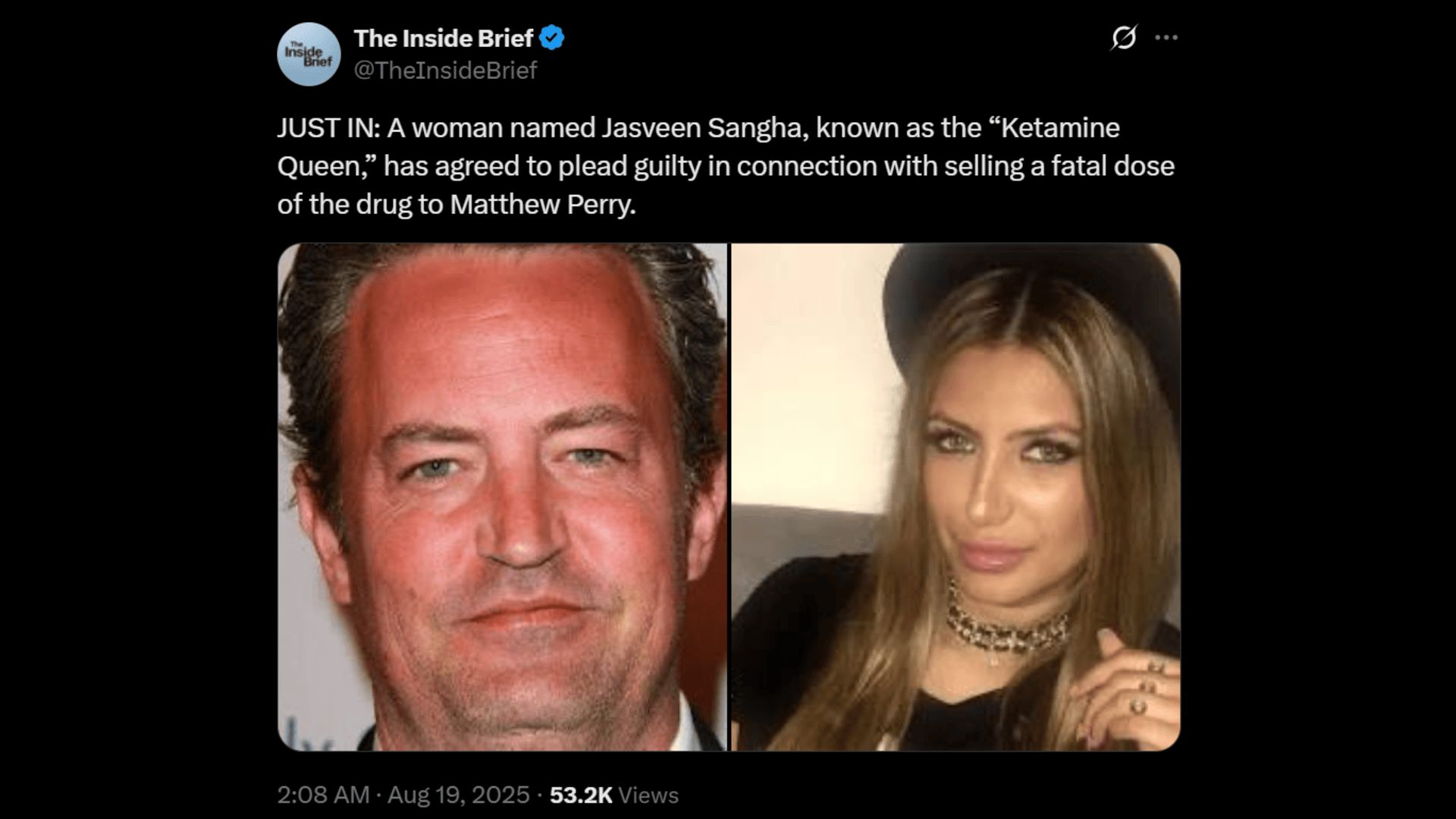
Jasveen Sangha Age, Background, and Federal Case Details
Jasveen Sangha was 41 years old at the time of her federal indictment in August 2024, placing her birth year around 1983. Known publicly in media reports as the "Ketamine Queen," the dual U.S.-U.K. citizen gained widespread internation...
Jasveen Sangha was 41 years old at the time of her federal indictment in August 2024, placing her birth year around 1983. Known publicly in media reports as the "Ketamine Queen," the dual U.S.-U.K. citizen gained widespread international attention following federal criminal charges related to the fatal ketamine overdose of actor Matthew Perry.
Contents
Who Is Jasveen Sangha? Age, Dual Citizenship, and Background
Public interest in Jasveen Sangha's age and background surged following her arrest by federal authorities in August 2024. At 41 years of age when indicted, Sangha maintained a high-profile presence across social media, frequently documenting international travel, luxury lifestyle purchases, and high-end social engagements in Southern California and abroad.
Beyond her public persona, official court filings and investigative reports revealed details regarding her educational and citizenship status:
- Citizenship: Sangha holds dual citizenship in the United States and the United Kingdom.
- Education: According to educational records and public profiles cited in reporting, she attended California State University, Northridge, earning a bachelor’s degree in business administration, and later obtained a Master of Business Administration (MBA) degree from Hult International Business School.
- Residence: Prior to her arrest, she operated primarily out of a residence in North Hollywood, California. Prosecutors later characterized this location in court documents as an active distribution hub for illicit controlled substances.
Federal law enforcement agencies, including the Drug Enforcement Administration (DEA) and the United States Postal Inspection Service (USPIS), began examining Sangha's activities in connection with illegal drug distribution networks operating in the Greater Los Angeles area.
Timeline of the Federal Investigation and Charges
The legal proceedings involving Sangha stem from an extensive multi-agency investigation triggered by the death of actor Matthew Perry in October 2023. The investigation sought to trace the supply chain of the controlled substance ketamine that led to the fatal overdose.
- October 2023: Death of Matthew Perry triggers DEA & LAPD investigation
- May 2024: Federal law enforcement executes search warrants in North Hollywood
- August 2024: Grand Jury unseals indictment charging Sangha and four co-defendants
- Present (2026): Ongoing federal court proceedings in U.S. District Court (Central District of California)
Key Milestones in the Law Enforcement Investigation
- October 28, 2023: Actor Matthew Perry was found unconscious in his hot tub at his Los Angeles home. The County of Los Angeles Department of Medical Examiner later ruled the primary cause of death to be the acute effects of ketamine.
- December 2023 – May 2024: Federal agents from the DEA, alongside local homicide detectives and federal postal inspectors, executed multiple search warrants. The search of Sangha's North Hollywood residence uncovered significant quantities of controlled substances, including over 80 vials of liquid ketamine, thousands of prescription pills, methamphetamine, and packaging materials.
- August 15, 2024: The U.S. Attorney's Office for the Central District of California unsealed a 18-count superseding indictment charging five individuals, identifying Sangha as a primary supplier of the fatal doses.
Summary of Charges and Statutory Legal Exposure
Federal prosecutors filed multiple felony charges against Jasveen Sangha in the U.S. District Court for the Central District of California. Due to the severity of the allegations and the inclusion of charges specifying death resulting from drug distribution, the statutory penalties associated with the indictment carry severe federal mandatory minimums.
Legal Disclaimer: Under U.S. federal criminal law, an indictment represents allegations made by a grand jury. All defendants, including Jasveen Sangha, are presumed innocent unless and until proven guilty beyond a reasonable doubt in a court of law.
| Charge Count | Alleged Offense | Federal Statutory Penalty | Alleged Role / Context |
|---|---|---|---|
| Count 1 | Conspiracy to Distribute Ketamine | Up to 20 years imprisonment | Coordinating illegal distribution network in Los Angeles |
| Count 2 | Distribution of Ketamine Resulting in Death | Mandatory 20-year minimum; up to Life Imprisonment | Supplying doses linked directly to the October 2023 fatal overdose |
| Count 3 | Maintaining a Drug-Involved Premises | Up to 20 years imprisonment | Utilizing North Hollywood residence for storage and sale |
| Counts 4–7 | Possession with Intent to Distribute Ketamine | Up to 20 years per count | Seizure of liquid ketamine vials during federal search warrants |
| Count 8 | Possession with Intent to Distribute Methamphetamine | Mandatory 5- to 40-year term | Commercial quantities of methamphetamine found on premises |
Statutory Mandatory Minimums and Sentences
The most severe charge facing Sangha is the distribution of a controlled substance resulting in death. Under 21 U.S.C. § 841(b)(1)(C), if a defendant is convicted of distributing a Schedule I or II controlled substance (or controlled substance analogue) and death or serious bodily injury results from the use of such substance, the statutory sentencing range imposes a mandatory minimum term of 20 years in federal prison, with maximum potential penalties extending to life imprisonment.
Furthermore, federal bail hearings resulted in detention orders due to risk-of-flight determinations. Prosecutors argued that Sangha’s dual citizenship, access to foreign accounts, and extensive international travel history presented a substantial risk of flight if released on bond.
Co-Defendants and Case Prosecution Dynamics
The federal prosecution strategy against the distribution chain involved five distinct individuals, each alleged to have played specific roles in acquiring, brokering, or administering the prescription medication outside legal channels.
Overview of Co-Defendants Charged in the Indictment
- Dr. Salvador Plasencia ("Dr. P"): A licensed physician charged with conspiracy to distribute ketamine. Alleged to have procured ketamine from wholesale channels and distributed it outside the legitimate scope of medical practice.
- Dr. Mark Chavez: A San Diego physician who entered a plea agreement with federal prosecutors, admitting to conspiracy to distribute ketamine by illegally sourcing the medication via fraudulent prescriptions.
- Kenneth Iwamasa: The personal live-in assistant to Matthew Perry, who pleaded guilty to conspiracy to distribute ketamine causing death, admitting to procuring and repeatedly administering the drug without medical supervision.
- Erik Fleming: An acquaintance who acted as a broker between Sangha and Iwamasa, pleading guilty to conspiracy to distribute ketamine resulting in death.
While multiple co-defendants entered guilty pleas and agreed to cooperate with federal law enforcement, Sangha and Plasencia initially entered pleas of not guilty, leading to complex pretrial litigation, evidentiary hearings, and motions regarding physical evidence seized under search warrants.
Regulatory and Law Enforcement Implications for Ketamine Distribution
The high-profile prosecution of Jasveen Sangha highlights growing scrutiny by federal regulatory bodies—including the U.S. Drug Enforcement Administration and the U.S. Food and Drug Administration—over the off-label administration and illegal diversion of ketamine.
Controlled Substance Classification and Enforcement
Ketamine is classified under Schedule III of the Controlled Substances Act (21 U.S.C. § 812). While it has legitimate medical uses as an anesthetic and, in specific controlled formulations (such as esketamine), for treatment-resistant depression, non-prescribed distribution remains illegal under federal law.
- Legitimate Medical Supply Chain:
- Pharmaceutical Manufacturer
- Licensed Pharmacy
- Supervised Medical Clinic
- Illicit Diversion Chain Alleged in Indictment:
- Illegal Sourcing / Storage
- Brokers / Intermediaries
- Unsupervised Administration
Federal law enforcement agencies have expanded operations targeting:
- Unlicensed Distribution Hubs: Residential premises used to store and distribute bulk pharmaceuticals without state or federal licensing.
- Postal and Courier Trafficking: Sourcing controlled substances through domestic and international shipping channels.
- Prescribing Practices: Physicians providing controlled pharmaceuticals outside the established doctor-patient relationship or for non-medical financial gain.
Frequently Asked Questions
What is Jasveen Sangha's age?
Jasveen Sangha was 41 years old when she was indicted by a federal grand jury in August 2024, placing her birth year around 1983.
What are the main charges filed against Jasveen Sangha?
Sangha was charged in an 18-count superseding federal indictment with offenses including conspiracy to distribute ketamine, distribution of ketamine resulting in death, maintaining a drug-involved premises, and possession with intent to distribute ketamine and methamphetamine.
Why is Jasveen Sangha referred to as the "Ketamine Queen"?
Federal law enforcement officials and court documents used the moniker "Ketamine Queen of North Hollywood" to describe her alleged role as a primary high-volume supplier of illicit ketamine operating out of a residential property in Los Angeles.
What potential prison sentence does Jasveen Sangha face if convicted?
The charge of distribution of ketamine resulting in death carries a statutory mandatory minimum sentence of 20 years in federal prison and a maximum potential penalty of life imprisonment.
What is Jasveen Sangha's citizenship status?
Court documents establish that Jasveen Sangha holds dual citizenship in both the United States and the United Kingdom, a factor that influenced judicial decisions regarding pre-trial detention and flight risk.
Following Federal Court Case Progress
To track formal filings, scheduling orders, and official rulings regarding federal court proceedings in the Central District of California:
- PACER (Public Access to Court Electronic Records): Public court filings for United States v. Sangha et al. can be accessed through the federal PACER system using the Central District of California court docket.
- Department of Justice Press Releases: Official announcements regarding plea agreements, trial dates, and verdict results are published by the U.S. Attorney's Office for the Central District of California.
- Legal Research Databases: Formal legal rulings on suppression motions or statutory interpretations are published via standard legal databases such as Google Scholar Legal Opinions or institutional law libraries.
Image Gallery