E-Filing Iowa: The Complete 2026 Guide for Tax and Legal Submissions
Electronic filing in Iowa encompasses two primary digital systems: the GovConnectIowa portal for state tax obligations and the Iowa Judicial Branch eFile system for legal proceedings. For the 2026 calendar year, taxpayers and legal pro...
Electronic filing in Iowa encompasses two primary digital systems: the GovConnectIowa portal for state tax obligations and the Iowa Judicial Branch eFile system for legal proceedings. For the 2026 calendar year, taxpayers and legal professionals must use these centralized platforms to ensure compliance with updated state regulations, expedite processing times, and maintain secure records of all official transmissions.
Contents
Navigating the landscape of Iowa's digital infrastructure requires a clear understanding of which department handles specific filings. Whether you are a resident filing your 2025 individual income tax return in early 2026, a business owner managing sales tax, or a legal representative submitting court documents, the state has transitioned almost entirely away from paper-based processing. This shift toward "e-filing first" is designed to reduce errors and provide real-time tracking of submissions.
Understanding the Iowa E-Filing Ecosystem in 2026
The state of Iowa utilizes a segmented approach to electronic filing. Unlike some states with a single "everything" portal, Iowa separates fiscal responsibilities from judicial ones. As of 2026, the primary entities involved are the Iowa Department of Revenue (IDR) and the Iowa Judicial Branch.
GovConnectIowa: The Centralized Tax Hub
GovConnectIowa is the official secure portal for Iowa tax filings and business licensing. Launched as part of a multi-year modernization effort, it has now become the standard for virtually all tax-related e-filing. In 2026, this portal serves:
- Individual Income Taxpayers (specifically for making payments and tracking refunds).
- Business owners for Sales, Use, and Withholding taxes.
- Corporations filing Income and Franchise taxes.
- Specialized categories such as Fuel Tax and Cigarette/Tobacco tax.
The Iowa Judicial Branch eFile System (EDMS)
For legal matters, the Electronic Document Management System (EDMS) is the mandatory gateway. Every county in Iowa uses this system for filing court documents in civil, criminal, and probate cases. It is essential for attorneys and self-represented litigants (pro se) to understand the technical requirements of this system to avoid "rejected" filings that can lead to missed legal deadlines.
Individual Income Tax E-Filing in 2026
For the 2026 filing season (covering the 2025 tax year), the Iowa Department of Revenue strongly encourages e-filing for individual income taxes. Statistics from previous years indicate that e-filed returns are processed up to six times faster than paper returns, with refunds typically issued within 10 to 14 business days via direct deposit.
Approved Software and Free File Options
The state does not provide a direct "fill-in-the-blank" web form for individual income tax returns on its own website. Instead, you must use one of two paths:
- Commercial Software: Utilizing IRS-approved providers like TurboTax, H&R Block, or TaxSlayer. These platforms integrate federal and state filing.
- Iowa Free File: If your Adjusted Gross Income (AGI) falls below a specific threshold (generally $79,000 for the 2025 tax year filed in 2026), you may be eligible for free e-filing through the Free File Alliance.
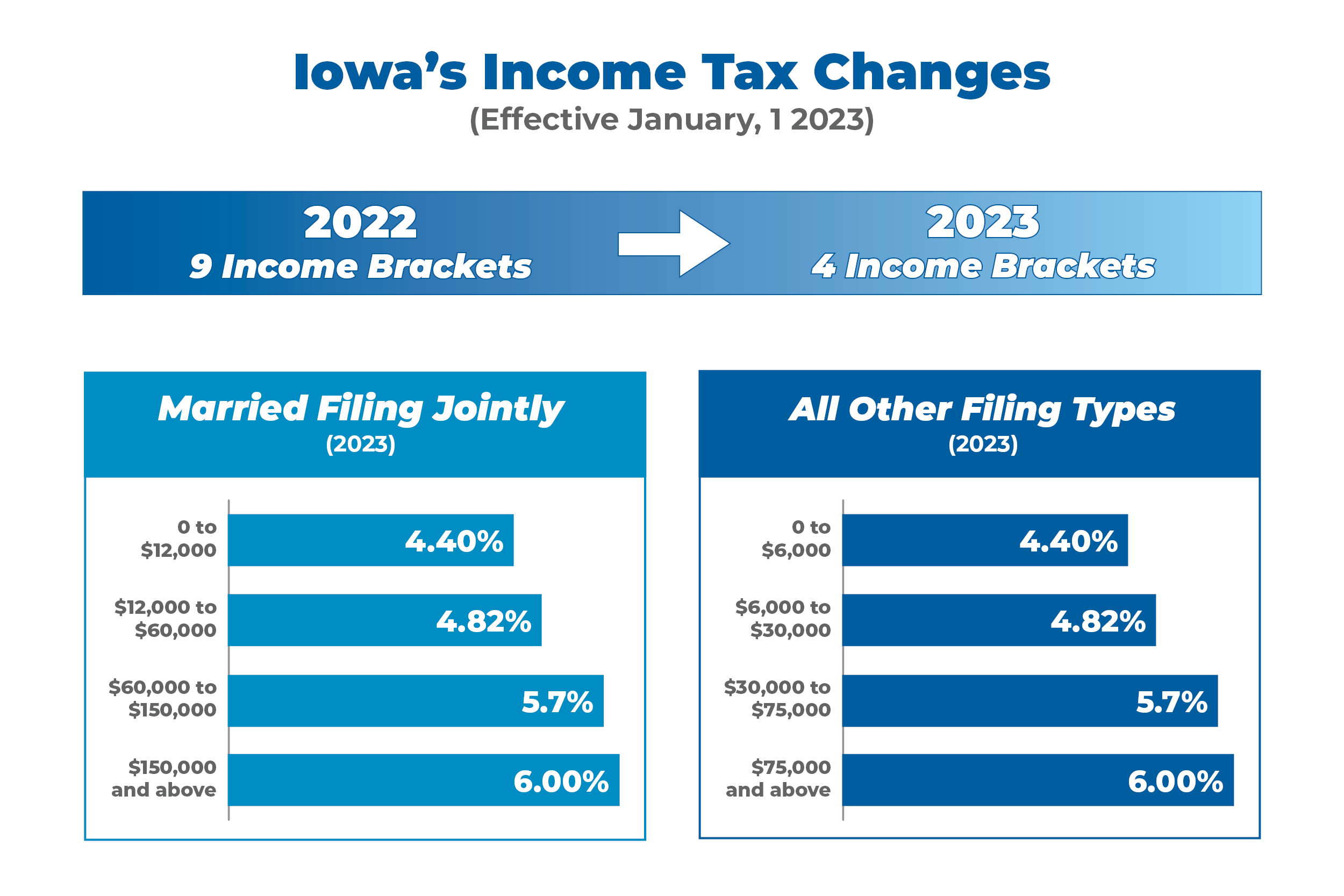
Expert Insight: The 2026 Flat Tax Transition It is important to note that for the 2026 filing year, Iowa continues its transition toward a simplified flat tax structure. Taxpayers should ensure their chosen e-file software is fully updated to reflect the 2025 tax year's rate adjustments. Filing electronically is the most reliable way to ensure the new calculation logic is applied correctly to your return.
Direct Debit and Refund Tracking
Even if you use third-party software to file your return, GovConnectIowa is where you should go to:
- Make a "Quick Pay" payment without creating an account.
- Check the status of your "Where's My Refund?" inquiry.
- Respond to a Department of Revenue "Identity Verification" letter, which has become more common in 2026 to combat fraud.
Business Tax E-Filing Requirements
Iowa law mandates that most business taxes be filed electronically. Failure to e-file can result in penalties, even if the tax is paid on time.
Sales and Use Tax
Businesses operating in Iowa must use GovConnectIowa to file sales and use tax returns. The frequency (monthly, quarterly, or annually) depends on the volume of sales. In 2026, the portal features a streamlined interface that allows for bulk filing for entities with multiple locations.
Withholding Tax
Employers are required to file Iowa withholding tax returns electronically. This includes the annual W-2 and 1099 reporting. The 2026 technical specifications for file uploads (such as EFW2 formats) remain consistent with IRS standards but must be submitted through the GovConnectIowa "Bulk Upload" feature for larger employers.
| Filing Type | System/Portal | Mandatory E-File? | Typical Deadline (2026) |
|---|---|---|---|
| Individual Income Tax | Approved Software / Free File | Highly Recommended | April 30, 2026 |
| Sales & Use Tax | GovConnectIowa | Yes | Last day of the month following the period |
| Corporate Income Tax | Approved Software / MeF | Yes | April 1 (for calendar year filers) |
| Legal/Court Documents | Judicial Branch eFile (EDMS) | Yes | Case Dependent |
| Withholding Tax | GovConnectIowa | Yes | Quarterly/Monthly |
Iowa Judicial Branch eFile System (EDMS) Guide
Legal e-filing in Iowa is governed by Chapter 16 of the Iowa Court Rules. Whether you are filing a small claims suit or a complex civil litigation document, the process follows a strict technical workflow.
Registration and Account Setup
Before filing, users must register for an account on the Iowa Judicial Branch eFile website. You will need a valid email address and, for attorneys, an Iowa Bar number. Pro se filers (individuals representing themselves) must also register but do not need professional credentials.
Document Standards and Formatting
The system has rigid requirements to ensure documents are searchable and archivable:
- Format: Documents must be in PDF format. It is highly recommended to "print to PDF" rather than scanning physical pages to maintain text searchability.
- Security: You must "flatten" PDFs to remove interactive form fields or comments before uploading.
- Redaction: Under Iowa Rule 1.103, filers are responsible for redacting protected information, such as full Social Security numbers, financial account numbers, and the names of minors, unless specifically required.
Filing Fees and Payments
Fees for court filings are paid through the eFile system using a credit card or an electronic check. The system provides an immediate "Notice of Electronic Filing" (NEF) once the document is successfully submitted, which serves as proof of filing for legal deadlines.
Deadlines and Important Dates for 2026
Timeliness is critical for e-filing to avoid interest and late-filing penalties. Iowa has unique deadlines compared to other states, particularly for individual income tax.
- January 1, 2026: E-filing for the 2025 tax year officially opens (aligned with IRS dates).
- March 31, 2026: Deadline for most farmers and fishers to file if they did not pay estimated tax.
- April 30, 2026: The primary deadline for Iowa individual income tax returns. Unlike the federal deadline of April 15, Iowa traditionally uses the last day of April.
- October 31, 2026: The deadline for those who filed for a six-month extension (note that 90% of the tax due must still be paid by April 30).
Procedural Note on Deadlines If a deadline falls on a Saturday, Sunday, or legal holiday, the deadline is extended to the next business day. In 2026, April 30th falls on a Thursday, so the deadline remains unchanged.
Troubleshooting Common E-Filing Issues
Even with a robust system, users may encounter technical hurdles. As a Senior Technical SEO and SME, I recommend the following solutions for common Iowa e-filing errors.
GovConnectIowa Login Failures
The most common issue is related to Two-Factor Authentication (2FA). Ensure that your mobile device is capable of receiving SMS codes or that you have an authentication app synced. If you lose access to your 2FA method, you must contact the Iowa Department of Revenue's technical support line to reset your account identity.
"Pending" vs. "Accepted" Status
After e-filing a tax return, your software might show "Pending." This means the state has received the data but has not yet validated it against their records.
- Pending: The transmission was successful.
- Accepted: The IDR has verified the basic return information.
- Rejected: There is a mismatch (often a Social Security number or a missing form). You must correct and re-file; the original timestamp may not count if not corrected within the "grace period."
EDMS File Size Limits
The Iowa Judicial Branch eFile system has a maximum file size per upload (currently 10MB to 20MB depending on the specific court). If your legal filing includes heavy exhibits or high-resolution images, you must split the filing into multiple "parts" or use PDF optimization tools to reduce the file size without sacrificing legibility.
Comparison: E-Filing vs. Paper Filing in Iowa
| Feature | E-Filing (Recommended) | Paper Filing (Legacy) |
|---|---|---|
| Processing Speed | 10–14 Days | 8–12 Weeks |
| Accuracy | Built-in error checking | High risk of manual calculation errors |
| Confirmation | Instant receipt/timestamp | No confirmation until processed |
| Refund Method | Direct Deposit or Check | Primarily Check |
| Security | Encrypted data transmission | Risk of mail theft or loss |
Steps to Successfully E-File Your Iowa Taxes in 2026
To ensure a seamless experience, follow this technical workflow:
- Gather Documentation: Collect all W-2s, 1099s, and 1095-B forms. In 2026, ensure you have your "Iowa Receipt Number" from your 2024 return if you need to verify your identity on GovConnectIowa.
- Select Software: Choose a provider from the Iowa Department of Revenue's list of approved vendors. If you are a business, log into GovConnectIowa.
- Complete Federal Return First: Most e-file software requires the federal return to be finished before it can map the data to the Iowa 1040.
- Review the Iowa "Add-Backs": Iowa has specific rules regarding the deduction of federal taxes and certain out-of-state income. The software should handle this, but manual review is advised.
- Submit and Save Receipt: Once you click "Submit," wait for the confirmation code. Print or save this as a PDF. Do not assume it went through until you see the confirmation number.
- Monitor GovConnectIowa: Log in 48 hours later to ensure your return status has moved to "Processed."
FAQ: Frequently Asked Questions About Iowa E-Filing
Can I file my Iowa state taxes for free in 2026? Yes, if your income meets the eligibility requirements of the Free File Alliance. Typically, this applies to taxpayers with an AGI of $79,000 or less, though specific vendor limits may vary. You must access these services through the official Iowa Department of Revenue website to ensure the fee is waived.
What is the "GovConnectIowa" ID number? This is a unique account identifier assigned to businesses and individuals who register for a tax account with the state. While individuals often use their SSN for simple filings, the GovConnectIowa ID is required for more complex business tax management and permit renewals.
How do I e-file a document for a small claims case in Iowa? You must register for an account on the Iowa Judicial Branch eFile (EDMS) portal. Once registered, you select the county, choose "Initial Filing," and upload your petition as a PDF. You will be required to pay the filing fee via credit card at the time of submission.
Is e-filing mandatory for all Iowa taxpayers in 2026? While not mandatory for all individual taxpayers (paper forms still exist but are difficult to find), it is mandatory for most businesses and legal professionals. The state reserves the right to impose a "non-electronic filing" penalty for businesses that could have filed digitally.
What happens if I e-filed to the wrong Iowa county in EDMS? The clerk of the court in the incorrect county will likely reject the filing. You will receive an email notification through the EDMS system. You must then re-file in the correct jurisdiction. Note that the original filing date may not be preserved, which could impact statutes of limitations.
How do I change my direct deposit information after e-filing? Once a return is e-filed and accepted, you cannot change the bank account information for that specific refund. If the account is closed, the bank will reject the deposit, and the Iowa Department of Revenue will automatically mail a paper check to the address on file.
Strategic Recommendation for 2026
For the 2026 season, the most efficient strategy for any Iowa resident or professional is to centralize all activity within GovConnectIowa for taxes and EDMS for legal matters. As the state moves toward a flat tax and continues to digitize its archives, maintaining a digital-first approach ensures that you have a verifiable audit trail. Always keep digital copies of your "Submission Confirmation" pages, as these are the only definitive proof of timely filing in the event of a system glitch or department inquiry.
Image Gallery