Choosing a Professional Makeup Mirror with Lights
Selecting a professional makeup mirror with lights involves balancing color temperature accuracy, lumen output, size, power source, and desk versus wall-mounting requirements to achieve flawless application in any lighting environment....
Selecting a professional makeup mirror with lights involves balancing color temperature accuracy, lumen output, size, power source, and desk versus wall-mounting requirements to achieve flawless application in any lighting environment.
Contents
Achieving a precise, color-accurate makeup application requires moving beyond standard household lighting and ambient room illumination. A professional makeup mirror with lights bridges the gap between everyday vanity setups and backstage dressing rooms, offering uniform illumination that eliminates shadows and reveals true skin tones. Whether you are building a professional freelance kit, upgrading a home studio, or simply looking to refine your daily beauty routine, choosing the right lighted mirror requires a careful evaluation of technical specifications, form factors, and ergonomic needs. This guide explores the critical factors that separate standard novelty mirrors from professional-grade tools, helping you make an informed investment.
Understanding Lighting Technology and Color Accuracy
The core value of any professional makeup mirror lies in its lighting system. Poorly designed lights can distort colors, create harsh glare, or cast unwanted shadows across the face. When evaluating mirrors, understanding how light interacts with skin and pigments is essential.
Color Temperature (Kelvin Scale)
Color temperature is measured on the Kelvin (K) scale and dictates how warm or cool the light appears. For makeup application, the goal is to replicate natural daylight so that your finished look translates accurately outdoors or in brightly lit offices.
- Warm Light (2700K – 3000K): Mimics traditional incandescent bulbs or sunset lighting. It tends to highlight yellow and red tones, which can cause over-application of warm foundations or bronzers.
- Neutral/Daylight (4000K – 5000K): The industry standard for professional makeup. This range balances cool and warm spectrums, providing a crisp, clear view of the skin without distortion.
- Cool Light (5500K – 6500K): Mimics overcast daylight or clinical environments. While it highlights fine details and texture clearly, it can sometimes introduce a blue cast that washes out subtle contours.
Many high-end professional mirrors feature adjustable or tri-color settings, allowing users to switch between daylight, office light, and evening light to test how their makeup looks across different environments.
Color Rendering Index (CRI)
While Kelvin measures the color appearance of the light source, the Color Rendering Index (CRI) measures how accurately that light reveals the true colors of objects compared to natural sunlight. A CRI rating ranges from 0 to 100.
For professional makeup application, a CRI of 90 or higher is strongly recommended. Mirrors with low CRI ratings can mask imperfections, misrepresent foundation undertones, and lead to mismatched color blending. High-CRI LED lights ensure that reds look truly red, blues look truly blue, and undertones are clearly distinguished.
Lumens and Brightness Control
Lumens measure the total amount of visible light emitted by a source. In a makeup mirror, you want sufficient brightness to illuminate the face fully, but excessive glare can cause eye strain. Look for mirrors offering adjustable brightness (dimming controls) via touch sensors or rotary dials. Dimmable functionality ensures you can dial in the exact intensity needed for detailed eyeliner work or broad-stroke contouring.
Evaluating Mirror Construction, Size, and Form Factor
Beyond the lights themselves, the physical design of the mirror dictates how and where it can be used. Professional settings range from fixed stationary vanities to highly mobile freelance setups.
Mirror Size and Shape
The dimensions of the mirror should correspond to your workspace and the scope of your makeup application.
- Compact & Tabletop Tri-Fold Mirrors: Excellent for personal vanities or travel. Tri-fold designs often feature side panels with different magnification levels, offering side angles that are difficult to see with a flat panel.
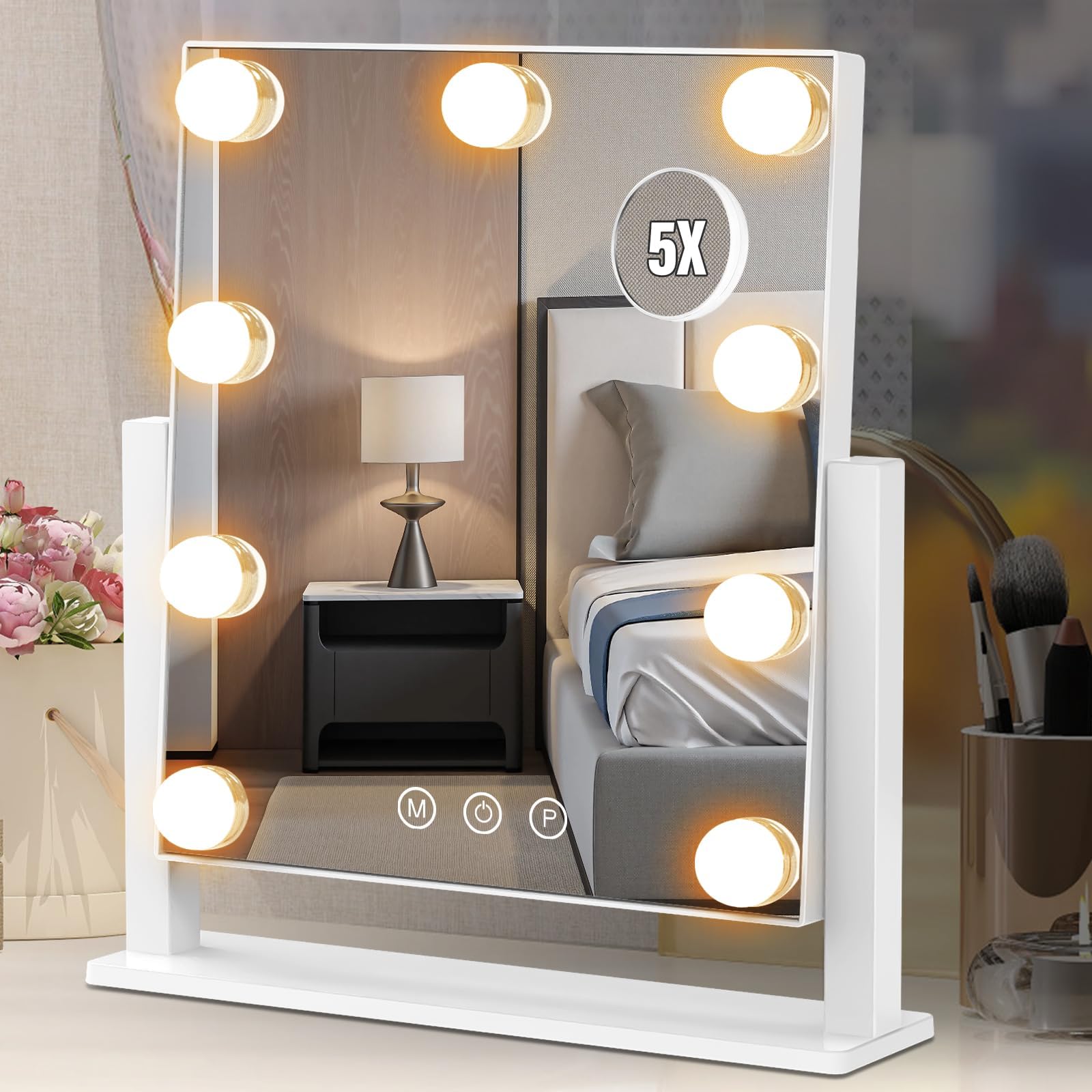
- Large Hollywood-Style Rectangular Mirrors: Featuring a perimeter of exposed bulb sockets or integrated LED strips, these large formats provide a comprehensive view of the entire upper body, ensuring balance in hair and makeup styling.
Magnification Options
Most professional mirrors combine a standard 1x true-image mirror with a magnified inset or a double-sided rotating design.
| Magnification Level | Best Used For | Potential Drawbacks |
|---|---|---|
| 1x (True Image) | Overall face balance, foundation blending, color matching, and full-face visibility. | Does not reveal fine hairs or micro-details. |
| 5x Magnification | Detailed eye makeup, winged eyeliner, eyebrow shaping, and precise lip lining. | Offers a limited focal distance; requires leaning in closely. |
| 10x Magnification | Precise tweezing, blemish extraction, and intricate lash placement. | Distorts the rest of the face; can induce dizziness if viewed for too long. |
When selecting magnification, consider your visual acuity and the specific tasks you perform most frequently. A 5x magnification panel strikes a versatile balance for most detailed beauty tasks.
Power Sources and Portability Considerations
How a mirror draws power impacts its longevity, brightness stability, and suitability for travel.
- AC Plug-In (Wired): Provides consistent, maximum voltage to the LEDs without dimming over time. Ideal for stationary studio setups, vanities, and permanent salon stations.
- Rechargeable Battery-Powered: Uses internal lithium-ion batteries charged via USB. These offer cordless versatility, reducing clutter on a vanity and allowing the mirror to be moved easily to a window with natural light. However, brightness may decrease as the battery depletes.
- Disposable Batteries (AA/AAA): Common in smaller travel mirrors. While convenient for occasional trips, they are generally less powerful and less cost-effective over the lifespan of the mirror compared to rechargeable or plug-in models.
Ergonomics, Adjustability, and Build Quality
A professional mirror must withstand daily use and adjust to the user's posture. Look for sturdy frames constructed from metal, high-grade ABS plastic, or wood. Flimsy plastic hinges or unstable bases can cause the mirror to tilt or slip during use.
Tilt mechanisms are another crucial consideration. A 360-degree rotation or a multi-angle tilt axis ensures you can adjust the mirror surface to accommodate sitting at various heights or standing. Furthermore, consider the integration of smart features, such as memory function (which remembers your last-used brightness setting) and auto-shutoff timers to preserve battery life.
Common Mistakes to Avoid When Buying
Purchasing a lighted makeup mirror can be overwhelming due to the sheer volume of options on the market. Avoiding common pitfalls ensures your investment delivers long-term value.
- Prioritizing Aesthetics Over CRI: A mirror may look sleek and modern, but if it uses low-CRI blue-toned LEDs, your makeup will look drastically different once you step outside. Always check the lighting specifications before design.
- Overlooking Size Constraints: Buying a massive Hollywood vanity mirror for a small desk or failing to check clearance heights can render the product unusable in your space. Measure your area carefully before purchasing.
- Ignoring Bulb Replacement Options: Integrated LED strips offer a clean, modern look and last for tens of thousands of hours, but if they fail, the entire unit often must be replaced. Traditional Hollywood bulbs can be replaced individually, offering greater long-term reparability.
Summary Checklist for Buyers
Before finalizing your purchase, run through this quick verification list to ensure the mirror meets professional standards:
- Does the light source offer a CRI of 90+?
- Can the color temperature be adjusted or does it strictly mimic natural daylight (around 4000K-5000K)?
- Is the brightness adjustable via a reliable dimmer switch?
- Does the form factor (tabletop, wall-mounted, or travel) match your primary workspace?
- Is the warranty or return policy robust enough to cover potential electrical defects?
By prioritizing technical lighting accuracy over superficial design elements, you can select a professional makeup mirror that elevates your application precision and stands up to daily use.
Image Gallery