Effective IT Problem Management: Strategies for Reducing Downtime and Root Cause Resolution
IT problem management is a systematic process within IT Service Management (ITSM) focused on identifying, managing, and resolving the underlying causes of incidents. Its primary objective is to prevent recurring disruptions and minimiz...
IT problem management is a systematic process within IT Service Management (ITSM) focused on identifying, managing, and resolving the underlying causes of incidents. Its primary objective is to prevent recurring disruptions and minimize the impact of incidents that cannot be prevented, ultimately enhancing service reliability and operational efficiency across the enterprise.
Contents
Understanding the Role of Problem Management in 2026
As of 2026, the complexity of enterprise IT environments—characterized by distributed cloud architectures, serverless computing, and interconnected microservices—has made robust problem management more critical than ever. While many organizations focus heavily on incident management to restore services quickly, problem management operates on a different timeline and with a different goal. It is not about "putting out the fire" (the incident); it is about "finding the arsonist" or the structural flaw that allowed the fire to start (the problem).
Under the ITIL 4 framework, problem management is categorized as a service management practice. It bridges the gap between reactive firefighting and proactive infrastructure optimization. In a modern high-velocity environment, this practice ensures that technical debt does not accumulate to a point where it stifles innovation or compromises Service Level Agreements (SLAs).
Problem Management vs. Incident Management
A common point of confusion for many IT professionals is the distinction between an incident and a problem. An incident is an unplanned interruption to a service or a reduction in the quality of a service. The goal of incident management is to restore normal service operation as quickly as possible, often using a temporary workaround.
A problem is a cause, or potential cause, of one or more incidents. Problem management seeks to understand the root cause so that the incident never happens again. For example, if a server crashes because its disk is full, "clearing the logs" is the incident management response (a workaround). "Investigating why the log rotation script failed" is the problem management response (the permanent fix).
The Problem Management Lifecycle
To be effective, problem management must follow a structured lifecycle. This ensures that no issue is overlooked and that resources are allocated to the most impactful issues.
1. Problem Identification
Problems are identified through various channels. Reactive identification occurs when an incident or a series of incidents suggest an underlying issue. Proactive identification involves analyzing trends in incident records, system logs, and performance data to find vulnerabilities before they result in a service outage. In 2026, AIOps (Artificial Intelligence for IT Operations) tools are standard in this phase, using pattern recognition to flag anomalies that human operators might miss.
2. Problem Control
Once a problem is identified, it enters the control phase. This involves prioritizing the problem based on its impact and urgency. A critical bug affecting a payment gateway takes precedence over a minor UI glitch in an internal HR portal.
During this phase, the IT team conducts Root Cause Analysis (RCA). The goal is to move from the symptoms of the failure to the actual origin. This phase concludes when the root cause is identified and documented. If a permanent fix is not immediately available, the team must develop and document a workaround to be used by the Service Desk.
3. Error Control
Error control manages Known Errors—problems where the root cause is understood but a permanent resolution has not yet been implemented. This phase involves a constant reassessment of the status of these errors. The team must decide whether the cost of a permanent fix (e.g., a major code refactor or expensive hardware replacement) outweighs the impact of the error. If a fix is approved, it is typically coordinated through the Change Management process to ensure that the solution itself does not cause new incidents.
Essential Root Cause Analysis (RCA) Methodologies
Determining the "why" behind a failure requires more than just technical intuition; it requires structured methodologies. Effective problem management teams use a variety of tools to dissect complex issues.
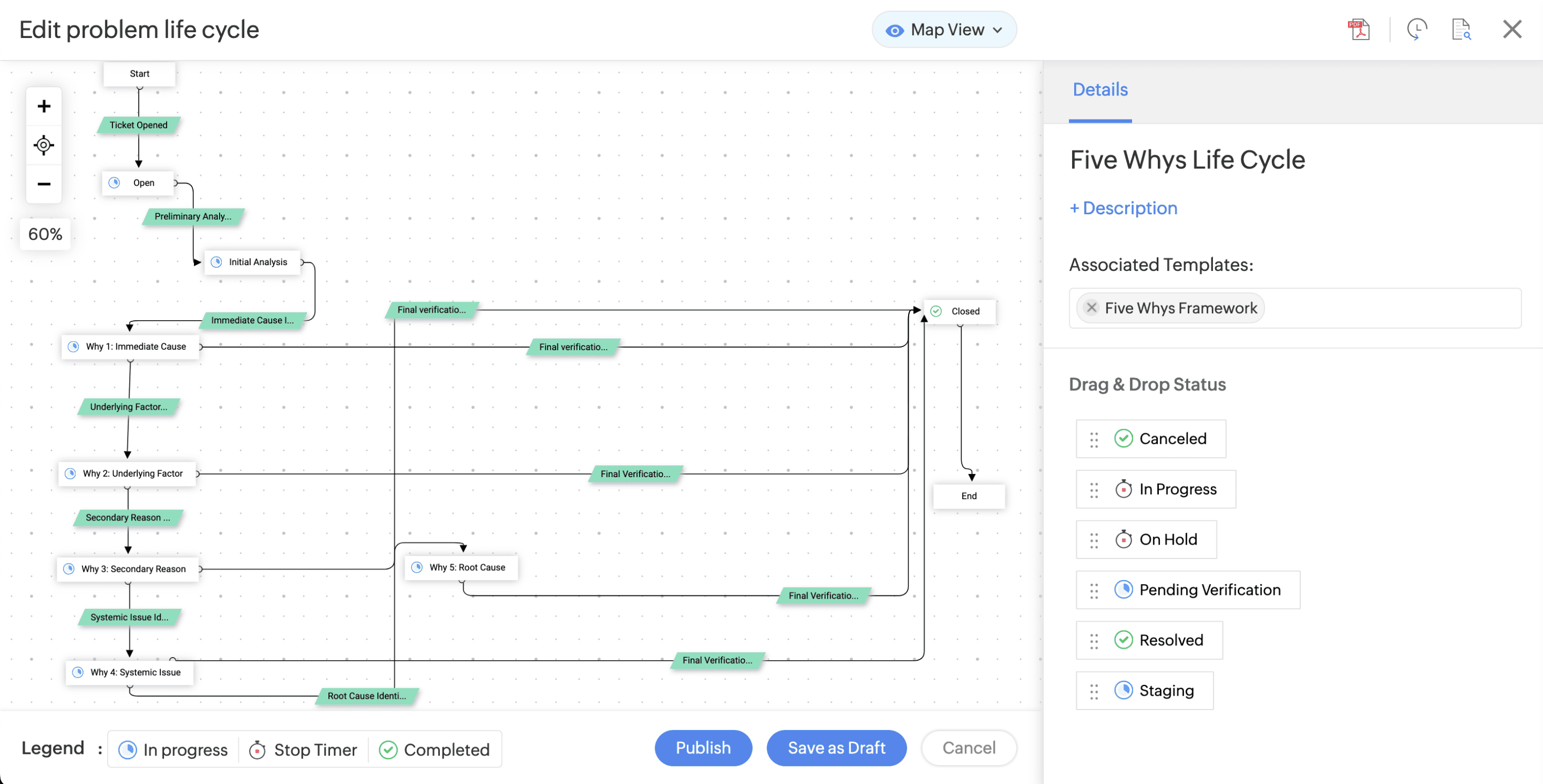
- The 5 Whys: A simple but powerful technique where the investigator asks "Why?" repeatedly (usually five times) until the source of the problem is revealed. It is particularly effective for straightforward human or process errors.
- Ishikawa (Fishbone) Diagram: A visual tool used to categorize the potential causes of a problem. It encourages teams to look at multiple dimensions, such as "Personnel," "Methods," "Machine," "Material," and "Environment." This is ideal for complex system failures where multiple factors may be at play.
- Pareto Analysis: Based on the 80/20 rule, this technique identifies the 20% of causes that are responsible for 80% of the problems. By focusing on these high-impact areas, IT teams can achieve the greatest improvement in stability with the least amount of effort.
- Chronological Analysis: This involves creating a detailed timeline of events leading up to an incident. In 2026, this often involves "time-travel" debugging in distributed systems to see exactly what state the data was in at the millisecond of failure.
| RCA Technique | Best Used For | Primary Advantage | Limitation |
|---|---|---|---|
| 5 Whys | Simple, linear problems | Fast and requires little training | May not capture complex interactions |
| Fishbone Diagram | Complex, multi-factor issues | Broad view of all contributing factors | Can become cluttered and overwhelming |
| Pareto Analysis | Prioritizing multiple problems | Maximizes ROI on effort | Does not identify the root cause itself |
| Fault Tree Analysis | High-stakes safety/security systems | Logical, deductive approach | Requires deep technical expertise |
Proactive vs. Reactive Problem Management
While most organizations begin their journey with reactive problem management—responding to major outages—the highest level of maturity is reached when the process becomes proactive.
Reactive Problem Management is triggered by a specific event, such as a Major Incident. The focus is on finding out what went wrong in a specific instance to prevent a recurrence. This is essential for maintaining stakeholder trust after a significant failure.
Proactive Problem Management is an ongoing activity. It involves analyzing "weak signals" in the environment. For instance, a proactive team might notice that latency on a specific database query is slowly creeping up by 5ms every week. While this hasn't caused an incident yet, proactive analysis can identify a memory leak or an unoptimized index before the system eventually crashes. This shift from "fixing" to "preventing" is what defines modern IT excellence.
Key Performance Indicators (KPIs) for Success
To measure the effectiveness of problem management in 2026, organizations should look beyond simple ticket counts. Meaningful metrics focus on the long-term health of the environment.
- Reduction in Recurring Incidents: The most direct measure of success. If the same incident occurs twice, the problem management process has failed to implement a successful fix or workaround.
- Mean Time to Resolution (MTTR) for Problems: Unlike incident MTTR, which should be minutes or hours, problem MTTR may be weeks. However, tracking this ensures that problems aren't left in a "pending" state indefinitely.
- Percentage of Proactive vs. Reactive Problems: A healthy IT department aims for a higher percentage of proactive problems identified.
- KEDB Utilization: Tracking how often the Service Desk uses the Known Error Database (KEDB) to resolve incidents quickly using documented workarounds.
Implementation Challenges and Solutions
Implementing a dedicated problem management process is rarely without friction. The most significant hurdle is often resource allocation. Because problem management is a "slow-burn" process, technical staff are often pulled away to handle "urgent" incidents.
To solve this, organizations must foster a culture that values long-term stability over short-term speed. This often requires a dedicated Problem Manager who has the authority to protect the time of subject matter experts. Another challenge is siloed data. If the network team and the database team don't share logs, the root cause of an application failure may never be found. Utilizing centralized observability platforms is the primary technical solution to this organizational barrier.
Frequently Asked Questions
What is the difference between a workaround and a permanent fix?
A workaround is a temporary way to restore service while a problem is still being investigated or while a permanent fix is being scheduled. For example, restarting a service every four hours to clear a memory leak is a workaround. Rewriting the code to eliminate the memory leak is the permanent fix.
Can problem management be outsourced?
Yes, many organizations use Managed Service Providers (MSPs) for problem management. However, the MSP must have deep access to historical data and internal documentation to be effective. The accountability for the service quality remains with the internal IT leadership.
What is a Known Error Database (KEDB)?
The KEDB is a repository of all known errors within the IT environment. It contains the symptoms of the error, the root cause (if known), and the approved workaround. This allows the Service Desk to resolve incidents immediately without having to reinvent the wheel every time a known issue resurfaces.
How does AI impact problem management in 2026?
AI significantly accelerates problem identification by correlating thousands of alerts into a single problem record. Machine learning models can also predict which changes are most likely to result in a problem, allowing teams to perform "Pre-Mortems" and mitigate risks before deployment.
Who should be involved in a Root Cause Analysis?
An RCA should include the Problem Manager, the technical lead for the affected system, and representatives from any other teams that might have been involved (e.g., Network, Security, or DevOps). In some cases, a third-party vendor may also need to participate if the failure occurred within their software or hardware.
Practical Recommendation for 2026
To optimize your IT problem management today, begin by separating your incident and problem data. Even if you do not have a dedicated problem management team, start "tagging" recurring incidents to identify trends. Invest in an observability platform that integrates with your ITSM tool to automate the flow of data between the identification and control phases. Finally, prioritize the creation of a Known Error Database; providing your Service Desk with documented workarounds is the fastest way to reduce the impact of underlying problems while your engineering teams work on permanent resolutions.
Image Gallery