Percentage of the World That Is Lactose Intolerant: Global Data and Demographics
Approximately 65% to 70% of the global adult population has a reduced ability to digest lactose, a condition known medically as lactase non-persistence. Prevalence varies dramatically by geographic region, ranging from less than 10% in...
Approximately 65% to 70% of the global adult population has a reduced ability to digest lactose, a condition known medically as lactase non-persistence. Prevalence varies dramatically by geographic region, ranging from less than 10% in Northern Europe to over 90% in parts of East Asia and Indigenous communities across the Americas.
Contents
Understanding Global Lactose Intolerance: Key Definitions and Rates
Lactose is the primary disaccharide sugar found in mammalian milk. To absorb lactose, the human small intestine must produce an enzyme called lactase (specifically lactase-phlorizin hydrolase). Lactase breaks down lactose into two simple sugars, glucose and galactose, which are easily absorbed into the bloodstream.
In most mammals, the production of lactase declines sharply after weaning. Humans are the only species where certain adult populations continue to produce lactase throughout adulthood. The global prevalence of lactose malabsorption is estimated at roughly 68%, based on systematic reviews and meta-analyses published in The Lancet Gastroenterology & Hepatology.
- Mammalian Default: High Lactase (Infancy)
- Gene Suppression
- Lactase Non-Persistence (Adulthood)
- Pastoral Mutation: High Lactase (Infancy)
- Persistent Mutation
- Lactase Persistence (Adulthood)
To interpret demographic statistics accurately, medical researchers distinguish between three related terms:
- Lactase Non-Persistence (LNP): The genetically programmed down-regulation of intestinal lactase expression post-weaning. This is the natural biological baseline for human adults.
- Lactose Malabsorption: The physiological failure of the small intestine to hydrolyze and absorb ingested lactose, regardless of whether symptoms occur.
- Lactose Intolerance: The onset of clinical gastrointestinal symptoms—such as bloating, abdominal cramping, flatulence, and diarrhea—directly resulting from lactose malabsorption.
Not every person with lactase non-persistence or lactose malabsorption experiences symptomatic lactose intolerance. Many adults with low enzyme levels can consume small amounts of dairy without discomfort, depending on meal composition, gut microbiome activity, and gastric emptying speed.
Regional Breakdown of Lactose Malabsorption
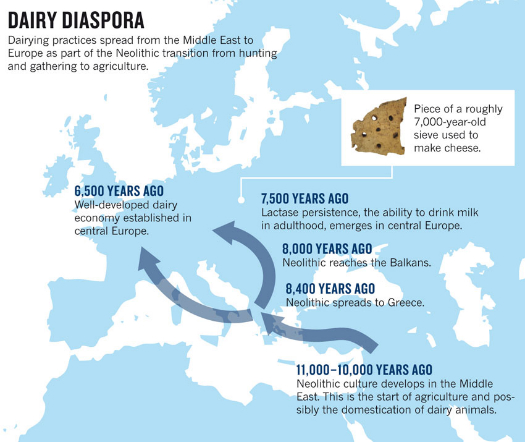
The distribution of lactose malabsorption is highly non-uniform across continents and ethnic groups. Geographic variation corresponds directly to historical agricultural practices, specifically whether an ancestral population practiced cattle farming and dairy consumption over thousands of years.
| Region | Estimated Malabsorption Rate |
|---|---|
| East Asia | 80% – 100% |
| Indigenous Americas | 80% – 100% |
| Sub-Saharan Africa | 70% – 90% |
| Middle East | 60% – 80% |
| Latin America | 50% – 80% |
| Southern Europe | 40% – 70% |
| Northern Europe | 2% – 15% |
East and Southeast Asia
East Asia exhibits the highest rates of lactose malabsorption in the world, with estimates ranging between 80% and 100% across China, Japan, Korea, and Vietnam. Historically, East Asian agriculture focused on crop cultivation and non-dairy livestock such as pigs and poultry, eliminating the selective evolutionary pressure to digest liquid animal milk past childhood.
Sub-Saharan Africa
Across Sub-Saharan Africa, the overall rate of lactose malabsorption is approximately 70% to 90%. However, sub-regional variations are pronounced. Ethnic groups with long histories of pastoral cattle herding—such as the Fulani in West Africa, the Tutsi in East Africa, and the Maasai—exhibit significantly higher rates of lactase persistence than neighboring agriculturalist groups.
The Americas and Indigenous Populations
Indigenous populations of North, Central, and South America display high rates of lactase non-persistence, ranging from 80% to 100%. In mixed populations across Latin America, malabsorption rates generally fall between 50% and 80%, reflecting combined Indigenous, European, and African ancestry.
Middle East and Mediterranean Regions
In the Middle East and Southern Europe, rates of lactose malabsorption range from 40% to 80%. Countries such as Italy, Greece, and Saudi Arabia show moderate to high rates of non-persistence, though fermented dairy products like yogurt and aged cheeses have historically remained dietary staples due to their reduced lactose content.
Northern and Western Europe
Northern and Western Europe possess the lowest rates of lactose malabsorption globally, ranging from 2% in Scandinavia to 15% in the United Kingdom and Northern France. Centuries of dairying culture, combined with natural selection favoring calcium and vitamin D absorption in low-sunlight environments, selected strongly for lactase persistence mutations.
| Region / Population Group | Estimated Malabsorption Rate (%) | Dominant Genetic Status | Key Historical Factors |
|---|---|---|---|
| East Asia (China, Japan, Korea) | 80% – 100% | Lactase Non-Persistence | Non-dairying agricultural history |
| Southeast Asia (Thailand, Vietnam) | 90% – 100% | Lactase Non-Persistence | Absence of domestic dairying animals |
| Indigenous Americas | 80% – 100% | Lactase Non-Persistence | No dairy cattle prior to European contact |
| Sub-Saharan Africa (Non-pastoral) | 70% – 90% | Lactase Non-Persistence | Crop-based agriculture without milk use |
| African Pastoralists (Fulani, Maasai) | 20% – 40% | Lactase Persistence | Independent pastoralist mutations |
| Middle East & North Africa | 60% – 80% | Mixed | Early goat/sheep dairying traditions |
| Southern Europe (Italy, Greece) | 40% – 70% | Mixed | Consumption of fermented dairy |
| Northern Europe (Scandinavia, UK) | 2% – 15% | Lactase Persistence | Heavy historical reliance on liquid milk |
| North America (Overall multi-ethnic) | 30% – 40% | Mixed | Reflects diverse ancestral origins |
Genetics and Evolutionary Biology of Lactase Persistence
The ability of an adult to digest lactose is known as lactase persistence. Rather than lactase deficiency being a disease or abnormality, lactase non-persistence is the ancestral genetic state for all humans and mammals.
Chromosome 2q21 Region:
- MCM6 Gene (Intron 9 & 13) Encoders/Enhancers
- C/T-13910 Mutation Sustains Enhancer Activity
- LCT Gene (Lactase Coding) Enzyme Production
- Lactase Expression Stays Active in Adults
The Role of the LCT and MCM6 Genes
The gene responsible for encoding the lactase enzyme is the LCT gene, located on human chromosome 2q21. However, the genetic mutations controlling whether this gene remains active in adulthood are located upstream within the regulatory introns of an adjacent gene, MCM6.
In populations with high lactase persistence, specific single nucleotide polymorphisms (SNPs) act as genetic enhancers, preventing the normal epigenetic silencing of the LCT gene after weaning:
- C/T-13910: The primary mutation common in European populations, where a thymine (T) nucleotide replaces a cytosine (C).
- G/C-14010, T/G-13915, and C/G-13907: Distinct single nucleotide variants identified in pastoralist populations across East Africa and the Arabian Peninsula.
These independent mutations demonstrate convergent evolution: different human populations developed separate genetic adaptations in response to the same environmental pressure—the domestication of dairy-producing animals during the Neolithic revolution approximately 10,000 years ago.
Classification of Lactase Deficiency
Gastroenterologists classify reduced lactase activity into four main categories:
- Primary Lactase Deficiency: The standard, genetically mediated down-regulation of lactase activity (lactase non-persistence). It is age-dependent, typically beginning between ages 2 and 12 depending on ethnicity.
- Secondary Lactase Deficiency: Temporary or permanent loss of lactase production caused by direct damage to the small intestine's mucosal brush border. Common causes include celiac disease, Crohn's disease, severe gastroenteritis, chemotherapy, or small intestinal bacterial overgrowth (SIBO).
- Congenital Lactase Deficiency (CLD): An extremely rare, autosomal recessive genetic disorder in which infants are born with zero lactase activity. Without immediate lactose-free infant formula, CLD leads to severe dehydration and failure to thrive.
- Developmental Lactase Deficiency: A temporary state observed in premature infants born before 34 weeks of gestation, whose digestive tracts have not fully developed lactase-producing cells.
Diagnostic Procedures for Lactose Malabsorption
Self-diagnosis of lactose intolerance based on self-reported symptoms frequently leads to misdiagnosis, as conditions like irritable bowel syndrome (IBS), inflammatory bowel disease, and sensitivity to FODMAPs share similar gastrointestinal complaints. Diagnostic protocols verified by clinical organizations such as the National Institute of Diabetes and Digestive and Kidney Diseases (NIDDK) rely on objective physiological testing.
Diagnostic Pathway for Suspected Lactose Intolerance:
- Symptom Presentation (Pain, Bloating, Diarrhea)
- Hydrogen Breath Test (HBT) (25g–50g Lactose Challenge + Breath Sampling)
20 ppm H2 Rise: Positive: Malabsorption Confirmed
- < 20 ppm H2 Rise: Negative: Consider IBS, SIBO, or FODMAP issues
Hydrogen Breath Test (HBT)
The Hydrogen Breath Test is the non-invasive clinical gold standard for diagnosing lactose malabsorption.
- Procedure: The patient fasts overnight and then drinks a solution containing 25 to 50 grams of pure lactose (equivalent to 500 to 1,000 mL of milk).
- Mechanism: If lactase enzyme levels are insufficient, unabsorbed lactose passes into the large intestine, where anaerobic colonic bacteria ferment it, releasing hydrogen ($H_2$) and methane ($CH_4$) gas.
- Interpretation: These gases are absorbed into the bloodstream and exhaled via the lungs. A rise in breath hydrogen levels of more than 20 parts per million (ppm) above baseline within 2 to 3 hours confirms lactose malabsorption.
Lactose Tolerance Test
This blood-based test measures systemic glucose levels following lactose administration. The patient consumes a high-dose lactose drink, and blood samples are taken at set intervals over two hours. If the intestinal mucosa successfully breaks down lactose into glucose, blood sugar levels rise by at least 20 mg/dL. A failure of blood glucose to rise indicates that lactose was not cleaved and absorbed.
Stool Acidity Test
Primarily reserved for infants and young children for whom breath testing is unfeasible. Unabsorbed lactose fermented by colonic bacteria produces lactic acid and short-chain fatty acids, lowering stool pH below 5.5.
Clinical Thresholds and Dietary Management
Having lactase non-persistence does not require a total exclusion of dairy products. Clinical research indicates that most individuals with lactose malabsorption maintain sufficient residual enzyme capacity to process small amounts of lactose without triggering severe symptoms.
Tolerable Dosage Thresholds
Systematic reviews evaluated by the National Institutes of Health (NIH) demonstrate that most adults diagnosed with lactose malabsorption can tolerate up to 12 grams of lactose in a single dose—equivalent to approximately 240 mL (1 cup) of standard milk—when consumed alongside other solid foods. When distributed throughout the day, many individuals can consume up to 24 grams of lactose with minimal to no discomfort.
| Dairy Product | Lactose Content |
|---|---|
| Whole Milk (1 cup / 240 mL) | 12.0g |
| Skim Milk (1 cup / 240 mL) | 12.5g |
| Yogurt (Plain, 1 cup / 245g) | 8.5g |
| Cottage Cheese (1/2 cup) | 3.2g |
| Cheddar Cheese (1 oz / 28g) | 0.4g |
| Swiss Cheese (1 oz / 28g) | 0.1g |
| Butter (1 tbsp / 14g) | 0.1g |
Management Strategies and Alternatives
For individuals experiencing symptomatic lactose intolerance, clinical management focuses on symptom control while preserving nutritional intake—particularly calcium and vitamin D:
- Exogenous Enzyme Replacement: Over-the-counter oral lactase enzyme supplements (derived from fungi such as Aspergillus oryzae) can be taken immediately before consuming dairy. These enzymes hydrolyze lactose in the stomach and duodenum before it reaches the colon.
- Lactose-Free Dairy: Commercial dairy manufacturers add purified lactase enzymes directly to liquid milk, pre-converting lactose into glucose and galactose. This renders the milk suitable for malabsorbers while retaining its original protein and mineral density.
- Aged and Fermented Dairy Products: Hard aged cheeses (such as Cheddar, Swiss, Parmesan, and Provolone) contain negligible lactose levels (often under 0.5g per serving) because whey is separated during production and bacteria consume remaining lactose during aging. Active-culture yogurts contain live probiotic bacteria (e.g., Lactobacillus bulgaricus and Streptococcus thermophilus) that release endogenously active lactase enzyme directly into the intestinal tract.
- Plant-Based Alternatives: Fortified soy, almond, oat, and coconut milks provide plant-based alternatives that naturally lack lactose.
Frequently Asked Questions
What percentage of the world population is lactose intolerant?
Approximately 65% to 70% of the world's adult population has reduced lactase enzyme activity (lactase non-persistence). However, actual symptom severity varies widely, and many individuals with malabsorption can tolerate small amounts of lactose without experiencing symptomatic distress.
Can a person develop lactose intolerance later in life?
Yes. Primary lactase non-persistence is genetically programmed to begin declining after infancy, but symptoms often manifest gradually during adolescence or early adulthood. Additionally, adults can develop secondary lactose intolerance at any age due to gastrointestinal diseases, infections, or intestinal surgery that damages the gut lining.
Why do Northern European populations have such low rates of lactose intolerance?
Northern European populations experienced strong natural selection for lactase persistence mutations (such as the C/T-13910 allele) due to early pastoral history. In high-latitude environments with low sunlight exposure, the ability to digest liquid milk provided a critical evolutionary survival advantage by supplying continuous calories, protein, hydration, calcium, and vitamin D.
How does lactose intolerance differ from a milk allergy?
Lactose intolerance is a non-allergic metabolic issue caused by a deficiency of the lactase enzyme in the digestive system. A cow's milk allergy is an immune system response (often IgE-mediated) directed against milk proteins such as casein or whey. Milk allergies can trigger severe allergic reactions, including hives, wheezing, vomiting, and anaphylaxis, and require total avoidance of dairy protein.
Can lactose intolerance be cured or reversed?
Primary lactase non-persistence cannot be reversed because it is determined by genetic regulation of the LCT gene. Secondary lactose intolerance, however, can often be resolved by identifying and treating the underlying gastrointestinal condition, allowing the mucosal lining of the small intestine to heal and resume natural enzyme production.
Summary and Practical Next Steps
Understanding your biological tolerance for lactose involves separating genetic predisposition from active clinical symptoms. If you suspect lactose malabsorption is causing chronic digestive distress:
- Obtain an Objective Diagnosis: Schedule a Hydrogen Breath Test through a physician or gastroenterologist to rule out secondary conditions such as IBS, celiac disease, or SIBO.
- Determine Your Individual Tolerance Threshold: Do not eliminate all dairy unnecessarily. Experiment systematically by consuming small amounts (e.g., half a cup of milk or hard cheese) alongside meals to establish your comfort limit.
- Utilize Enzyme Replacement and Modified Dairy: Incorporate lactase enzyme supplements before eating high-lactose foods, or choose pre-treated lactose-free dairy and fermented foods like yogurt.
- Monitor Calcium and Vitamin D Intake: If restricting dairy products, ensure adequate micro-nutrient intake through fortified plant milks, leafy greens, canned fish with bones, or targeted supplementation under medical supervision.
Image Gallery