Understanding Virginia Sales and Use Tax Rules
Virginia sales and use tax applies to the sale, lease, or rental of tangible personal property and specific taxable services within the Commonwealth. As of 2026, businesses with physical or economic nexus in Virginia must register with...
Virginia sales and use tax applies to the sale, lease, or rental of tangible personal property and specific taxable services within the Commonwealth. As of 2026, businesses with physical or economic nexus in Virginia must register with the Department of Taxation, collect the combined state and local tax rates, and remit payments electronically to remain compliant with state law.
Contents
Navigating the complexities of the Virginia tax code requires a deep understanding of how "nexus" is defined, the distinction between sales and use tax, and the specific regional rate variations that exist across the state. Whether you are a local brick-and-mortar retailer or a remote online seller, Virginia’s "destination-based" sourcing rules and marketplace facilitator laws dictate your collection responsibilities. Failure to adhere to these regulations can lead to significant penalties, interest, and the risk of a state audit.
Defining Taxable Presence: Physical and Economic Nexus
Before a business can collect tax, it must determine if it has a legal obligation to do so, a concept known as nexus. In Virginia, nexus is established through either physical presence or economic activity.
Physical Nexus
Physical nexus is the traditional standard for tax liability. A business has physical nexus in Virginia if it maintains a storefront, warehouse, or office within the state. However, the definition extends beyond mere real estate. Having employees, independent contractors, or sales representatives working in the state—even temporarily—creates nexus. Furthermore, storing inventory in a fulfillment center located in Virginia (such as those operated by large e-commerce platforms) generally establishes a physical presence for tax purposes.
Economic Nexus
Following the landmark Supreme Court decision in South Dakota v. Wayfair (2018), Virginia implemented economic nexus laws. As of 2026, any remote seller or marketplace facilitator that does not have a physical presence in the state but makes more than $100,000 in annual gross sales or conducts 200 or more separate transactions with Virginia customers is required to register and collect sales tax. This threshold is calculated based on the previous or current calendar year. It is important to note that gross sales include exempt sales, meaning you may hit the threshold even if the products you sell are not ultimately taxable.
Virginia Sales Tax Rates and Regional Variations
Virginia’s sales tax structure is composed of a base state tax and a local option tax. While the state sales tax is uniform, various regions have additional "add-on" taxes to fund transportation or school construction projects.
The Standard Combined Rate
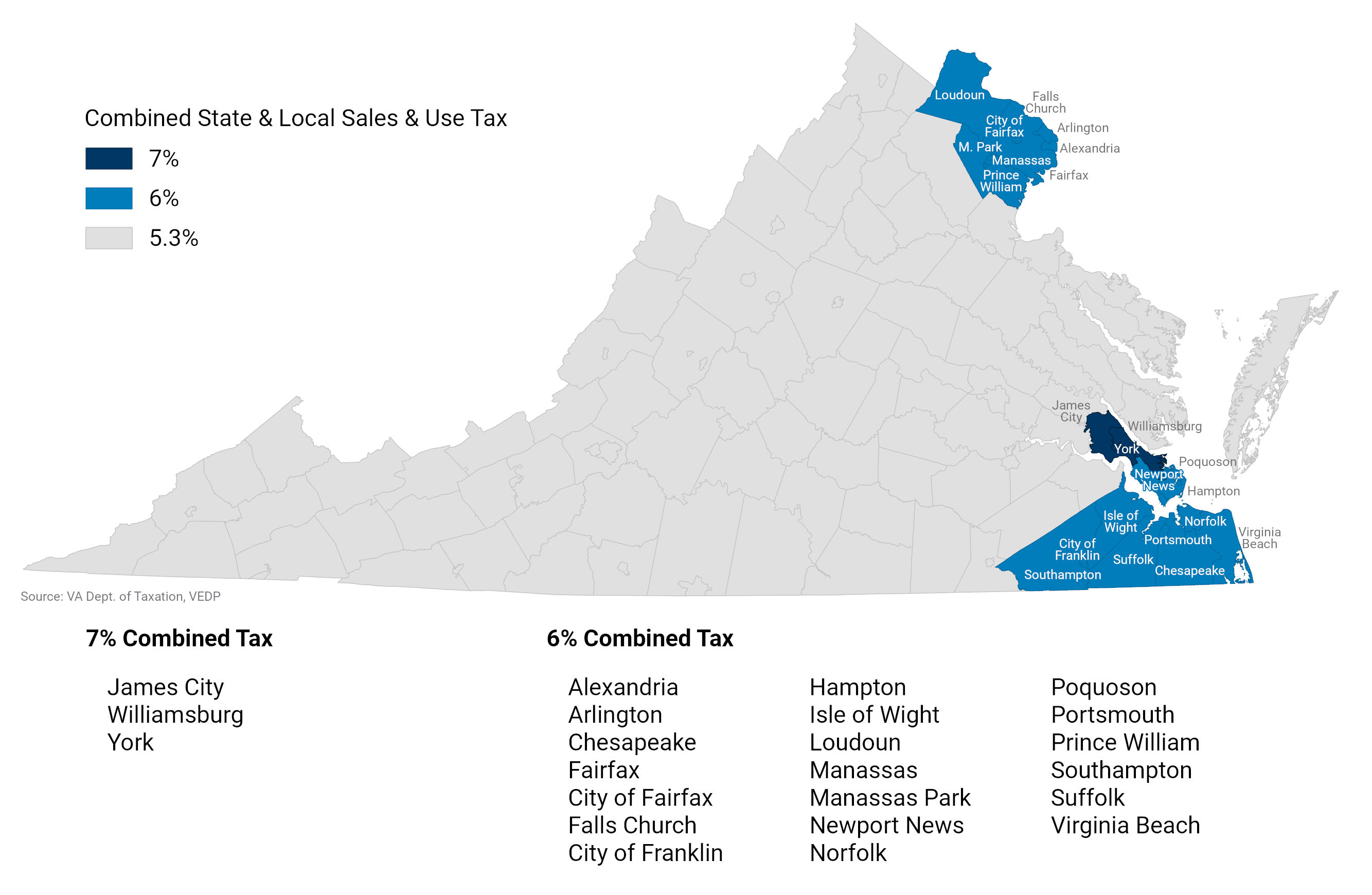
The base sales tax rate in most of Virginia is 5.3%. This is comprised of a 4.3% state tax and a 1% local option tax. Every jurisdiction in Virginia imposes at least the 1% local tax, making 5.3% the minimum rate you will encounter.
Regional Increases
Specific regions in Virginia have higher rates due to regional legislative acts. For example:
- Northern Virginia (NoVa): Districts such as Alexandria, Arlington, and Fairfax have a total rate of 6%.
- Hampton Roads: Cities like Virginia Beach, Norfolk, and Newport News also carry a 6% rate.
- Central Virginia: The Richmond area frequently sees a 6% rate to support regional transit.
- Historic Triangle: The region encompassing Williamsburg, James City County, and York County has a higher rate of 7% due to additional tourism-related levies.
Sourcing Rules
Virginia generally follows destination-based sourcing for remote sellers. This means that the tax rate is determined by the location where the product is delivered to the customer, not where the seller is located. For in-state sellers with a physical location in Virginia, the rules can sometimes lean toward origin-based sourcing for the local 1% portion, but for the majority of modern e-commerce transactions, the delivery address is the governing factor.
Exemptions and Non-Taxable Transactions
Not every transaction in Virginia is subject to sales tax. The state provides several exemptions based on the nature of the product or the identity of the purchaser.
Resale Exemptions
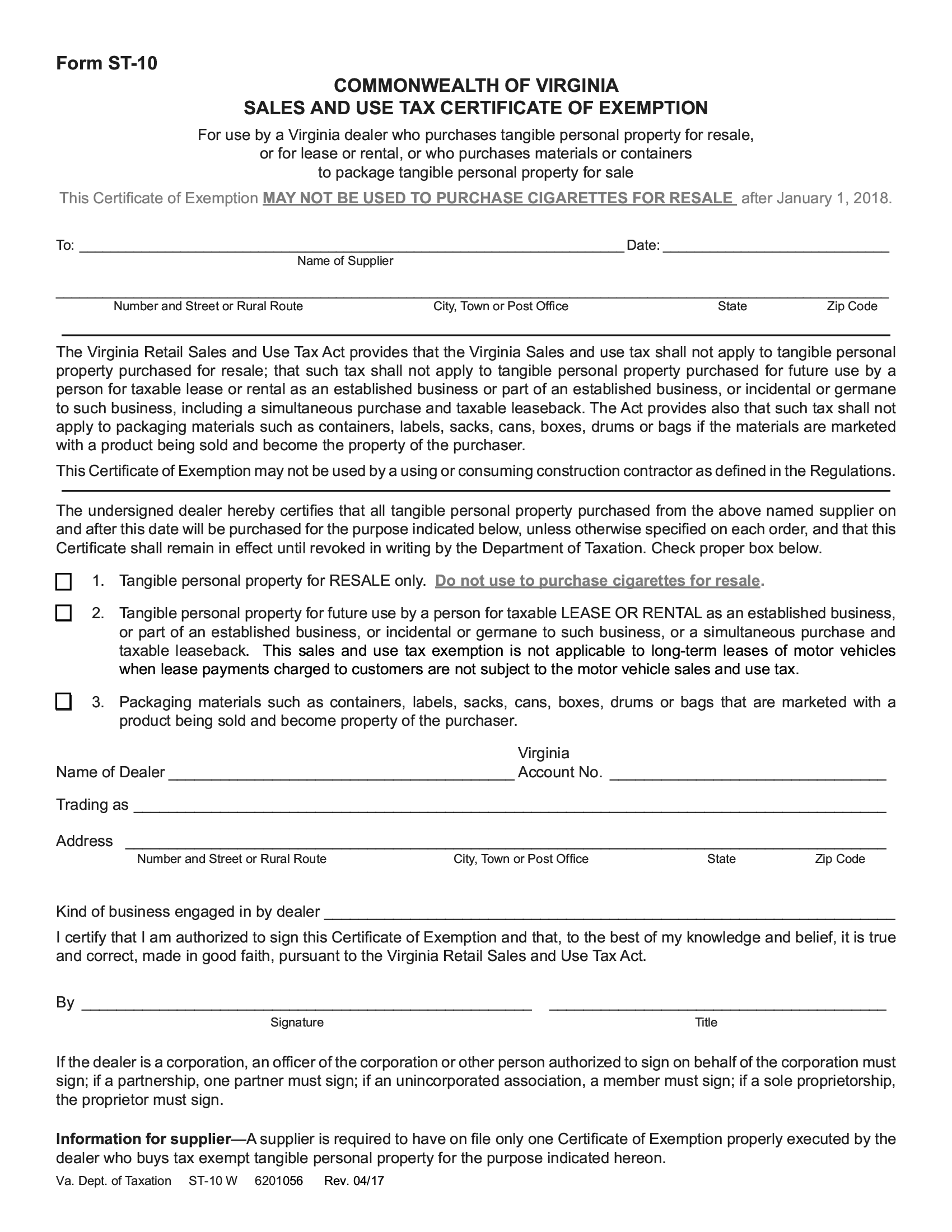
The most common exemption is for resale. If a business purchases goods intended to be resold in the normal course of business, they can provide the seller with a Virginia Sales and Use Tax Certificate of Exemption (Form ST-10). This prevents "double taxation" where the tax would be paid both by the retailer and the end consumer.
Manufacturing and Industrial Exemptions
Virginia encourages industrial growth by exempting machinery, tools, and supplies used directly in the manufacturing, processing, or refining of tangible personal property for sale. This also applies to certain research and development activities. To claim this, businesses typically use Form ST-11.
Government and Non-Profit Organizations
Sales to the United States federal government and the Commonwealth of Virginia are exempt. Additionally, many non-profit organizations with a 501(c)(3) or 501(c)(4) status are exempt from paying sales tax on purchases, provided they have obtained a formal exemption certificate from the Virginia Department of Taxation.
The "True Object" Test for Services
Virginia generally does not tax services unless they are part of the sale of tangible personal property. To determine taxability, the state uses the "True Object" test. If the true object of the buyer is to obtain a service (e.g., legal advice or accounting), the transaction is usually non-taxable, even if some paperwork is provided. However, if the service is incidental to the sale of a product (e.g., a fabrication fee for a custom-made table), the entire invoice may be taxable.
Understanding Use Tax: The "Mirror" of Sales Tax
Use tax is often referred to as the "complement" to sales tax. It is designed to ensure that the state receives revenue even when a purchase is made from an out-of-state vendor who does not collect Virginia sales tax.
Consumer Use Tax
If an individual or business in Virginia purchases a taxable item from a seller in another state (or online) and that seller does not charge sales tax, the buyer is legally obligated to report and pay Consumer Use Tax to Virginia. The rate for use tax is identical to the sales tax rate in the buyer's locality. This most commonly applies to equipment or supplies purchased for business use from vendors who lack Virginia nexus.
Business Use Tax
Businesses must track all untaxed purchases and report them on their monthly or quarterly sales and use tax returns (Form ST-9). Common triggers for use tax include:
- Purchasing office supplies online from a retailer without a Virginia presence.
- Withdrawing items from inventory (originally purchased tax-free for resale) for personal or internal business use.
- Buying furniture or machinery from an out-of-state liquidator.
| Tax Category | Typical Rate | Basis for Collection | Responsibility |
|---|---|---|---|
| Standard Sales Tax | 5.3% | Point of Sale/Delivery | Seller collects from Buyer |
| Regional Sales Tax | 6.0% - 7.0% | Specific District Delivery | Seller collects from Buyer |
| Consumer Use Tax | 5.3% - 7.0% | Un-taxed out-of-state purchase | Buyer pays to State |
| Reduced Grocery Tax | 1.0% | Essential food items | Seller collects from Buyer |
Registration and Filing Procedures
Once a business determines it has nexus, it must register for a Sales and Use Tax Certificate of Registration through the Virginia Tax Online Services for Businesses.
Filing Frequency
The Department of Taxation assigns a filing frequency—usually monthly or quarterly—based on the business's anticipated tax liability.
- Monthly: Required for most active businesses. Returns and payments are due on the 20th day of the month following the reporting period.
- Quarterly: May be allowed for businesses with very low tax liabilities.
Electronic Filing Mandate
Virginia requires all sales tax returns and payments to be submitted electronically. Failure to file electronically can result in penalties, even if the tax is paid on time. Businesses are also entitled to a small "dealer discount" for timely filing and payment, which allows them to retain a fraction of the tax collected to offset the costs of administration.
Common Mistakes and Audit Triggers
The Virginia Department of Taxation is active in auditing businesses to ensure compliance. Several common errors often lead to assessments:
- Incorrect Local Rates: Applying the 5.3% rate to a customer in a 6% district. In a destination-based state, the seller is responsible for identifying the correct local tax based on the ZIP+4 code.
- Missing Exemption Certificates: If you sell to a "tax-exempt" entity but fail to keep a copy of their Form ST-10 or other certificate on file, the state will treat those sales as taxable during an audit.
- Taxes on Shipping and Handling: In Virginia, if shipping and handling charges are separately stated on the invoice, they are generally not subject to sales tax. However, if they are combined with the price of the goods, the entire amount is taxable.
- Use Tax Oversight: Many businesses focus solely on what they sell and forget to track what they buy without paying tax. Auditors frequently check accounts payable records to find un-taxed out-of-state purchases.
Frequently Asked Questions
Does Virginia tax digital products or software?
As of 2026, Virginia's stance on digital products remains focused on "tangible" property. Generally, software delivered electronically is not taxable, provided no tangible medium (like a disc or USB) is provided. However, Software as a Service (SaaS) and certain digital downloads are subject to ongoing legislative review. Always check for the most recent administrative rulings regarding "cloud-based" transactions, as the "True Object" test is frequently applied here.
What is the tax rate on groceries and essential items?
Virginia significantly reduced the tax on "essential" groceries. While the state-level tax was eliminated in recent years, a 1.0% local option tax still applies to most food items intended for home consumption. This does not apply to prepared "hot" foods, which are taxed at the full standard sales tax rate plus any local meals taxes.
Are marketplace facilitators responsible for Virginia sales tax?
Yes. Entities like Amazon, Etsy, and Walmart (marketplace facilitators) are required to collect and remit Virginia sales tax on behalf of their third-party sellers if they meet the $100,000 or 200-transaction threshold. If a marketplace facilitator collects the tax, the individual seller does not need to collect it again but must still report these "marketplace sales" on their Virginia return if they are registered.
What happens if I file my Virginia tax return late?
Virginia imposes a penalty of 6% of the tax due for each month or fraction of a month the return is late, up to a maximum of 30%. Additionally, interest accrues at the federal underpayment rate plus 2%. Even if you owe $0 in tax for a period, you must still file a "zero return" to avoid late filing penalties.
Do I need a Virginia business license to collect sales tax?
While a Sales and Use Tax Certificate is a state-level requirement, many Virginia cities and counties also require a local Business, Professional, and Occupational License (BPOL). These are separate from sales tax and are usually based on gross receipts rather than sales tax collection.
Practical Recommendation for Compliance
To maintain compliance with Virginia sales and use tax rules in 2026, businesses should implement automated tax software that integrates with their sales platforms. Because Virginia utilizes destination-based sourcing and has multiple regional rate increases, relying on manual calculations is high-risk. Ensure that your system validates the delivery address down to the specific local tax district. Furthermore, conduct a "nexus review" annually; even if you do not have physical staff in Virginia, your sales volume may cross the economic threshold as your business grows. Finally, always maintain a digital archive of exemption certificates for at least three years, as the burden of proof for non-taxable sales rests entirely on the seller during a state audit.
Image Gallery