Understanding Why Workers Compensation Benefits Are Generally Not Taxable
Workers compensation benefits are generally not taxable at the federal or state level, meaning you typically do not need to report these payments as income on your annual tax returns. This exclusion applies to regular weekly wage repla...
Workers compensation benefits are generally not taxable at the federal or state level, meaning you typically do not need to report these payments as income on your annual tax returns. This exclusion applies to regular weekly wage replacement checks and lump-sum settlements intended to compensate for workplace injuries or occupational illnesses, provided they meet specific regulatory requirements.
Contents
The Federal Tax Status of Workers Compensation
The Internal Revenue Service (IRS) classifies workers compensation payments as "benefits paid under a workers' compensation act." Under the Internal Revenue Code, these payments are specifically excluded from gross income. Because they are designed to replace lost wages resulting from a job-related injury or illness, the tax code treats them as compensatory rather than as taxable income.
This principle is rooted in the legislative intent behind workers compensation laws. These systems were designed to provide a "no-fault" mechanism for injured workers to receive medical care and a portion of their lost wages without the necessity of litigation. By exempting these benefits from taxation, the government ensures that the full value of the support intended to assist the worker during their recovery remains available for living expenses and medical necessities.
Distinguishing Tax-Exempt Benefits from Taxable Income
While the core benefits are tax-exempt, the financial landscape surrounding an injury claim can sometimes become complicated. It is important to distinguish between pure workers compensation benefits and other types of compensation that may accompany an injury claim.
For instance, if you receive a settlement that includes compensation for damages other than the injury itself—such as punitive damages or compensation for non-physical emotional distress unrelated to the job injury—those specific portions may be subject to different tax rules. The IRS generally looks at the underlying basis for the payment. If the payment is strictly for the personal physical injury or physical sickness, it remains excluded from gross income. However, if the settlement includes back pay that was specifically owed to you regardless of the injury, that component may be taxable as wages.
The Impact of Social Security Disability Integration
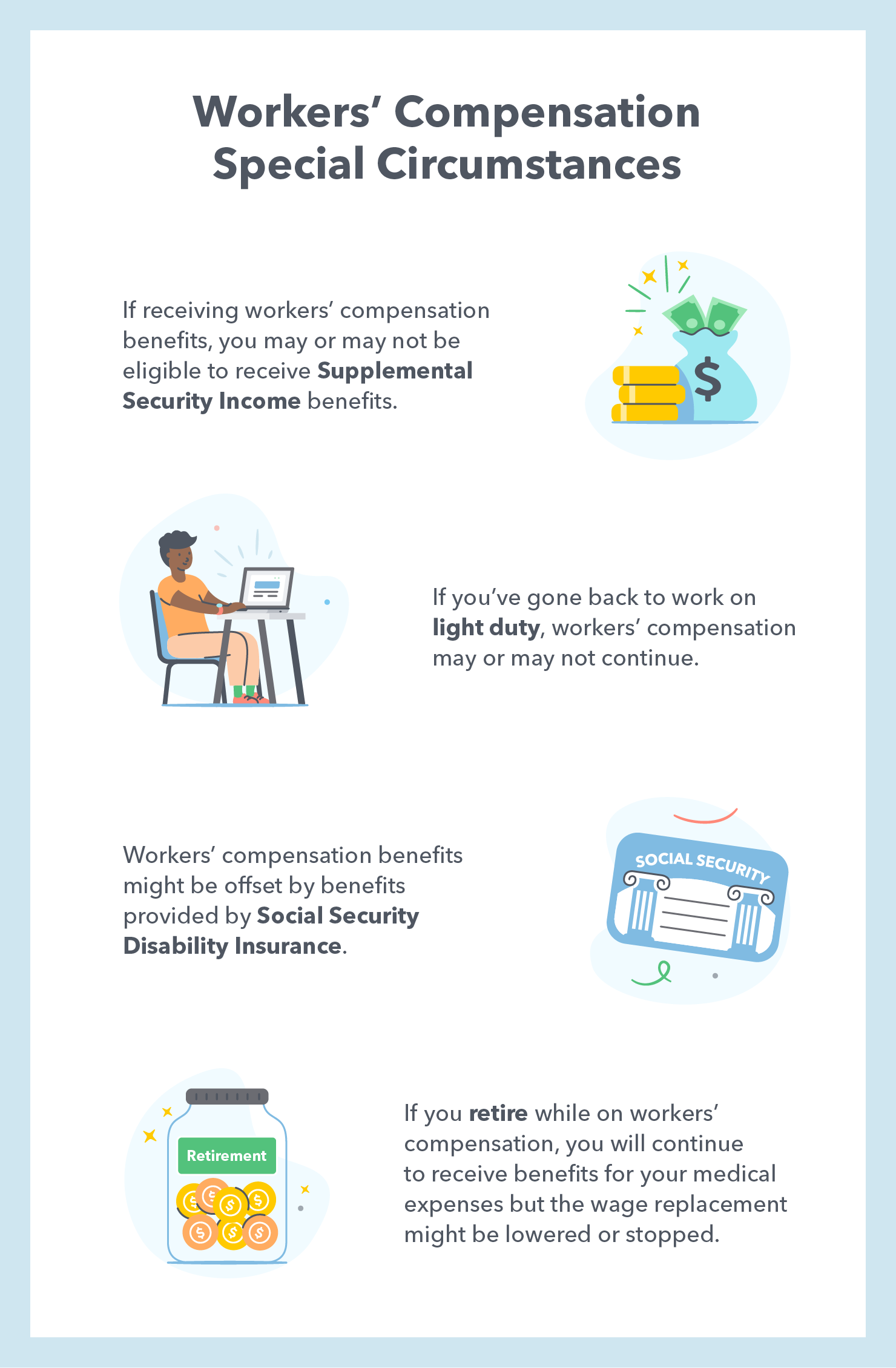
A critical nuance in tax law involves the interaction between workers compensation and Social Security Disability Insurance (SSDI) or Supplemental Security Income (SSI). This is commonly referred to as the "workers compensation offset."
When a worker receives both workers compensation and SSDI, the Social Security Administration (SSA) may reduce the SSDI benefit to ensure that the total combined benefit does not exceed a certain percentage of the worker's average current earnings. When this offset is applied, a portion of the workers compensation benefit may essentially be "recharacterized" for tax purposes. Under Section 86 of the Internal Revenue Code, if your workers compensation benefits cause a reduction in your Social Security benefits, a portion of those benefits may be treated as Social Security disability payments, which can be taxable depending on your overall income level.
Lump-Sum Settlements and Structured Payments
Many workers compensation cases conclude with a "compromise and release" or a lump-sum settlement. Regardless of whether the money is paid in a single check or structured over several years, the tax-exempt status remains consistent, provided the settlement is exclusively for the work-related injury.
However, if a settlement agreement is poorly drafted, it can lead to confusion during tax season. Legal counsel typically structures these agreements to clearly indicate that the funds are in lieu of ongoing workers compensation benefits. If a portion of a settlement is allocated to items such as future medical expenses, attorney fees, or vocational rehabilitation, those allocations typically do not change the underlying tax-exempt status of the settlement as a whole, but it is prudent to maintain documentation that confirms the origin of the funds as a settlement of a workplace injury claim.
Comparison of Financial Impact: Workers Compensation vs. Other Benefits
| Benefit Type | Federal Tax Status | Basis for Taxation |
|---|---|---|
| Workers Compensation | Generally Non-Taxable | Excluded under IRC Section 104(a)(1) |
| SSDI (Social Security Disability) | Often Taxable | Subject to thresholds based on total income |
| Employer-Provided Sick Pay | Taxable | Considered regular wages |
| Private Disability Insurance | Varies | Taxable if premiums were paid by employer |
| Unemployment Compensation | Taxable | Reported as ordinary income |
Prerequisites for Maintaining Tax-Exempt Status
To ensure that your benefits remain tax-exempt, you must maintain accurate records of all correspondence and payment stubs provided by your employer’s insurance carrier.
- Keep Payment Records: Retain the initial award letters from your state’s workers compensation board or the insurance company.
- Review Settlement Documents: Ensure that your settlement agreement clearly references the relevant workers compensation statute under which the claim is being closed.
- Report Accurately: If you are unsure whether a specific payment is considered a "benefit" or a separate taxable component (like a severance package or unrelated bonus), consult with a tax professional before filing your return.
- Monitor Offset Letters: If you receive a letter from the Social Security Administration regarding an offset, keep this documentation. It will be necessary if you need to calculate the taxable portion of your Social Security benefits later.
Potential Pitfalls and Mistakes
One common mistake is failing to report the receipt of benefits when your tax software or employer’s W-2/1099 reporting seems to suggest otherwise. In most cases, workers compensation insurance carriers do not issue a W-2 or 1099 for these benefits, as they are not taxable wages. If you receive a tax form from an insurance company, review it carefully. If it is a 1099-MISC, the insurer may be reporting the payment, but this does not automatically mean the amount is taxable. You may need to report the amount and then take a corresponding deduction or exclusion, depending on the instructions provided by the IRS for that specific tax year.
Another error occurs when individuals assume that private long-term disability (LTD) benefits are taxed the same way as workers compensation. If you transitioned from a state workers compensation program to a private LTD plan, the tax rules change significantly. Unlike workers compensation, private disability payments are often taxable if your employer paid the premiums for the policy.
Professional Advice Limitation
This information is provided for educational purposes and reflects general tax principles as of 2026. Tax laws are subject to legislative changes, state-specific nuances, and individual financial circumstances. Because tax liability depends on your total household income, filing status, and the specific language of your settlement, you should consult with a Certified Public Accountant (CPA) or a tax attorney if your situation involves large lump-sum settlements, Social Security offsets, or complex multi-state claims.
Frequently Asked Questions
Are all workers compensation settlements tax-free? Yes, generally speaking, settlements for workplace injuries are tax-exempt. However, if a settlement includes back pay or compensation for claims outside of the physical injury (such as a separate discrimination claim), those specific portions may be considered taxable income.
Do I need to report workers compensation on my tax return? In most cases, you do not need to report workers compensation benefits as income on your Form 1040. If you receive a 1099 form from an insurance provider, you should consult a tax professional to determine if you need to include the amount and then offset it with an exclusion to prevent an incorrect tax assessment.
What happens if I receive both Social Security and Workers Compensation? The SSA may reduce your Social Security benefits to prevent you from receiving more than 80% of your pre-disability earnings. A portion of this offset amount may be treated as taxable income under federal law. It is essential to keep all documentation regarding the SSA offset calculations.
Is medical expense reimbursement taxable? No. Any payments made by a workers compensation carrier to cover your medical bills—or reimbursements for out-of-pocket medical costs—are not considered taxable income.
What if my employer mistakenly withholds taxes from my workers compensation check? If your employer continues to pay you through the payroll system while you are on leave, they may erroneously withhold taxes. If this happens, you should contact your HR or payroll department immediately to correct the classification of those payments and request a refund of the withheld taxes.
Next Steps for Recipients
If you are currently receiving workers compensation, your immediate priority should be to gather and organize your documentation. Ensure that you have a file containing your initial claim acceptance, any subsequent award letters, and any closing settlement documents. If you receive any documentation from the IRS or the Social Security Administration regarding these benefits, do not ignore them. A proactive approach to verifying the tax status of your specific payments will prevent complications during the tax filing season and ensure that your financial recovery remains intact.
Image Gallery