Mechanical Engineering Ethics: Standards, Codes, and Professional Responsibility
Mechanical engineering ethics comprise the moral framework and professional standards that govern the conduct of engineers. These principles prioritize public health, safety, and welfare above all else, ensuring that the design, produc...
Mechanical engineering ethics comprise the moral framework and professional standards that govern the conduct of engineers. These principles prioritize public health, safety, and welfare above all else, ensuring that the design, production, and maintenance of mechanical systems adhere to rigorous safety standards, legal requirements, and total honesty in all professional reporting and representations.
Contents
The Foundational Principles of Mechanical Engineering Ethics
The practice of mechanical engineering is built upon a foundation of trust between the practitioner and the public. As of 2026, the complexity of integrated mechanical systems—ranging from automated manufacturing plants to autonomous transportation—has only heightened the importance of a robust ethical framework. At its core, engineering ethics is not merely a set of rules to avoid litigation, but a proactive commitment to the betterment of society through technical excellence and moral integrity.
The "Paramountcy Rule" remains the most critical pillar of the profession. This rule dictates that an engineer’s primary obligation is to protect the health, safety, and welfare of the public. If a design flaw is discovered that could lead to catastrophic failure, the engineer's ethical duty to report and rectify that flaw supersedes their loyalty to an employer or a client. This creates a professional hierarchy where safety stands at the apex, followed by the engineer’s duty to the profession, the client, and finally, their own career interests.
Integrity and competence are the secondary pillars. Engineers must only perform services in areas where they are qualified by education or experience. In the rapidly evolving landscape of 2026, this means mechanical engineers must be transparent about the limits of their knowledge, especially when interfacing with software engineering, artificial intelligence, and materials science. Misrepresenting one’s expertise is considered a severe ethical breach that undermines the reliability of the entire engineering community.
Major Professional Codes of Ethics
In the United States and much of the international community, two primary organizations define the ethical landscape for mechanical engineers: the American Society of Mechanical Engineers (ASME) and the National Society of Professional Engineers (NSPE). While their codes share common ground, they serve slightly different functions within the professional ecosystem.
The ASME Code of Ethics for Engineers
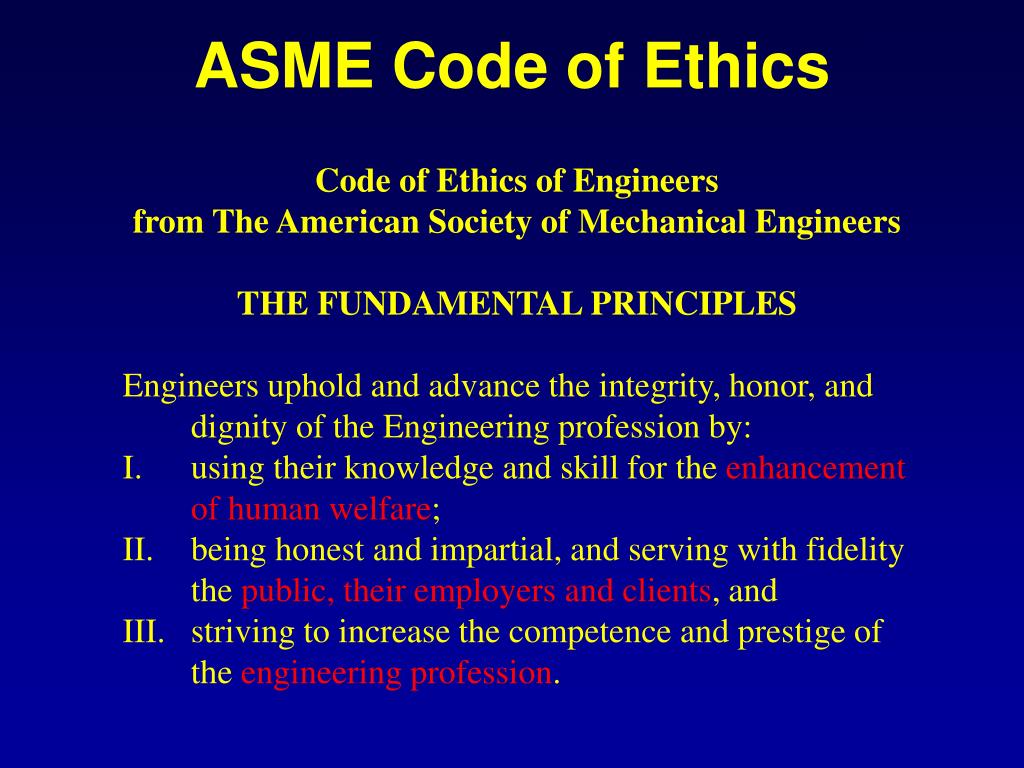
ASME provides a comprehensive set of "Fundamental Canons" that are specifically tailored to the technical and industrial challenges faced by mechanical practitioners. These canons emphasize the importance of sustainable development and the ethical use of resources. ASME's guidelines also demand that engineers act as faithful agents for their employers while strictly avoiding conflicts of interest. In 2026, ASME continues to update its interpretive guidelines to account for global supply chain ethics and the environmental footprint of heavy machinery.
The NSPE Code of Ethics
The NSPE code is often considered the universal standard for all engineering disciplines, but it is particularly vital for mechanical engineers seeking or maintaining their Professional Engineer (PE) license. The NSPE code is structured into Fundamental Canons, Rules of Practice, and Professional Obligations. It provides specific language regarding the "Engineer’s Creed," a public pledge to dedicate professional knowledge to the advancement and betterment of human welfare.
| Feature | ASME Code of Ethics | NSPE Code of Ethics |
|---|---|---|
| Primary Focus | Technical standards and industrial practice. | Professional licensure and legal practice. |
| Sustainability | Heavily emphasizes environmental stewardship. | Broadly covers public welfare. |
| Public Safety | Categorized as the first fundamental canon. | Categorized as a primary fundamental canon. |
| Conflict of Interest | Focuses on transparency with clients/employers. | Detailed rules on gifts, commissions, and dual roles. |
| Global Reach | Widely adopted by international mechanical firms. | Primarily focused on U.S. licensed practitioners. |
Navigating Whistleblowing and Reporting
Whistleblowing is perhaps the most difficult ethical challenge a mechanical engineer can face. It occurs when an engineer identifies a practice or product within their organization that violates ethical standards or poses a risk to the public and, after failing to resolve it internally, takes the information to an external authority or the public.
By 2026, legal protections for whistleblowers in the engineering sector have become more robust, yet the professional risks remain significant. Ethical practice requires a tiered approach to reporting. First, the engineer must document the concern thoroughly using technical data. Second, they must exhaust all internal channels, including direct supervisors and internal ethics committees. If the organization refuses to address a clear threat to public safety, the engineer is ethically obligated by both ASME and NSPE codes to notify proper authorities, such as the Occupational Safety and Health Administration (OSHA) or relevant state licensing boards.
The ethical burden here is not just about identifying "evil" intent, but often about addressing "normalization of deviance." This is a phenomenon where small deviations from safety protocols become accepted practice over time until a failure occurs. A mechanical engineer’s ethical duty includes resisting this cultural slide and insisting on adherence to established safety factors and testing protocols.
Conflict of Interest and Professional Integrity
A conflict of interest arises when an engineer’s professional judgment could be compromised by personal, financial, or secondary professional interests. In mechanical engineering, this frequently manifests during the procurement of parts, the selection of vendors, or when providing consulting services for competing firms.
To maintain integrity, engineers must practice full disclosure. If an engineer owns stock in a company that is bidding for a contract their firm is managing, that interest must be disclosed in writing to all parties. Even the appearance of a conflict can be as damaging to a firm's reputation as an actual conflict. In 2026, the digital tracking of corporate affiliations has made it easier to identify these overlaps, but the moral responsibility still rests with the individual engineer to remain "faithful agents and trustees" of their clients.
Furthermore, engineers must avoid the "revolving door" ethical trap—accepting a position with a regulatory body that oversees their former employer, or vice versa, without a cooling-off period. This ensures that safety inspections and compliance audits remain objective and are not influenced by past or future employment promises.
Ethics in the Age of AI and Automation
As of 2026, the integration of Artificial Intelligence (AI) and Machine Learning (ML) into mechanical design and structural analysis has introduced new ethical complexities. Mechanical engineers are now responsible for the "algorithmic integrity" of the tools they use. An engineer cannot ethically claim "the software made a mistake" as a defense for a failed design.
The ethical obligation in this context involves verification and validation (V&V). Engineers must understand the underlying assumptions of the simulations and AI models they employ. If a generative design tool suggests a lattice structure for a load-bearing component, the mechanical engineer must ethically ensure that the structure can be reliably manufactured and inspected for defects, even if the AI suggests it is "optimal."
There is also the matter of data privacy and intellectual property. Engineers often use vast datasets to train predictive maintenance models. Ensuring this data is sourced ethically and that the resulting models do not infringe on the intellectual property of other firms is a modern requirement of the profession.
Environmental Stewardship and Sustainable Design
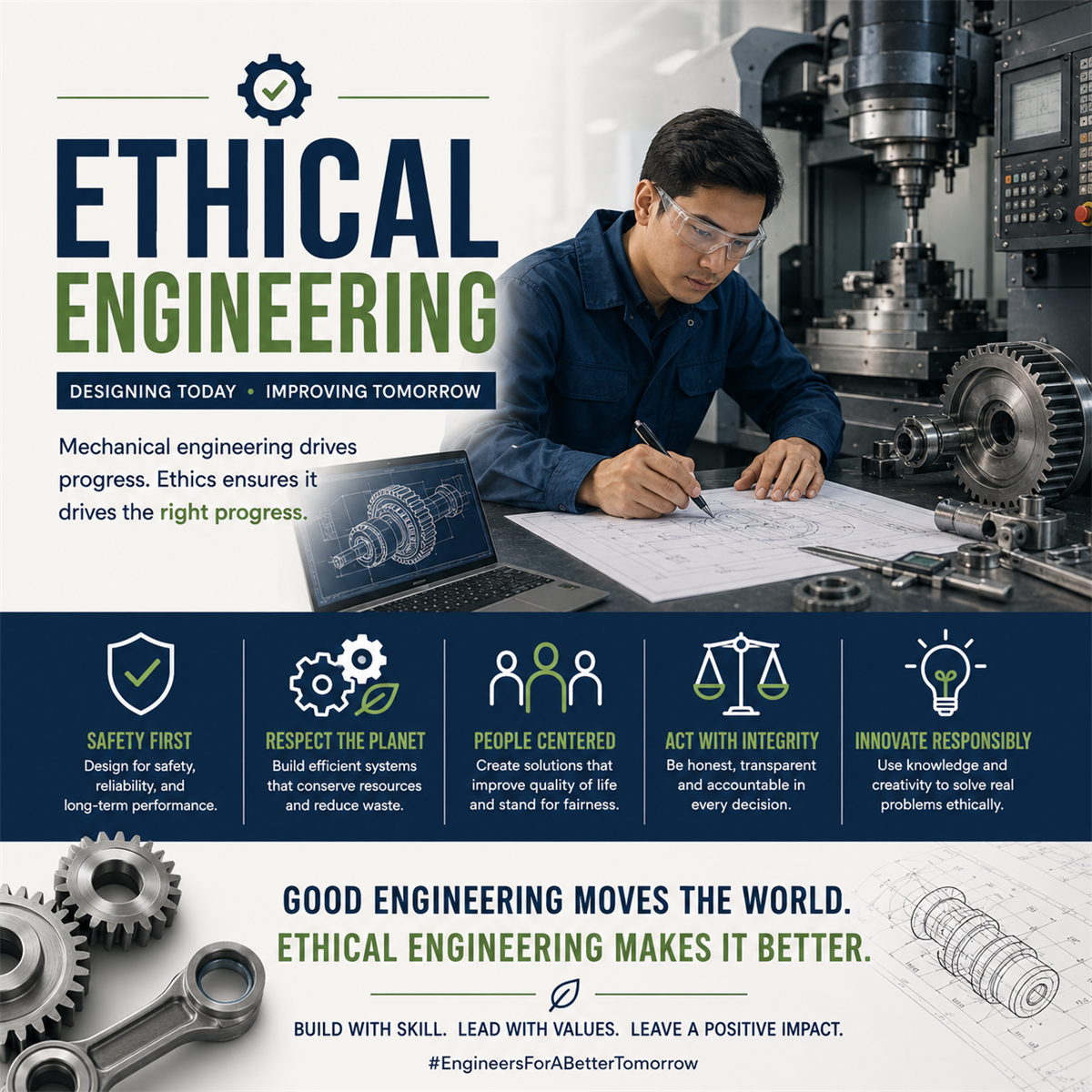
In 2026, the role of the mechanical engineer has shifted from purely functional design to "lifecycle responsibility." This means that the ethical scope of a project extends from the extraction of raw materials to the eventual decommissioning and recycling of the machine.
Sustainable engineering is no longer an optional "extra" but a core ethical mandate. The ASME canons explicitly state that engineers shall strive to comply with the principles of sustainable development. This involves:
- Resource Efficiency: Minimizing waste during the manufacturing process.
- Energy Performance: Designing systems that consume the least amount of energy possible over their operational life.
- Longevity vs. Planned Obsolescence: Ethically, engineers should design products for durability and repairability rather than designing them to fail to drive future sales.
When a mechanical engineer chooses a material that is cheaper but significantly harder to recycle, or one that requires toxic processing methods, they must weigh that decision against their ethical duty to protect the environment for future generations.
Ethical Decision-Making Framework
When faced with an ethical dilemma, mechanical engineers should follow a structured process to ensure their actions align with professional standards.
- Define the Problem: Clearly state the ethical conflict. Is it a matter of safety, honesty, or conflict of interest?
- Gather the Facts: Collect all technical data, specifications, and internal communications related to the issue.
- Identify the Stakeholders: Who will be affected? This includes the public, the client, the employer, and the environment.
- Consult the Codes: Refer specifically to the ASME and NSPE canons.
- Evaluate Options: Consider the consequences of various actions (e.g., staying silent, internal reporting, external whistleblowing).
- Seek Guidance: Discuss the matter with a trusted mentor, a legal professional, or the ethics board of a professional society.
- Take Action: Implement the most ethical solution, ensuring all steps are documented.
Frequently Asked Questions
What is the most important rule in mechanical engineering ethics?
The most important rule is the Paramountcy Rule, which states that engineers must hold paramount the safety, health, and welfare of the public in the performance of their professional duties. All other obligations, including those to employers and clients, are secondary to this fundamental responsibility.
Can an engineer be held legally liable for ethical breaches?
Yes. While ethics and law are distinct, they often overlap. An ethical breach, such as signing off on a design an engineer is not competent to evaluate, can lead to charges of professional negligence. This can result in the loss of a Professional Engineer (PE) license, civil lawsuits, and in cases of gross negligence leading to injury or death, criminal charges.
What should I do if my boss asks me to ignore a safety concern?
You should first document your concern with technical evidence and present it to your boss in writing. If they still insist on ignoring it, you should escalate the issue to the next level of management or the company's ethics officer. If the safety concern poses an immediate threat to the public and the company refuses to act, your ethical code requires you to report the matter to external regulatory authorities.
Is it ethical to accept gifts from vendors?
Generally, no. Both ASME and NSPE codes warn against accepting gifts, hospitality, or commissions from parties dealing with an engineer's client or employer. Accepting such items can create a conflict of interest or the appearance of one, potentially biasing the engineer's judgment in selecting equipment or services. Small, "token" items of nominal value (like a branded pen) are usually permissible, but anything substantial must be declined.
How does "competence" factor into engineering ethics?
Competence is an ethical requirement. Engineers are forbidden from "stamping" or approving plans and documents that deal with subject matter outside their area of expertise. If a mechanical engineer is asked to design a complex electrical control system without the proper training, they must ethically decline the task or bring in a qualified electrical engineer to collaborate.
Final Recommendations for Practitioners
For mechanical engineers practicing in 2026, ethics should not be viewed as a static set of rules learned in university, but as an evolving part of professional development. It is highly recommended to participate in annual ethics training provided by organizations like ASME or the Order of the Engineer. Furthermore, maintaining a detailed professional log of design decisions and the safety rationales behind them serves as both a best practice for engineering quality and a personal safeguard for ethical accountability. Always remember that a mechanical engineer's greatest asset is not their technical skill, but their professional reputation for integrity and public service.
Image Gallery