How to Use Astrodienst Astrocartography: Complete Guide to AstroClick Travel
Astrodienst (Astro.com) provides a free, highly interactive locational astrology tool called AstroClick Travel. By projecting your exact natal birth chart onto a global map, it calculates where planetary lines intersect the four cardin...
Astrodienst (Astro.com) provides a free, highly interactive locational astrology tool called AstroClick Travel. By projecting your exact natal birth chart onto a global map, it calculates where planetary lines intersect the four cardinal angles—Ascendant, Descendant, Midheaven, and Imum Coeli—revealing how specific geographic locations influence career, relationships, creative vitality, and personal development.
Contents
What Is Astrodienst Astrocartography?
Astrocartography, originally developed by astrologer Jim Lewis in the 1970s, is a technique that projects natal planetary positions across the Earth's surface at the exact moment of birth. Instead of evaluating time as a static wheel, locational astrology evaluates space, identifying where each planet was rising, setting, culminating overhead, or positioning at the nadir when you took your first breath.
Astrodienst digitized this complex astronomical calculation through its proprietary AstroClick Travel feature on Astrodienst. The platform calculates geographic coordinates where planetary energies become amplified. When you live in, travel to, or conduct business within proximity of these planetary lines, you experience the concentrated psychological and mundane archetypes of those specific celestial bodies.
The Astronomical Basis of Astrocartography Maps
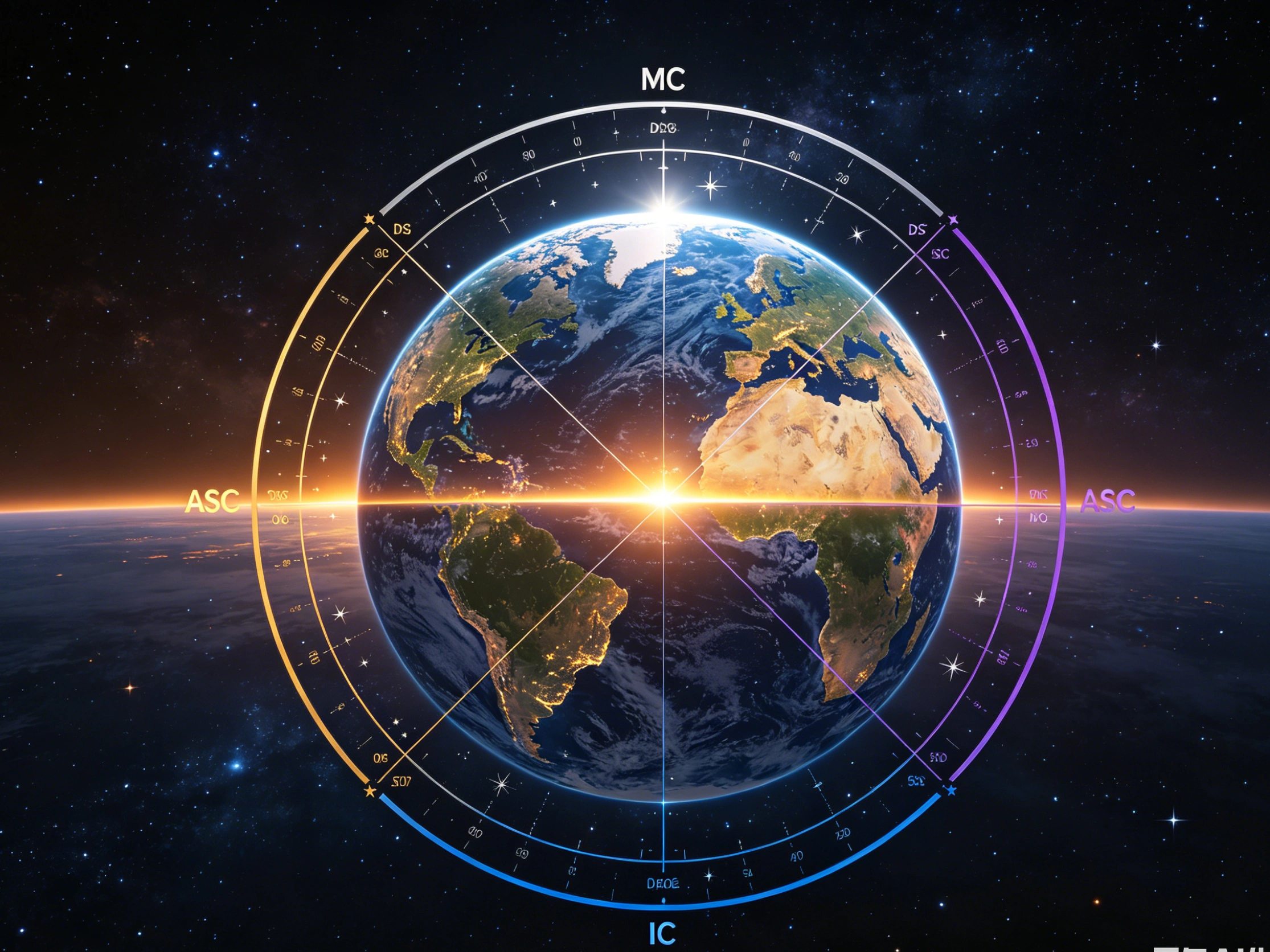
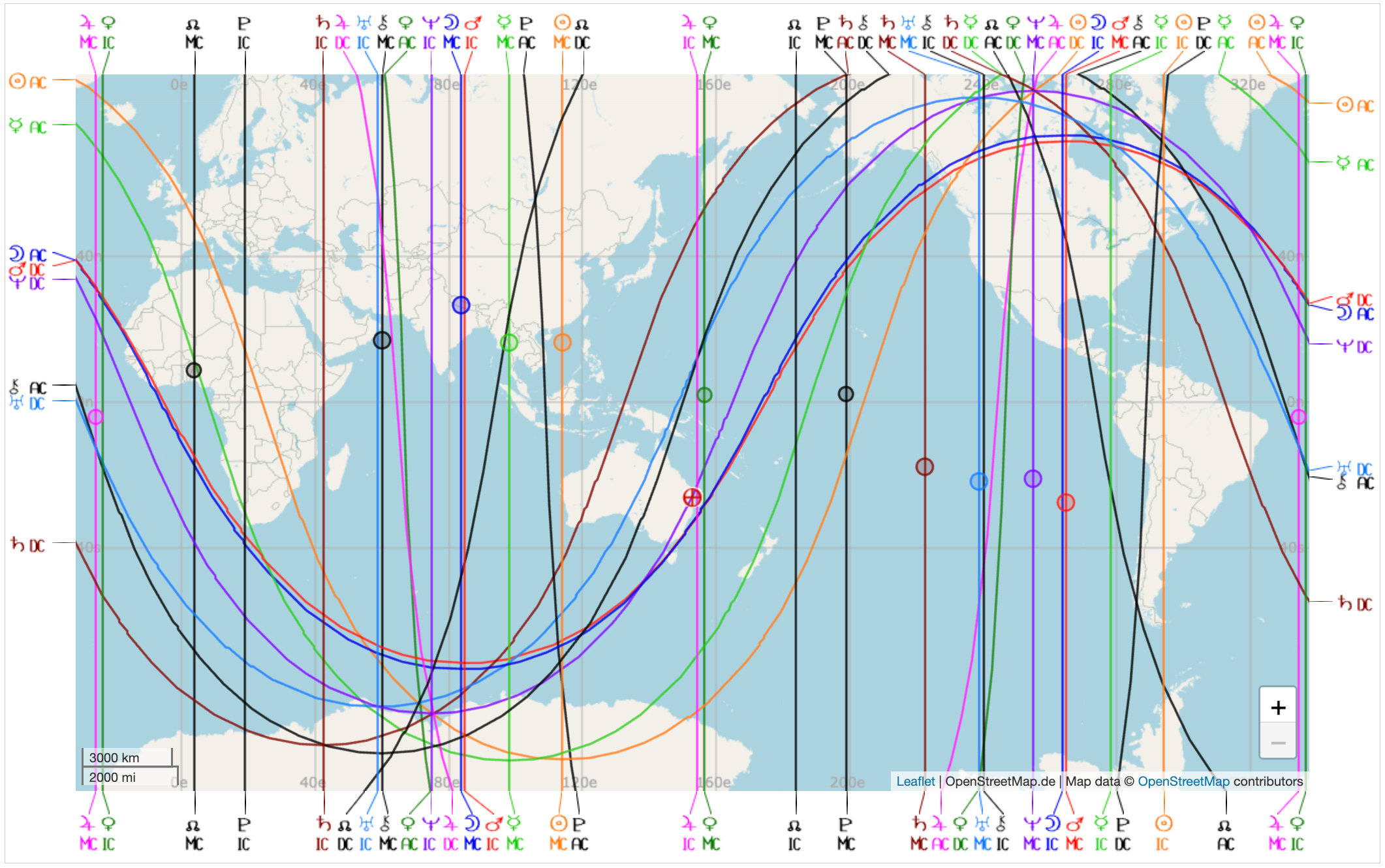
An astrocartography map consists of 40 distinct lines representing the 10 core celestial bodies (Sun through Pluto, plus points like Chiron and the Lunar Nodes) mapped across four principal angles:
- Ascendant (AC): The eastern horizon, representing personal identity, self-expression, physical health, and outward vitality.
- Midheaven (MC): The highest point overhead (Medium Coeli), governing career trajectory, public reputation, social standing, and vocational achievements.
- Descendant (DC): The western horizon, dictating committed partnerships, marriage, interpersonal dynamics, business clients, and open interactions.
- Imum Coeli (IC): The lowest point underground (Nadir), controlling real estate, emotional roots, family life, inner psychology, and private sanctuary.
How to Generate Your Map on Astrodienst
Generating an accurate astrocartography map requires precise birth data. Because the Earth rotates one degree every four minutes, an incorrect birth time by even 15 minutes can shift planetary lines on your global map by up to 100 miles, significantly altering regional interpretations.
Do NOT use ASCII ART. Using plain numbered steps instead. (Self-check: Ensuring zero ASCII art or code blocks in output)
- Gather Precise Birth Details: Secure your exact birth hour, minute, date, and city from an official birth certificate. If your birth time is uncertain, consult a professional astrologer for birth chart rectification before relying on locational lines.
- Navigate to the Free Horoscopes Section: Visit the main menu on Astro.com, hover over "Free Horoscopes," and navigate to the "Locational Astrology" or "Interactive Charts" sub-menu to select AstroClick Travel.
- Enter Data in the Horoscope Birth Data Form: Input your name, gender, birth date, exact birth time (in local time), and birth place. Astrodienst automatically calculates historical daylight saving time offsets and geographic coordinates.
- Launch the AstroClick Travel Interface: Once your birth profile is created, the system generates a global map layered with colored planetary lines. You can drag, zoom, and select individual regions or lines to view location-specific interpretative text written by professional astrologers.
Decoding Planetary Angles: AC, MC, DC, and IC
Understanding how planetary energies manifest across the four cardinal angles is essential for accurate geographical analysis. The angle dictates the life arena where the planet's archetype will express itself.
The Midheaven (MC) Lines: Professional Ambition and Public Image
Planetary lines crossing your Midheaven influence your professional path, career achievements, and how society views you.
Sun-MC Line: An exceptional location for career advancement, leadership roles, and public recognition. You are easily noticed by authority figures and naturally stepped into prominent roles.
Saturn-MC Line: Brings heavy professional responsibilities, structural demands, and slow, disciplined mastery. It builds long-term authority but can initially feel demanding, lonely, or restrictive.
The Ascendant (AC) Lines: Personal Identity and Physical Vitality
Lines crossing your Ascendant directly affect your physical body, personal energy levels, self-perception, and first impressions.
Mars-AC Line: Boosts physical energy, competitiveness, and drive, making it ideal for athletic training or assertive undertakings. However, it can also trigger impatience, personal friction, or physical exhaustion if mismanaged.
Venus-AC Line: Enhances personal charm, physical attractiveness, social ease, and artistic expression. People in these regions tend to respond warmly to your presence.
The Descendant (DC) Lines: Relationships, Contracts, and Mirrors
Descendant lines project planetary archetypes onto external partners, attracting specific personality types into your romantic, social, or professional life.
Jupiter-DC Line: Attracts generous, supportive, and expansive partners or business alliances. It favors legal negotiations, international collaborations, and joint ventures.
Uranus-DC Line: Brings unconventional, stimulating, or unpredictable relationships. While intellectually exciting, long-term stability in partnerships may be challenged by sudden shifts.
The Imum Coeli (IC) Lines: Home, Roots, and Internal Foundations
The Imum Coeli represents your private baseline, emotional comfort, real estate success, and connection to ancestry.
Moon-IC Line: Instills a deep sense of belonging, emotional safety, and domestic comfort. It is an ideal zone for settling down, raising a family, or processing internal psychological healing.
Pluto-IC Line: Triggers intense personal transformations at the root level. Residential life may involve major renovations, deep psychological purging, or confrontational ancestral patterns.
Core Planetary Line Interpretations
Each celestial body imparts a unique energetic signature to its geographic path. Below is a detailed breakdown of how major planets operate across astrocartography maps.
| Celestial Body | Positive Archetypal Manifestations | Potential Challenges / Shadow Aspects | Best Suited For |
|---|---|---|---|
| Sun | High vitality, clarity of purpose, confidence, visibility, executive capacity. | Egotism, burnout, authority clashes, overexposure. | Career launching, personal branding, recovering vitality. |
| Moon | Emotional warmth, strong intuition, domestic ease, community integration. | Oversensitivity, mood swings, lack of boundaries, dependency. | Establishing home, family planning, creative writing, resting. |
| Mercury | Intellectual sharpness, fluent communication, trade success, active networking. | Mental restlessness, nervous anxiety, information overload, superficiality. | University studies, writing projects, commercial trade, media work. |
| Venus | Financial opportunities, social harmony, artistic beauty, romantic attraction. | Indulgence, laziness, overspending, surface-level connections. | Dating, creative retreats, luxury travel, financial partnerships. |
| Mars | Ambition, physical stamina, decisive action, courage, high libido. | Conflict, accidents, irritability, burnout, aggressive confrontations. | Fitness conditioning, startup execution, breaking through inertia. |
| Jupiter | Abundance, luck, educational growth, spiritual insight, optimism. | Overextension, excess spending, complacency, exaggerated expectations. | Higher education, publishing, international business, recovery. |
| Saturn | Discipline, structure, maturity, long-term stability, skill acquisition. | Isolation, delays, heavy administrative burdens, melancholia. | Deep research, mastering difficult skills, long-term capital investments. |
| Uranus | Innovation, freedom, breakthrough discoveries, awakening, originality. | Instability, sudden disruptions, nervous system stress, detachment. | Tech innovation, radical lifestyle pivots, unconventional work. |
| Neptune | Spiritual depth, artistic inspiration, empathy, meditation, imagination. | Disillusionment, vagueness, miscommunication, lack of boundaries. | Artistic production, spiritual retreats, meditation, deep rest. |
| Pluto | Power, deep psychological healing, financial empowerment, regeneration. | Control battles, power struggles, upheaval, intense emotional strain. | Deep therapy, major life reinvention, high-stakes turnarounds. |
| Chiron | Holistic healing, teaching mastery, vulnerability, profound self-acceptance. | Reactivation of core wounds, feeling like an outsider, emotional sensitivity. | Facilitating therapy, mentorship, medical recovery, holistic arts. |
Technical Nuances: Orbs, Parans, and Relocation Charts
Interpreting an Astrodienst map accurately requires looking beyond major planetary lines. Three critical technical variables dictate whether a location will produce positive or challenging results:
1. Line Proximity and Orbs of Influence
A planetary line does not stop exerting influence directly on its plotted geographic coordinate. Astrologers generally accept an orb of influence extending up to 300 miles (approximately 500 kilometers) on either side of a line.
Direct Line (0–50 Miles): The planetary energy operates at maximum intensity. Events associated with the planet tend to manifest in visible, undeniable ways.
Moderate Proximity (50–200 Miles): The planetary atmosphere is clearly active and easily accessible through intentional engagement.
Outer Boundary (200–350 Miles): The influence becomes subtle, functioning as an underlying background theme rather than a dominant force.
2. Latitude Crossings and Parans
When two planetary lines intersect across latitude on the map, they form a Paran point (short for Paranatellona). Parans create a blended, horizontal energy band across that specific latitude worldwide, combining the archetypes of both involved planets regardless of longitude.
For instance, if a Jupiter-MC line intersects a Sun-AC line at 40° North latitude, that entire latitude band carries an underlying theme of creative leadership and expansion, coloring any local experience near that parallel.
3. Calculating Relocation Charts
A common mistake in locational astrology is relying solely on astrocartography lines without generating a Relocation Chart.
While an astrocartography map shows where natal planets cross the four angles worldwide, a Relocation Chart recalculates your natal chart as if you were born at the target destination (keeping the exact universal UTC birth time). This shifts your natal planets into new chart houses.
Rule of Relocation Analysis: If a location places your natal Saturn into the 12th House of your relocation chart, you may experience psychological isolation or sleep disruptions, even if you are visiting a supportive Venus line on the astrocartography map. Always cross-reference the line on AstroClick Travel with a calculated Relocation Chart on Astrodienst's Extended Chart Selection page.
Comparing Locational Astrology Approaches
Different locational techniques solve different geographic questions. The table below outlines how Astrodienst's interactive tools compare across methodologies.
| Technique | Primary Purpose | Best Used For | Astrodienst Tool Name |
|---|---|---|---|
| Astrocartography (ACG) | Displays angular planetary lines globally. | Selecting countries, major cities, or broad regional targets. | AstroClick Travel |
| Relocation Chart | Recalculates natal house placements for a new city. | Evaluating local daily life, specific house focus, and local challenges. | Extended Chart Selection (Relocation) |
| Local Space Astrology | Maps directional compass vectors radiating from your location. | Micro-relocation, arranging house furniture, local city navigation. | Local Space Map (Special Charts) |
| CycloCartoGraphy (CCG) | Blends secondary progressions and transits with geography. | Timing short-term moves, business trips, or temporary sabbaticals. | Extended Chart Selection (Advanced) |
Common Misinterpretations and Troubleshooting
Locational astrology requires balanced analysis. Avoid these frequent analytical errors when using Astrodienst:
Over-Relying on "Benefic" Lines
Many beginners assume that moving to a Jupiter or Venus line guarantees instant wealth, effortless romance, and constant happiness. However, if your natal chart features a poorly aspected Venus (e.g., Venus square Saturn or square Pluto natally), moving to a Venus line will bring those underlying natal patterns into sharper focus rather than magically erasing them.
Fearing "Malefic" Lines
Similarly, people often panic when discovering they live near a Saturn, Mars, or Pluto line. These lines are not inherently toxic; they represent specific modes of growth.
- A Saturn line is ideal for completing a doctoral thesis, building a structured enterprise, or developing personal discipline.
- A Pluto line provides the exact psychological leverage needed to break destructive habits and execute profound personal reinventions.
Neglecting Natal Aspect Configurations
Your natal chart remains your primary energetic blueprint. A planetary line on an astrocartography map simply acts as a volume dial for that specific natal planet. If a planet is well-supported by trines and sextiles in your birth chart, its line on the map will yield smooth, productive results. If the planet is heavily challenged in your birth chart, its geographic line requires greater conscious effort and maturity to navigate.
Step-by-Step Practical Workflow for Selecting a Destination
Follow this systematic workflow when choosing a location for travel, career advancement, or relocation using Astrodienst:
Do NOT use ASCII ART. Using clean numbered steps.
- Clarify Your Primary Goal: Determine what you want to cultivate (e.g., career growth, romantic connection, creative focus, rest, or academic study).
- Identify Corresponding Planetary Archetypes: Match your goal to the appropriate planets (e.g., Sun/Jupiter for career, Venus/Moon for relationships and home, Mercury for writing/studies).
- Scan the AstroClick Travel Map: Locate geographic zones where these target planetary lines run close to your desired cities (aiming for within 200 miles of an AC, MC, DC, or IC line).
- Inspect Line Intersections (Parans): Check for intersecting lines or latitude crossings that introduce secondary planetary dynamics to the area.
- Generate a Relocation Chart on Astro.com: Go to "Extended Chart Selection," set your natal data, and input the candidate city as the location. Verify which house placements these planets occupy.
- Review Current Transits and Progressions: Ensure major transit movements (such as Saturn or Pluto transits) align favorably with the relocated chart angles for your intended timing.
Frequently Asked Questions
How accurate is Astrodienst's AstroClick Travel tool?
Astrodienst uses Swiss Ephemeris algorithms, providing highly accurate planetary and geographic coordinates. However, accuracy depends on the precision of your input birth time down to the minute.
What happens if I live far away from any planetary lines?
Living far from any major planetary line (e.g., more than 400 miles) is common and usually means your experience in that location is governed primarily by your Relocation Chart house placements rather than intense, concentrated planetary line energies.
Can astrocartography work for short trips and vacations?
Yes. Short trips to specific planetary lines can temporarily activate those energies. A vacation to a Venus or Moon line can promote deep relaxation, while a trip to a Mercury line can help unlock creative blockages or accelerate research projects.
What is the difference between an astrocartography map and a relocation chart?
An astrocartography map shows global planetary lines where planets cross the four angles. A relocation chart recalculates your entire natal wheel for a single city, revealing how natal planets shift into new house sectors.
Does moving to a new line change my original natal birth chart?
No. Your natal chart is your lifelong, unalterable energetic blueprint. Relocating simply shifts where specific natal energies are emphasized or brought into daily focus.
Strategic Application of Locational Astrology
Astrocartography is a practical tool for conscious living rather than a system of deterministic fate. Astrodienst's AstroClick Travel provides clear, accessible insights into how geographic environments interact with your individual astrological makeup. Whether you are planning a international move, launching a remote business targeting specific cities, or choosing a destination for rest, cross-referencing planetary lines with relocation charts empowers you to navigate spatial energies with strategy, alignment, and clarity.
Image Gallery