Most Conservative States: Comprehensive Data Analysis and Rankings
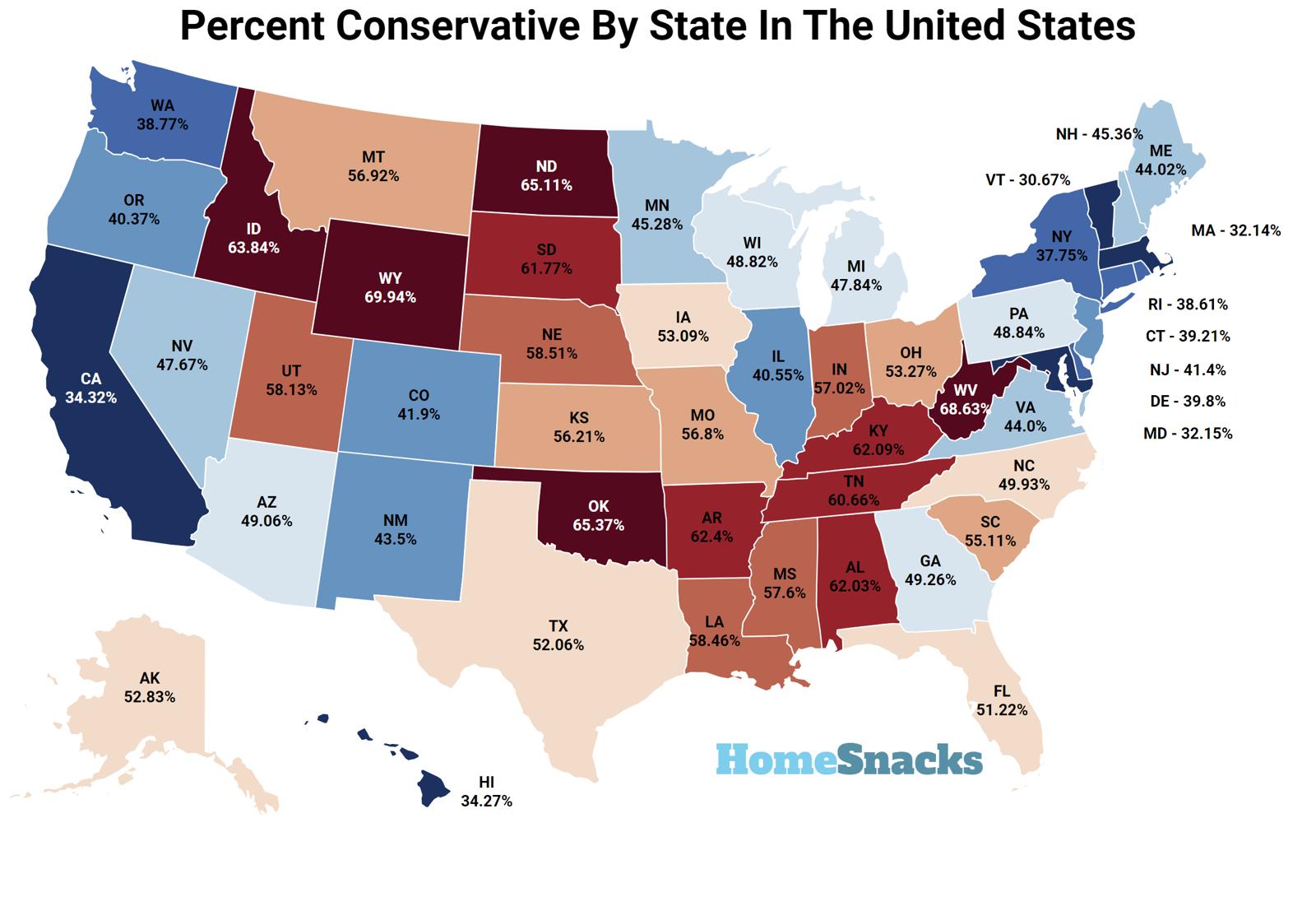
Wyoming, West Virginia, North Dakota, Idaho, and Oklahoma consistently rank as the most conservative states in the United States. These rankings are calculated using composite political metrics, including the Cook Partisan Voting Index...
Wyoming, West Virginia, North Dakota, Idaho, and Oklahoma consistently rank as the most conservative states in the United States. These rankings are calculated using composite political metrics, including the Cook Partisan Voting Index (PVI), self-identified ideological polling, sustained state government trifectas, and legislative policy frameworks that prioritize low state taxation, deregulation, and social conservatism.
Contents
Quantitative Frameworks for Measuring State Conservatism
Determining political orientation across U.S. states requires an objective, multi-variable approach rather than reliance on single-election outcomes. Political scientists, policy analysts, and demographic researchers use four primary metrics to evaluate where states fall along the ideological spectrum.
Cook Partisan Voting Index (PVI)
Developed by the Cook Political Report, the Partisan Voting Index measures how strongly a state leans toward the Republican or Democratic Party compared to the nation as a whole. Calculated by analyzing candidate performance across the preceding two presidential elections relative to the national average, a higher "R+" rating indicates a deeper conservative voting pattern.
Ideology Polling and Self-Identification
Survey data from non-partisan research firms, such as Gallup and the Pew Research Center, captures voters' self-identified political ideology. High percentages of residents identifying as "conservative" rather than "moderate" or "liberal" provide a baseline measurement of grass-roots ideological orientation.
State Government Control (Trifectas and Supermajorities)
A political trifecta occurs when a single political party holds the governor’s office and majorities in both chambers of the state legislature. In the most conservative states, Republican control often extends beyond simple majorities to veto-proof supermajorities. This continuous legislative control enables the passage of signature conservative policies without significant institutional friction.
Economic and Regulatory Policy Rankings
Indices produced by non-partisan and policy research institutes—such as the Tax Foundation’s State Business Tax Climate Index and the Mercatus Center’s Freedom in the 50 States report—evaluate state governance based on tangible economic metrics. Key factors include state income tax rates, regulatory burdens, right-to-work legislation, and fiscal expenditure caps.
Conservative policy frameworks typically prioritize flat or non-existent income tax systems, strict spending caps, limited administrative regulation, and strong protection of property rights. These structural choices directly reflect the voting preferences of conservative electorates.
Detailed Profile of the Top Conservative States
1. Wyoming
Wyoming routinely ranks as the most conservative state in the nation. With a Cook PVI frequently sitting at or above R+25, the state demonstrates deep-seated conservative preferences across federal, state, and local levels.
- Political Structure: Republican trifecta with veto-proof legislative supermajorities exceeding 85% in both the Senate and House of Representatives.
- Fiscal Policy: Wyoming levies zero personal or corporate state income taxes, relying primarily on severance taxes from mineral and energy extraction.
- Key Legislative Priorities: Protection of energy sector development (coal, oil, and gas), expansive constitutional carry laws for firearms, and strict regulatory limits on state agencies.
2. West Virginia
West Virginia has undergone a dramatic political realignment over the past two decades, transitioning from a union-heavy Democratic stronghold to one of the most staunchly conservative states in the country.
- Political Structure: R+22 Cook PVI rating accompanied by dominant Republican majorities across state offices and judicial appointments.
- Fiscal Policy: Recent legislative reforms have aggressively reduced state personal income tax brackets, aiming for a long-term phase-out of personal income taxes entirely.
- Key Legislative Priorities: Strong support for domestic fossil fuel extraction, expanded educational choice via universal education savings accounts (ESAs), and strict restrictions on reproductive procedures.
3. North Dakota
North Dakota’s political climate is defined by agrarian economic values, energy independence initiatives, and fiscal restraint.
- Political Structure: Consistent Republican trifecta with supermajority legislative control. Voters in North Dakota consistently return conservative candidates to federal offices by wide margins.
- Fiscal Policy: Maintains low personal and corporate income tax rates alongside a strong Legacy Fund derived from oil and gas royalties to maintain low overall state debt.
- Key Legislative Priorities: Agricultural deregulation, protection of natural resource development, and family-focused social legislation.
4. Idaho
Idaho’s conservative profile combines mountain-west libertarian principles with traditional social conservatism. The state has experienced significant population growth driven partly by political migration from West Coast states.
- Political Structure: Continuous Republican trifecta governance for decades, maintaining an R+18 to R+20 Cook PVI.
- Fiscal Policy: Transitioned to a low flat income tax rate, alongside constitutional requirements for balanced state budgets and strict spending caps.
- Key Legislative Priorities: Universal school choice programs, strong Second Amendment protections, protection of agricultural water rights, and strict limits on administrative rule-making.
5. Oklahoma
Oklahoma holds a unique position in American elections: every single county in the state has voted for the Republican presidential nominee in consecutive election cycles for over two decades.
- Political Structure: Unified Republican executive and legislative control with R+18 Cook PVI.
- Fiscal Policy: Aggressive tax-reduction strategies, including the elimination of state grocery taxes and reductions in individual income tax rates.
- Key Legislative Priorities: Expansive private school voucher availability, protection of traditional energy manufacturing, and comprehensive restrictions on federal administrative mandates.
6. Alabama
Alabama exemplifies traditional Southern conservatism, characterized by religious cultural foundations, fiscal restraint, and strong support for national defense and law enforcement.
- Political Structure: Republican supermajorities in the State House and Senate, supported by an R+15 Cook PVI baseline.
- Fiscal Policy: Low property tax rates combined with steady budget stabilization funds designed to limit state spending growth.
- Key Legislative Priorities: Enactment of constitutional carry rights, strict limits on public union payroll deductions, and robust protections for faith-based institutions.
Comparative Data Analysis of Top Conservative States
The table below outlines key political, fiscal, and governance metrics across the top conservative states.
| State | Cook PVI Rating | State Government Control | State Individual Income Tax Structure | Universal School Choice Status | Constitutional Carry Enacted |
|---|---|---|---|---|---|
| Wyoming | R+25 | Republican Trifecta | 0.00% (No Income Tax) | Enacted / Phased | Yes |
| West Virginia | R+22 | Republican Trifecta | Graduated (Top Rate ~4.7%) | Universal ESA Active | Yes |
| North Dakota | R+20 | Republican Trifecta | Low Graduated (Top Rate 2.5%) | Limited / Proposed | Yes |
| Idaho | R+19 | Republican Trifecta | Flat Rate (5.69%) | Universal Tax Credit / ESA | Yes |
| Oklahoma | R+18 | Republican Trifecta | Graduated (Top Rate ~4.75%) | Universal Tax Credit Active | Yes |
| Alabama | R+15 | Republican Trifecta | Graduated (Top Rate 5.0%) | Enacted (Phasing to Universal) | Yes |
| South Dakota | R+16 | Republican Trifecta | 0.00% (No Income Tax) | Limited | Yes |
| Mississippi | R+14 | Republican Trifecta | Flat Rate (4.0%) | Targeted | Yes |
| Arkansas | R+16 | Republican Trifecta | Graduated (Top Rate ~3.9%) | Universal LEARNS Act | Yes |
Policy Pillars Defining Conservative State Governance
Conservative policy across state capitals centers on several key legislative initiatives that reflect the economic and social principles of their electorates.
- State Policy Priorities in Conservative Jurisdictions
- Fiscal Strategy
- Income Tax Reductions
- Spending Caps
- Sovereign Wealth
- Regulatory Landscape
- Reduced Permitting Time
- Right-to-Work Laws
- Deregulated Energy
- Individual Rights
- Constitutional Carry
- School Choice Vouchers
- Parental Rights Laws
- Fiscal Strategy
1. Tax Structure and Fiscal Restraint
Conservative states emphasize tax policies designed to incentivize capital investment, business relocation, and personal income retention.
- Income Tax Elimination or Flattening: States like Wyoming and South Dakota levy no personal income tax. Others, including Idaho and Mississippi, have shifted from progressive multi-tier tax brackets to flat-rate systems.
- Balanced Budget Mandates: Strict statutory and constitutional limits govern state spending, preventing deficit spending and requiring structural reserves (often called "Rainy Day Funds").
2. Labor and Business Deregulation
Economic conservatism at the state level privileges market-based solutions over government intervention.
- Right-to-Work Legislation: Nearly all top conservative states maintain right-to-work laws, prohibiting collective bargaining agreements that compel workers to pay union dues as a condition of employment.
- Occupational Licensing Reform: Recent legislative trends include universal recognition of out-of-state professional licenses, lowering barriers to entry for skilled trades and professionals moving into the state.
3. School Choice and Educational Reform
Educational governance has become a focal point of legislative activity in conservative states.
- Education Savings Accounts (ESAs): States such as West Virginia, Oklahoma, and Arkansas have implemented broad ESA policies, allowing state education funds to follow students to private, parochial, or home-school environments.
- Curriculum Transparency: Enactment of legislation requiring public school districts to publish instructional materials online and enforcing parental notification policies regarding student welfare.
Relocation Considerations: Economic and Infrastructure Realities
For individuals and businesses evaluating relocation to conservative states, governance strategies produce specific economic environments alongside distinct public infrastructure trade-offs.
Economic Advantages
- Lower Total Tax Burdens: Reduced personal income, business, and property tax burdens allow households to retain a larger percentage of gross earnings.
- Affordable Cost of Living: Housing costs in states such as West Virginia, Oklahoma, and Alabama remain well below the national median, improving purchasing power.
- Favorable Commercial Climate: Business-friendly regulatory frameworks shorten commercial building permitting timelines and lower corporate compliance costs.
Structural Trade-offs and Considerations
- Public Services and Infrastructure Spending: Lower tax revenue models often result in lower per-pupil public school spending and variable state highway spending compared to higher-tax jurisdictions.
- Healthcare Infrastructure: Several conservative states have opted out of optional Medicaid expansion programs or maintain fewer rural hospital networks, affecting medical access in non-metropolitan counties.
- Local Government Autonomy: State legislatures in conservative states frequently exercise preemption powers, blocking municipal governments from imposing local minimum wage increases, energy restrictions, or specialized tenant regulations.
Frequently Asked Questions
What is the single most conservative state in the United States?
Wyoming is widely recognized as the most conservative state based on statistical metrics. It holds the highest Cook Partisan Voting Index rating (R+25) and consistent Republican majorities in its state legislature exceeding 85%.
How do researchers measure whether a state is conservative?
Researchers evaluate states using a combination of the Cook Partisan Voting Index (PVI), voter self-identification surveys, partisan control of state government offices (trifectas), and policy scores tracking tax burdens, regulatory frameworks, and social legislation.
Which conservative states have no personal state income tax?
Wyoming, South Dakota, Texas, Florida, and Tennessee maintain no personal state income tax on earned wages. These states fund government services primarily through sales taxes, property taxes, and natural resource severance taxes.
What is driving political migration toward conservative states?
Voters and business owners often relocate to conservative states seeking lower tax rates, more affordable housing markets, deregulation, favorable business climates, and aligned social policies, particularly in Sun Belt and Intermountain West states.
What is the difference between Cook PVI and self-identified ideology polling?
Cook PVI measures actual voting behavior in federal presidential elections relative to national averages. Self-identified ideology polling tracks how residents describe their political views (conservative, moderate, or liberal) in survey interviews, regardless of how they cast their ballots.
Strategic Policy Outlook
Understanding the political, fiscal, and regulatory frameworks of the most conservative states is essential for demographic researchers, site selection consultants, and citizens evaluating relocation. As state-level policy environments continue to diverge across the nation, jurisdictions maintaining conservative governance models remain anchored in low-tax strategies, regulatory restraint, and expanded individual educational options. To evaluate how these state profiles compare to your specific tax, business, or lifestyle requirements, consult the official legislative and revenue portals for each state.
Image Gallery