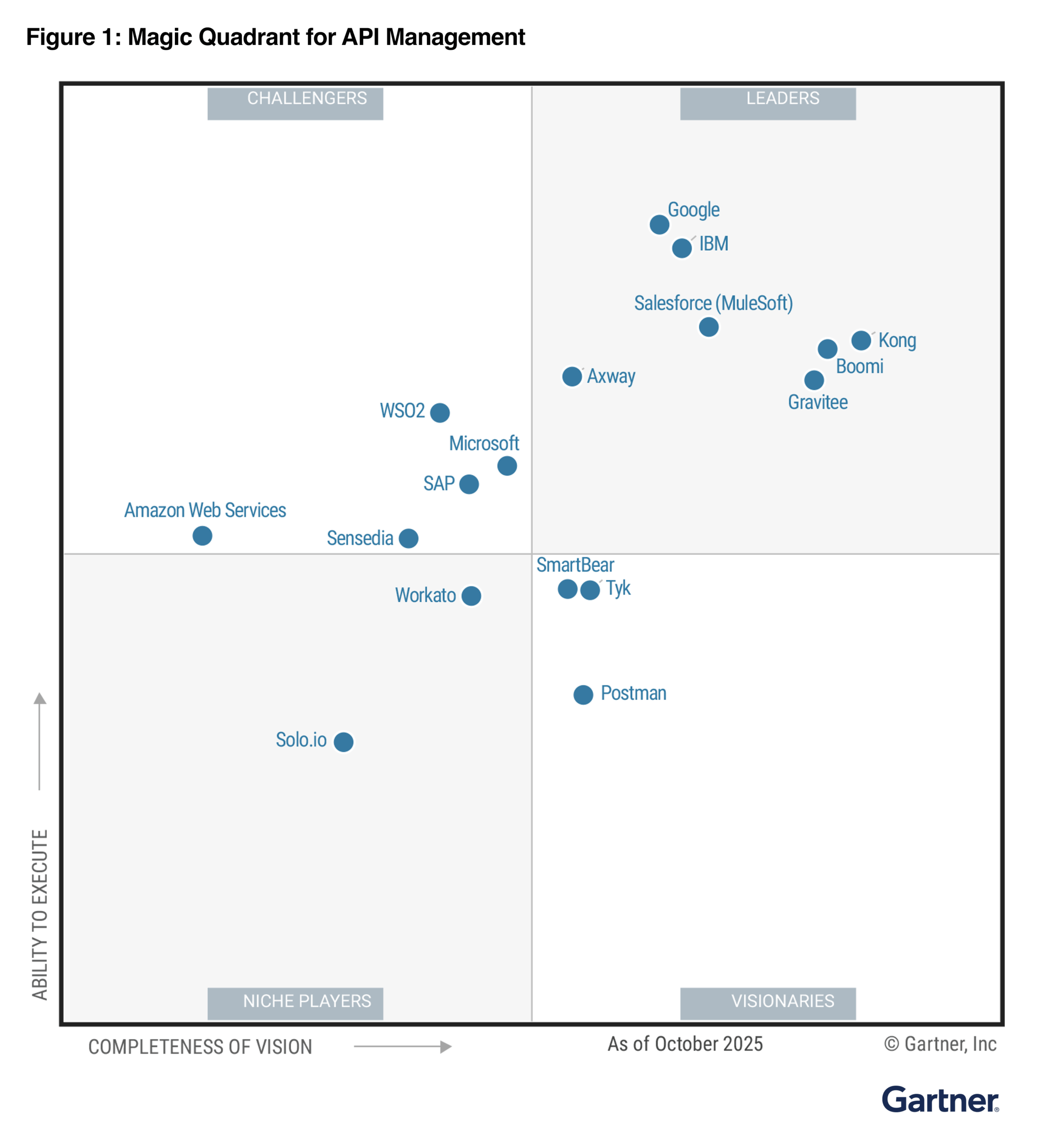
Navigating the 2025 Gartner Magic Quadrant for API Management
The 2025 Gartner Magic Quadrant for API Management serves as the definitive benchmark for evaluating vendors in an era where APIs are the primary connective tissue for AI integration and hybrid-cloud architectures. This report highligh...
The 2025 Gartner Magic Quadrant for API Management serves as the definitive benchmark for evaluating vendors in an era where APIs are the primary connective tissue for AI integration and hybrid-cloud architectures. This report highlights a shift toward "API Platforms" that prioritize security, developer experience, and the orchestration of LLM-based services over traditional gateway functions.
Contents
API management has evolved from a niche middleware requirement into a foundational pillar of modern enterprise architecture. As we look back from 2026, the 2025 Gartner Magic Quadrant (MQ) represents a pivotal moment when the industry transitioned from managing simple RESTful interfaces to governing complex, multi-protocol ecosystems involving GraphQL, gRPC, and specialized AI endpoints. For IT leaders and procurement teams, this report remains the primary tool for distinguishing between legacy vendors and those capable of supporting the next decade of digital transformation.
The Evolution of API Management in 2025
The 2025 evaluation cycle arrived at a time of significant technical volatility. Organizations were no longer satisfied with basic rate limiting and authentication; they demanded "full-lifecycle" management that integrated seamlessly with CI/CD pipelines and internal developer portals. Gartner's 2025 analysis reflected this by placing a higher premium on "Completeness of Vision" for vendors who addressed the "API-sprawl" caused by microservices and the rapid adoption of Generative AI.
In the 2025 landscape, the "Ability to Execute" was measured not just by market share, but by the robustness of a vendor's global SaaS infrastructure and their ability to provide unified governance across distributed environments. This was the year when "Federated API Management" moved from a buzzword to a core requirement, as enterprises sought to manage APIs living across AWS, Azure, Google Cloud, and on-premises data centers through a single "pane of glass."
Identifying the Leaders: Market Dominance in 2025
The "Leaders" quadrant in 2025 was occupied by firms that demonstrated both a high degree of innovation and a proven track record of supporting large-scale, mission-critical deployments. These vendors successfully bridged the gap between traditional enterprise needs and the agility required by modern DevOps teams.
Google (Apigee)
Google’s Apigee platform continued its long-standing dominance in 2025. Its primary strength lies in its deep integration with Google Cloud’s AI and machine learning suite. In the 2025 report, Apigee was lauded for its "Advanced API Security" module, which utilizes AI to detect anomalous traffic patterns and potential BOLA (Broken Object Level Authorization) attacks in real-time. For organizations heavily invested in the Google ecosystem, Apigee offered the most seamless path to scaling global API programs.
Kong
Kong maintained its position as a top-tier Leader by doubling down on high-performance, cloud-native architecture. In 2025, Kong’s move toward a unified "Kong Konnect" platform allowed it to appeal to both the "bottom-up" developer crowd and the "top-down" enterprise architects. Gartner specifically noted Kong's leadership in the service mesh space and its ability to handle ultra-low latency requirements for high-frequency financial services and real-time data streaming.
MuleSoft (Salesforce)
MuleSoft’s position in 2025 was reinforced by its "Anypoint Platform," which remains the gold standard for integration-led API management. While often perceived as a more expensive option, its ability to weave together legacy systems with modern SaaS applications through "Composer" and "DataWeave" made it indispensable for complex digital transformations. The 2025 evaluation highlighted MuleSoft's success in enabling "citizen integrators" while maintaining strict IT governance.
Microsoft
Microsoft’s Azure API Management (APIM) benefited significantly from the explosion of OpenAI-related development on Azure. By 2025, Microsoft had integrated comprehensive "AI Gateway" features into APIM, allowing developers to manage tokens, rate-limit LLM calls, and monitor the performance of AI-driven applications. This strategic alignment with the "AI-first" enterprise solidified its position in the Leaders quadrant.
Challengers, Visionaries, and Niche Players
Beyond the Leaders, the 2025 Magic Quadrant highlighted several vendors making significant moves in specialized segments.
- Challengers: These vendors, such as IBM and Software AG (webMethods), offered powerful, reliable tools with massive installed bases. Their challenge in 2025 was maintaining the pace of innovation compared to cloud-native startups, though their support for hybrid and "sovereign cloud" environments remained a key differentiator for government and highly regulated sectors.
- Visionaries: Companies like Postman and Tyk were recognized for pushing the boundaries of what an API platform can be. Postman’s transition from a testing tool to a full-lifecycle platform was a major narrative in the 2025 report, focusing heavily on the "design-first" philosophy.
- Niche Players: This quadrant included vendors like Axway and Broadcom (Layer7). These firms often focus on specific industries or legacy modernization use cases. In 2025, their value proposition centered on deep domain expertise and the ability to provide stable, long-term support for massive on-premises API gateways that newer SaaS vendors struggle to replace.
Key Technical Trends Evaluated in 2025
The 2025 Gartner report did not just rank vendors; it defined the technical standards that separated the "average" from the "excellent." Several key trends dominated the evaluation criteria:
- AI Gateway Capabilities: With the rise of Large Language Models (LLMs), vendors were evaluated on their ability to manage "AI APIs." This includes features like prompt caching (to reduce costs), semantic rate-limiting, and PII (Personally Identifiable Information) masking within API payloads.
- Internal Developer Portals (IDP): The integration of API catalogs with broader IDPs (often based on the Backstage.io framework) became a major evaluation point. Gartner emphasized that APIs are useless if developers cannot find, test, and subscribe to them easily.
- API Security Convergence: The 2025 MQ noted a merging of API management with WAAP (Web Application and API Protection). Leaders were expected to offer integrated threat protection that goes beyond simple OAuth/OIDC implementation.
- Multi-Gateway Federation: As companies realized that no single vendor would own 100% of their API traffic, the ability for a "Manager of Managers" to govern APIs across multiple different gateways (e.g., managing AWS Lambda APIs and on-premise Apigee gateways in one dashboard) became a "Visionary" trait.
Comparative Overview of Top 2025 Vendors
| Vendor | Primary Strength | Ideal Use Case | Deployment Model |
|---|---|---|---|
| Google (Apigee) | AI-driven security & Global Scale | Large-scale, cloud-native enterprise | SaaS, Hybrid, Private Cloud |
| Kong | Latency & Multi-cloud flexibility | Microservices & High-performance apps | SaaS, Hybrid, Kubernetes |
| MuleSoft | Integration & Data Transformation | Complex legacy-to-SaaS migrations | SaaS, Hybrid, On-Prem |
| Microsoft | Azure ecosystem & AI integration | Azure-centric enterprises | SaaS (Azure) |
| IBM | Robustness & Regulatory Compliance | Banking, Government, & Mainframe | Hybrid, On-Prem, IBM Cloud |
| Postman | Developer Experience (DevEx) | Design-first API development teams | SaaS |
The "Critical Capabilities" Supplement
While the Magic Quadrant visualizes the market position, Gartner’s 2025 "Critical Capabilities for API Management" provided the raw data behind the rankings. This companion report scored vendors across specific use cases:
- Internal API Management: Focuses on service-to-service communication, service discovery, and developer productivity.
- External API/Ecosystem Management: Prioritizes the developer portal, monetization features, and public-facing security.
- Multi-Cloud Governance: Evaluates the consistency of policy enforcement across diverse cloud environments.
- Adaptive Governance: Measures how well the platform handles different "speeds" of development, from agile startups to slow-moving legacy systems.
Strategic Recommendations for Procurement
Selecting a vendor based on the 2025 Magic Quadrant requires more than just picking a name from the top-right corner. Organizations should follow a structured evaluation process based on the report’s findings:
- Audit Your Protocol Needs: If your roadmap includes heavy use of AsyncAPI (Kafka/RabbitMQ) or GraphQL, ensure your chosen "Leader" has native, first-class support for these protocols, as some 2025 vendors still treated them as secondary to REST.
- Consider the "Total Cost of Ownership" (TCO): High-end Leaders like MuleSoft and Apigee offer immense power but come with significant licensing and operational costs. Ensure the complexity of your environment justifies the investment.
- Focus on Security Integration: In 2025, API-based breaches were the leading cause of data loss. Prioritize vendors that offer integrated behavioral analysis and automated discovery of "Shadow APIs" (APIs that exist outside of official governance).
Frequently Asked Questions
How often does Gartner update the Magic Quadrant for API Management?
Gartner typically updates this Magic Quadrant every 12 to 18 months. The 2025 report followed the late 2023/early 2024 cycle, reflecting the massive shift toward AI-centric API governance that occurred throughout 2024.
Can I access the 2025 Gartner Magic Quadrant for free?
While the full report is behind a Gartner paywall for subscribers, many of the vendors listed in the "Leaders" quadrant (such as Google, Kong, or Microsoft) typically license the report for distribution. You can often find a complimentary copy on their official websites in exchange for basic contact information.
What is the difference between an API Gateway and API Management?
An API Gateway is a technical component that handles the request/response flow (security, routing, rate limiting). API Management refers to the entire lifecycle, including the developer portal, analytics, documentation, monetization, and policy governance. The 2025 MQ evaluates the latter, though the quality of the gateway remains a core component.
Why did some vendors drop in ranking in the 2025 report?
Vendors typically drop in the rankings if they fail to modernize their architecture (e.g., lack of native Kubernetes support) or if they do not provide a clear roadmap for emerging requirements like AI governance and federated multi-cloud management.
Is a "Leader" always the best choice?
Not necessarily. A "Niche Player" might be a better fit if they have deep expertise in your specific industry or if your technical requirements are very narrow. For example, if you only need to manage a few legacy APIs on-premises, a lightweight Niche Player might offer better ROI than a complex Leader platform.
Next Steps for Organizations
For those moving forward with the insights from the 2025 Gartner Magic Quadrant, the first step is to conduct a Proof of Concept (PoC) with at least two vendors from different quadrants. Focus the PoC on your most difficult "edge cases," such as multi-cloud security or AI token management, rather than simple CRUD operations. By 2026 standards, an API platform must prove it can reduce the "cognitive load" on developers while simultaneously tightening the "governance belt" for the security team.
Image Gallery