Why a Sample Irrevocable Life Insurance Trust Works: Mechanics and Strategy Explained
A sample irrevocable life insurance trust (ILIT) works by establishing an independent legal entity to purchase or hold a life insurance policy, effectively removing the policy proceeds from your taxable gross estate. This legal structu...
A sample irrevocable life insurance trust (ILIT) works by establishing an independent legal entity to purchase or hold a life insurance policy, effectively removing the policy proceeds from your taxable gross estate. This legal structure avoids federal estate taxation, shields payouts from creditors, protects policy liquidity, and enables structured distributions to beneficiaries using annual gift tax exclusions through Crummey withdrawal powers.
Contents
The Core Concept: How an Irrevocable Life Insurance Trust Functions
An Irrevocable Life Insurance Trust is a non-amendable trust designed specifically to hold one or more life insurance policies. Under standard estate law and the Internal Revenue Code (IRC), when an individual owns a life insurance policy on their own life, the death benefit is included in their gross estate upon death. While life insurance proceeds are generally free from ordinary income tax under IRC Section 101(a), they remain subject to federal and state estate taxes if the insured holds any "incidents of ownership" at death.
An ILIT solves this exposure by transferring ownership of the policy—and all associated economic rights—to an independent trustee. The grantor (the person creating the trust and paying the premiums through gifts) relinquishes the right to alter, amend, revoke, or terminate the trust.
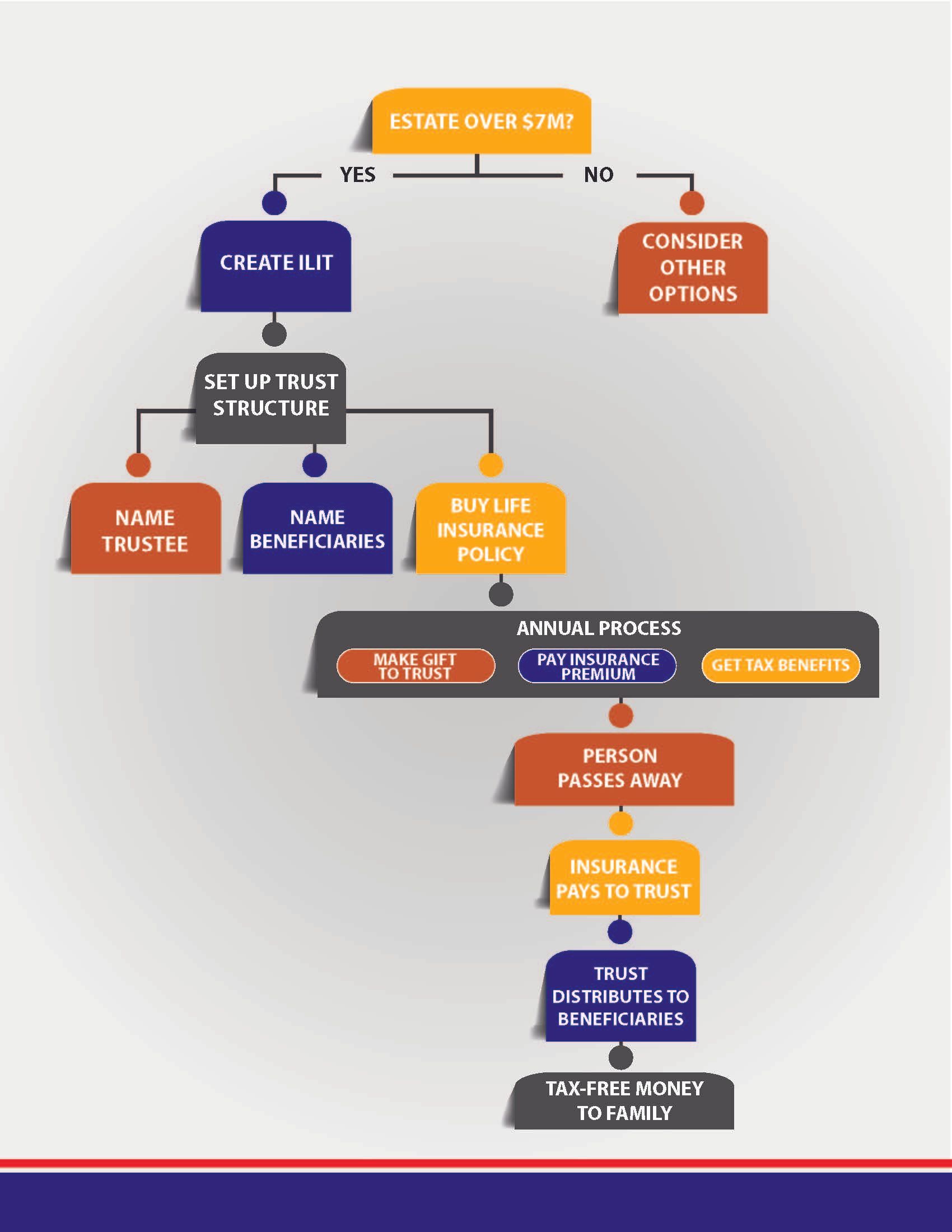
ILIT Mechanics:
- Grantor / Insured: Gifts premium funds to ILIT Bank Account.
- ILIT Bank Account: Issues Crummey Notice to Beneficiaries (30-day window to withdraw).
- If unexercised: ILIT Bank Account pays premium; Independent Trustee holds policy rights for the Life Insurance Policy.
- Life Insurance Policy: Pays death benefit to ILIT Account, which provides tax-free payouts to Beneficiaries.
To understand why a sample ILIT document works effectively as a financial planning tool, it is essential to examine the four primary roles defined within its terms:
- The Grantor (Settlor): The individual who creates the trust agreement, transfers an existing policy or funds the purchase of a new policy, and provides ongoing cash gifts to pay policy premiums.
- The Trustee: The fiduciary designated to administer the trust, manage trust bank accounts, hold the insurance policy title, pay insurance premiums, issue beneficiary notices, and distribute death benefits according to the trust agreement.
- The Beneficiaries: The individuals or entities designated to receive financial distributions from the trust, either during the grantor's lifetime or following the grantor's death.
- The Policy Ownership Structure: The legal title of the life insurance contract, which is held solely in the name of the trustee on behalf of the trust, rather than in the individual name of the grantor.
Why a Sample ILIT Serves as an Essential Structural Blueprint
Reviewing a sample ILIT agreement helps grantors and advisors understand how technical legal provisions translate into practical wealth protection. A well-constructed sample template demonstrates how specific clauses interact with federal tax statutes to achieve tax exclusion and asset protection.
Key Clauses Found in a Valid Sample ILIT
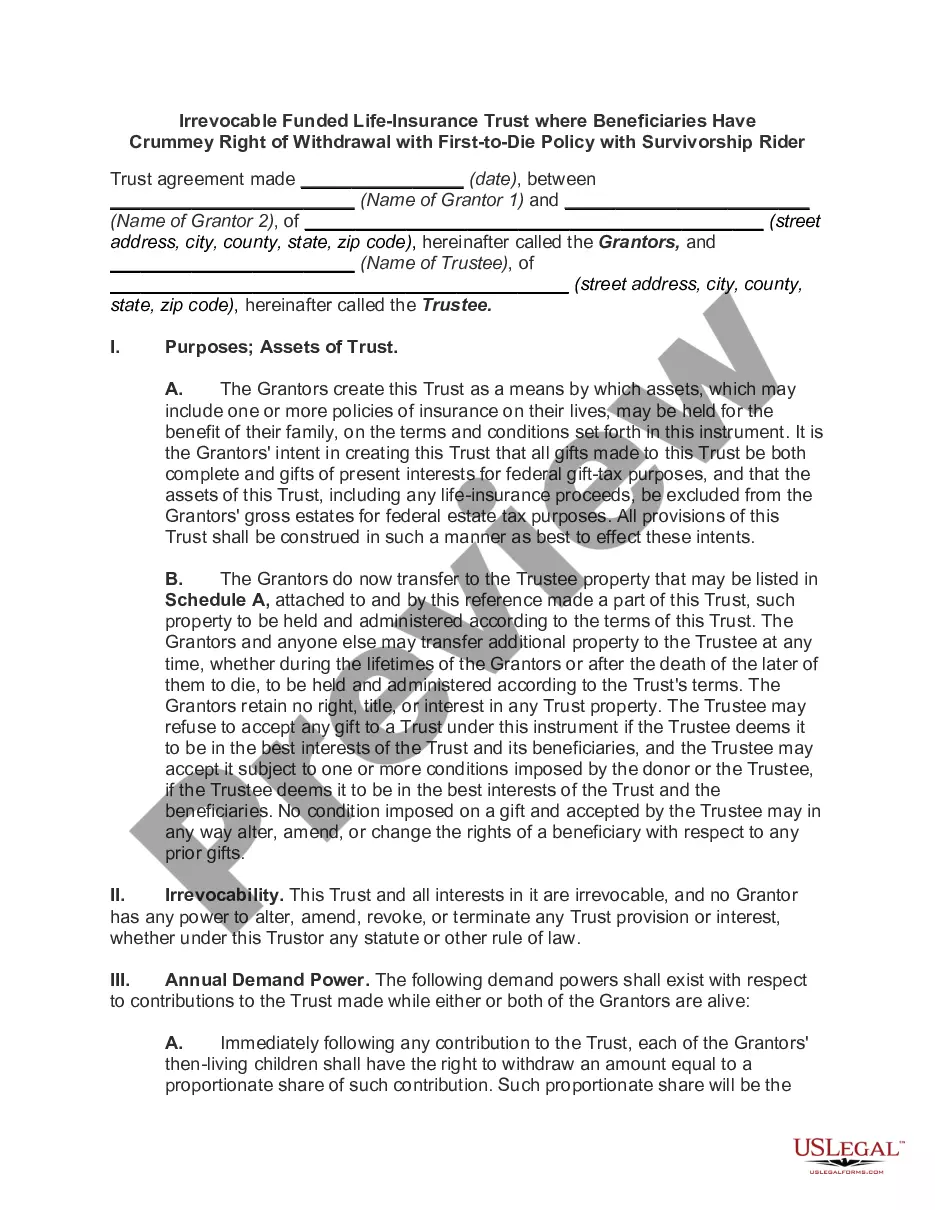
- Irrevocability Clause: Explicitly states that the grantor surrenders all rights to modify, revoke, amend, or terminate the agreement. Without this definitive surrender of control, the Internal Revenue Service (IRS) will view the trust as a revocable grantor trust and include the policy proceeds in the grantor's taxable estate.
- Incidents of Ownership Relinquishment: Explicitly prohibits the grantor from serving as trustee, changing policy beneficiaries, borrowing against policy cash surrender values, assigning policy rights, or surrendering the policy for cash.
- Crummey Withdrawal Rights Provision: Grants beneficiaries a limited, temporary right to withdraw a portion of each gift transferred into the trust, transforming gifts of "future interests" into "present interest" gifts eligible for the annual gift tax exclusion under IRC Section 2503(b).
- Trustee Powers and Discretion: Outlines the legal authority of the trustee to purchase life insurance contracts, retain policy proceeds, invest liquid assets, and make distributions according to fixed schedules or discretionary standards (such as health, education, maintenance, and support).
- Spendthrift Protections: Restricts beneficiaries from assigning, pledging, or transferring their anticipated interest in the trust, protecting trust assets from future beneficiary creditors or former spouses.
Note: While sample ILIT documents provide vital structural insights, estate planning requires customization under applicable state trust law. Using an unedited template without state-specific legal counsel risks invalidating tax exemptions.
Tax Mechanics: Excluding Life Insurance Proceeds from the Gross Estate
The primary financial objective of an ILIT is preventing life insurance death benefits from inflating the grantor's gross estate. Under IRC Section 2042, the value of an insurance policy's proceeds is included in a decedent's gross estate under two main conditions:
- The proceeds are payable directly or indirectly to the decedent's estate.
- The decedent possessed any "incidents of ownership" in the policy, exercisable alone or in conjunction with any other person, at the time of death.
Understanding Incidents of Ownership
Incidents of ownership refer to the economic rights and administrative controls over an insurance policy. If a grantor retains any of the following rights, the IRS includes the total death benefit in the taxable estate:
- The power to change beneficiaries or contingent beneficiaries.
- The authority to pledge the policy as collateral for a personal loan.
- The power to borrow against the policy's cash surrender value.
- The power to surrender, cancel, or assign the policy.
- A reversionary interest in the policy that exceeds 5 percent of its value immediately before death.
By establishing an ILIT and transferring policy ownership to an independent trustee, the grantor divests all incidents of ownership. When structured correctly, the death benefit passes to the ILIT completely outside the grantor's gross estate, eliminating federal estate tax liability on those funds.
The Three-Year Transfer Rule (IRC Section 2035)
A crucial distinction exists between transferring an existing life insurance policy into an ILIT versus having the trustee apply for a new policy directly:
- Transferring an Existing Policy: If the grantor owns an existing policy and assigns ownership to the ILIT, IRC Section 2035(a) mandates a three-year lookback rule. If the grantor dies within three years of the transfer date, the full proceeds of the policy are pulled back into the grantor's gross estate for tax purposes.
- Purchasing a New Policy: If the trustee opens the ILIT first and applies directly for a new life insurance policy as the original applicant and owner, the grantor never holds incidents of ownership. Consequently, the three-year rule does not apply, and the full death benefit is excluded from the estate immediately upon policy issuance.
Gift Tax Optimization and Crummey Withdrawal Powers
Because an ILIT requires ongoing cash transfers to pay annual policy premiums, funding the trust exposes the grantor to potential gift tax implications. A standard gift to an irrevocable trust is legally classified as a gift of a "future interest," which does not qualify for the annual gift tax exclusion under IRC Section 2503(b).
Without a mechanism to convert these gifts into "present interest" transfers, every premium contribution would consume part of the grantor's lifetime unified estate and gift tax exemption or trigger immediate gift taxes.
The Crummey Power Mechanism:
- Grantor contributes cash to the ILIT bank account.
- Trustee issues written Crummey letters notifying beneficiaries of their right to withdraw a pro-rata share of the gift within a set timeframe (e.g., 30 days).
- Beneficiaries allow the withdrawal window to lapse without taking cash.
- Contribution qualifies as a "present interest gift" under IRC Sec. 2503(b).
- Trustee uses the retained cash to pay the annual insurance policy premium.
The Legal Origin: Crummey v. Commissioner
In the landmark case Crummey v. Commissioner (397 F.2d 82, 9th Cir. 1968), the court ruled that if a trust beneficiary is given an immediate, unrestricted right to withdraw contributions made to a trust—even for a limited period—the contribution constitutes a gift of a present interest.
To operationalize Crummey withdrawal powers inside a sample ILIT:
- Contribution: The grantor transfers cash into a checking account opened under the ILIT's Taxpayer Identification Number (TIN).
- Written Notice: The trustee serves formal written notices ("Crummey letters") to each beneficiary, informing them of their right to withdraw their pro-rata share of the contribution.
- Withdrawal Window: Beneficiaries are given a reasonable timeframe (typically 30 days) to exercise their right to withdraw the funds.
- Lapse of Right: If the beneficiaries do not exercise their withdrawal rights before the deadline, the right lapses.
- Premium Payment: The trustee retains the funds in the trust bank account and uses them to pay the life insurance policy premium.
Through this procedure, premium funding qualifies for the annual gift tax exclusion per beneficiary.
Comparing Ownership Structures
Understanding why an ILIT is superior to personal ownership or simple trust structures requires analyzing how different arrangements handle tax exposure, creditor protection, and distribution control.
| Feature / Criteria | Direct Personal Ownership | Simple Revocable Trust | Irrevocable Life Insurance Trust (ILIT) |
|---|---|---|---|
| Gross Estate Inclusion | Included under IRC §2042 | Included under IRC §2042 | Excluded (if proper formalities are met) |
| Income Tax on Death Benefit | Exempt under IRC §101(a) | Exempt under IRC §101(a) | Exempt under IRC §101(a) |
| Creditor Protection for Insured | Vulnerable to claims | Vulnerable to claims | Shielded from grantor's personal creditors |
| Creditor Protection for Heirs | None after direct receipt | Minimal | High via spendthrift trust provisions |
| Control Over Distribution | Defined by will or beneficiary form | Full control via grantor | Defined by irrevocable trust agreement terms |
| Annual Gift Tax Treatment | N/A (Self-owned) | N/A (Self-owned) | Requires Crummey powers to use exclusion |
| 3-Year Lookback Exposure | Not Applicable | Not Applicable | Applies only if transferring existing policy |
Step-by-Step Operational Workflow of a Functional ILIT
To ensure an ILIT maintains its tax-exempt status under IRS scrutiny, parties must follow a strict administrative sequence throughout the lifetime of the trust.
Step-by-Step Operational Sequence:
- STEP 1: Trust Drafting & Execution — Attorney drafts irrevocable agreement; Grantor and Trustee sign.
- STEP 2: Tax ID Registration & Account Opening — Trustee secures EIN from IRS and opens an independent bank account.
- STEP 3: Policy Acquisition or Transfer — Trustee applies for new policy OR Grantor transfers existing policy.
- STEP 4: Annual Gift Funding & Crummey Administration — Grantor gifts funds; Trustee issues Crummey notices; window lapses.
- STEP 5: Premium Settlement — Trustee pays premium directly from the ILIT bank account.
- STEP 6: Claims Settlement & Distribution — Upon death, Trustee collects proceeds and manages beneficiary payouts.
Step 1: Legal Execution of Trust Document
The grantor and trustee execute the ILIT agreement. The grantor must select an independent trustee (such as an adult child, professional advisor, or corporate trust department) to maintain tax separation.
Step 2: Obtaining an Employer Identification Number (EIN)
The trustee applies for a Federal Employer Identification Number (EIN) from the IRS via Form SS-4. An ILIT cannot use the grantor’s Social Security Number because it is a separate legal entity. The trustee then uses this EIN to open a dedicated trust checking account.
Step 3: Acquiring Policy Ownership
The trustee applies for a life insurance policy on the life of the grantor, listing the trust as the sole policy owner and beneficiary. If transferring an existing policy, formal assignment paperwork is executed with the insurer, initiating the three-year clock under IRC Section 2035.
Step 4: Administering Crummey Gifts
Annually, at least 30 to 45 days prior to the premium due date, the grantor deposits gift funds into the ILIT bank account. The trustee prepares and delivers written Crummey notices to each beneficiary, establishing proof of receipt.
Step 5: Paying Premiums
Once the withdrawal window expires (typically 30 days after notice delivery), the trustee writes a check or initiates a wire transfer directly from the trust bank account to the insurance carrier to pay the premium.
Step 6: Estate Liquidity and Policy Distribution
Upon the grantor’s death, the trustee files a claim with the insurance company. The tax-free death benefit is paid into the trust. The trustee can then:
- Hold and invest funds for long-term beneficiary distributions.
- Distribute cash directly to named heirs according to trust milestones.
- Purchase illiquid real estate or business assets from the grantor's probate estate, providing the estate with cash to pay administrative costs and taxes without forced asset sales.
Common Structural Pitfalls and Operational Failure Points
While sample ILIT templates provide an effective model, procedural deviations during administration can trigger tax invalidation. Estate planners commonly warn against these specific failure points:
1. The Grantor Serving as Trustee
If the grantor acts as trustee, the IRS considers them to possess incidents of ownership under IRC Section 2042 due to administrative discretionary powers. The entire death benefit will be pulled back into the taxable estate.
2. Paying Insurance Premiums Directly
If the grantor writes personal checks directly to the insurance carrier rather than transferring funds into the trust checking account, the transaction fails the Crummey mechanism. The payment constitutes a gift of a future interest, triggering gift tax reporting and potential lifetime exemption usage.
3. Missing Crummey Documentation
Failing to send written notices or failing to retain signed acknowledgement receipts from beneficiaries leaves the trust vulnerable during an IRS audit. Without paper records of Crummey notices, the IRS can retroactively reclassify annual transfers as non-qualifying future-interest gifts.
4. Violating the 5-and-5 Rule
If a beneficiary's Crummey withdrawal power exceeds the greater of $5,000 or 5 percent of the trust assets under IRC Section 2514(e), the lapse of that power can be treated as a taxable gift made by the beneficiary to the other trust members. Careful drafting ensures withdrawal rights are capped at appropriate limits.
Frequently Asked Questions
Can the grantor change or revoke an ILIT after signing?
No. An ILIT is fundamentally irrevocable. Once executed, the grantor cannot alter its terms, change beneficiaries, or cancel the trust. Minor adjustments can sometimes be made indirectly through trustee discretionary powers, special powers of appointment, or state-specific trust decanting statutes, but the grantor retains no direct authority.
Who can serve as trustee of an ILIT?
Any legally competent adult or corporate fiduciary can serve as trustee, except the grantor. While grantors often choose trusted family members, adult children, or corporate trust institutions, selecting an independent trustee prevents conflict of interest and avoids accidental retention of incidents of ownership.
How do Crummey powers protect annual premium gifts from taxes?
Crummey powers give beneficiaries a temporary, absolute right to withdraw cash contributions transferred into the trust. This immediate access converts what would otherwise be a gift of a future interest into a gift of a present interest under IRC Section 2503(b), qualifying each transfer for the annual gift tax exclusion.
What happens if the grantor dies within three years of transferring an existing policy?
Under IRC Section 2035, if an existing life insurance policy is transferred into an ILIT and the grantor dies within three years of the transfer date, the policy proceeds are pulled back into the grantor's gross estate for federal tax calculation purposes. To bypass this rule, many planners establish the ILIT first and have the trustee purchase a new policy directly.
Does an ILIT shield life insurance proceeds from creditors?
Yes. Because the ILIT owns the policy and receives the proceeds, the assets are generally protected from personal creditors of the grantor. Furthermore, if the sample ILIT contains a properly drafted spendthrift clause, the proceeds are also protected from the creditors, lawsuit judgments, and claims of former spouses of the trust beneficiaries.
Strategic Action Items for Establishing an ILIT
To implement an Irrevocable Life Insurance Trust strategy using a sample template effectively, complete the following initial steps:
- Evaluate Gross Estate Valuation: Determine if your total estate value—including existing life insurance policies, real estate, investments, and business assets—approaches or exceeds current federal or state estate tax exemption limits.
- Engage Licensed Estate Planning Counsel: Work with an attorney qualified in your state to convert a sample ILIT draft into an enforceable legal instrument compliant with state trust statutes.
- Appoint an Independent Trustee: Identify an individual or corporate entity capable of performing administrative duties, managing accounts, issuing timely Crummey letters, and handling insurance disbursements.
- Establish Proper Administrative Infrastructure: Secure an EIN from the IRS and open a dedicated trust bank account prior to issuing policy premium payments.
Legal Limitation Disclaimer: Estate tax thresholds, gift tax exemptions, and trust laws are governed by dynamic federal statutes and state-specific regulations. This article is intended solely for educational purposes and structural analysis of sample legal concepts. Consult a qualified legal attorney and certified financial professional before establishing an ILIT.
Image Gallery