Optimizing Email Deliverability Services: A Strategic Guide for 2026
Email deliverability services are specialized technical solutions designed to ensure that marketing, transactional, and operational emails reach the intended recipient's inbox rather than being diverted to the spam or junk folder. By m...
Email deliverability services are specialized technical solutions designed to ensure that marketing, transactional, and operational emails reach the intended recipient's inbox rather than being diverted to the spam or junk folder. By managing sender reputation, authenticating domain protocols, and monitoring infrastructure health, these services act as the critical bridge between an outgoing mail server and an Internet Service Provider’s (ISP) filtering system.
Contents
Understanding the Mechanics of Email Delivery
Deliverability is not synonymous with "delivery." Delivery simply means that an email successfully reached the recipient’s mail server. Deliverability refers to whether that email actually lands in the primary inbox after passing through the filters of providers like Gmail, Outlook, or Yahoo. In 2026, ISPs employ increasingly complex machine-learning algorithms to analyze sender behavior, engagement metrics, and authentication standards.
When you send an email, the receiving server checks several criteria in milliseconds:
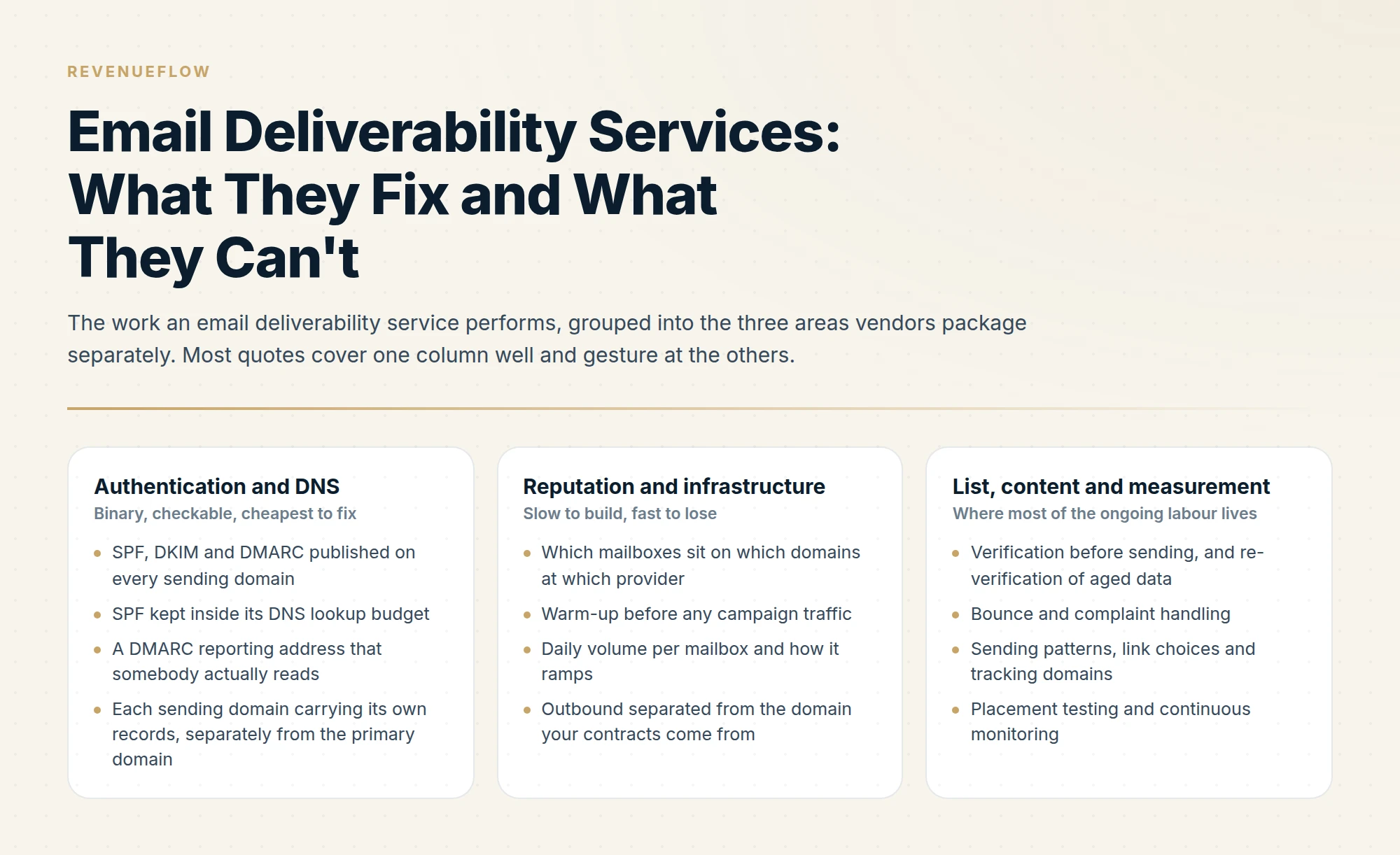
- Authentication: Does the sender have valid DNS records proving they own the domain (SPF, DKIM, DMARC)?
- Reputation: What is the historical track record of the IP address and the sending domain?
- Content Quality: Does the message contain indicators of spam, such as suspicious links, high-pressure language, or broken HTML?
- Engagement: Do the recipient’s previous interactions with this sender suggest they want to see this mail?
Why Businesses Require Dedicated Deliverability Services
As email volume continues to grow, ISPs have tightened their policies to protect users. Relying solely on basic SMTP servers or shared IP pools often leads to reputation "collateral damage." If a single user on a shared IP sends malicious content, your email might be blocked simply because you are using the same infrastructure.
Deliverability services provide the tools to monitor these variables proactively. They allow organizations to maintain clean list hygiene, track blocklists in real-time, and manage the technical DNS configurations that act as the digital passport for your communications.
Core Components of Deliverability Infrastructure
To effectively manage email flow, organizations must leverage a combination of protocols and monitoring tools. The following table summarizes the essential elements required to maintain a healthy sending environment.
| Component | Function | Strategic Importance |
|---|---|---|
| SPF (Sender Policy Framework) | Lists authorized IP addresses. | Prevents unauthorized sources from spoofing your domain. |
| DKIM (DomainKeys Identified Mail) | Adds a cryptographic signature. | Ensures the email was not tampered with in transit. |
| DMARC (Domain-based Message Authentication) | Provides policy instructions. | Instructs ISPs on how to handle emails failing SPF/DKIM. |
| IP Warming | Gradual volume increase. | Builds a positive reputation for new, dedicated IPs. |
| Feedback Loops (FBLs) | Reports spam complaints. | Allows senders to remove unhappy users from lists. |
Implementing a Deliverability Strategy
Achieving high inbox placement is a continuous process rather than a one-time configuration. For businesses operating in 2026, the focus must shift from "getting it sent" to "maintaining sender identity."
1. Authentication Audit
Begin by ensuring your DNS records are correctly published. A missing or misconfigured DMARC record is a primary reason for immediate rejection by major providers. You should verify that your SPF record does not exceed the 10-DNS lookup limit, a common technical oversight that leads to authentication failure.
2. Reputation Monitoring
Use deliverability services to track your "Sender Score." This is a composite metric often derived from multiple sources that estimates the trustworthiness of your sending IP. Monitoring this score helps you identify if a specific campaign caused a dip in reputation, allowing for quick remediation.
3. List Hygiene and Suppression
Sending to inactive or invalid email addresses is the fastest way to damage your reputation. Implement a "sunset policy" where subscribers who have not engaged with your emails for a set period (e.g., 6–12 months) are automatically removed or moved to a re-engagement campaign. Modern deliverability tools automatically suppress known "hard bounces" and spam traps.
4. Engagement Analysis
ISPs track how users interact with your emails. If users frequently delete your messages without opening them or mark them as spam, your future emails are likely to be filtered. Deliverability services offer analytics that correlate specific subject lines or content types with engagement drops.
Common Deliverability Pitfalls to Avoid
- Over-reliance on Shared Infrastructure: While cost-effective, shared IPs place your reputation in the hands of others. If your volume justifies it, moving to a dedicated IP address is a standard step for high-volume senders.
- Ignoring Feedback Loops: If a recipient hits the "Mark as Spam" button, your service should instantly receive a signal from the ISP. If you continue to email that address, your reputation will plummet.
- Inconsistent Sending Volume: ISPs look for predictability. Sending millions of emails once a month, then nothing for weeks, looks like suspicious "burst" behavior common with botnets. Maintain a consistent, gradual flow where possible.
Troubleshooting Sudden Drops in Performance
If you notice a sudden shift in your inbox placement rates, treat it as a technical incident. First, verify that no recent changes were made to your DNS records. Often, a simple syntax error in an SPF record or an expired DKIM key can cause an immediate, catastrophic drop in delivery.
Second, check your domain against major blacklists. If you are listed, investigate the source. It may be due to a compromised account or a sudden spike in spam complaints from a recent marketing campaign. Finally, analyze your bounce logs. ISPs often provide specific error codes that indicate exactly why an email was rejected—such as "exceeded rate limit" or "authentication failure"—which provides the specific roadmap for your technical team to fix the issue.
Frequently Asked Questions
What is the difference between an ESP and a deliverability service? An Email Service Provider (ESP) is the platform that sends your emails. A deliverability service is a specialized layer of monitoring, authentication, and diagnostic tools—sometimes built into the ESP or provided as an add-on—that ensures the technical infrastructure is optimized for inbox placement.
How long does IP warming take? IP warming typically takes 2 to 4 weeks, depending on your sending volume and the recipient domains (e.g., Gmail, Yahoo). The process involves starting with a small number of emails to highly engaged users and gradually increasing volume daily to demonstrate "normal" behavior to ISPs.
Do deliverability services guarantee inbox placement? No service can guarantee 100% inbox placement. ISPs maintain the right to filter mail based on their internal, proprietary algorithms. Deliverability services maximize your chances by ensuring you meet all technical requirements and follow industry best practices.
What is a spam trap? A spam trap is an email address used by ISPs or blacklisting organizations to identify senders who are not following permission-based email practices. Sending to a spam trap—which does not belong to a real, active user—is an immediate indicator to ISPs that your list acquisition methods are poor.
Why does my email go to spam even with good authentication? Authentication is only the baseline. If your content is repetitive, includes blacklisted domains in your links, or if your recipient engagement is extremely low, ISPs may still filter your mail based on the content or user behavior signals.
Final Recommendations
For most organizations, the first step is conducting a comprehensive audit of current DNS configurations. Ensure that DMARC is set to at least a p=quarantine policy to signal your commitment to security to major ISPs. If you are currently sending high volumes, evaluate the stability of your IP reputation through an external deliverability platform. Focus on list quality by implementing double-opt-in processes, which naturally filter out invalid addresses and bots, providing a long-term foundation for reliable communication.
Image Gallery