How to Rehabilitate a Student Loan: A Complete Guide to Clearing Default in 2026
To rehabilitate a student loan, you must enter into a formal agreement with your loan holder to make nine voluntary, reasonable, and affordable monthly payments within a period of ten consecutive months. Completing this process removes...
To rehabilitate a student loan, you must enter into a formal agreement with your loan holder to make nine voluntary, reasonable, and affordable monthly payments within a period of ten consecutive months. Completing this process removes the default status from your credit report and restores eligibility for federal student aid and repayment plans.
Contents
Understanding Student Loan Rehabilitation
Student loan rehabilitation is a statutory program designed to help borrowers who have defaulted on their federal student loans. Under the Higher Education Act, borrowers are granted a one-time opportunity per loan to move out of default and back into "good standing." In the context of 2026, while various temporary relief programs have come and gone, the formal rehabilitation process remains a primary, stable mechanism for debt recovery.
When a federal loan defaults—typically after 270 days of non-payment—the entire balance becomes due immediately, and the borrower loses access to deferment, forbearance, and income-driven repayment (IDR) plans. Rehabilitation acts as a bridge to restore these lost benefits. It is not a simple "catch-up" payment; rather, it is a structured, performance-based path to financial recovery.
It is important to distinguish rehabilitation from other forms of debt resolution. Unlike loan consolidation, which creates a new loan to pay off the old ones, rehabilitation keeps the original loan intact but "cleanses" its status through a period of consistent payment behavior.
Eligibility Requirements for Loan Rehabilitation
Not all student debt is eligible for the federal rehabilitation program. The program is strictly limited to federal student loans, including Direct Loans and loans made under the Federal Family Education Loan (FFEL) Program.
Qualified Loan Types
- Direct Subsidized and Unsubsidized Loans: These are the most common federal loans.
- Direct PLUS Loans: This includes loans taken out by graduate students or parents (Parent PLUS).
- Federal Perkins Loans: Though the program has ended, existing Perkins Loans in default can be rehabilitated through the school that issued them.
- FFEL Program Loans: These older, privately-held federal loans are also eligible, though the process involves working with a guaranty agency.
The One-Time Limit
The most critical eligibility constraint is the "one-time" rule. You can only rehabilitate a specific federal student loan once. If you successfully rehabilitate a loan and then default on it a second time, you are generally barred from using the rehabilitation program for that specific debt again. In such cases, your only remaining options to exit default would be to pay the loan in full or use loan consolidation, provided you meet the specific requirements for consolidating a second default.
The Step-by-Step Process to Rehabilitate Your Loan
Navigating rehabilitation requires proactive communication with your loan holder. Because the process is governed by federal law, the steps are standardized, but the burden of initiation lies with the borrower.
1. Identify Your Loan Holder
You must first determine who owns your defaulted debt. This is often no longer your original servicer. Most defaulted federal loans are managed by the U.S. Department of Education’s Office of Default Management or a contracted private collection agency. You can verify your current loan holder by logging into your account at StudentAid.gov.
2. Request Rehabilitation and Negotiate Payments
Once you contact the loan holder, you must specifically state that you wish to enter into a Loan Rehabilitation Agreement. The loan holder will calculate a monthly payment amount based on your income. By law, this payment must be "reasonable and affordable."
3. Sign the Written Agreement
After negotiating the payment amount, the loan holder will send you a written rehabilitation agreement. This document outlines the payment amount, the due dates, and the consequences of missing a payment. You must sign and return this document to officially start the "clock" on your nine payments.
4. Complete Nine Consecutive Payments
The core of the program is making nine full, voluntary payments within 10 consecutive months. "Voluntary" means these must be payments you initiate; involuntary payments, such as those taken through wage garnishment or Treasury offset (tax refund seizure), do not count toward the nine required payments.
Calculating Your Rehabilitation Payment
The most common fear among defaulted borrowers is that the rehabilitation payment will be too high. However, federal regulations provide two specific methods to ensure the payment is manageable.
The 15% Formula
Initially, the loan holder will calculate your payment using the 15% formula. This is 15% of your annual discretionary income, divided by 12. Discretionary income is defined as the amount by which your Adjusted Gross Income (AGI) exceeds 150% of the federal poverty guideline for your family size and state.
The "Reasonable and Affordable" Alternative
If the 15% formula results in a payment you cannot afford, you can request an alternative calculation. You will be required to submit a Financial Disclosure Form (Form 15c) that details your monthly income and essential expenses (rent, food, utilities, medical costs). The loan holder then uses this information to determine a lower payment amount, which can sometimes be as low as $5 per month, depending on your financial hardship.
Benefits of Completing the Rehabilitation Program
The effort required to complete nine months of payments is offset by significant legal and financial benefits that are not available through any other default-exit strategy.
- Credit Report Correction: This is the hallmark of rehabilitation. Once completed, the "Default" notation for the rehabilitated loan is removed from your credit report. This can lead to a substantial increase in your credit score. Note, however, that the original late payments (the 30, 60, or 90-day delinquencies) that occurred before the default will remain on your report for seven years.
- Restoration of Federal Benefits: Upon completion, you regain eligibility for federal student aid (FAFSA), which is vital if you plan to return to school. You also regain access to deferment, forbearance, and IDR plans.
- Ceasing Involuntary Collections: Once you have made five of the nine required rehabilitation payments, the Department of Education will stop administrative wage garnishment, provided you continue to make your rehabilitation payments on time.
- Eligibility for Forgiveness: Rehabilitated loans can once again be counted toward Public Service Loan Forgiveness (PSLF) or IDR-based forgiveness schedules, though time spent in default does not count as "qualifying months" toward these goals.
Rehabilitation vs. Loan Consolidation
While rehabilitation is a powerful tool, it is not the only way to exit default. Borrowers often weigh rehabilitation against Federal Loan Consolidation. The following table highlights the key differences as of 2026.
| Feature | Loan Rehabilitation | Loan Consolidation |
|---|---|---|
| Time to Exit Default | 9–10 Months | 1–2 Months |
| Credit Report Impact | Removes "Default" status entirely | Marks status as "Paid in Full" |
| Payment Calculation | Income-based or expense-based | Based on IDR formulas |
| Collection Charges | May be reduced or capped | Added to the new principal balance |
| Frequency | Once per loan | Can be done multiple times (with limits) |
| Garnishment Stop | After 5th successful payment | Only after the loan is paid off by consolidation |
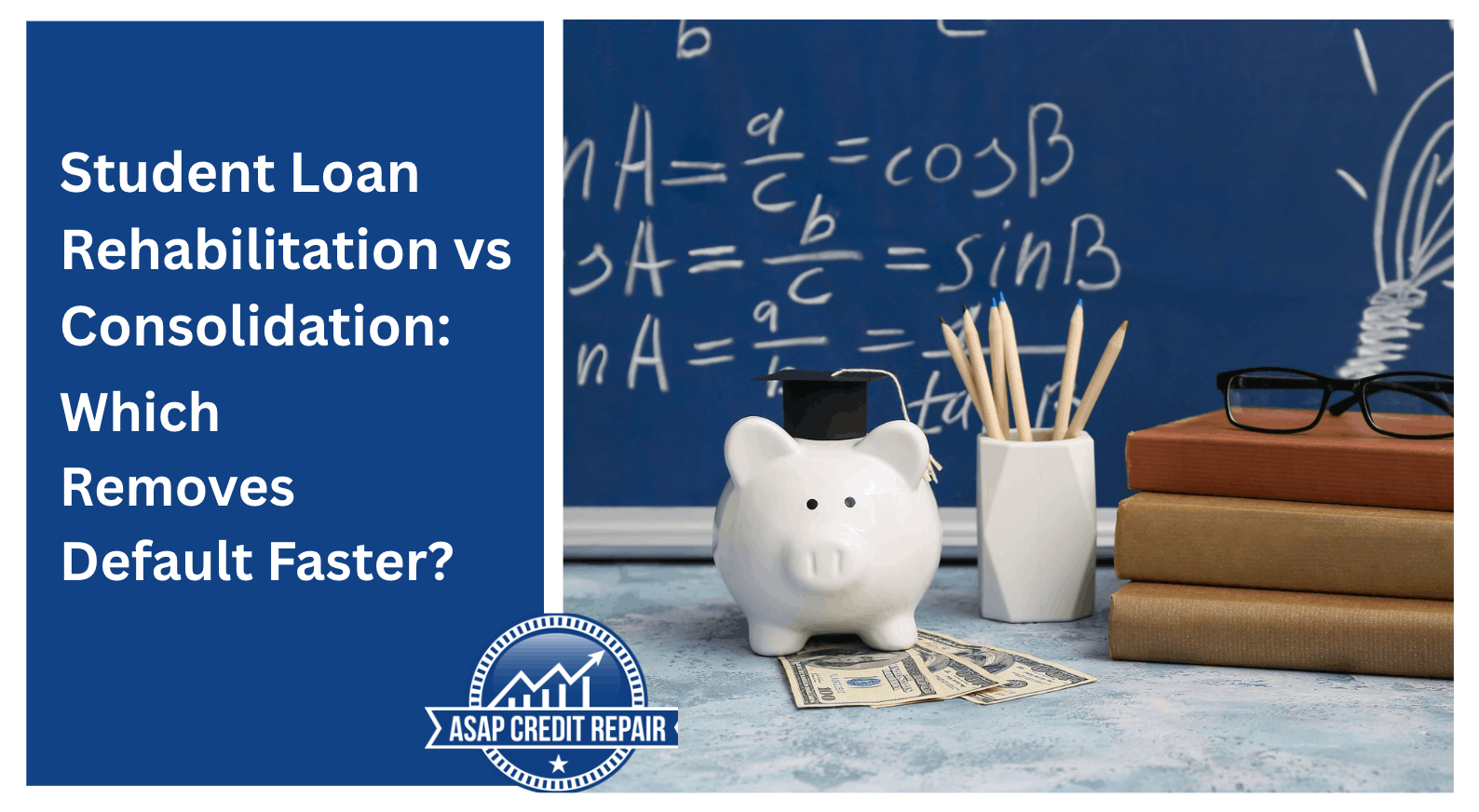
Rehabilitation is generally superior for credit score recovery, while consolidation is better for borrowers who need to exit default immediately to return to school or stop a tax offset quickly.
Common Challenges and Troubleshooting
The rehabilitation process is strict, and minor errors can result in having to start the entire process over.
Missing a Payment
If you miss a payment during the nine-month period, you generally have a "one-month" grace window because the law allows for nine payments within ten months. However, if you miss two payments, you typically must start the cycle over from month one. Consistency is the most critical factor for success.
Involuntary Collections and the "Double Payment"
A common point of confusion is the overlap between rehabilitation payments and wage garnishment. If your wages are already being garnished, your voluntary rehabilitation payments are in addition to the garnishment. You must continue to pay the negotiated amount out of pocket until you reach the five-payment milestone where the garnishment is lifted. Failing to make the voluntary payment because "they are already taking money from my check" is a frequent mistake that prevents rehabilitation from ever starting.
Servicer Transfers Post-Rehabilitation
Once you complete your ninth payment, your loan is "purchased" by a standard loan servicer and moved out of the default management system. It is vital to confirm who your new servicer is and immediately sign up for an Income-Driven Repayment plan. If you do not select a plan, you will be placed on the Standard Repayment Plan, which may have much higher monthly payments, putting you at risk of defaulting again.
FAQs
Can I rehabilitate a private student loan?
No. The loan rehabilitation program described here is a statutory right under the Higher Education Act, which applies only to federal loans. Private lenders may offer their own internal "repayment programs," but they are not required to follow these rules, and they rarely remove default notations from credit reports.
What happens to the collection costs?
When a loan defaults, collection costs (up to 16% or more) are added to the balance. During rehabilitation, these costs can be high, but completing the program often results in a significant reduction or waiver of these fees compared to consolidation, where they are often capitalized into the new loan balance.
Is there a fee to enter a rehabilitation agreement?
No. There are no application fees or administrative fees to enter a federal student loan rehabilitation agreement. Be wary of private "debt relief" companies that charge fees to set this up for you; you can do it for free by contacting your loan holder directly.
Can I rehabilitate multiple loans at once?
Yes. If you have several defaulted federal loans, you can include all of them in a single rehabilitation agreement. You will make one monthly payment that is distributed across the loans, and they will all move out of default simultaneously after the ninth payment.
Does rehabilitation remove the history of late payments?
No. Rehabilitation removes the "Default" status and the record of the default itself. However, the month-by-month history showing that you were 30, 60, or 90 days late leading up to the default remains on your credit report for seven years from the date of the delinquency.
Practical Recommendation
If you are currently in default, your first action should be to log into StudentAid.gov to identify your loan holder. If your primary goal is to repair your credit score and you can afford a modest monthly payment, Loan Rehabilitation is the most effective path. Once you enter the agreement, set up automated reminders for your payments to ensure you do not miss the ten-month window. Immediately upon completion of the ninth payment, contact your new servicer to enroll in an Income-Driven Repayment (IDR) plan to ensure your new monthly payments remain affordable and prevent a future default.
Image Gallery