Understanding Manson Murder Autopsy Photos: Legal Access, Privacy Laws, and Forensic History in 2026
Manson murder autopsy photos are highly restricted legal and forensic documents originating from the 1969 Tate-LaBianca murder investigations. In 2026, California state law and federal privacy mandates strictly prohibit the public rele...
Manson murder autopsy photos are highly restricted legal and forensic documents originating from the 1969 Tate-LaBianca murder investigations. In 2026, California state law and federal privacy mandates strictly prohibit the public release of these sensitive materials. Access is exclusively granted to authorized law enforcement personnel, legal counsel, and certified forensic researchers to protect the dignity of the victims and the privacy of their surviving families.
Contents
The Manson Family murders remain one of the most studied criminal cases in American history. Decades after the 1969 killing spree directed by Charles Manson, public interest continues to surge, often driven by true crime media and historical retrospectives. However, a significant distinction exists between public interest and public access. The autopsy photographs of Sharon Tate, Jay Sebring, Abigail Folger, Wojciech Frykowski, Steven Parent, and Leno and Rosemary LaBianca are not part of the public domain. Understanding why these records remain sealed requires an analysis of California’s legal framework, the evolution of victim advocacy, and the specific forensic standards of the Los Angeles County Department of Medical Examiner.
The Forensic Legacy of the 1969 Tate-LaBianca Case
The autopsies performed following the August 1969 murders were conducted under the supervision of Dr. Thomas Noguchi, the then-Chief Medical Examiner-Coroner for Los Angeles County. Known as the "Coroner to the Stars," Dr. Noguchi’s work on these cases set early benchmarks for high-profile forensic investigations. The autopsies provided the essential physical evidence needed to link the Manson Family members to the crime scenes through wound pattern analysis and behavioral profiling.
Complexity of the Forensic Evidence
The nature of the Manson murders was characterized by "overkill," a forensic term describing the infliction of more injury than is necessary to cause death. This complexity made the autopsy photographs vital pieces of evidence during the 1970–1971 trials.
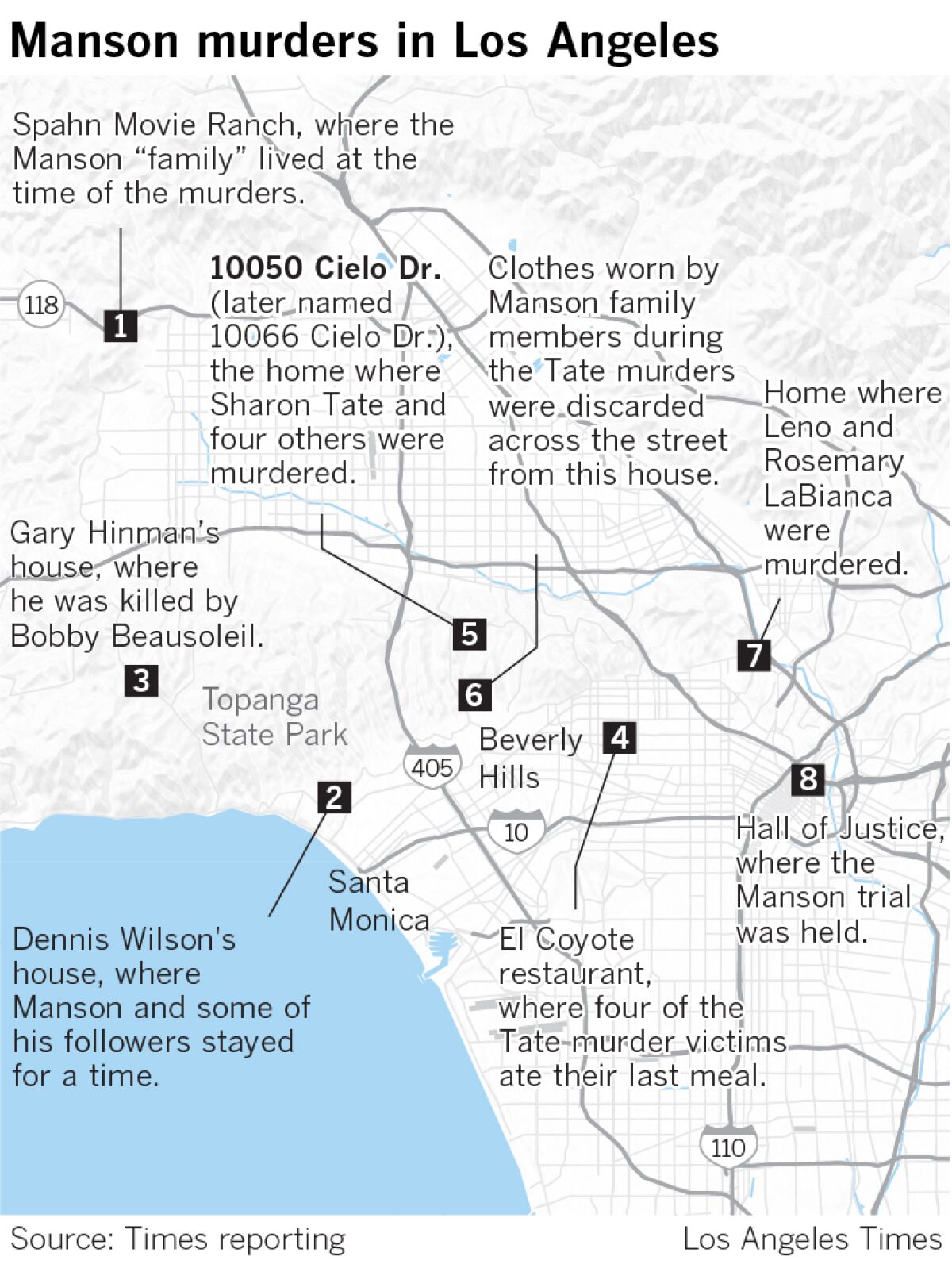
- Sharon Tate and Guests: The autopsies revealed a combined total of over 100 stab wounds among the five victims at 10050 Cielo Drive. The photographs documented the precise angles and depths of these wounds, which allowed investigators to determine the types of weapons used and the likely number of assailants.
- The LaBianca Residence: At the home of Leno and Rosemary LaBianca, the forensic photos documented not only the cause of death but also the post-mortem mutilations and the use of household items as secondary weapons. These images were instrumental in proving the ritualistic and symbolic nature of the crimes, which supported the "Helter Skelter" motive proposed by Prosecutor Vincent Bugliosi.
In 2026, these photographs are preserved in digital and physical archives by the Los Angeles Police Department (LAPD) and the District Attorney’s office. They are categorized as active evidentiary records because, although the primary perpetrators are deceased or incarcerated, the files remain legally "protected" to prevent exploitation.
Legal Framework Governing Sensitive Forensic Imagery in California
The unavailability of Manson murder autopsy photos is not a matter of bureaucratic whim but a result of rigorous statutory protections. Several layers of law prevent the dissemination of these images to the general public or media outlets.
California Code of Civil Procedure Section 129
The primary legal barrier is California Code of Civil Procedure Section 129. This statute explicitly prohibits the making of any copy, reproduction, or facsimile of any photograph, negative, or print of the body of a deceased person taken by or for the coroner during an autopsy, except for use in a criminal trial or for specific educational purposes within the medical community.
Legal Protections for Deceased Individuals
The General Rule of Non-Disclosure Under Section 129, the default status of autopsy imagery is "private." Even if a case is decades old, the passage of time does not automatically trigger public release. This is designed to prevent the sensationalism of violent deaths and to protect the emotional well-being of the victims' descendants.
The Court Order Exception A party seeking access must demonstrate a compelling legal or scientific need. This usually requires a petition to the Superior Court, where a judge must weigh the "public interest" against the "privacy rights" of the family. Historically, the California courts have sided with the families of the Manson victims, denying numerous requests from authors and documentarians.
Marsy’s Law and Victim Rights in 2026
The California Victims' Bill of Rights Act of 2008, commonly known as Marsy’s Law, further strengthened these protections. As of 2026, the law remains a robust shield for the families of Sharon Tate and the LaBiancas. Marsy’s Law grants victims and their families the right to "be treated with fairness and respect for his or her privacy and dignity."
Courts have interpreted this to include protection against the public display of a loved one’s remains in a state of trauma. The Tate and LaBianca families have been vocal and legally active in ensuring that the Manson autopsy photos remain under seal, viewing any potential leak as a secondary victimization.
Comparison of Access: High-Profile Forensic Records
While many believe all government records eventually become public, forensic imagery follows a different trajectory. The following table compares the accessibility of forensic materials from notable 20th-century cases as they stand in 2026.
| Case Subject | Date of Incident | Availability of Autopsy Photos (2026) | Primary Reason for Status |
|---|---|---|---|
| Manson Family Victims | 1969 | Strictly Restricted | CA CCP Section 129 & Marsy's Law |
| John F. Kennedy | 1963 | Restricted / National Archives | JFK Records Collection Act of 1992 |
| Elizabeth Short (Black Dahlia) | 1947 | Historically Leaked / Public Domain | Age of case and lack of living heirs |
| Nicole Brown Simpson | 1994 | Strictly Restricted | Family privacy and CA State Law |
| Marilyn Monroe | 1962 | Partially Leaked / Restricted | High-profile celebrity privacy protocols |
The Ethical Debate Surrounding True Crime Research
In 2026, the intersection of forensic science and the "True Crime" entertainment industry has created a complex ethical landscape. Researchers and historians often argue that viewing the Manson murder autopsy photos is necessary for a complete understanding of the psychology of the Manson Family. Conversely, bioethicists and victim advocates maintain that the "right to know" does not extend to the visual consumption of a person's most vulnerable and tragic moments.
The Educational Loophole
There is a narrow exception for the use of these photos in medical and forensic training. Forensic pathologists studying "sharp force trauma" or "ligature strangulation" may encounter these images in peer-reviewed journals or academic presentations. However, even in these professional settings, the images are usually de-identified or cropped to focus solely on the medical finding, avoiding the inclusion of the victim's face to maintain a level of clinical anonymity.
Unauthorized Leaks and Digital Misinformation
Despite the legal restrictions, low-quality or "reconstructed" images often circulate on the periphery of the internet. It is important for researchers to distinguish between:
- Authentic Forensic Records: These are maintained by the LAPD and are not online.
- Crime Scene Sketches: Often mistaken for photos, these are hand-drawn diagrams used in the trial and are often public.
- Graphic Re-enactments: Created for films or documentaries, these are often falsely labeled as "leaked autopsy photos" to drive engagement.
Engaging with or distributing leaked forensic imagery can carry civil liabilities in 2026, as families have the right to sue for emotional distress under modern privacy torts.
How to Conduct Legitimate Historical Research on the Manson Case
For those looking to understand the forensic details of the Tate-LaBianca murders without violating legal or ethical boundaries, several legitimate avenues exist.
- Review the Trial Transcripts: The testimony of Dr. Thomas Noguchi and other medical experts provides a detailed, text-based description of every wound and finding. These descriptions are public record and offer the same data as the photos without the visual intrusion.
- Consult Official Summaries: The Los Angeles County Department of Medical Examiner often provides summary reports that detail the cause and manner of death while withholding the visual media.
- Academic Archives: University libraries and criminal justice archives may hold non-visual forensic data related to the Manson trial that is accessible to registered scholars.
Frequently Asked Questions
Are Manson murder autopsy photos available on the dark web?
While many sites claim to host these images, they are frequently fraudulent or contain malware. The actual high-resolution forensic sets have never been legally digitized for public consumption and remain in secure government custody as of 2026.
Why did the LAPD fight to keep the Manson records sealed in 2012?
The LAPD, supported by the families of the victims, fought to keep the records sealed to protect the integrity of other "cold cases" that might have links to the Manson Family and to prevent the glorification of Charles Manson’s cult. This precedent remains the standard in 2026.
Can I buy the Manson autopsy report?
You can often purchase or view copies of the text-based autopsy reports through various historical archives or public record requests. However, these documents will be redacted, and any accompanying photographs or diagrams of a sensitive nature will be removed.
Who has the final say on releasing the photos?
The Los Angeles County Superior Court has the final authority. A judge would have to rule that the historical significance of the images outweighs the privacy rights of the deceased and their heirs, which is an extremely high legal threshold that has not been met in over 50 years.
Has anyone ever seen the original photos?
Aside from the original investigators and the 1971 jury, very few people have viewed the full set of Manson autopsy photos. A small number of forensic professionals and historians have been granted limited access for specific authorized projects under strict non-disclosure agreements.
Summary of Access Protocols for 2026
If you are a researcher or a member of the public seeking forensic data on the Manson case, it is essential to adhere to the following 2026 guidelines:
- Respect Statutory Privacy: Acknowledge that CA CCP Section 129 is a permanent restriction, not a temporary one.
- Prioritize Survivors: Recognize that the families of the victims are the primary stakeholders in how these records are handled.
- Focus on Documentation over Imagery: Utilize the vast amount of public testimony and investigative reporting to reconstruct the case history rather than seeking out restricted visual media.
In 2026, the Manson murder autopsy photos remain a solemn reminder of a national tragedy. The continued closure of these files reflects a societal shift toward prioritizing the dignity of victims over the curiosity of the public, ensuring that the legacy of those lost is not defined by the violence they suffered, but by the justice and privacy they are afforded by the law.
Image Gallery