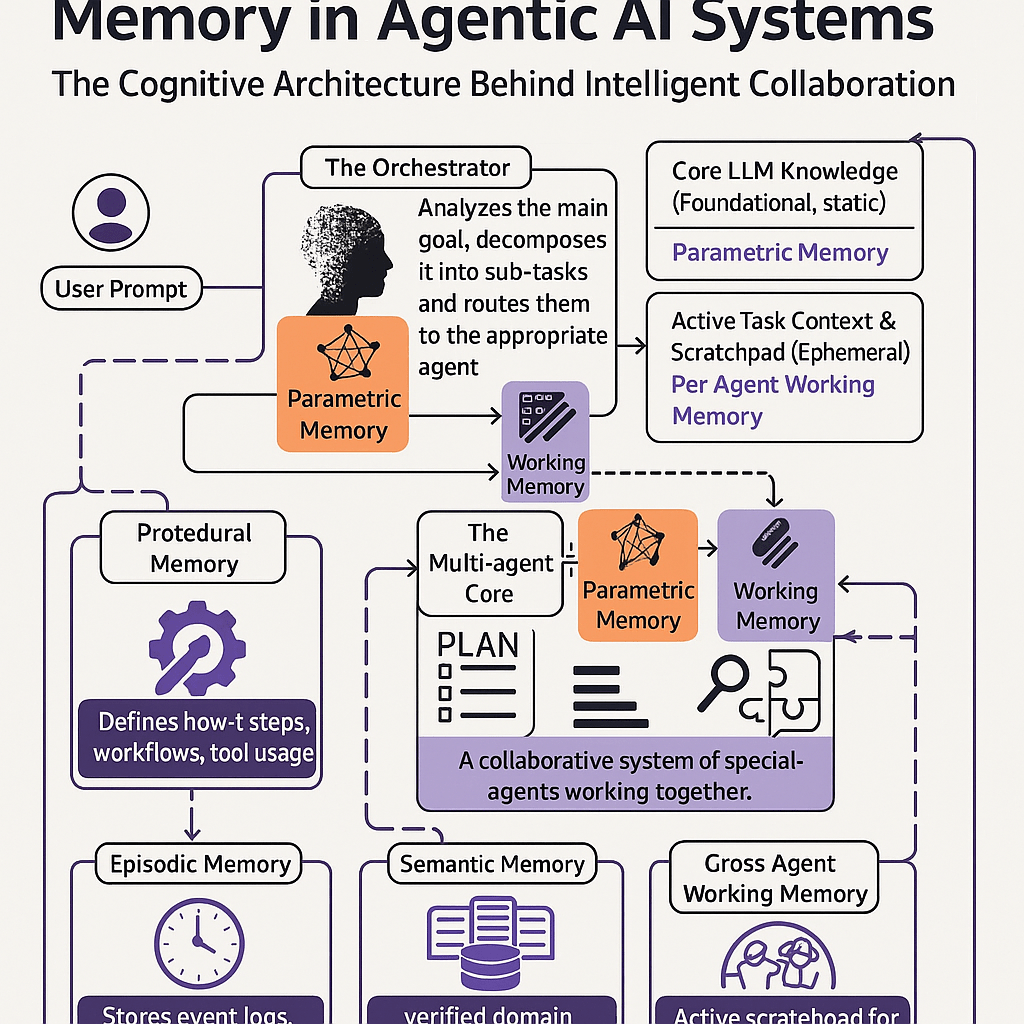
Decoding the Core Technology Behind the Agentic CRM
An agentic CRM relies on a sophisticated stack of Large Language Models (LLMs), vector databases for long-term semantic memory, autonomous reasoning loops, and deterministic API orchestration layers. This architecture shifts software f...
An agentic CRM relies on a sophisticated stack of Large Language Models (LLMs), vector databases for long-term semantic memory, autonomous reasoning loops, and deterministic API orchestration layers. This architecture shifts software from passive data storage to active, goal-directed task execution across sales, marketing, and support channels.
Contents
The transition from traditional Customer Relationship Management (CRM) platforms to agentic systems marks a fundamental shift in enterprise software design. Traditional systems function as passive ledgers. Sales representatives, customer support agents, and marketing teams manually input data, trigger static workflows, and query databases for historical insights. An agentic CRM introduces autonomous software agents capable of planning, reasoning, and executing complex, multi-step workflows with minimal human intervention. To understand how these systems operate, one must examine the underlying core technology stack that bridges natural language understanding with enterprise application programming interfaces (APIs).
The Architectural Shift: From Passive Ledgers to Autonomous Engines
Traditional CRMs are fundamentally database wrappers. They organize records—accounts, contacts, opportunities, and tickets—using relational schemas. While powerful for reporting and manual data entry, they lack agency. They cannot infer intent, anticipate user needs, or autonomously execute workflows across disparate systems without rigid, pre-configured conditional logic rules (e.g., "If lead status equals X, send email Y").
Agentic CRMs redefine this paradigm by placing an autonomous reasoning layer on top of traditional or hybrid data stores. Instead of forcing human users to navigate complex user interfaces, click through multiple menus, and manually update records, an agentic CRM interprets natural language instructions, breaks them down into sub-tasks, queries relevant data sources, and executes actions across internal and external applications.
This architectural evolution requires a move away from rigid decision trees toward probabilistic, model-driven orchestration. The system must perceive its environment, maintain context over long horizons, determine the optimal path to achieve a specified goal, and verify the outcome before reporting back to the user.
Large Language Models as the Reasoning Core
At the center of any agentic CRM is a foundational Large Language Model (LLM) or a composite network of smaller, specialized models. The LLM serves as the cognitive engine, responsible for natural language understanding (NLU), intent recognition, and step-by-step planning.
When a user issues a command—such as "Find all enterprise accounts that showed decreased product engagement last month, draft a personalized re-engagement strategy for each, and schedule check-in calls with the account owners"—the LLM performs several critical operations:
- Intent Parsing: It decodes the unstructured prompt into discrete operational goals.
- Task Decomposition: It breaks the high-level objective into sequential steps (e.g., Step 1: Query engagement metrics; Step 2: Filter enterprise accounts; Step 3: Analyze usage drop; Step 4: Draft emails; Step 5: Check calendar availability).
- Context Retention: It maintains the conversational state and remembers intermediate variables across multiple execution cycles.
Modern agentic CRMs often employ a multi-model architecture. A smaller, highly efficient model (such as an optimized open-weights model) handles high-frequency, low-latency tasks like entity extraction and basic data classification, while a larger, highly capable reasoning model handles complex strategic planning and multi-step orchestration.
Memory Systems: Short-Term Context and Long-Term Vector Search
For an agent to function effectively within a customer relationship environment, it must manage two distinct types of memory: short-term context and long-term semantic memory.
Short-Term Context Management
Short-term memory encompasses the immediate working context of a session, including recent chat history, active API payloads, and temporary variables. Managing this memory requires sophisticated context window handling, sliding window token management, and summarization techniques to prevent the agent from forgetting early instructions during long, complex workflows.
Long-Term Vector Memory and Retrieval-Augmented Generation (RAG)
Enterprise CRMs store massive volumes of historical data: years of email threads, meeting transcripts, support ticket notes, and contract details. Traditional relational databases struggle to retrieve relevant historical context based on conceptual similarity rather than exact keyword matches.
Agentic CRMs integrate vector databases to solve this challenge. Unstructured text data is converted into high-dimensional numerical representations (embeddings) via embedding models. When an agent needs to recall past interactions with a specific client or find patterns across closed-won deals, it performs a vector similarity search. This Retrieval-Augmented Generation (RAG) pipeline allows the agent to pull precise, highly relevant historical context into its active working memory, ensuring that autonomous decisions align with past customer communications and internal business policies.
| Memory Type | Primary Technology | Core Function in Agentic CRM | Data Format |
|---|---|---|---|
| Short-Term Memory | Context Windows & State Buffers | Tracks active conversation turns, current task steps, and temporary variables. | Structured JSON / Raw Token Streams |
| Long-Term Memory | Vector Databases & RAG Pipelines | Stores historical emails, call transcripts, notes, and documentation for semantic retrieval. | High-Dimensional Embeddings |
| Structured Memory | Relational & NoSQL Databases | Maintains standard CRM records, contact details, pipeline stages, and permissions. | Tabular Rows & Columns |
Action Execution: Tool Use, Function Calling, and API Orchestration
Reasoning and memory are useless without the ability to act. The defining characteristic of an agentic system is its capacity to use tools. In software engineering, this is executed through function calling and structured API orchestration.
LLMs natively output text, but modern models are trained to output structured data schemas (such as JSON) that define tool calls. When an agent determines it needs to check inventory, update a deal stage, or send an email, it generates a structured payload specifying the tool name and required arguments.
The agentic CRM framework acts as the middleware intercepting this output:
- API Gateway: Validates the agent's requested action against security policies and user permissions.
- Connector Layer: Translates the structured function call into the appropriate third-party API request (e.g., Salesforce, HubSpot, Gmail, Slack, Stripe).
- Response Normalization: Captures the API response, formats it into a readable structure, and feeds it back into the LLM's context window for the next reasoning step.
This capability allows agents to operate across software boundaries, integrating data from accounting software, project management tools, and communication channels into a unified CRM workflow.
Guardrails, Deterministic Fallbacks, and Safety Architecture
Autonomous systems introduce significant enterprise risk. Unconstrained LLMs can suffer from hallucinations, execute unintended data deletions, or violate compliance regulations (such as GDPR or HIPAA) by mishandling sensitive customer data. Therefore, the core technology stack of an agentic CRM incorporates rigorous guardrail and safety mechanisms.
Deterministic Guardrails
Critical business actions—such as modifying financial records, sending outbound communications to major accounts, or deleting database entries—are rarely left entirely to probabilistic autonomy. Enterprise architectures implement "human-in-the-loop" (HITL) checkpoints or deterministic code guardrails.
For example, an agent may plan a batch email campaign, but a hardcoded validation rule intercepts the execution payload, requiring manual human approval in the CRM dashboard before the API calls are dispatched.
Output Validation and Schema Enforcement
To prevent malformed API calls or prompt injection attacks, advanced frameworks utilize constrained generation techniques. Libraries and inference servers force the LLM's output to strictly adhere to predefined JSON schemas, rejecting any response that deviates from expected parameters.
Frequently Asked Questions
What is the primary difference between a traditional CRM workflow and an agentic CRM?
Traditional CRMs rely on static, human-configured trigger-action rules and require manual data entry. An agentic CRM utilizes Large Language Models and vector memory to autonomously reason, plan, and execute complex, multi-step tasks across various enterprise tools based on high-level natural language instructions.
How do agentic CRMs maintain data privacy and security?
Enterprise agentic CRMs enforce security through role-based access controls (RBAC) at the API orchestration layer, data encryption in transit and at rest, and deterministic guardrails. This ensures that autonomous agents can only access records and execute tools permitted by the user's specific authorization level.
What role do vector databases play in an agentic CRM?
Vector databases store high-dimensional numerical embeddings of unstructured enterprise data—such as meeting transcripts, emails, and support tickets. They enable semantic search and Retrieval-Augmented Generation (RAG), allowing autonomous agents to pull relevant historical context instantly.
Can an agentic CRM operate without human supervision?
While agents can execute repetitive, low-risk tasks autonomously (such as data enrichment or lead categorization), enterprise architectures incorporate human-in-the-loop validation checkpoints for high-impact actions like modifying financial data or sending external communications.
What technical prerequisites are needed to implement an agentic CRM?
Implementation requires robust API infrastructures, clean and centralized data schemas, secure LLM integration pipelines (either via enterprise APIs or hosted open-weights models), and established identity and access management protocols.
Practical Next Actions for Technical Evaluation
Organizations evaluating or building agentic CRM solutions should begin by auditing their existing API infrastructure and data hygiene. Autonomous agents are only as effective as the tools and data they can access. Ensure that internal systems expose clean, well-documented APIs with strict rate-limiting and authorization controls. Next, conduct a pilot project focused on a single, well-defined vertical use case—such as automated meeting follow-up and CRM record updating—before attempting enterprise-wide autonomous orchestration. Establish clear monitoring metrics to track agent success rates, API latency, and hallucination frequencies during the pilot phase.
Image Gallery