Understanding Mold Remediation Costs in Omaha: Complete Price Guide
In Omaha, Nebraska, professional mold remediation typically costs between $1,500 and $4,500, with most homeowners spending an average of $2,800 for standard residential treatment. Minor surface removal in a small bathroom can start aro...
In Omaha, Nebraska, professional mold remediation typically costs between $1,500 and $4,500, with most homeowners spending an average of $2,800 for standard residential treatment. Minor surface removal in a small bathroom can start around $500, while widespread contamination across basements, attics, or HVAC systems can exceed $7,500 to $10,000.
Contents
Overview of Mold Remediation Expenses in Omaha
Mold remediation involves far more than simply wiping down visible fungal growth with bleach. Professional remediation encompasses containment, negative air pressure scrubbing, physical removal of contaminated porous materials, antimicrobial chemical treatment, HEPA vacuuming, and post-remediation verification.
In the Omaha metropolitan area—including Douglas, Sarpy, and Washington counties—costs generally track with national averages but reflect regional labor rates, local building codes, and typical Midwest residential architecture. On a square-foot basis, mold remediation in Omaha ranges from $10 to $25 per square foot for standard cleanups, increasing to $30 or more per square foot when structural repairs, demolition, or hazardous materials (such as lead paint in older homes) are involved.
| Remediation Scope | Cost Range |
|---|---|
| Minor Spot Remediation (< 10 sq. ft.) | $500 – $1,200 |
| Moderate Room / Crawl Space Project | $1,500 – $3,500 |
| Substantial Basement or Attic Project | $3,500 – $7,000 |
| Whole-House / HVAC Contamination | $7,000 – $12,000+ |
Understanding the total financial outlay requires evaluating both the direct cost of cleaning and the secondary expenses, such as initial inspection testing, moisture source repair, and dry wall or flooring restoration.
Primary Cost Factors for Omaha Properties
Several key variables dictate whether a mold cleanup project sits at the lower or higher end of the pricing spectrum.
1. Extent and Severity of Spore Dispersion
The single largest price driver is the total surface area and volume of affected space. Mold spores travel through air currents and central air systems. What begins as a small patch behind a basement washing machine can quickly turn into an airborne contamination issue requiring industrial air scrubbers across an entire story.
2. Location Within the Home
Accessibility heavily impacts labor time. Remediation in an open, unfinished basement with high ceilings requires less manual labor than maneuvering equipment through a cramped, unconditioned crawl space or a low-clearance attic filled with blown-in cellulose insulation.
3. Moisture Source Repair
Remediation solves the existing mold problem, but it does not address the underlying moisture defect. In Omaha, common water drivers include:
- Sump pump failures during spring downpours.
- Ice dams and roof leaks following winter freeze-thaw cycles.
- Plumbing leaks behind drywall or inside subfloors.
- High summer humidity (frequently exceeding 70% relative humidity in non-air-conditioned spaces).
Remediation contracts rarely cover the plumbing, roofing, or foundation waterproofing needed to stop water intrusion. Property owners must budget separately for these essential repairs.
4. Type of Affected Materials
Non-porous materials like poured concrete, glass, and metal can usually be scrubbed and disinfected at lower cost. Porous materials—such as drywall, carpet padding, acoustic ceiling tiles, and fibrous insulation—cannot be completely sanitized once mold hyphae penetrate deep inside. These items must be cut out, bagged in sealed containment, disposed of according to local waste regulations, and rebuilt.
Mold Remediation Cost Breakdown by Location
Different zones within an Omaha home present unique environmental and structural challenges. Below is a detailed breakdown of average costs by location.
| Home Location | Typical Square Footage | Cost Range (Omaha Average) | Key Cost Drivers |
|---|---|---|---|
| Attic | 300 – 1,000 sq. ft. | $1,800 – $4,800 | Baffles installation, insulation removal/replacement, roof leak repairs, heat stress labor |
| Basement (Unfinished) | 400 – 1,200 sq. ft. | $1,500 – $4,000 | Concrete sealing, foundation crack injection, sump pump installation, dehumidification |
| Basement (Finished) | 400 – 1,200 sq. ft. | $3,000 – $8,500 | Tear-out of drywall, trim, carpet, subflooring; contents cleaning; re-framing |
| Crawl Space | 200 – 800 sq. ft. | $1,500 – $4,500 | Vapor barrier removal/encapsulation, limited clearance, timber joist wire-brushing |
| HVAC / Ductwork | Entire System | $1,200 – $3,200 | Coil cleaning, duct sanitization, flex-duct replacement, air handler decontamination |
| Bathroom / Closet | 20 – 100 sq. ft. | $600 – $1,800 | Tile removal, subfloor replacement, vanity removal, plumbing fixture repairs |
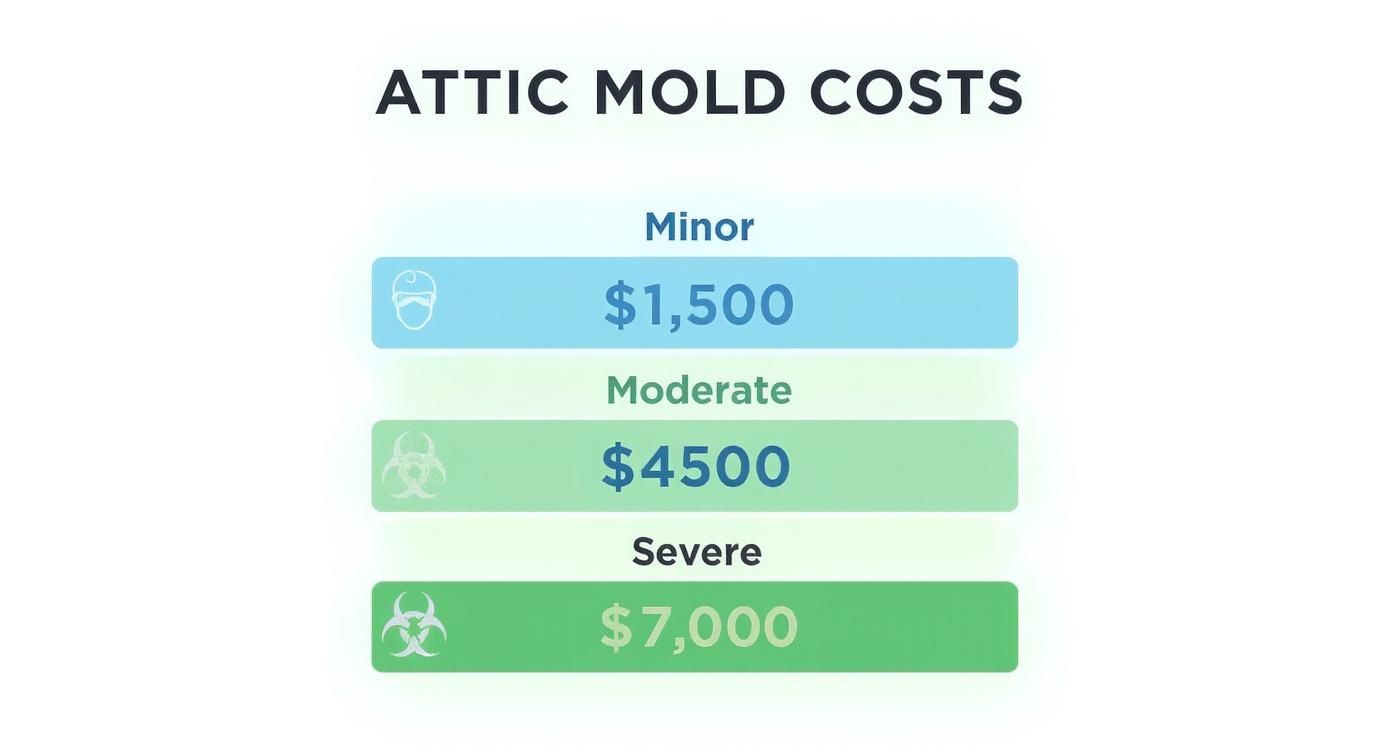
Attic Mold Remediation
Attic mold in eastern Nebraska is frequently caused by poor soffit ventilation coupled with warm, humid interior air escaping into the attic during winter. Moisture condenses on the cold underside of the roof sheathing, fostering Cladosporium or Aspergillus growth.
Remediation requires setting up negative pressure, vacuuming insulation, applying antimicrobial fungicides to rafters, and often soda-blasting heavy surface growth. Costs typically range between $1,800 and $4,800. If roof vents or insulation need upgrading, owners should expect an additional $1,000 to $2,500 in trade work.
Basement and Crawl Space Remediation
Due to Omaha's high soil moisture levels and heavy clay soils (which retain water against foundation walls), basements represent the most frequent area for remediation calls. Unfinished basements are relatively straightforward, averaging $1,500 to $4,000.
However, finished basements with wet carpet, padded underlayment, and wet drywall can rapidly escalate to $3,000 to $8,500. Crawl spaces often require installing a 12-mil or 20-mil reinforced vapor barrier (encapsulation) along with a dedicated commercial dehumidifier, which adds $1,500 to $3,500 to the base cleaning costs.
HVAC System Decontamination
If mold spores enter the central air distribution system, they can spread throughout every living area when the heating or air conditioning cycles on. Sanitizing an HVAC unit and metal ductwork costs between $1,200 and $3,200. If flexible ductwork is heavily contaminated, complete duct replacement may be required, costing upwards of $2,500 to $5,000.
Regional Climate and Housing Considerations in Omaha
Omaha’s geographic location creates specific environmental dynamics that directly influence home remediation demands.
Seasonal Moisture Patterns
Omaha experiences a humid continental climate characterized by severe seasonal shifts:
- Spring (March–May): Rapid snowmelt combined with thunderstorm systems leads to saturated ground conditions, hydrostatic pressure against foundations, and basement flooding.
- Summer (June–August): Outdoor humidity frequently surges. Warm outdoor air entering cool basements reaches its dew point, creating surface condensation on exposed cold-water pipes and concrete floors.
- Winter (December–February): High indoor relative humidity trapped inside tightly sealed modern homes leads to window condensation and attic frost accumulation.
Older vs. Modern Housing Stock
Historic neighborhoods such as Midtown, Dundee, Benson, and South Omaha feature homes built in the late 19th and early 20th centuries. These properties frequently feature brick, stone, or unreinforced block foundations, along with gravity-fed ductwork or plaster walls. Remediation in historic homes often requires specialized containment to preserve original woodwork, as well as lead or asbestos testing prior to structural demolition.
Conversely, modern homes in West Omaha, Elkhorn, and Papillion often feature finished basements and tight building envelopes. While structural materials in newer homes are modern, improper exterior grading, blocked window wells, or failed sump pumps can trap water within timber-frame wall cavities, leading to hidden mold colonies behind drywall.
Breakdown of Remediation Service Phases
A professional remediation project adheres to standard industry protocols—primarily governed by the Institute of Inspection, Cleaning and Restoration Certification (IICRC S520 Standard for Professional Mold Remediation). Understanding each step helps clarify where project funds are allocated.
- Inspection & Air Testing ($300 - $600)
- Thermal imaging, moisture meters, spore trap sampling
- Containment & Negative Air Setup ($400 - $1,000)
- Polyethylene sheeting, HEPA air scrubbers, zipper doors
- Removal & Physical Cleaning ($800 - $3,500)
- Material tear-out, wire brushing, HEPA vacuuming, fungicides
- Encapsulation & Surface Drying ($300 - $800)
- Antimicrobial primers, commercial air movers, dehumidifiers
- Post-Remediation Verification Testing ($250 - $450)
- Independent air testing to confirm ambient spore clearance
1. Inspection and Diagnostic Testing
Before work begins, an assessment identifies the mold species, airborne spore concentrations, and moisture boundaries.
- Cost: $300 to $600.
- Tools: Infrared cameras, pinless moisture meters, and air cassette samplers sent to accredited microbiology laboratories.
2. Containment and Air Pressure Stabilization
Remediators construct physical barriers using heavy plastic sheeting (6-mil poly) and zipper doors to isolate the work zone. High-efficiency particulate air (HEPA) air scrubbers vent air outside to create negative air pressure, preventing spores from migrating into clean living areas.
- Cost: $400 to $1,000 (included in total contract price).
3. Material Removal and HEPA Cleaning
Non-salvageable materials are cut out, sealed in bags, and removed. Hard structural timbers are physically scrubbed, sanded, or media-blasted (using dry ice or baking soda). All surfaces are vacuumed with certified HEPA equipment that captures particles down to 0.3 microns.
- Cost: $800 to $3,500+ depending on labor hours.
4. Antimicrobial Application and Encapsulation
Technicians apply EPA-registered antimicrobial, fungicidal treatments to destroy residual microscopic fungal elements. In attics or crawl spaces, an elastomeric white or clear sealant coating (encapsulant) is sprayed over wood framing to lock down remaining fibers and resist future moisture absorption.
- Cost: $300 to $800.
5. Post-Remediation Clearance Testing
Once remediation is complete, an independent environmental professional should take air samples to verify that spore levels inside the containment match or are lower than outdoor baseline levels.
- Cost: $250 to $450.
Insurance Coverage and Legal Disclosures in Nebraska
Navigating financial responsibility requires an understanding of standard property insurance policies and state real estate laws.
Homeowners Insurance Coverage Limitations
A primary concern for Omaha property owners is whether insurance will cover mold remediation. As a general rule:
- Covered Scenarios: Insurance typically covers mold remediation if it is the direct result of a "covered peril" that is sudden and accidental. Examples include a burst washing machine hose, a ruptured water heater, or pipe freeze-up during a severe cold snap.
- Excluded Scenarios: Insurance generally denies claims caused by long-term maintenance neglect, continuous pipe drips, surface condensation, or surface groundwater intrusion entering through foundation walls.
- Policy Caps: Even when mold coverage applies, many carrier policies in Nebraska impose a strict sub-limit endorsement on mold cleanup—typically capped at $5,000 or $10,000 total, regardless of total damage.
Disclaimer: Insurance policy terms vary widely. Property owners should consult their specific policy declaration pages or contact a licensed insurance agent to confirm coverage limits.
Nebraska Real Estate Disclosure Obligations
Under the Nebraska Real Property Disclosure Act (Neb. Rev. Stat. § 76-2,120), property sellers are legally required to complete a written Seller Property Condition Disclosure Statement. Sellers must disclose known past or present mold issues, roof leaks, basement water seepage, or structural flooding.
Failing to disclose known mold problems can expose sellers to post-closing lawsuits for damages, misrepresentation, and mandated remediation costs. Retaining documentation of professional remediation, including clearance testing certificates, helps preserve property value during real estate transactions.
How to Select a Qualified Remediation Professional in Omaha
Because Nebraska does not currently require a state-level license specifically for general mold remediation contractors, property owners must carefully evaluate contractor credentials.
Checklist for Hiring a Contractor
- Industry Certification: Confirm the contractor or on-site supervisor holds current certifications from recognized bodies, such as the IICRC (e.g., Applied Microbial Remediation Technician - AMRT) or the National Association of Mold Remediators and Inspectors (NAMRI).
- Insurance Requirements: Require proof of general liability insurance as well as specialized Pollution Liability Insurance. Standard general liability policies often explicitly exclude mold and biological pollution damages.
- Separation of Inspection and Remediation: To avoid conflicts of interest, avoid companies that offer "free mold tests" and then perform their own clearance testing. Ideally, use an independent environmental testing firm to write the initial scope of work and perform final clearance testing.
- Detailed Written Estimates: Ensure the estimate breaks down containment protocols, disposal fees, specific chemicals used (EPA registration numbers), labor hours, and post-remediation clearance guarantees.
- Local Experience: Choose established local contractors familiar with Omaha's specific housing foundations, climate patterns, and municipal waste protocols.
Frequently Asked Questions
How much does professional mold testing cost in Omaha?
Standalone professional mold testing in Omaha costs between $300 and $600. This fee covers a physical evaluation by an inspector, moisture meter readings, thermal imaging scan, and two to four air or surface samples analyzed by an accredited laboratory. Home test kits purchased at hardware stores ($15–$50) are generally unreliable because ambient air naturally contains harmless mold spores, leading to frequent false positives without laboratory context.
Can I clean mold myself to save money?
The U.S. Environmental Protection Agency (EPA) advises that DIY mold cleaning is reasonable only if the affected area is less than 10 square feet (approximately a 3-foot by 3-foot patch) and was caused by clean water. For larger areas, structural contamination, or issues involving sewage, hiring professional remediators with HEPA containment equipment is necessary to prevent spreading millions of microscopic spores into living quarters.
How long does a typical remediation project take?
A standard residential mold remediation project takes between 1 and 3 days to complete. Larger projects involving extensive drywall removal, crawl space encapsulation, or structural drying following severe water intrusion can take 4 to 7 business days.
Will bleach eliminate mold on basement walls or studs?
No. Chlorine bleach is designed for non-porous surfaces like porcelain or vinyl. On porous surfaces like concrete, wood framing, or drywall, the water component of liquid bleach penetrates the material while the chemical agent remains on the surface. This adds moisture to the core of the material, which can cause mold roots (hyphae) to grow back more aggressively. Professionals use commercial antimicrobial fungicides and mechanical removal instead.
How can I prevent mold from returning after remediation?
To keep mold from returning:
- Maintain indoor relative humidity below 50% using a commercial basement dehumidifier.
- Ensure exterior downspouts discharge water at least 5 to 6 feet away from foundation walls.
- Ensure proper ventilation in attics, kitchens, and bathrooms.
- Promptly repair plumbing drips and foundation settlement cracks.
Actionable Recommendations for Property Owners
When facing potential mold issues in an Omaha home, follow a structured sequence to manage costs and ensure complete remediation:
- Stop the Water Source First: Fix plumbing leaks, repair roof damage, or clear clogged sump pump discharge lines immediately. Remediation completed before stopping moisture intrusion will fail.
- Document Everything: Take photographs and video of visible growth and water damage before touching anything, especially if submitting an insurance claim.
- Engage an Independent Assessor for Large Projects: If mold covers more than 10 square feet, hire an independent environmental consultant to perform air sampling and draft an objective scope of work.
- Collect Three Detailed Quotes: Request itemized proposals from IICRC-certified remediation firms operating in Douglas or Sarpy County. Verify pollution liability insurance coverage before signing contracts.
- Obtain Clearance Testing: Ensure the remediation contract specifies that final payment is contingent upon passing a post-remediation clearance test verified by an independent laboratory.
Image Gallery