The Comprehensive Guide to AO3 Archive of Our Own: Features, Navigation, and Fandom Culture
Archive of Our Own (AO3) is a non-profit, open-source repository for fanfiction, fan art, and other fanworks, hosted by the Organization for Transformative Works (OTW). Established in 2008 and fully opened in 2009, AO3 has grown into o...
Archive of Our Own (AO3) is a non-profit, open-source repository for fanfiction, fan art, and other fanworks, hosted by the Organization for Transformative Works (OTW). Established in 2008 and fully opened in 2009, AO3 has grown into one of the largest and most influential digital archives for fan-generated creative content, powered almost entirely by user tagging, robust archiving standards, and a strict non-commercial ethos.
Contents
Understanding the Core Architecture and Foundation of AO3
The technical and organizational backbone of the Archive of Our Own distinguishes it from standard blogging platforms or commercial content hosts. Built using open-source Ruby on Rails software developed by volunteer coders, AO3 operates under a commitment to user accessibility, data longevity, and structural transparency.
Unlike platforms governed by algorithmic feeds or monetization models, AO3 is sustained through donations and managed by the OTW, a non-profit organization dedicated to preserving the history and culture of fandom. This structure ensures that user-generated works remain accessible without intrusive advertisements, corporate data harvesting, or sudden policy changes driven by commercial interests.
The system relies on a database architecture designed specifically for narrative and visual fanworks. Users can upload multi-chapter stories, standalone works, podfics (audio fiction), and fan art. Every submission is integrated into an extensive metadata network that categorizes works by fandom, relationship dynamics, content warnings, and thematic tags.
Navigating the Archive: Search and Filtering Mechanics
Effective navigation on AO3 depends on mastering its advanced search and filtering interface. Because the archive hosts millions of works across thousands of distinct fandoms, the search engine utilizes a combination of boolean operators, inclusion/exclusion toggles, and user-generated tags.
| Search Parameter | Functionality | Example Usage |
|---|---|---|
| Fandoms | Narrows results to a specific source material or crossover. | fandom: "Sherlock (TV)" |
| Rating | Filters by content maturity levels (General to Explicit). | rating: Teen And Up Audiences |
| Warnings | Includes or excludes standard content advisory warnings. | warning: Major Character Death |
| Word Count | Sets minimum or maximum length boundaries for works. | words > 50000 |
| Custom Tags | Filters by specific tropes, characters, or freeform tags. | freeform: "Alternate Universe - Coffee Shop" |
Users can combine these parameters using the dedicated Search page or by applying filters directly from the sidebar of any fandom tag page. The platform allows readers to exclude specific tropes or pairings, ensuring that search results align closely with individual preferences.
The Power of Tagging: Taxonomy and Freeform Labels
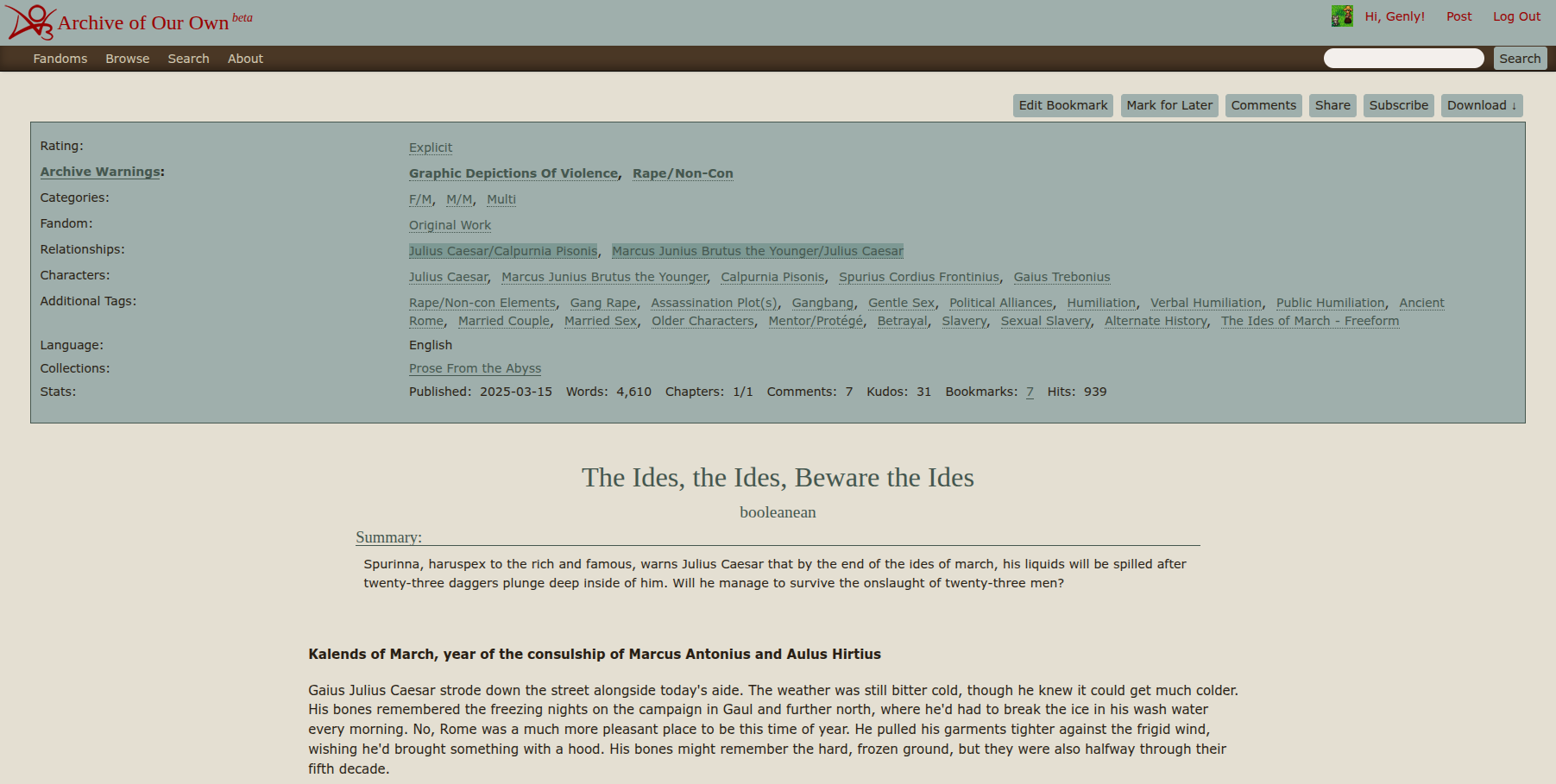
The tagging system is the defining feature of AO3, separating it from traditional publishing platforms and older web archives. The taxonomy is divided into several distinct categories:
- Fandoms: The original media, books, television shows, movies, or real-person entities that inspire the work.
- Characters: Specific individuals appearing within the narrative.
- Relationships: Denoted by slashes (/) for romantic pairings and ampersands (&) for platonic relationships.
- Additional Tags (Freeform): User-submitted descriptions covering specific tropes, alternate universes, narrative styles, and technical disclaimers.
This system is managed by the Tag Wranglers, a dedicated team of volunteers who organize synonyms, merge duplicate tags, and ensure that searches return comprehensive results. For example, variations of a trope like "Coffee Shop AU" are automatically linked so that searching for one variant captures all related entries.
Creating an Account and Publishing Works on the Platform
Accessing AO3 as a reader requires no account, but publishing works, leaving comments, subscribing to authors, and bookmarking require registration. Because of anti-spam measures, new account creation uses an automated invitation queue system. Prospective users submit an email address to join the queue and receive an invite token.
Once registered, creators use a structured posting interface designed to maintain formatting integrity and accessibility:
- Work Information: Inputting titles, author pseudonyms, co-creators, and series associations.
- Rating and Warnings: Selecting mandatory content ratings and choosing among standard OTW content warnings or selecting "Author Chose Not To Use Archive Warnings."
- Categorization: Applying fandoms, character tags, relationship tags, and freeform tags.
- Body Content: Utilizing a rich-text editor or raw HTML input to compose or paste chapters. The platform strips unsafe scripts while supporting clean formatting for italics, bolding, blockquotes, and custom CSS skins.
Reader Engagement, Bookmarking, and Curation Tools
AO3 provides readers with sophisticated tools to interact with creators and curate their own reading experiences. These features extend far beyond basic likes or comments:
- Kudos: A lightweight, single-click appreciation metric indicating that a reader enjoyed a work.
- Comments: Threaded discussion areas allowing detailed feedback between readers and authors.
- Bookmarks: Private or public collections of works, which can be organized with personal tags and notes. Public bookmarks contribute to a work's visibility and recommendation metrics.
- Collections and Anthologies: Curated groups of works centered around specific themes, writing challenges, or exchange events (such as Yuletide or fandom-specific gift exchanges).
- History Tracking: Logged reading history that allows users to easily relocate works they have previously opened, complete with indicators showing whether a work has been updated since their last visit.
Content Policies, Legal Protection, and User Safety
The operational framework of AO3 is rooted in the legal defense of transformative works established by the OTW and supported by organizations like the Electronic Frontier Foundation (EFF). Fanfiction is legally protected in many jurisdictions as transformative fair use under copyright law, provided it is non-commercial and does not usurp the market for the original work.
To maintain this legal standing and protect user autonomy, AO3 operates under a strict "no censorship" policy regarding creative content. The platform does not judge works based on moral, aesthetic, or political criteria. Instead, user safety is managed through mandatory content warnings, rating filters, and robust user-block tools.
Authors are required to use specific standardized warnings when their works depict:
- Graphic depictions of violence
- Major character death
- Non-consensual sexual content
- Underage sexual content
If a creator prefers not to disclose whether these elements are present, they must select "Author Chose Not To Use Archive Warnings," signaling readers to exercise discretion based on freeform tags.
Frequently Asked Questions About AO3
How do I get an account on Archive of Our Own?
You can request an invite by visiting the AO3 homepage and clicking the "Get Invited!" link, which places your email address into an automated queue. Once your turn arrives, an activation token is emailed to you to complete registration.
Is Archive of Our Own free to use?
Yes, AO3 is 100% free to use for both readers and creators, with no subscription fees, paywalls, or advertisements. The platform is entirely funded through charitable donations and maintained by the non-profit Organization for Transformative Works (OTW).
Can I download stories to read offline?
Yes, AO3 allows users to download complete works or individual chapters in multiple formats, including EPUB, MOBI, PDF, HTML, and AZW3. This feature is accessible directly from the header of any published work.
What are Archive Warnings and why are they mandatory?
Archive Warnings are four specific content advisories (Violence, Death, Non-Con, and Underage) required for all fictional works to help readers filter content and protect user safety. Authors who do not wish to specify must select the catch-all warning waiver.
Why do some works have restricted access?
Authors can choose to restrict the visibility of their works so that only registered, logged-in users can view them. This protects creator privacy and limits scraping by external data collectors or search engines.
How are tags managed on the platform?
Tags are organized and standardized by a global team of volunteer Tag Wranglers. They link synonymous terms, categorize freeform tags, and ensure that search queries return accurate results across different variations of terminology.
Conclusion and Recommendations for Writers and Readers
Archive of Our Own stands as a monument to digital preservation, community governance, and open-source software development within fan communities. Whether you are publishing multi-chapter epic narratives, organizing fan art galleries, or exploring specific creative tropes through advanced filtering, mastering the platform's metadata structure enhances your experience. Creators should prioritize accurate tagging and clear content warnings to reach their target audience, while readers can leverage history logs, subscriptions, and public bookmarks to curate an organized reading library.
Image Gallery