Pelosi, Schumer, and Trump Oval Office Meeting Explained: Context, Key Clashes, and Political Fallout
The December 11, 2018, Oval Office meeting between President Donald J. Trump, House Democratic Leader Nancy Pelosi, and Senate Democratic Leader Chuck Schumer was a watershed moment in modern American political communication. Originall...
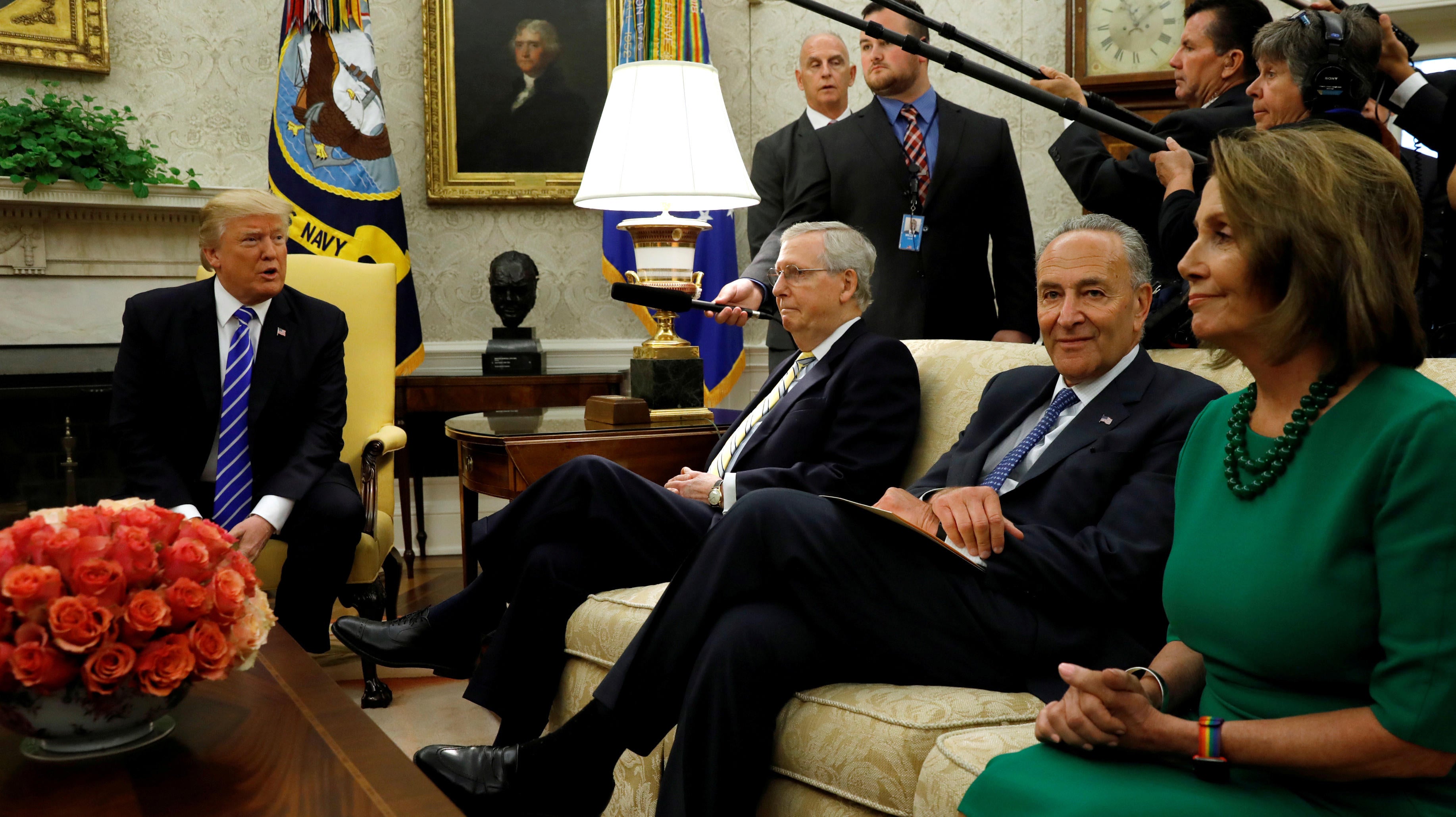
The December 11, 2018, Oval Office meeting between President Donald J. Trump, House Democratic Leader Nancy Pelosi, and Senate Democratic Leader Chuck Schumer was a watershed moment in modern American political communication. Originally intended as a brief press photo-opportunity ahead of private budget negotiations, it escalated into an unprecedented 17-minute live televised debate on federal funding, border security, and executive power.
Contents
- December 11, 2018 Oval Office Meeting
- President Donald Trump: Demands $5B Border Wall, Threatens Shutdown
- House Speaker-Designate Nancy Pelosi: Rejects Wall Funding
- Senate Minority Leader Chuck Schumer: Focuses on Senate Votes
- 35-Day US Government Shutdown (Dec 22, 2018 – Jan 25, 2019)
Understanding this clash requires examining the broader fiscal standoff over the U.S.–Mexico border wall, the tactical choices made by each party, the mechanics of congressional budget authority, and the long-term impact on executive-legislative negotiations in a divided government.
Historical Context: The 2018 Budget Standoff and Border Wall Funding
The meeting took place during the closing weeks of the 115th United States Congress. At the time, the federal government faced an approaching deadline of December 21, 2018, to pass appropriations bills for several major federal agencies, including the Department of Homeland Security, the Department of Justice, and the Department of the Interior. Without approved appropriations or a continuing resolution (CR), funding for approximately 25 percent of the federal government would lapse.
The core policy dispute centered on President Trump’s demand for $5 billion in direct federal appropriations to construct a physical wall along the U.S.–Mexico border. Congressional Democrats opposed direct wall appropriations, proposing instead $1.3 billion for general border security enhancements, including technological upgrades, port-of-entry infrastructure, and repair of existing fencing.
| Party | Federal Appropriations Dispute (December 2018) |
|---|---|
| Administration Request | $5.0 Billion (Physical Wall) |
| Democratic Proposal | $1.3 Billion (Border Security) |
The political context was further heightened by the results of the November 2018 midterm elections. Democrats had secured a decisive majority in the House of Representatives, set to take power on January 3, 2019, with Nancy Pelosi slated to resume the Speakership. Meanwhile, Republicans maintained control of the Senate, though short of the 60-vote threshold required to pass controversial funding bills without Democratic support.
This created a unique legislative dynamic:
- The Republican Administration sought to secure wall funding before losing unified Republican control of Congress.
- House Democrats aimed to defer major funding decisions until their incoming majority assumed office in January.
- Senate Democrats leveraged the 60-vote filibuster threshold to block standalone border wall appropriations in the upper chamber.
Anatomy of the Oval Office Clash: Arguments and Tactics
When reporters entered the Oval Office on December 11, President Trump departed from customary protocol by initiating an open debate in front of the press corps. What ensued was a unscripted negotiation that highlighted distinct approaches to public bargaining, constitutional authority, and legislative strategy.
1. Trump’s Leverage Strategy and Ownership of the Shutdown
President Trump entered the meeting seeking to apply public pressure on Democratic leadership. He argued that border security was an emergency issue that justified withholding approval of government funding. Trump asserted that if Congress did not approve funding for the wall, a government shutdown was an acceptable outcome to enforce policy priorities.
The most critical moment of the meeting occurred during an exchange with Senator Schumer. Responding to warnings about the economic and administrative cost of a lapse in funding, President Trump declared:
"I am proud to shut down the government for border security, Chuck... I will take the mantle. I will be the one to shut it down. I’m not going to blame you for it."
This statement was politically significant because executive branch leadership historically attempts to attribute blame for government shutdowns to the opposing party in Congress. By explicitly accepting responsibility on live television, Trump altered the political leverage of the upcoming negotiations.
2. Pelosi’s Focus on Constitutional Process and House Dynamics
Representative Pelosi centered her argument on constitutional roles, parliamentary realities, and party unity. Recognizing that the meeting was taking place before live news cameras, Pelosi repeatedly urged the President to move the debate to an executive session without media presence.
Pelosi made several key strategic points:
- House Republican Votes: She pointed out that Republicans, despite controlling the House majority until January, lacked the votes within their own caucus to pass a funding bill containing $5 billion for the wall without Democratic help.
- Constitutional Frame: She emphasized that legislation must pass both chambers of Congress to reach the President's desk, challenging Trump's assertion that he could force funding through unilateral demand.
- Pushback on Political Authority: When President Trump suggested that Pelosi was constrained in her bargaining position due to her upcoming election as Speaker of the House, Pelosi firmly responded, asking him not to characterize the strength of her leadership or her position within the House Democratic Caucus.
3. Schumer’s Focus on Senate Vote Thresholds and Factual Claims
Senator Schumer focused on procedural constraints in the U.S. Senate and the availability of bipartisan funding alternatives. He reminded the President that any appropriations bill required 60 votes in the Senate to overcome a legislative filibuster, meaning a Republican-only bill could not pass even with a Senate majority.
Schumer advocated for passing six fully negotiated full-year appropriations bills alongside a continuing resolution for the Department of Homeland Security, which would allow the rest of the government to operate normally while border funding was negotiated separately. He also challenged various factual assertions made by the President regarding the status of existing wall construction and border security metrics.
4. The Role of Vice President Mike Pence
Seated beside President Trump, Vice President Mike Pence remained silent throughout the 17-minute exchange. Observers noted that his posture provided a striking visual contrast to the heated three-way debate, reflecting the administration's internal focus on letting the President lead direct communications.
Key Takeaways and Political Strategies Compared
The table below outlines the primary objectives, key arguments, tactical approaches, and political outcomes for each principal actor during the December 11, 2018 meeting.
| Principal Actor | Strategic Objective | Core Arguments Presented | Key Tactical Move | Immediate Outcome |
|---|---|---|---|---|
| President Donald Trump | Secure $5 billion in direct border wall appropriations. | Border security is a national security emergency; a wall is mandatory. | Publicly accepted political responsibility for a shutdown. | Lost public leverage after claiming ownership of the shutdown. |
| Speaker-Designate Nancy Pelosi | Prevent border wall funding; defer main budget battles to 2019. | House Republicans lack internal votes; public policy shouldn't be negotiated on live TV. | Highlighted House Republican vote shortages and requested private talks. | Consolidated House Democratic caucus support and established executive boundary. |
| Senator Chuck Schumer | Protect Senate filibuster leverage; secure non-wall funding. | A Senate 60-vote threshold requires bipartisan consensus; alternative budget deals exist. | Pressed Trump on Senate voting math and existing bipartisan compromise options. | Kept Senate Democrats aligned against wall funding. |
The Immediate Outcome: The 35-Day Government Shutdown
The breakdown in negotiations during and immediately after the December 11 meeting led directly to the longest federal government shutdown in United States history.
- December 11, 2018: Oval Office Meeting; Live Televised Clash
- December 22, 2018: Funding Lapses for 25% of Federal Operations
- January 25, 2019: Shutdown Ends via CR Without Wall Appropriations
When existing appropriations expired at midnight on December 21, 2018, operational funding lapsed for nine executive departments and numerous independent agencies.
Economic and Operational Effects
- Federal Workforce Impact: Approximately 800,000 federal employees were affected. Roughly 420,000 "excepted" personnel (such as TSA officers, border patrol agents, and air traffic controllers) worked without immediate pay, while 380,000 were furloughed.
- Economic Losses: The nonpartisan Congressional Budget Office (CBO) estimated that the 35-day shutdown reduced overall U.S. gross domestic product (GDP) by approximately $11 billion, including a permanent economic loss of $3 billion that was never recovered.
- Public Opinion: Continuous national polling during the shutdown indicated that a majority of the public attributed responsibility for the government closure to President Trump and Congressional Republicans, driven in large part by the President's televised comments on December 11.
Resolution of the Crisis
On January 25, 2019, after 35 days, President Trump signed a short-term continuing resolution passed by both houses of Congress that opened the government for three weeks without allocating money for a border wall.
Subsequent negotiations yielded the Consolidated Appropriations Act, 2019, which provided $1.375 billion for border fencing—matching the initial Democratic offer—rather than the $5 billion requested by the administration. To fund additional construction, President Trump subsequently declared a national emergency under the National Emergencies Act, diverting funds from Department of Defense construction projects, a move that triggered extensive federal litigation.
Structural Impact on Congressional-Executive Negotiations
The December 11 meeting had lasting consequences for how presidential leadership and legislative leaders interact under divided government.
The Limits of Unfiltered Media Bargaining
Traditionally, leadership negotiations over sensitive fiscal bills occur behind closed doors, allowing participants to test concessions without immediate public reaction. By opening the meeting to live cameras, the administration attempted to leverage public sentiment directly. However, the outcome demonstrated that live bargaining carries significant risk when political opponents are prepared to challenge factual assertions and procedural premises in real time.
Shift in Power Dynamics for the 116th Congress
The meeting set the tone for executive-legislative relations during the 116th Congress (2019–2021). It established Nancy Pelosi’s unified control over the House Democratic Majority and demonstrated the effectiveness of coordinated legislative resistance between the House and Senate Democratic caucuses.
- Traditional Negotiations
- Closed-door sessions
- Private compromises
- Managed public statements
- December 11, 2018 Oval Office Meeting
- Live televised press coverage
- Real-time tactical confrontations
- Immediate public accountability
Institutional Precedent for Government Shutdown Politics
The 2018–2019 standoff highlighted that accepting public responsibility for a shutdown undermines executive bargaining power. Future administrations and congressional leaders have referenced the December 11 meeting as a case study in the risks of using funding lapses as routine policy leverage.
Frequently Asked Questions
When did the televised Pelosi-Schumer-Trump meeting take place?
The meeting took place on December 11, 2018, in the Oval Office of the White House, ten days before funding for several federal agencies was set to expire.
Why did Donald Trump allow reporters to broadcast the Oval Office meeting?
President Trump initially invited the press pool into the Oval Office to demonstrate confidence, apply public pressure on Democratic leaders, and highlight his commitment to building a border wall. However, the routine photo-op turned into an extended 17-minute debate when Democratic leaders actively pushed back on live television.
What was the main policy disagreement during the meeting?
The core disagreement was over federal spending for a physical wall on the U.S.–Mexico border. President Trump demanded $5 billion in direct funding, threatening to shut down the government if Congress did not comply. Representative Pelosi and Senator Schumer refused, offering $1.3 billion for general border security measures instead.
Why did Vice President Mike Pence remain silent throughout the exchange?
Vice President Pence chose not to intervene during the debate, allowing President Trump to lead the dialogue directly. His silence became a widely discussed visual element of the broadcast, illustrating the strategic decision of the Vice President to maintain a neutral demeanor during direct executive-legislative confrontations.
How did the meeting lead to the longest government shutdown in U.S. history?
During the meeting, President Trump stated that he would be "proud to shut down the government for border security" and would take responsibility for doing so. When neither side conceded on border wall appropriations by December 21, 2018, funding lapsed for roughly 25% of the federal government, initiating a 35-day shutdown that lasted until January 25, 2019.
Practical Takeaways for Analyzing Legislative Bargaining
Analyzing high-stakes political exchanges like the December 11, 2018 meeting provides practical insights into constitutional mechanics and political negotiation strategy:
- Verify Constitutional Vote Requirements: Executive proposals always depend on congressional math. In the U.S. system, passing spending bills requires simple majorities in the House and a 60-vote threshold in the Senate to overcome filibusters, making bipartisan cooperation necessary regardless of executive demands.
- Examine Official Budget Documents: When evaluating government funding disputes, consult nonpartisan resources such as the Congressional Budget Office (CBO) and official legislation on Congress.gov to understand exact dollar figures rather than relying solely on political rhetoric.
- Assess Leverage in Public vs. Private Bargaining: Open negotiations limit a leader's ability to offer concessions without angering their base, whereas private negotiations often yield functional compromises. Recognizing this distinction helps predict whether a legislative impasse will lead to resolution or policy deadlock.
Image Gallery