Workers Compensation Insurance for Painters in California: 2026 Requirements and Costs
In California, workers' compensation insurance is a legal mandate for all licensed painting contractors as of 2026, regardless of whether they employ others or work alone. This coverage provides medical benefits and wage replacement to...
In California, workers' compensation insurance is a legal mandate for all licensed painting contractors as of 2026, regardless of whether they employ others or work alone. This coverage provides medical benefits and wage replacement to employees injured on the job while protecting business owners from devastating lawsuits resulting from workplace accidents.
Contents
The 2026 Legal Landscape for California Painting Contractors
For decades, solo painters in California could opt out of workers' compensation insurance by filing an exemption with the Contractors State License Board (CSLB), asserting they had no employees. However, legislative shifts have fundamentally altered this landscape. Under the provisions of Senate Bill 216, which was phased in over several years, the exemption for most contracting classifications has been eliminated.
As of January 1, 2026, all active C-33 (Painting and Decorating) licensees are required to carry workers' compensation insurance. This change was implemented to level the playing field between solo operators and larger firms, ensuring that all professionals in high-risk trades have coverage for potential injuries and contributing to the state's social safety net. Even if you are a "man-in-a-van" operation with zero employees, the CSLB now requires proof of an active workers' compensation policy to maintain an active license.
Failure to maintain this coverage can lead to the immediate suspension of your C-33 license, heavy fines from the Division of Labor Standards Enforcement (DLSE), and potential criminal charges. Furthermore, without this insurance, a painter is personally liable for all medical expenses and lost wages if an assistant (even a casual laborer or "independent" subcontractor who is legally deemed an employee) is injured.
Understanding the C-33 Classification and Workers' Comp Codes
The cost and administration of your insurance are largely dictated by how your work is classified. In California, the Workers' Compensation Insurance Rating Bureau (WCIRB) determines the classifications used by insurers to set rates.
For painting contractors, the primary classification is Class Code 5474: Painting or Paperhanging. This code covers:
- Interior and exterior painting of residential and commercial structures.
- Surface preparation, including sanding, scraping, and pressure washing.
- The use of ladders, scaffolding, and lifts.
- Waterproofing of structures when performed as part of a painting contract.
It is vital to ensure your payroll is reported under the correct code. If you also perform significant amounts of other work—such as drywall installation (Code 5445) or floor covering (Code 5437)—you may be able to split your payroll across multiple classifications, provided you maintain meticulous time records. However, Class Code 5474 is the "catch-all" for most painting operations and typically carries a rate reflecting the moderate-to-high risk of falls and repetitive motion injuries associated with the trade.
How Workers' Compensation Costs are Calculated in 2026
Insurance premiums for California painters are not flat fees; they are dynamic calculations based on your specific business profile. The standard formula used by carriers is:
(Total Payroll / 100) x Base Class Rate x Experience Modification Rate (ExMod) = Annual Premium
1. Total Annual Payroll
This includes all gross wages, bonuses, and commissions paid to employees. In 2026, even if you are an owner-operator (Incorporated or LLC), your own "salary" or a state-mandated minimum "owner's payroll" value will be used to calculate the premium unless you specifically qualify for an executive exclusion (which is becoming increasingly rare for active field workers).
2. The Base Class Rate
This is the rate per $100 of payroll assigned to Class Code 5474. This rate is influenced by the statewide claims history for painters. If the industry sees an uptick in falls or ladder-related injuries, the base rate for all painters in California rises. Private carriers set their own rates based on these benchmarks, leading to price competition.
3. The Experience Modification Rate (ExMod)
The ExMod is a multiplier that rewards safe companies and penalizes those with high claim frequencies. A "neutral" ExMod is 1.00. If your company has a better-than-average safety record over a three-year period, your ExMod might be 0.85 (a 15% discount). If you have frequent injuries, it might be 1.25 (a 25% surcharge). For small, new painting businesses, the ExMod typically starts at 1.00 until enough data is collected.
| Component | Impact on Cost | Management Strategy |
|---|---|---|
| Payroll | Direct/Proportional | Maintain accurate records; distinguish between field work and clerical. |
| Class Code | High | Ensure you aren't misclassified into a higher-risk category like "Roofing." |
| ExMod | Variable (Surcharge/Discount) | Implement a strict "Ladders & Scaffolding" safety program. |
| Carrier Choice | 10% - 30% Variance | Shop between private insurers and the State Fund. |
The Role of the State Compensation Insurance Fund (State Fund)
California is home to the State Compensation Insurance Fund, a self-supporting, non-profit public enterprise. While private insurers can choose whom they cover, the State Fund is the "insurer of last resort."
If you are a new painting contractor or have a history of frequent claims, private carriers like Travelers, Hartford, or Berkshire Hathaway might decline to offer you a policy. In these instances, the State Fund is legally required to provide you with a quote. While State Fund rates were historically higher than private carriers, their 2026 pricing remains competitive for small-to-mid-sized painting firms, and they offer extensive safety resources specifically tailored to California’s strict Cal/OSHA regulations.
Safety Risks and Claim Mitigation for Painters
In the painting industry, insurance claims are rarely "minor." Because the work involves heights and chemical exposure, injuries tend to be severe. To keep premiums low and stay compliant with California law, painters must address the following:
Fall Protection and Ladders
Falls remain the leading cause of permanent disability and death in the painting trade. In 2026, California insurers heavily scrutinize a contractor's safety equipment. Utilizing modern, stabilized scaffolding and ensuring all employees have undergone certified ladder safety training can prevent the "shock loss" claims that drive ExMod rates through the roof.
Repetitive Motion and Ergonomics
Long-term claims often arise from rotator cuff tears, carpal tunnel, and back strain caused by overhead reaching and heavy lifting. Implementing mechanical sprayers where appropriate and rotating tasks among crew members can reduce the likelihood of "wear and tear" claims, which are notoriously difficult for insurers to close and expensive to litigate.
Respiratory and Chemical Hazards
Exposure to Volatile Organic Compounds (VOCs) and lead-based paint (especially on pre-1978 structures) remains a significant liability. California’s strict environmental laws overlap with workers' comp; an employee who develops respiratory issues due to inadequate PPE (Personal Protective Equipment) represents a massive long-term financial liability.
Essential Steps to Securing Coverage
For a painting contractor in California, obtaining and maintaining workers' comp involves several technical steps:
- Determine Your Payroll Estimate: You must provide an honest estimate of your total payroll for the coming year. Underestimating can lead to a massive "audit bill" at the end of the policy term.
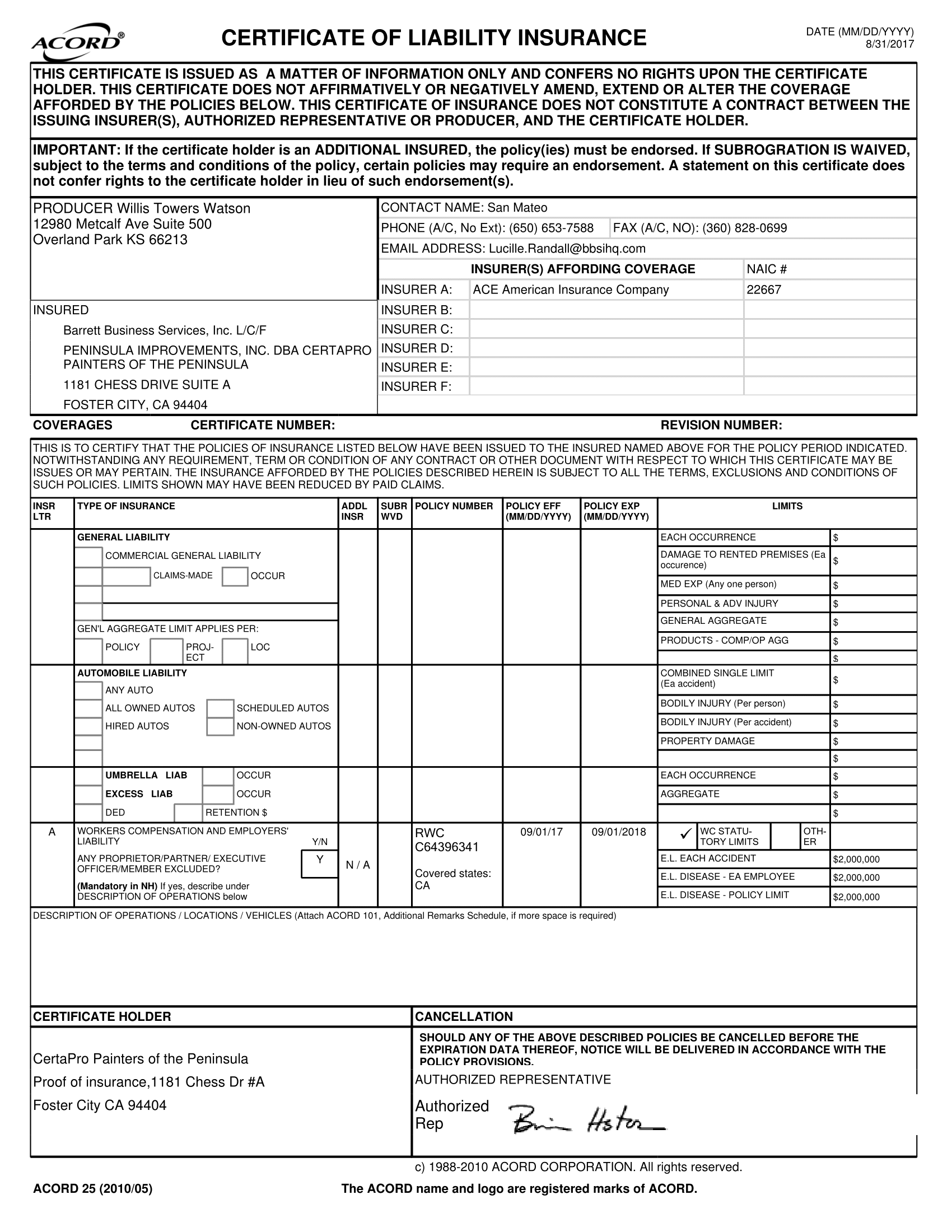
- Verify Subcontractors: If you hire other painters as "subcontractors," you must obtain their Certificates of Insurance (COI). In California, if your subcontractor does not have workers' comp, they are legally considered your employee, and your insurance carrier will charge you a premium for their labor during your annual audit.
- Implement an IIPP: California law requires every employer to have a written Injury and Illness Prevention Program (IIPP). Insurers in 2026 often ask to see this document before bound coverage is issued.
- The Annual Audit: At the end of each policy year, the insurer will review your actual payroll records (941s, payroll journals). If your business grew and you paid out more in wages than estimated, you will owe an additional premium. Conversely, if payroll was lower, you may receive a credit.
Frequently Asked Questions
Do I need workers' comp if I only hire family members?
Yes. In California, there is no "family exemption" for workers' compensation. If a family member is performing work for your painting business, even if they are not receiving a traditional paycheck, they are generally considered employees under the law. Failure to cover them can result in the same penalties as failing to cover any other worker.
Can I use a "Ghost Policy" just to keep my C-33 license?
In 2026, the concept of a "ghost policy" (a policy with $0 payroll used strictly to satisfy a license requirement) is largely obsolete for painters. Because California law now requires coverage for the owner-operator, the policy must reflect the owner's payroll or the state's minimum assigned payroll for a working officer. Carriers are also increasingly unwilling to write "zero-payroll" policies for high-risk trades like painting.
What happens if I am caught painting without workers' comp?
The consequences are severe. The CSLB can issue a "Stop Order," meaning all work on your current job sites must cease immediately. You can be fined up to $1,500 per employee for every day you are uninsured. Additionally, a single injury to a worker could result in a lawsuit that targets your personal assets, including your home and savings.
Does my General Liability insurance cover my workers?
No. This is a common and dangerous misconception. General Liability (GL) insurance covers damage you cause to a client's property or injuries to third parties (like a homeowner tripping over your ladder). It explicitly excludes injuries to your own workers. Only workers' compensation insurance covers employee work-related injuries.
How does SB 216 affect me if I am a sole proprietor?
As of 2026, SB 216 requires you to have workers' compensation insurance even if you have no employees. You must submit proof of insurance to the CSLB to maintain your license. You no longer have the option to file an "Exemption from Workers' Compensation."
Summary of Action for 2026
To ensure compliance and financial stability, California painters should immediately verify their CSLB status and insurance expiration dates. With the full implementation of SB 216, the era of the "uninsured solo painter" has ended. Contractors should shop for quotes at least 60 days before their current policy or license renewal, focusing on carriers that offer specialized safety training for Class Code 5474. Prioritizing a robust Injury and Illness Prevention Program (IIPP) remains the most effective way to control long-term insurance costs and protect the workforce.
Image Gallery