Carmelo Anthony’s Tenure with the Denver Nuggets: A Comprehensive Historical Analysis
Carmelo Anthony played for the Denver Nuggets for seven and a half seasons, from his debut in 2003 until his trade in February 2011. Drafted third overall, Anthony transformed the franchise from a struggling lottery team into a perenni...
Carmelo Anthony played for the Denver Nuggets for seven and a half seasons, from his debut in 2003 until his trade in February 2011. Drafted third overall, Anthony transformed the franchise from a struggling lottery team into a perennial Western Conference contender, culminating in a 2009 Western Conference Finals appearance.
Contents
The Arrival: The 2003 NBA Draft and Immediate Impact
When the Denver Nuggets selected Carmelo Anthony with the third overall pick in the 2003 NBA Draft, the franchise was at its lowest point. The team had finished the previous season with a dismal 17-65 record. The arrival of the Syracuse standout, who had just led the Orangemen to an NCAA Championship as a freshman, immediately shifted the trajectory of the organization.
Anthony’s impact was instantaneous. Unlike many rookies who require a period of adjustment, "Melo" transitioned to the professional level with a polished offensive repertoire that featured a lethal mid-range jumper, physical post play, and the ability to finish at the rim. In his first season (2003-2004), he averaged 21.0 points and 6.1 rebounds per game, playing in all 82 contests.
His presence sparked a 26-game improvement for the Nuggets, as they finished 43-39 and secured a playoff berth for the first time since 1995. Although Anthony narrowly lost the Rookie of the Year award to LeBron James, his impact on winning was arguably more immediate, as Denver became a fixture in the postseason from his very first year.
The Developmental Years and Playoff Hurdles (2004–2007)
Between 2004 and 2007, Anthony solidified his status as one of the premier scorers in the NBA. During this period, he was the focal point of an offense coached primarily by George Karl, who took over during the 2004-2005 season. Anthony’s scoring average climbed steadily, reaching 28.9 points per game during the 2006-2007 season.
Despite the individual brilliance, the Nuggets faced significant hurdles in the postseason. For five consecutive years (2004–2008), Denver was eliminated in the first round of the playoffs. This era was characterized by high-octane offense but inconsistent defensive effort. The team experimented with various rosters, bringing in veterans like Kenyon Martin and Marcus Camby to provide toughness and rim protection, yet they could not find the right chemistry to advance past the elite teams of the West, such as the San Antonio Spurs and the Phoenix Suns.
Anthony’s personal growth during these years was evident in his selection to his first NBA All-Star Game in 2007. However, the "first-round exit" narrative began to weigh on his reputation, leading to questions about whether a team led by a scoring-first forward could achieve championship success.
The Allen Iverson Experiment (2006–2008)
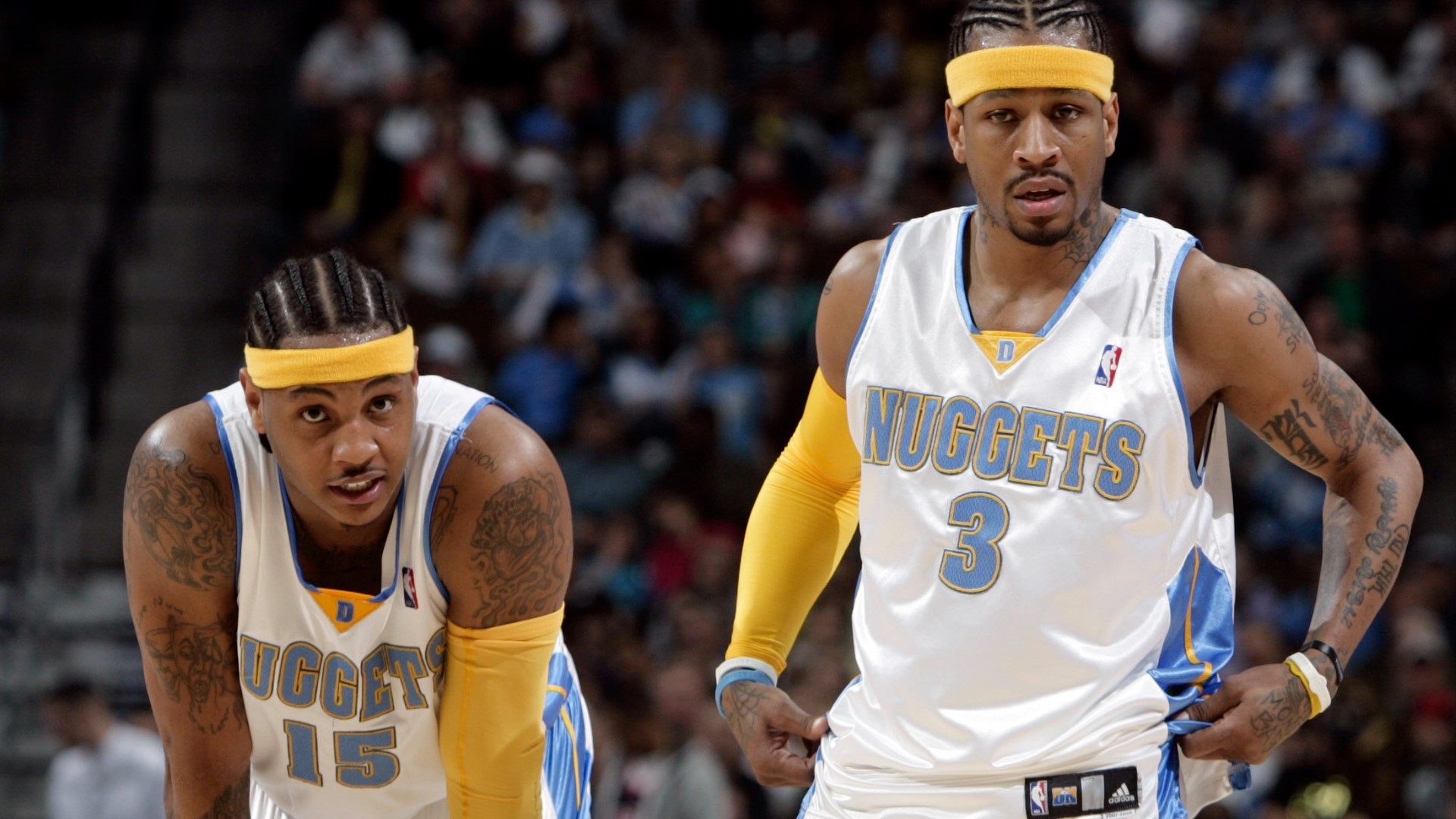
In December 2006, the Nuggets made a blockbuster move that shook the league, acquiring legendary guard Allen Iverson from the Philadelphia 76ers. The goal was to pair Anthony with another elite scorer to alleviate the defensive pressure on him and create the most formidable scoring duo in NBA history.
Statistically, the pairing was a success. Both Anthony and Iverson averaged over 25 points per game, making Denver one of the most entertaining teams to watch. However, the technical fit was problematic. Both players required the ball in their hands to be effective, and the lack of a traditional "floor general" often led to stagnant offensive possessions in late-game situations.
The Nuggets won 50 games in the 2007-2008 season—the most in the Anthony era to that point—but were swept by the Los Angeles Lakers in the first round. This failure prompted the front office to realize that while they had immense talent, they lacked the veteran leadership and defensive structure necessary for a deep playoff run.
The 2009 Western Conference Finals Run: The Pinnacle
The turning point for Anthony’s tenure in Denver occurred early in the 2008-2009 season. The Nuggets traded Allen Iverson to the Detroit Pistons in exchange for Chauncey Billups, a Denver native and a championship-winning point guard. Billups brought the leadership, defensive mindset, and "clutch" play that the team had desperately lacked.
With Billups managing the floor, Anthony was able to focus on his strengths while becoming a more efficient player. The 2008-2009 season saw the Nuggets tie a franchise record with 54 wins and earn the second seed in the Western Conference.
In the playoffs, Anthony finally broke through the first-round ceiling. The Nuggets defeated the New Orleans Hornets in five games and then dispatched the Dallas Mavericks in five games to reach the Western Conference Finals for the first time since 1985. Anthony was spectacular, averaging 27.2 points per game during the postseason.
Although the Nuggets eventually lost to the Los Angeles Lakers in six games, the series was highly competitive. Anthony’s performance against Kobe Bryant cemented his status as a superstar who could lead a team to the brink of the NBA Finals.
Statistical Summary of Carmelo Anthony's Denver Career
Anthony's time in Denver was defined by elite scoring consistency and high-volume production. He remains one of the most prolific players in the history of the franchise.
| Category | Career Totals (Denver) | Average Per Game |
|---|---|---|
| Games Played | 564 | — |
| Total Points | 13,970 | 24.8 |
| Total Rebounds | 3,566 | 6.3 |
| Total Assists | 1,729 | 3.1 |
| Field Goal % | 45.9% | — |
| 3-Point % | 31.1% | — |
| All-Star Selections | 4 (2007, 2008, 2010, 2011) | — |
| All-NBA Selections | 4 (Second/Third Team) | — |
The "Melodrama" and the Trade to New York (2010–2011)
As the 2010-2011 season approached, rumors began to circulate that Anthony was unwilling to sign a long-term contract extension with the Nuggets. Having watched his 2003 draft classmates LeBron James and Chris Bosh join forces in Miami, Anthony expressed a desire to play in a larger market, specifically his hometown of New York.
The ensuing months became known in the media as the "Melodrama." Despite the distractions, Anthony continued to play at a high level, but the uncertainty hovered over the locker room. The Nuggets' front office, led by Masai Ujiri, sought to maximize Anthony's trade value rather than lose him for nothing in free agency.
On February 22, 2011, the Nuggets finalized a massive multi-team trade with the New York Knicks. Anthony was sent to New York along with Chauncey Billups, Shelden Williams, Anthony Carter, and Renaldo Balkman. In return, Denver received a haul of young talent and picks, including Raymond Felton, Danilo Gallinari, Wilson Chandler, Timofey Mozgov, a 2014 first-round pick, and two second-round picks.
While the trade ended the Anthony era, the Nuggets remained competitive, using the depth acquired in the trade to win 57 games just two seasons later.
Legacy and the #15 Jersey Controversy
The legacy of Carmelo Anthony in Denver is complex. On one hand, he is undoubtedly one of the greatest players in franchise history. He led the team to the playoffs in every full season he played and brought the Nuggets back to relevance on the national stage. His scoring records and the 2009 playoff run remain high-water marks for the organization.
On the other hand, the nature of his departure left a bitter taste for many fans. The controversy was further complicated years later when the Nuggets assigned the #15 jersey—the number Anthony wore in Denver—to a second-round pick from Serbia named Nikola Jokic.
As Jokic transformed into a multiple-time MVP and led the Nuggets to their first-ever NBA Championship in 2023, the question of jersey retirement became a heated debate. While Anthony’s #15 is historically significant for his individual scoring, Jokic’s #15 represents the ultimate team success. Anthony has expressed disappointment regarding the jersey situation, but as of 2026, the Nuggets have not officially retired the number for either player, though Jokic’s eventual retirement of the number is considered a certainty.
Frequently Asked Questions
How many years did Carmelo Anthony play for the Nuggets?
Carmelo Anthony played for the Denver Nuggets for 7.5 seasons. He joined the team in October 2003 and was traded in February 2011.
Did Carmelo Anthony ever win an MVP in Denver?
No, Anthony never won a league MVP award while playing for the Nuggets. His highest finish in MVP voting during his Denver years was 6th place in the 2009-2010 season. However, he was a perennial All-Star and All-NBA selection.
Why was Carmelo Anthony traded from the Nuggets?
Anthony was traded because he declined to sign a three-year, $65 million contract extension. He wanted to play in a larger market and indicated that he would leave as a free agent if not traded. To avoid losing him for no compensation, the Nuggets traded him to the New York Knicks.
Who did the Nuggets get in return for Carmelo Anthony?
The Nuggets received a substantial package that included Danilo Gallinari, Wilson Chandler, Raymond Felton, Timofey Mozgov, a 2014 first-round draft pick, and multiple second-round picks. This trade is often cited as one of the most successful "superstar trades" for a team losing its primary player.
Did Carmelo Anthony win a championship with the Nuggets?
No, the furthest Anthony reached with the Nuggets was the Western Conference Finals in 2009, where they lost to the Los Angeles Lakers in six games.
Final Perspective on the Anthony Era
For fans and historians looking back at the Denver Nuggets in the 2000s, Carmelo Anthony remains the defining figure of that era. He brought a level of star power and scoring prowess that the city had not seen in decades. While his departure was tumultuous, his contribution to the franchise’s culture and its transition from a "basement-dweller" to a winning organization is undeniable.
If you are researching the history of the Nuggets, studying the 2008-2009 season provides the best insight into Anthony’s peak performance and the team’s highest level of synergy during his tenure.
Image Gallery