W8 or W9: Choosing the Right IRS Form for Tax Compliance
Navigating United States tax documentation requires determining whether you are classified as a U.S. person or a foreign individual/entity. Form W-9 certifies a U.S. taxpayer identification number for domestic reporting, while various...
Navigating United States tax documentation requires determining whether you are classified as a U.S. person or a foreign individual/entity. Form W-9 certifies a U.S. taxpayer identification number for domestic reporting, while various Form W-8 variants establish foreign status to claim exemptions from U.S. tax withholding.
Contents
Understanding the Fundamental Difference Between Form W-8 and Form W-9
Choosing the correct tax form prevents incorrect tax withholding and ensures compliance with Internal Revenue Service (IRS) regulations. Payers in the United States are legally required to obtain a properly executed tax certification before issuing payments to independent contractors, vendors, or foreign entities. Failing to secure the correct form can result in the payer being held liable for statutory withholding penalties, typically 24% for domestic backup withholding or up to 30% for foreign source income under Chapter 3 or Chapter 4 (FATCA).
The governing compliance framework separates individuals and entities into two distinct compliance tracks:
- Domestic Track (Form W-9): Applies exclusively to U.S. citizens, resident aliens, partnerships, corporations, estates, or domestic trusts.
- Foreign Track (Form W-8): Applies to nonresident aliens, foreign corporations, foreign partnerships, foreign estates, or foreign trusts receiving U.S.-sourced income.
Misclassifying a recipient creates severe administrative hurdles. Providing a Form W-9 when you are legally a nonresident alien exposes you to domestic tax penalties, while submitting a Form W-8 while residing and working within the United States as a green card holder or U.S. citizen constitutes tax fraud.
Comprehensive Breakdown of Form W-9
Form W-9, officially titled Request for Taxpayer Identification Number and Certification, is utilized exclusively within the United States. Its primary purpose is to supply a correct Taxpayer Identification Number (TIN)—which may be a Social Security Number (SSN), Employer Identification Number (EIN), or Individual Taxpayer Identification Number (ITIN)—to any person or organization required to file an information return with the IRS.
When to Use Form W-9
You must complete and submit a Form W-9 under specific operational scenarios:
- Independent Contracting: When you provide freelance, consulting, or contractual services to a U.S. company and anticipate earning $600 or more within a calendar year.
- Financial Accounts: When opening a bank account, brokerage account, or establishing a mortgage, financial institutions require confirmation of your tax identity to report interest or dividend income via Form 1099.
- Real Estate Transactions: When closing on property sales where proceeds must be reported to the IRS.
- Canceled Debt and Acquisitions: When reporting discharged debt or the acquisition of secured property.
Key Legal Certifications on Form W-9
By signing a Form W-9, you legally certify under penalties of perjury that:
- The number shown on the form is your correct taxpayer identification number.
- You are not subject to backup withholding due to a failure to report interest and dividend income.
- You are a U.S. citizen or other U.S. person (including a U.S. resident alien).
- The FATCA code(s) entered on the form (if any) indicating that you are exempt from FATCA reporting is correct.
Comprehensive Breakdown of Form W-8 Family
Unlike the single Form W-9, the Form W-8 family consists of multiple specialized variants. The most common iteration is Form W-8BEN (Certificate of Foreign Status of Beneficial Owner for United States Tax Withholding and Reporting), but foreign entities and intermediaries must utilize alternative documents.
Variants Within the W-8 Series
- Form W-8BEN: Used by foreign individuals to certify their foreign status and claim reduced withholding rates under an income tax treaty.
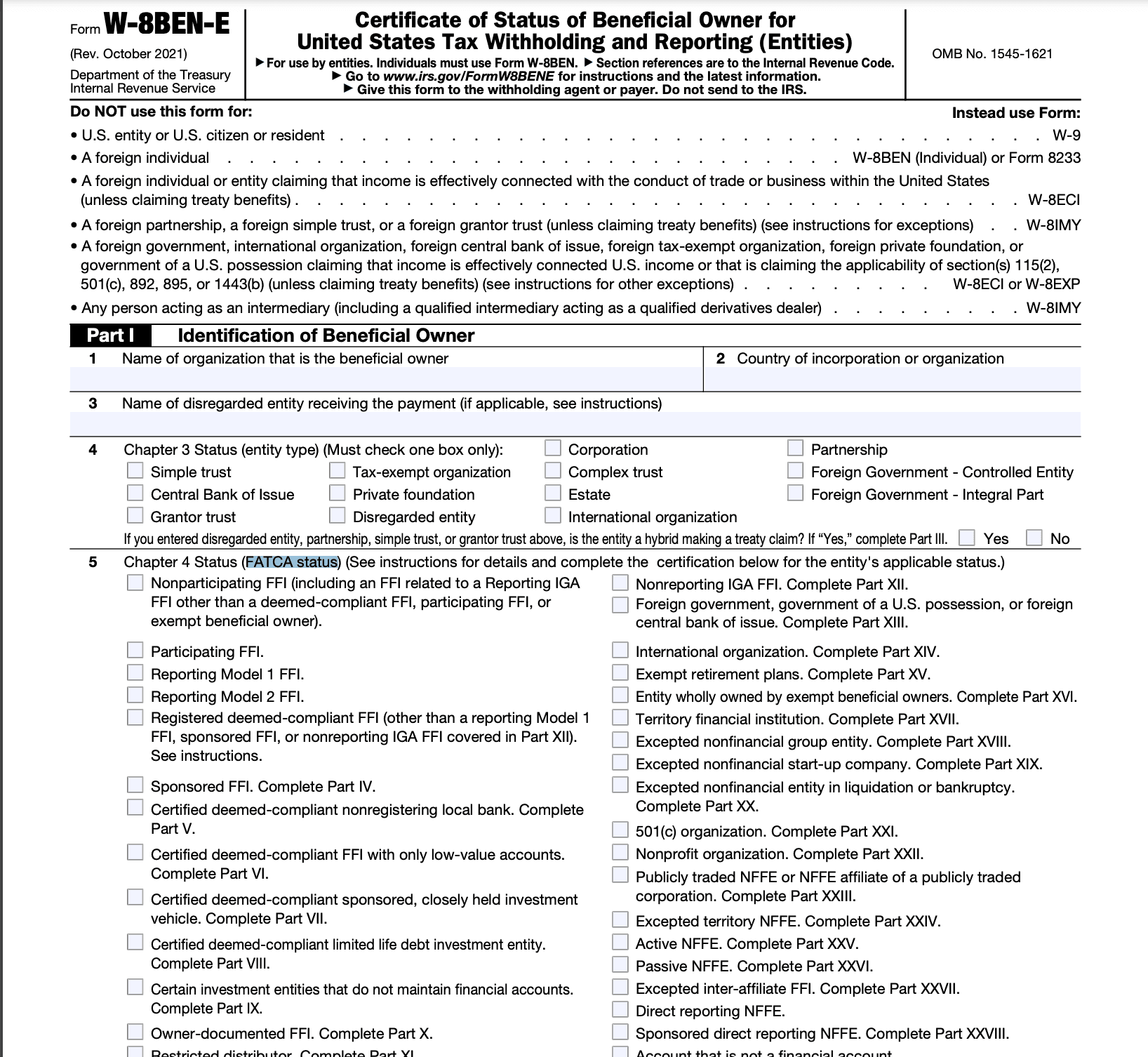
- Form W-8BEN-E: Used by foreign entities (corporations, foundations, partnerships) to document their status under Chapter 3 and Chapter 4 of the Internal Revenue Code.
- Form W-8ECI: Used by foreign persons or entities to certify that income is effectively connected with the conduct of a trade or business within the United States.
- Form W-8EXP: Used by foreign governments, foreign tax-exempt organizations, foreign private foundations, or international organizations.
- Form W-8IMY: Used by intermediaries, flow-through entities, or qualified intermediaries acting on behalf of other beneficial owners.
Key Certifications on Form W-8BEN
Submitting a Form W-8BEN requires confirming that:
- You are the beneficial owner of the income or accounts to which the form relates.
- You are not a U.S. person.
- You are a resident of a foreign country with which the United States holds an active income tax treaty (if claiming treaty benefits).
- You agree to submit a new form within 30 days if any certification on the form becomes incorrect.
Key Differences: Form W-8 vs. Form W-9 Comparison
Reviewing structural specifications side-by-side clarifies which documentation applies to specific business operations and payee profiles.
| Feature | Form W-9 | Form W-8 (e.g., W-8BEN / W-8BEN-E) |
|---|---|---|
| Target Audience | U.S. Citizens, Resident Aliens, Domestic Entities | Nonresident Aliens, Foreign Entities, Foreign Intermediaries |
| Primary Identifier | SSN, EIN, or ITIN | Foreign Tax Identifying Number (FTIN) or none required |
| Standard Validity | Indefinite until circumstances change or information becomes incorrect | Exactly three full calendar years from the date of signature |
| Withholding Obligation | Generally 0% (unless subject to backup withholding by IRS notice) | 30% statutory withholding, unless reduced via tax treaty |
| Filing Destination | Retained by the withholding agent (payer); not filed directly with IRS | Retained by the withholding agent (payer); not filed directly with IRS |
| Governing Law | U.S. Domestic Tax Law (Internal Revenue Code) | U.S. International Tax Law and Bilateral Income Tax Treaties |
Step-by-Step Guide: Determining Your Status
Executing the correct tax form requires evaluating legal residency, citizenship, and entity formation.
Step 1: Evaluate Your Citizenship and Immigration Status
Determine whether you hold U.S. citizenship, a valid U.S. green card, or meet the substantial presence test administered by the IRS. If you pass the substantial presence test or hold permanent residency, you are treated as a U.S. resident alien and must complete a Form W-9. If you reside entirely outside the United States, hold no citizenship, and fail the substantial presence test, you are a nonresident alien and must complete a Form W-8.
Step 2: Analyze Entity Formation and Place of Business
For corporations, LLCs, and partnerships, examine the jurisdiction of organization. An entity incorporated under the laws of a U.S. state is a domestic entity and completes Form W-9. An entity incorporated under foreign laws (e.g., a limited company registered in the United Kingdom or a corporation in Singapore) is a foreign entity and must utilize Form W-8BEN-E or the appropriate W-8 variant.
Step 3: Assess Income Source and Tax Treaty Eligibility
If you determine you are a foreign person or entity receiving U.S.-sourced income (such as royalties, licensing fees, software sales, or digital services), examine whether your home country maintains an active bilateral income tax treaty with the United States. Providing a valid Foreign Tax Identifying Number (FTIN) on a Form W-8BEN allows you to lower or eliminate the statutory 30% withholding rate.
Step 4: Execute, Sign, and Submit to the Payer
Complete all required lines without leaving mandatory fields blank. Ensure the date of signature matches the day the document is transmitted. Transmit the form securely to the accounts payable department or compliance division of the requesting company. Never email unencrypted tax forms containing sensitive SSN or EIN data.
Common Mistakes and Compliance Pitfalls
Mismanaging tax compliance documents triggers severe administrative penalties and financial friction during tax season. Avoid these frequent errors:
- Treating Form W-8 as Permanent: Form W-8 variants expire on December 31 of the third full calendar year following the date of signature. Payers must collect updated W-8 forms every three years to maintain compliance.
- Entering an Incorrect Identifier on W-9: Providing an invalid or mismatched SSN or EIN triggers IRS CP2100 notices, forcing the payer to implement mandatory backup withholding at 24%.
- Misclassifying Single-Member LLCs: Single-member LLCs owned by a foreign individual must carefully evaluate whether the LLC is disregarded for tax purposes or treated as a corporation, which dictates whether a W-8BEN or W-8BEN-E is required.
- Ignoring FATCA Requirements: Foreign financial institutions and non-financial foreign entities must accurately document their Chapter 4 status on Form W-8BEN-E to avoid catastrophic 30% withholding on gross proceeds.
Frequently Asked Questions
What happens if I submit the wrong form to a client or employer?
Submitting the wrong form forces the payer to freeze disbursements or withhold taxes automatically—either at 24% for domestic backup withholding or 30% for foreign statutory withholding. You must submit the correct form immediately to halt future withholding and request refunds for improperly withheld amounts from the IRS.
How long is a Form W-8 valid before it expires?
A Form W-8 (including W-8BEN and W-8BEN-E) remains valid for a period starting on the date signed and ending on December 31 of the third full calendar year, unless a change in circumstances makes any information on the form incorrect.
Do I need to mail Form W-8 or W-9 directly to the IRS?
No. You submit Form W-8 or Form W-9 directly to the withholding agent, payer, bank, or platform requesting the documentation. The payer retains the form in their tax records to support reporting exemptions during audits.
Can a non-U.S. citizen living abroad use a Form W-9?
No. Non-U.S. citizens residing abroad who provide services or receive income from U.S. sources must utilize the appropriate Form W-8 variant. Using a Form W-9 while living abroad as a non-U.S. person violates federal tax certification rules.
What is backup withholding and how does it relate to Form W-9?
Backup withholding is a mechanism where a payer is legally forced to withhold 24% of payments made to an independent contractor or vendor and remit it directly to the IRS. This occurs if the payee fails to provide a valid Form W-9, provides an incorrect TIN, or if the IRS notifies the payer that the payee underreported interest or dividend income.
Ensure your tax documentation aligns with current IRS regulations by verifying your residency and entity classification before submitting your paperwork to financial institutions or corporate payers.
Image Gallery