Complete RACI Definition of Roles: Framework, Rules, and Implementation Guide
The RACI definition of roles is a responsibility assignment matrix framework used in project management and operational governance to clarify team expectations across four key designations: Responsible, Accountable, Consulted, and Info...
The RACI definition of roles is a responsibility assignment matrix framework used in project management and operational governance to clarify team expectations across four key designations: Responsible, Accountable, Consulted, and Informed. It establishes unambiguous decision-making boundaries, prevents task overlap, and ensures seamless cross-functional execution across complex organizational initiatives.
Contents
Understanding the RACI Framework in Organizational Governance
Unclear role assignment remains one of the primary drivers of project delays, duplicated effort, and operational friction. When cross-functional teams collaborate without defined decision-making rights, accountability dissolves into groupthink, while critical tasks fall through structural gaps. The RACI framework addresses this challenge by mapping every work breakdown structure (WBS) component or business process step directly to specific human roles.
Originally developed to streamline complex workflows in enterprise management systems and project frameworks—such as the Project Management Institute's PMBOK Guide and ITIL service management methodologies—RACI operates as a governance grid. Rather than relying on job titles, which vary widely between organizations, RACI assigns structural responsibility to functional roles. This distinction allows organizations to scale operations, onboard personnel efficiently, and maintain operational stability during corporate restructuring.
Integrating RACI into operational governance transforms vague project goals into traceable actions. By differentiating between the party executing the task and the party ultimately answerable for its outcome, RACI provides executive leadership with immediate visibility into project health and structural bottlenecks.
Deep Breakdown: Defining the Four RACI Roles
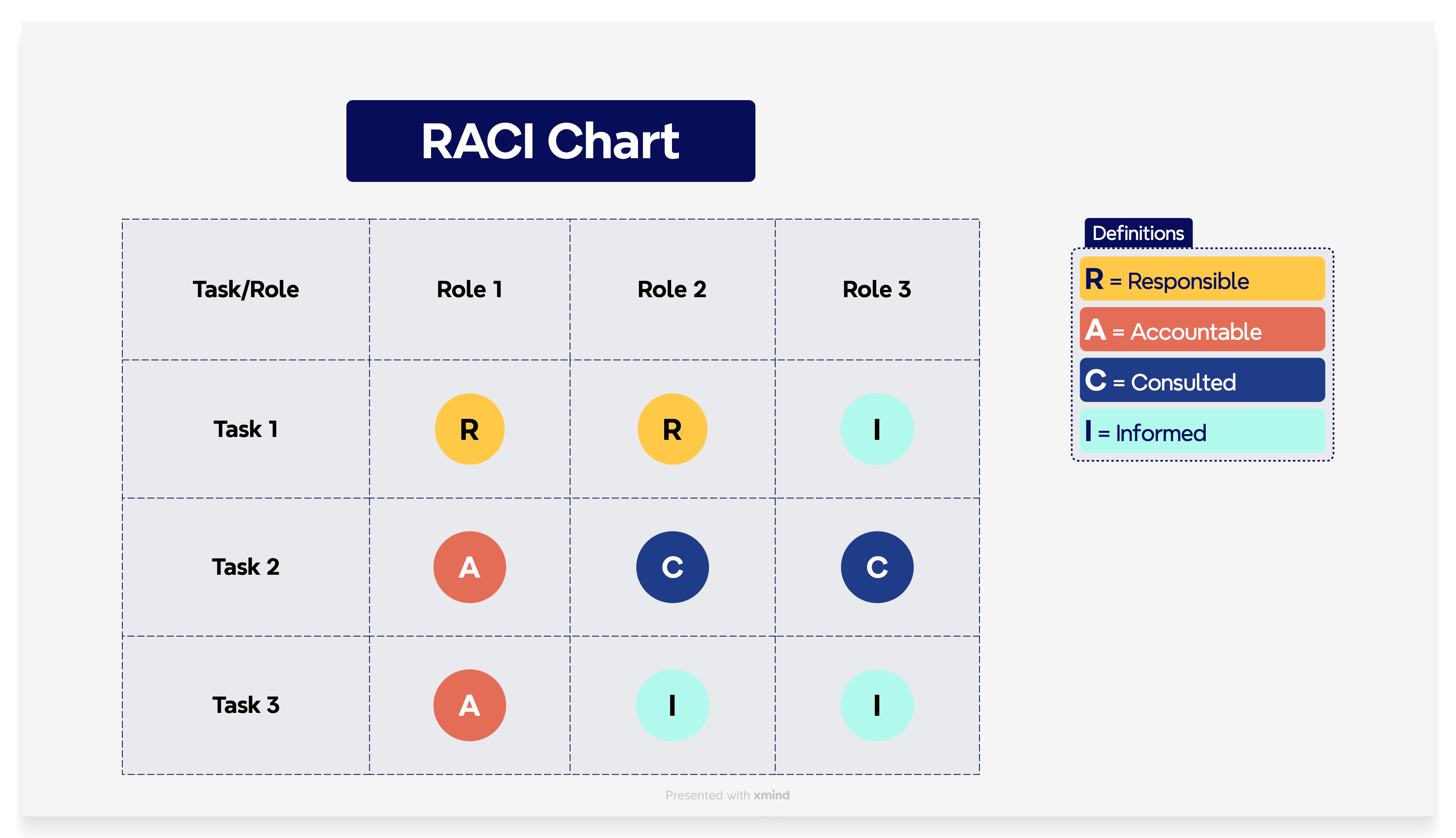
Each letter in the RACI acronym represents a distinct level of involvement and authority in a process or project milestone. Understanding the precise legal, operational, and structural definitions of these four roles is essential for accurate deployment.
| Role | Description |
|---|---|
| RESPONSIBLE (R) | "The Doer" - Executes hands-on activity |
| ACCOUNTABLE (A) | "The Owner" - Final authority & veto power |
| CONSULTED (C) | "The Expert" - Two-way input before decisions |
| INFORMED (I) | "The Stakeholder" - One-way progress updates |
Responsible (R): The Execution Engine
The Responsible role designates the "doers" of the project—the individuals or teams assigned to complete the hands-on activity, author documents, write code, or execute deliverables.
- Primary Function: Direct task execution and completion of operational outputs.
- Authority Level: Tactical decision-making within the scope defined by project guidelines and technical standards.
- Multiplicity: Multiple individuals or teams can hold an "R" designation for a single task, particularly when execution requires multidisciplinary technical contributions.
- Key Risk: Assigning too many "R" designations to a single task without clear sub-task breakdown can cause internal confusion and conflicting operational approaches.
For example, in a software release deployment, senior developers and DevOps engineers hold the "Responsible" designation for writing deployment scripts and executing code pushes to production environments.
Accountable (A): The Ultimate Decision-Maker
The Accountable role identifies the single person who holds ultimate ownership of the deliverable or process outcome. This individual possesses final decision-making authority, sign-off responsibility, and veto power over the work produced by those marked as Responsible.
- Primary Function: Decision approval, risk ownership, budget management, and final quality assurance.
- Authority Level: Strategic oversight and definitive authority across the task lifecycle.
- Multiplicity Rule: Exactly one "A" must be assigned per task or milestone. Assigning multiple Accountable entities dilutes authority and recreates gridlock.
- Key Risk: Designating an Accountable party who lacks sufficient organizational authority to enforce decisions or assign resource priorities.
In corporate operations, while an engineering team is Responsible for drafting technical security architecture, the Chief Information Security Officer (CISO) is Accountable for approving the architecture and accepting security exposure.
Consulted (C): Two-Way Technical Expertise
The Consulted role represents subject matter experts (SMEs), legal advisors, regulatory leads, or downstream stakeholders whose active input is required before work is finalized or a decision is locked down.
- Primary Function: Providing specialized domain expertise, technical validation, operational feedback, and risk analysis.
- Authority Level: Advisory. While Consulted parties provide vital guidance, they do not hold veto power unless formally delegated by the Accountable party.
- Communication Pattern: Two-way communication. Consultation requires active dialogue, formal review cycles, and documented feedback loops.
- Key Risk: Creating a "Consulted bloat" dynamic where too many advisors slow down execution through excessive review cycles.
During a corporate marketing launch, the legal counsel holds a "Consulted" role regarding copyright compliance and data privacy regulations before materials receive final sign-off.
Informed (I): One-Way Status Visibility
The Informed role consists of individuals, departments, or external partners who must be kept updated on project milestones, progress, and outcomes, but whose direct input is not required to complete the task.
- Primary Function: Maintaining operational alignment, downstream awareness, and organizational transparency.
- Authority Level: Passive observer.
- Communication Pattern: One-way communication. Information flows outward via status reports, dashboard updates, automated release notes, or executive summaries.
- Key Risk: Misclassifying active stakeholders as passive "Informed" parties, leading to late-stage alignment friction when unaddressed expectations surface.
When an infrastructure team performs planned database maintenance, customer support teams are "Informed" of the outage schedule so they can prepare customer communications.
Comparative Matrix: RACI Roles at a Glance
The following matrix contrasts the operational boundaries, communication requirements, and structural traits of each RACI role.
| RACI Role | Primary Function | Communication Direction | Veto / Approval Power | Maximum Recommended Per Task | Typical Organizational Level |
|---|---|---|---|---|---|
| Responsible (R) | Executes the task or activity | Internal team coordination | Tactical execution approval only | 1 to 5 (depending on scope) | Specialists, Engineers, Analysts, Workstream Leads |
| Accountable (A) | Owns outcome and final sign-off | Direct reporting to executive leads | Full Veto Authority | Strictly 1 | Department Heads, Directors, Executive Sponsors, Product Owners |
| Consulted (C) | Provides expert advice and requirements | Two-way active consultation | Advisory oversight | 2 to 4 key experts | Subject Matter Experts, Risk Officers, Legal Counsel, Architects |
| Informed (I) | Monitors progress and outcomes | One-way outbound broadcasts | None | Unlimited | Stakeholders, Adjacent Teams, Customer Support, End Users |
Crucial Rules for Constructing a Functional RACI Matrix
Building an effective RACI matrix requires adherence to specific governance rules. Deviating from these core guidelines frequently leads to confusion, delayed timelines, and systemic operational friction.
- RULE 1: Exactly ONE Accountable (A) per task
- RULE 2: At least ONE Responsible (R) per task
- RULE 3: Minimize Consulted (C) roles to avoid bloat
- RULE 4: Assign to Functional Roles, not Personal Names
1. The Single Accountable Mandate
The most critical governance rule in the RACI methodology is that there can be only one "Accountable" (A) assigned to any given activity.
When two or more individuals are designated as Accountable for a single deliverable, ownership becomes diluted. In times of crisis or disagreement, split accountability results in finger-pointing, delayed decisions, or paralysis. If a complex task seems to require two Accountable owners, the task is too broad and must be broken down into smaller, discrete sub-tasks within the work breakdown structure.
2. Balancing Execution (R) and Ownership (A)
While an individual can be both Responsible and Accountable (R/A) for a small, self-contained task—such as a senior designer creating and approving an internal icon set—complex enterprise initiatives must separate execution from governance.
When a project manager or functional lead is both executing the work and approving their own quality standards, objectivity declines and internal checks-and-balances fail. Maintaining distinct roles between those doing the work (R) and the single executive approving the result (A) provides structural oversight.
3. Controlling Consultation Bloat
A common error in matrix construction is over-assigning the Consulted (C) role to preserve organizational harmony or appease stakeholders. Every additional "C" entry introduces mandatory review cycles, meetings, and feedback management.
To maintain project momentum:
- Reserve the Consulted designation strictly for individuals whose technical or legal clearance is necessary for risk mitigation or functional execution.
- Reassign passive observers or secondary stakeholders to the Informed (I) category.
- Define explicit review windows for Consulted parties (e.g., 48-hour feedback SLAs) to prevent review bottlenecks.
4. Mapping to Functional Roles Instead of Names
RACI matrices should map tasks to organizational roles (e.g., Database Administrator, Compliance Lead, Lead Copywriter) rather than individual employee names.
Mapping to job titles ensures that:
- The matrix remains valid when employees change roles, take leave, or exit the organization.
- Team onboarding efficiency increases, as new hires can immediately identify their systemic responsibilities.
- Operational capacity planning can be scaled cleanly across regional or functional units.
Step-by-Step Implementation Guide for Project Leaders
Deploying a RACI matrix across an enterprise team requires structured preparation, stakeholder alignment, and operational integration.
- Step 1: Identify Deliverables & WBS Tasks
- Step 2: Define Project Roles & Functions
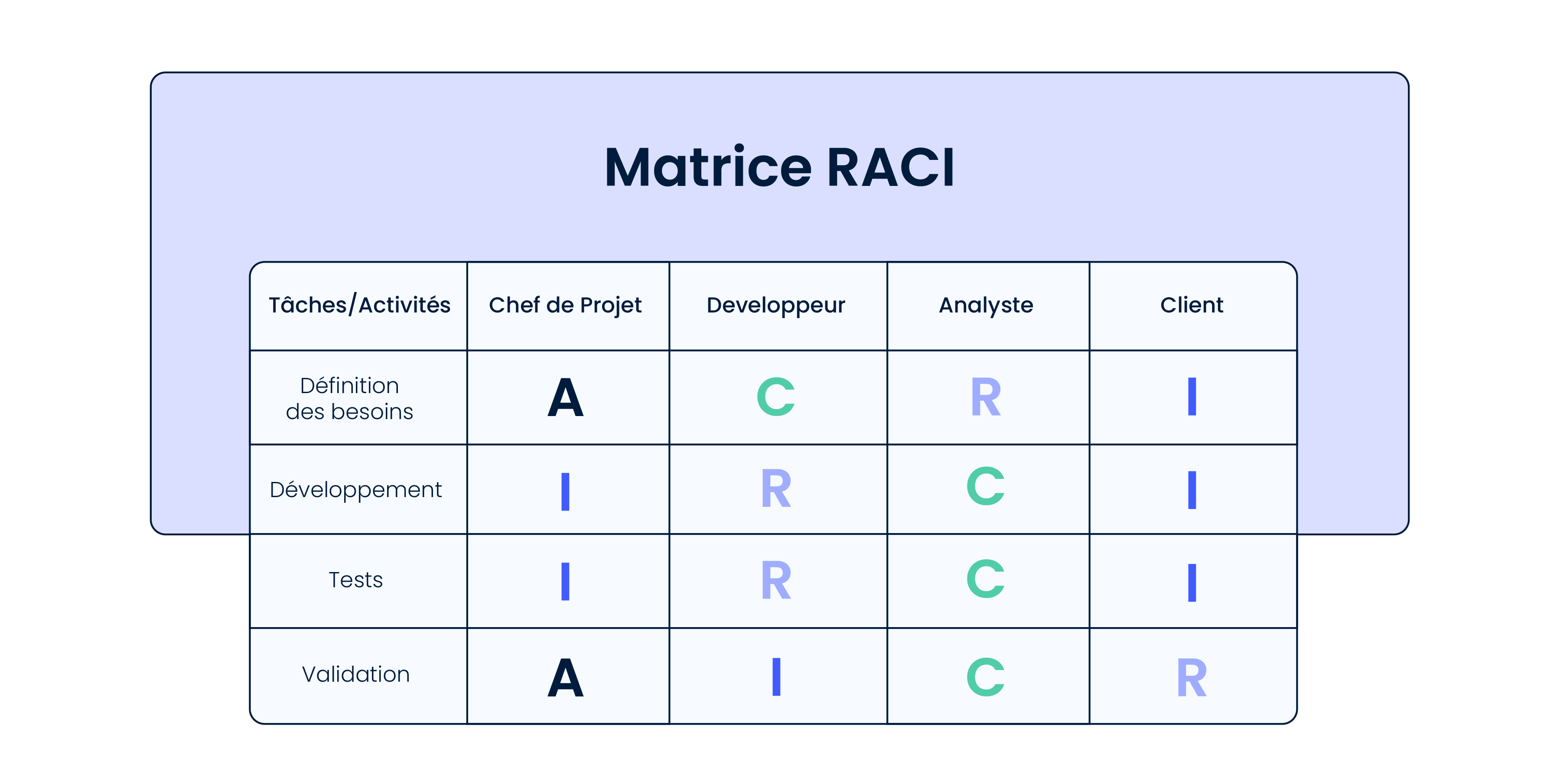
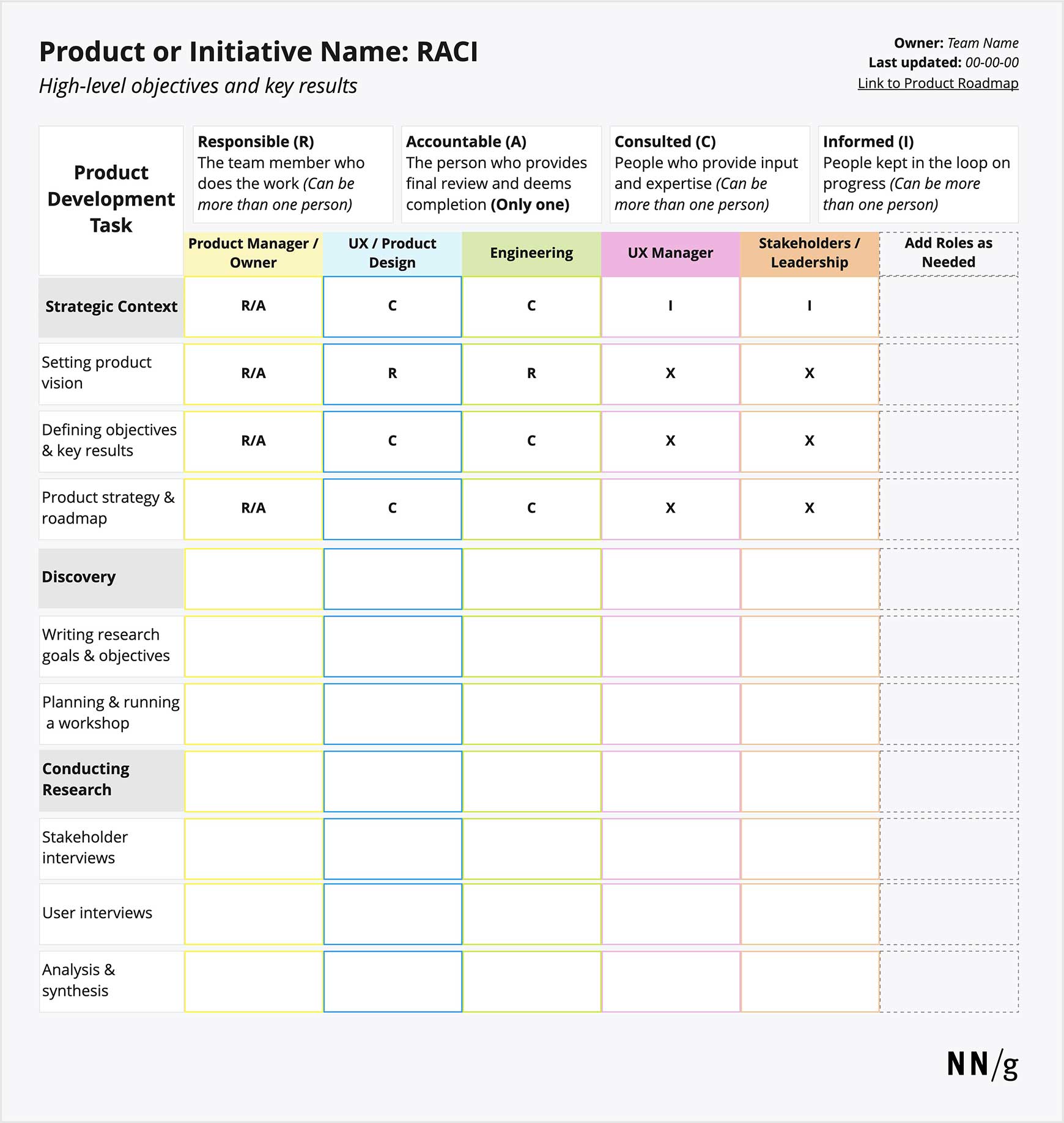
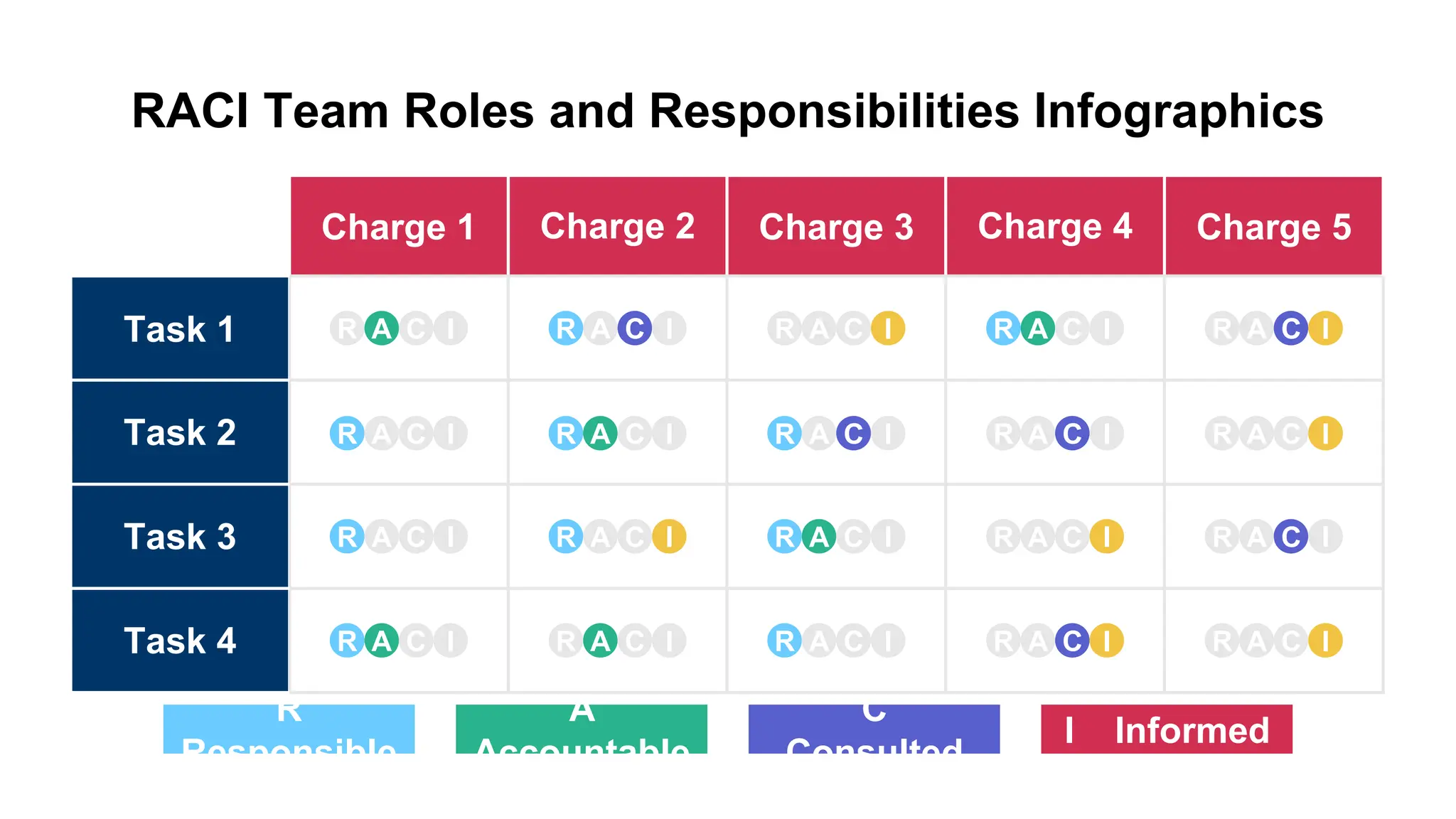
- Step 3: Populate the RACI Grid Matrix
- Step 4: Audit Grid for Structural Errors
- Step 5: Baseline, Publish & Integrate SLAs
Step 1: Define Task Breakdown and Milestones
Begin by extracting actionable items from the project work breakdown structure (WBS) or operational process map. Focus on concrete deliverables, key milestones, and critical decisions rather than minor routine administrative steps. Aim for high-impact activities such as "Approve System Architecture Design," "Sign Off Security Compliance Audit," or "Deploy Version 2.0 to Staging."
Step 2: Establish Functional Roles
List all cross-functional departments, technical positions, and external partners involved in the project lifecycle across the top horizontal axis of the grid. Avoid naming individual staff members; rely strictly on designated operational titles.
Step 3: Map RACI Codes Across the Grid
Systematically evaluate each row (deliverable) against each column (role):
- Assign Accountable (A) first: Identify the single role with final decision power.
- Assign Responsible (R): Identify who will execute the tangible work.
- Assign Consulted (C): Identify subject matter experts required for pre-completion review.
- Assign Informed (I): Identify teams affected by the outcome who require notifications.
Step 4: Conduct Horizontal and Vertical Audits
Before publishing the matrix, perform a structural grid audit:
Horizontal Analysis (Row-by-Row):
- No 'A' in a row: Who owns the outcome? (Grid error—must assign one 'A').
- Multiple 'A's in a row: Who has final veto power? (Grid error—split until only one 'A' remains).
- No 'R' in a row: Who is executing the task? (Grid error—must assign at least one 'R').
- Excessive 'C's in a row: Will review meetings stall execution? (Prune non-essential experts to 'I').
Vertical Analysis (Column-by-Column):
- Too many 'A's for one role: Is this individual overloaded with decision rights?
- Too many 'R's for one role: Does this role have realistic capacity to complete all assigned work?
- Empty columns: Is this role genuinely necessary for the project workstream?
Step 5: Publish, Baseline, and Enforce SLAs
Distribute the approved RACI matrix to all team members and store it in a central project repository (such as Jira, Confluence, or enterprise SharePoint environments). Integrate RACI clear-paths into operational SLAs—establishing clear turnaround windows for Consulted inputs and Accountable sign-offs.
Framework Variations: RASCI, DACI, and RACI-VS
While standard RACI covers most organizational governance needs, specialized variants exist to address specific operational environments.
RASCI (Adding the Support Role)
The RASCI framework introduces a Support (S) role to distinguish individuals who provide operational assistance, tools, or resources to the Responsible party.
- Responsible (R): Leads and coordinates execution.
- Support (S): Provides auxiliary hands-on labor, computing infrastructure, or administrative assistance during execution.
- Accountable (A): Final decision authority.
This variation is common in IT infrastructure and enterprise resource planning (ERP) deployments where a lead engineer (R) requires hands-on support from junior technicians (S) to complete migrations.
DACI (Driver, Approver, Contributor, Informed)
Popularized by high-growth software and product management organizations, DACI shifts focus directly toward rapid decision-making:
- Driver (D): The single individual driving the decision process forward (equivalent to R).
- Approver (A): The single decision-maker who approves or vetoes (equivalent to A).
- Contributor (C): Subject experts providing input (equivalent to C).
- Informed (I): Stakeholders updated on the decision (equivalent to I).
RACI-VS (Verifier and Sign-off)
Used primarily in regulated industries (medical devices, aerospace, and finance), RACI-VS adds strict quality validation steps:
- Verifier (V): Checks whether the outcome meets defined quality, legal, and safety standards.
- Sign-off (S): The executive who formally signs off on project release following verification.
Common RACI Anti-Patterns and How to Avoid Them
Even well-intentioned team leads can implement RACI incorrectly, introducing structural failures into their organization.
| Anti-Pattern | Systemic Symptom |
|---|---|
| Micromanagement Grid | Accountable role steps in to execute (R) |
| Committee Rule | Multiple Accountable (A) tags per row |
| Consultation Paralysis | Excessive Consulted (C) tags per row |
| Silent Execution | Zero Informed (I) notifications sent |
1. The Micromanagement Grid
This anti-pattern occurs when an Accountable manager constantly steps over the Responsible party, executing the work directly or overruling minor tactical decisions. This practice destroys team initiative and creates management bottlenecks.
- Fix: Enforce strict boundaries. The Accountable role sets quality metrics, constraints, and accepts final outcomes, while the Responsible party maintains autonomy over daily execution mechanics.
2. Designating Departments Instead of Roles
Assigning an entire department (e.g., "Marketing" or "IT Department") as Responsible or Accountable dilutes individual clarity. When an issue arises, whole departments cannot be held answerable for missed details.
- Fix: Specify the precise functional role within that team (e.g., "Lead Infrastructure Architect" instead of "IT Department").
3. Static Documentation Syndrome
A RACI matrix created during project kickoff and then archived in a hidden folder provides zero operational value.
- Fix: Embed the RACI matrix into daily workflow tools. Integrate RACI designations into ticket routing rules in software systems like Jira, ServiceNow, or Asana, ensuring automated notifications mirror the defined matrix paths.
Frequently Asked Questions
What is the primary difference between Responsible (R) and Accountable (A) in RACI?
The Responsible party is the execution agent who performs the hands-on work to create the deliverable. The Accountable party is the single individual who holds final decision-making power, owns the strategic risk, and has ultimate approval authority over the work. While multiple people can be Responsible for a task, exactly one person must be Accountable.
Can a single person be both Responsible and Accountable (R/A) for a task?
Yes, a single role can be designated as both Responsible and Accountable (R/A), provided the task scope is small and self-contained. However, for high-risk, complex, or enterprise-level tasks, splitting these roles is recommended to maintain objective quality checks and clear administrative oversight.
What happens if a task has more than one Accountable (A) role assigned?
Assigning multiple Accountable roles creates split ownership, leading to management gridlock, conflicting directions, and lack of accountability when issues occur. If a task appears to require multiple Accountable leads, the activity must be broken down into discrete sub-tasks within the work breakdown structure, each with its own single Accountable owner.
How does the RACI framework function in Agile and Scrum environments?
In Agile frameworks, RACI maps naturally to core Scrum roles. The Product Owner is generally Accountable for backlog prioritization and product outcomes. The Developers/Engineers are Responsible for executing sprint tasks and delivering operational code increments. Subject Matter Experts act as Consulted parties during backlog refinement, while external stakeholders remain Informed via sprint reviews and demo sessions.
Is RACI suitable for small operations and early-stage startups?
While RACI is highly effective in large enterprise environments, scaled-down RACI models benefit small teams by clarifying operational boundaries early. In smaller organizations, individuals frequently wear multiple functional hats; mapping roles (rather than names) clarifies which hat an employee is wearing during a specific decision lifecycle.
Strategic Recommendations and Next Actions
To successfully implement the RACI framework across your operational or project workflows, adopt the following actionable steps:
- Audit Current Workstreams: Select one high-friction project or operational workflow that currently suffers from approval delays or task overlaps.
- Draft a Role-Based Grid: Extract the top 10-15 key deliverables or decision gates for that workstream. Map them to structural roles rather than individual employee names.
- Enforce the Single-A Standard: Review the grid horizontally to ensure every task has exactly one Accountable owner. Resolve any split-ownership entries immediately.
- Conduct a Stakeholder Review: Host a targeted 30-minute alignment session with key functional leads to review assigned roles, confirm operational feasibility, and lock in review SLAs for Consulted parties.
- Operationalize via Software Systems: Integrate the finalized RACI framework directly into project management platforms (e.g., Jira, Asana, Azure DevOps) to automate task routing, sign-off approvals, and status notifications.
Image Gallery