The Irishman Anna Paquin Appearance: Analyzing the Power of Silence in Scorsese’s Epic
In Martin Scorsese’s 2019 masterpiece The Irishman, Anna Paquin portrays the adult Peggy Sheeran, the daughter of the protagonist Frank Sheeran. Despite her prominent billing, Paquin famously speaks only seven words throughout the film...
In Martin Scorsese’s 2019 masterpiece The Irishman, Anna Paquin portrays the adult Peggy Sheeran, the daughter of the protagonist Frank Sheeran. Despite her prominent billing, Paquin famously speaks only seven words throughout the film’s three-and-a-half-hour runtime, serving as a silent, moral witness to her father’s descent into crime.
Contents
As of 2026, The Irishman continues to be studied by cinema enthusiasts and film students alike for its unconventional narrative choices. One of the most enduring discussions surrounding the film is the "Anna Paquin appearance"—a performance that sparked a global conversation about the necessity of dialogue versus the power of presence. While some critics initially viewed her lack of lines as a waste of an Academy Award-winning actress, a deeper analysis reveals that her silence is the film’s moral heartbeat.
This article explores the technical, thematic, and narrative reasons behind Anna Paquin’s limited dialogue, the critical reception of her role, and why her appearance remains one of the most effective examples of "silent" acting in modern cinema.
The Role of Peggy Sheeran: A Character Study
To understand Anna Paquin's appearance, one must first understand the character of Peggy Sheeran. Peggy is the daughter of Frank Sheeran (Robert De Niro), a truck driver who becomes a high-ranking hitman for the Bufalino crime family. Throughout the film, the character of Peggy is used as a lens through which the audience judges Frank’s actions.
The character is portrayed by two actresses: Lucy Gallina plays the younger Peggy, while Anna Paquin takes over the role as the character reaches adulthood. The transition between the two actresses is seamless, largely because both performances rely on the same primary tool: the "death stare." From a young age, Peggy perceives the inherent violence in her father’s world. She witnesses him beat a local grocer and sees the shadowy figures, like Russell Bufalino (Joe Pesci), who inhabit their home.
By the time Anna Paquin appears on screen as the adult Peggy, the character has completely withdrawn from her father emotionally. Her silence is not a lack of agency; rather, it is an active, aggressive refusal to engage with a man she views as a monster. In a film filled with men who talk incessantly—bragging, lying, and negotiating—Peggy’s silence stands out as the only honest response to the surrounding corruption.
The "Seven Words" Controversy: Statistics and Context
When The Irishman premiered on Netflix, social media was quickly flooded with observations about Paquin’s lack of dialogue. For a star of her caliber, who won an Oscar at age 11 for The Piano, the brevity of her speaking part was jarring to some.
The adult Peggy Sheeran speaks exactly six lines consisting of seven words. The specific moment occurs after the disappearance of Jimmy Hoffa (Al Pacino), a man Peggy actually liked and trusted. She confronts her father, sensing his involvement in Hoffa’s death, and asks:
"Why?" and "Why haven't you called Jo?" (referring to Hoffa’s wife).
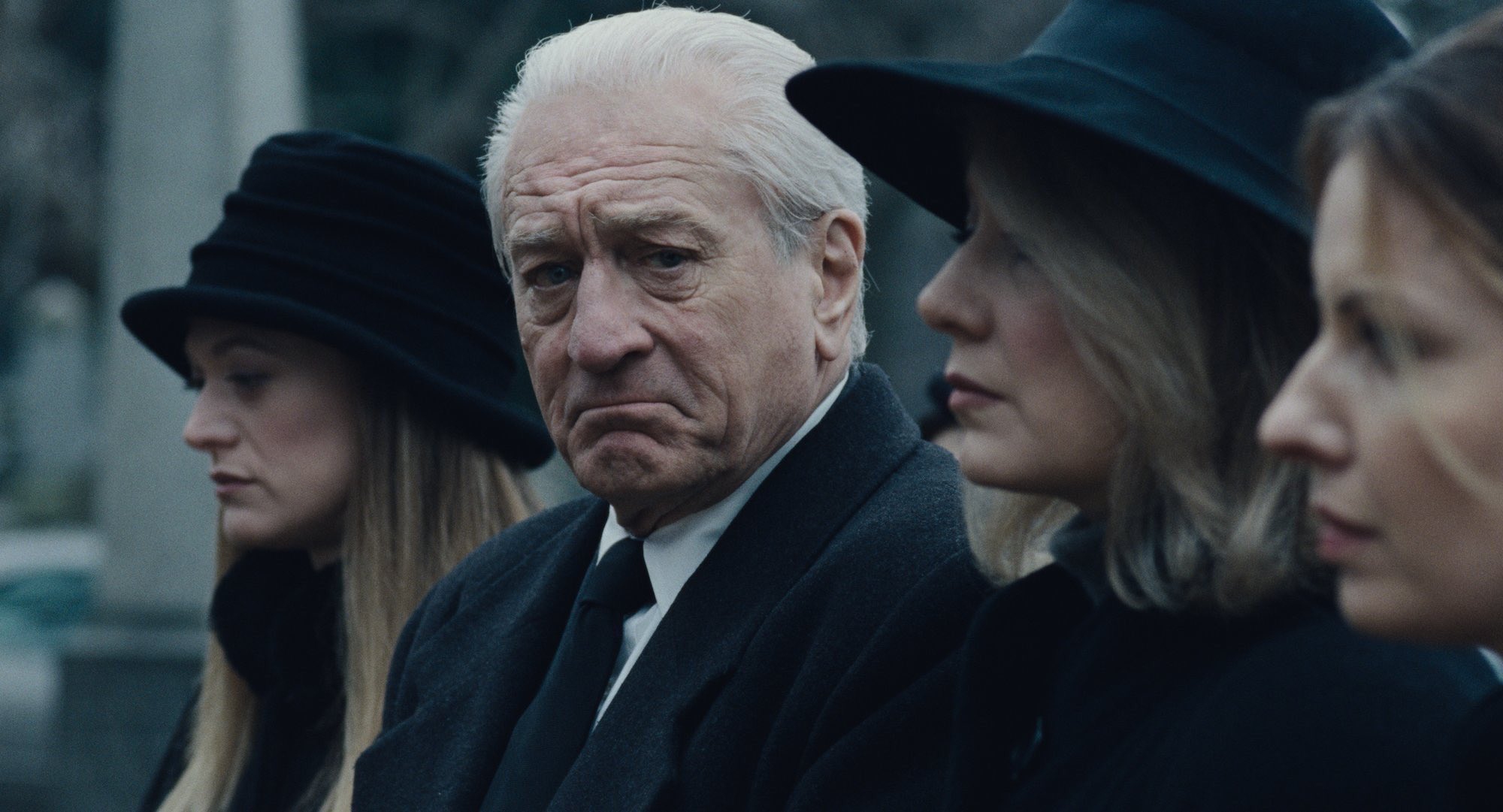
These are the only words she utters in the entire film. While this seems statistically insignificant for a major character, the technical depth of the performance lies in her screen time. Paquin is present in several pivotal scenes, often positioned in the background or at the edge of the frame, watching. Her physical presence acts as a constant reminder of Frank’s failures as a father.
Comparative Analysis of Character Dialogue in The Irishman
The following table compares the dialogue and narrative function of the primary characters to highlight the intentionality of Peggy's silence.
| Character | Actor | Primary Communication Style | Narrative Function |
|---|---|---|---|
| Frank Sheeran | Robert De Niro | Stoic, methodical, deceptive | The protagonist/unreliable narrator. |
| Jimmy Hoffa | Al Pacino | Voluble, aggressive, charismatic | The catalyst for the film's climax. |
| Russell Bufalino | Joe Pesci | Quiet, manipulative, authoritative | The "whisperer" and puppet master. |
| Peggy Sheeran | Anna Paquin | Silent, observational, judgmental | The moral conscience and "judge." |
Director and Cast Responses to the Minimal Dialogue
The controversy surrounding the Anna Paquin appearance reached such heights that both Martin Scorsese and Robert De Niro eventually addressed it in various interviews. Their defense of the creative choice provides insight into the technical intent of the script written by Steven Zaillian.
Scorsese explained that he and Zaillian felt that Peggy didn’t need to say anything because her silence spoke volumes. In an interview with The Hollywood Reporter, Scorsese noted that Paquin’s performance was about the "power of the look." He argued that if she had engaged in long, argumentative scenes with Frank, it would have diminished the impact of her total abandonment of him later in life.
Robert De Niro also defended his co-star, stating that the performance was "powerful" precisely because of its restraint. De Niro pointed out that in the context of the Sheeran family's history, Peggy’s refusal to speak was her only way of hurting her father. For a man who dealt in the currency of secrets and "painting houses" (a euphemism for contract killing), being shut out by his daughter's silence was the ultimate punishment.
Paquin herself took to social media to clarify that she was proud to be part of the film and that she didn't need a massive script to feel the weight of the role. She expressed that being asked to join a Scorsese project alongside legends like De Niro, Pesci, and Pacino was an opportunity she would never have declined, regardless of the word count.
The Technical Art of Silent Acting
The "Anna Paquin appearance" is a masterclass in what film theorists call the Kuleshov Effect. This is a film editing effect where viewers derive more meaning from the interaction of two sequential shots than from a single shot in isolation. When Scorsese cuts from a scene of Frank committing a violent act to a shot of Paquin’s face, the audience projects her judgment onto Frank.
Paquin’s performance relies on several technical elements:
- Micro-expressions: Because she has no lines to convey emotion, Paquin uses subtle shifts in her brow, eyes, and mouth to signal her internal state. Her expression during the wedding scene, where she watches Frank and Russell talk, conveys a mixture of disgust and profound sadness.
- Blocking and Framing: Scorsese often places Paquin in doorways or mirrored reflections. This visual choice frames her as an outsider looking into a world she refuses to inhabit. She is physically there, but emotionally miles away.
- The Gaze: The "gaze" of Peggy Sheeran is the primary antagonist to Frank’s peace of mind. While the FBI and rival mobsters threaten his life, Peggy’s gaze threatens his soul.
Re-evaluating the Performance in 2026
Looking back from the perspective of 2026, the initial backlash against Paquin's "small" role feels dated. In the years since the film's release, film criticism has shifted to better appreciate non-verbal storytelling. The "Anna Paquin appearance" is now often cited alongside other famous nearly-silent roles, such as Tom Hardy in Mad Max: Fury Road or Ryan Gosling in Drive, where the character’s identity is defined by action and observation rather than dialogue.
Furthermore, the character of Peggy serves as a vital counter-narrative to the "mob wife" or "mob daughter" tropes. Unlike characters in The Godfather or Goodfellas who often rationalize or ignore the violence surrounding them, Peggy refuses to be complicit. Her silence is her protest. By not speaking, she refuses to participate in the "business" of the family.
Historical and Narrative Significance
The Irishman is based on the book I Heard You Paint Houses by Charles Brandt. In the real-life account of the Sheeran family, the rift between Frank and his daughter Peggy was very real. According to the book, Peggy did indeed stop speaking to her father after the disappearance of Jimmy Hoffa and did not speak to him for the rest of his life.
By keeping Paquin silent, Scorsese remained historically accurate to the emotional reality of the Sheeran family. The silence wasn't a creative flourish; it was a representation of a permanent, unbridgeable gap between a father and his child. When Frank tries to visit Peggy at her workplace later in the film, her refusal to acknowledge him is one of the most devastating scenes in the movie. It marks the moment Frank realizes that while he may have survived the "mob wars," he has lost the only thing that truly mattered.
Frequently Asked Questions
How many words does Anna Paquin say in The Irishman?
Anna Paquin speaks exactly seven words in The Irishman. Her only lines are "Why?" and "Why haven't you called Jo?" These occur during a confrontation with her father, Frank Sheeran, following the disappearance of Jimmy Hoffa.
Why did Martin Scorsese give Anna Paquin so little dialogue?
Scorsese and screenwriter Steven Zaillian intended for Peggy Sheeran to be a "silent witness." They believed that her silence was a more powerful tool of condemnation against her father's criminal lifestyle than a traditional verbal argument would have been.
Did Anna Paquin receive any awards for her role?
While she did not receive major individual awards like an Oscar for this specific role, she was part of the ensemble cast that received numerous nominations, including the Screen Actors Guild Award for Outstanding Performance by a Cast in a Motion Picture.
Who played the young Peggy Sheeran?
The younger version of Peggy Sheeran was played by Lucy Gallina. Her performance established the character's observant and wary nature, which Anna Paquin then carried into the character's adult years.
Was the real Peggy Sheeran actually silent toward her father?
According to the source material I Heard You Paint Houses, the real Peggy Sheeran did break off all contact with her father after he was suspected of involvement in Jimmy Hoffa's disappearance. She reportedly did not speak to him for the remaining decades of his life.
Final Recommendation
For those revisiting The Irishman in 2026, it is highly recommended to watch the film specifically through the lens of the Sheeran children. Pay close attention to the blocking of scenes featuring Anna Paquin. Rather than looking for what she says, focus on where she is standing and who she is looking at. By treating her appearance as a silent film within a talkie, you will gain a much deeper appreciation for the thematic weight she brings to the story. Her performance proves that in the hands of a skilled actress and director, silence is not just the absence of noise—it is a narrative force in its own right.
Image Gallery