Understanding German Television: Systems, Access, and the 2026 Media Landscape
German television operates on a unique "dual system" that balances powerful public broadcasters, funded by a mandatory license fee, with a diverse array of commercial private stations. Viewers can access content through satellite, cabl...
German television operates on a unique "dual system" that balances powerful public broadcasters, funded by a mandatory license fee, with a diverse array of commercial private stations. Viewers can access content through satellite, cable, IPTV, and increasingly via integrated streaming platforms like Joyn and RTL+, while public content remains accessible through the central ARD and ZDF "Mediatheken."
Contents
The Dual System: Public vs. Private Broadcasting
The cornerstone of German television is the dual system (duales Rundfunksystem), established in the 1980s. This framework ensures a balance between public service broadcasting, which focuses on information, education, and culture, and private broadcasting, which is primarily market-driven and financed through advertising.
Public Service Broadcasters (Öffentlich-rechtlicher Rundfunk)
Public television in Germany is dominated by two main entities: ARD (Arbeitsgemeinschaft der öffentlich-rechtlichen Rundfunkanstalten der Bundesrepublik Deutschland) and ZDF (Zweites Deutsches Fernsehen).
ARD is not a single station but a consortium of nine regional broadcasters, such as WDR (Westdeutscher Rundfunk), BR (Bayerischer Rundfunk), and NDR (Norddeutscher Rundfunk). Together, they produce the national channel "Das Erste" (The First). ZDF, headquartered in Mainz, operates as a centralized national channel. These broadcasters are mandate-driven, meaning they are legally required to provide "basic provision" (Grundversorgung) of news, culture, and entertainment to all citizens, regardless of commercial viability.
Private Broadcasters (Privatsender)
The private sector is led by two major media conglomerates: RTL Group and ProSiebenSat.1 Media SE. RTL Group operates channels such as RTL, VOX, and n-tv, while ProSiebenSat.1 manages ProSieben, Sat.1, and Kabel Eins. These stations rely heavily on American imports, reality TV formats, and sports. Unlike public stations, which are limited in their advertising airtime (restricted to 20 minutes per day on weekdays and prohibited on Sundays and holidays), private stations are largely funded by high-volume commercial breaks.
The Rundfunkbeitrag: How German TV is Funded
In 2026, the mandatory broadcasting fee, or Rundfunkbeitrag, remains the financial backbone of public media. Every household in Germany is legally required to pay this fee, currently set at €18.36 per month, regardless of whether they own a television or use the services.
The rationale behind this model is to ensure that public media remains independent of both state influence and commercial pressure. The fee is collected by the Beitragsservice (formerly known as the GEZ). While controversial, the system is strictly enforced. Failure to register or pay can result in significant fines and legal action. Exemptions are available for specific groups, including students receiving state aid (BAföG) or individuals receiving social security benefits (Bürgergeld), but an active application for exemption must be filed with the relevant authorities.
The allocation of these funds is overseen by the KEF (Kommission zur Ermittlung des Finanzbedarfs der Rundfunkanstalten), an independent commission that evaluates the financial requirements of the broadcasters and recommends fee adjustments to the state governments.
Technical Access: How to Watch German TV
Germany offers multiple technical paths for accessing linear television. The choice usually depends on geographic location and the infrastructure of the specific residential building.
Satellite (DVB-S2)
Satellite remains the most popular way to receive German television, especially in rural areas. Most German channels are broadcast via the Astra 19.2° East satellite position.
- Public Channels: Available in HD for free (unencrypted).
- Private Channels: Available in SD for free. However, watching private channels like RTL or ProSieben in HD requires a subscription to a service like HD+, which utilizes a CI+ module and a smart card for decryption.
Cable (DVB-C)
Cable television is common in urban apartment complexes. Historically, the market was fragmented, but Vodafone is now the dominant provider after its acquisition of Unitymedia. Cable customers usually pay a monthly utility fee (often bundled with internet) and may require a receiver or a CI+ module for encrypted premium content.
Terrestrial (DVB-T2 HD)
The "antenna" method uses the DVB-T2 HD standard. While this offers the most portability, it provides a limited selection of channels compared to satellite or cable. Public channels are free to air, but private channels are encrypted and require a freenet TV subscription. A compatible antenna and receiver are necessary.
IPTV and Streaming
Internet Protocol Television (IPTV) has seen massive growth by 2026. Providers like Deutsche Telekom (MagentaTV), Vodafone (GigaTV), and 1&1 offer TV packages bundled with high-speed fiber or DSL connections. These services often include cloud recording, restart functions, and integrated access to streaming apps.
Digital Transformation: The Rise of Mediatheken and Apps
The landscape of German television has shifted from purely linear viewing to "on-demand" consumption. The public broadcasters have invested heavily in their digital presence to remain relevant to younger demographics.
- ARD and ZDF Mediathek: These platforms host nearly all content aired on the public channels. Shows are typically available for streaming immediately after (or even before) broadcast. Due to legal restrictions (Verweildauer), some content is only available for a limited time, though recent regulations have extended these windows for cultural and educational programming.
- Joyn: This is the primary streaming platform for the ProSiebenSat.1 Group. It offers a free tier with live TV and ad-supported VOD, as well as a "Plus" tier with premium content and fewer ads.
- RTL+: Formerly known as TVNOW, this is the RTL Group’s answer to Netflix. It focuses heavily on exclusive reality TV, high-end German drama series, and live sports rights, including European football.
Programming and Language Conventions
For international viewers, the most striking feature of German television is Synchronisation (dubbing). Germany has one of the world's most sophisticated dubbing industries. Unlike many Northern European countries that use subtitles, German TV dubs almost all foreign-language content (primarily from the US and UK) into German.
While high-end IPTV services and streaming platforms (Netflix, Disney+, Amazon Prime) offer original audio tracks, linear television is still dominated by German-only audio. However, the public broadcasters (specifically Arte and 3sat) frequently offer dual-audio options for documentaries and international films.
Content Categories to Know
- Krimi: Crime procedurals are the "bread and butter" of German TV. The most iconic is Tatort, which has aired on Sunday nights on ARD since 1970 and remains a significant cultural touchstone.
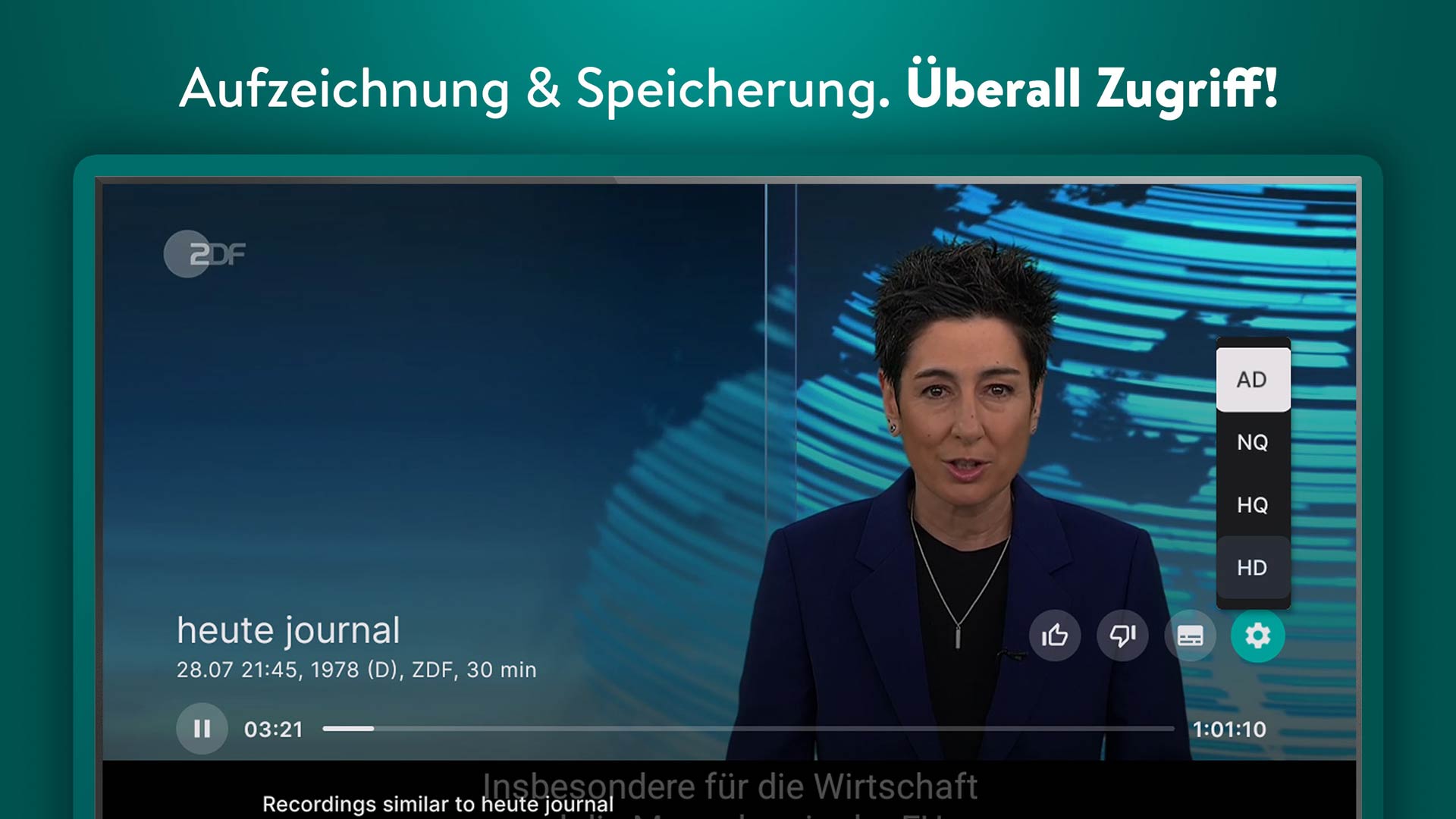
- Nachrichten: News programs like Tagesschau (ARD) and heute (ZDF) are highly respected for their neutrality and remain the most-watched news sources in the country.
- Talkshows: Political talk shows (e.g., Anne Will, Maybrit Illner) play a major role in shaping public discourse.
Comparing German TV Service Tiers
| Feature | Public Broadcasters (ARD/ZDF) | Private Broadcasters (RTL/ProSieben) | Streaming Platforms (Joyn/RTL+) |
|---|---|---|---|
| Primary Funding | Monthly License Fee (Beitrag) | Advertising Revenue | Subscription + Advertising |
| HD Availability | Free (Unencrypted) | Requires Subscription (HD+) | Requires Premium Tier |
| Advertising | Limited / None after 8:00 PM | High Frequency | Varies by Tier |
| Content Focus | News, Culture, Regional, Sport | Entertainment, Reality, US Imports | Exclusive Series, Reality, Sports |
| Digital Platform | ARD/ZDF Mediathek | Joyn / RTL+ App | Centralized Apps |
Legal Requirements and Compliance
Living in Germany involves specific legal obligations regarding media consumption. The most important is the registration with the ARD ZDF Deutschlandradio Beitragsservice. Upon moving into a new apartment, the local registration office (Bürgeramt) shares your data with the Beitragsservice. You will typically receive a letter requesting payment within a few weeks of registration.
It is a common mistake to ignore these letters. The fee is a "solidarity model," meaning it is due even if you do not own a TV, radio, or computer. In 2026, the enforcement mechanisms are highly automated. Unpaid fees can lead to late surcharges and, eventually, a visit from a bailiff (Gerichtsvollzieher). If you live in a shared flat (WG), only one person needs to pay for the entire household; ensure you have their contribution number (Beitragsnummer) to avoid being double-charged.
Frequently Asked Questions
Do I have to pay the TV tax if I don't speak German?
Yes. The Rundfunkbeitrag is a household fee, not a usage fee. The German legal position is that the public broadcasting system provides a social benefit to the country that all residents must support, regardless of their individual consumption or language proficiency.
How can I watch German TV for free?
You can watch all public channels for free via the ARD and ZDF Mediathek websites or apps. For private channels, most offer a limited "live stream" for free on their respective apps (Joyn or RTL+), though these are usually in standard definition (SD) and include unskippable advertisements.
Is satellite TV still relevant in 2026?
Absolutely. While fiber-optic expansion has made IPTV more popular, satellite remains the only way to receive a massive variety of international and local channels without a monthly service contract (excluding the optional HD+ fee for private channels). It is the preferred method for home owners and those in rural regions.
Can I get English-language channels on German TV?
Most satellite dishes pointed at Astra 19.2°E will pick up international news channels like BBC News, CNN International, and Sky News for free. However, for general entertainment in English (like UK or US networks), you would typically need a secondary satellite dish pointed at Astra 28.2°E or a high-end IPTV subscription that includes international packages.
What is the difference between ARD and ZDF?
ARD is a collection of regional stations (like a network of state broadcasters) that produce a national program together. It tends to have more regional news and variety. ZDF is a single, national organization based in one location. While their programming is similar, they compete for ratings while collaborating on major events like the Olympics or World Cup.
Practical Recommendation
For those newly arriving in Germany in 2026, the most efficient setup is to utilize a Smart TV with built-in apps for the ARD and ZDF Mediatheken. This allows you to access the vast majority of high-quality German content (news, documentaries, and drama) for free without needing a cable or satellite contract. If you desire private channels or sports, subscribing to an IPTV service like MagentaTV or a streaming aggregator like Zattoo or Waipu.tv offers the most flexibility, as these services work over any standard internet connection and do not require complex hardware installations.
Image Gallery