Strategic Tax Planning for Small Businesses: A Comprehensive Guide
Effective tax planning for small businesses involves structuring operations, timing revenues and expenses, maximizing statutory deductions, and choosing appropriate entity classifications to legally minimize federal, state, and local t...
Effective tax planning for small businesses involves structuring operations, timing revenues and expenses, maximizing statutory deductions, and choosing appropriate entity classifications to legally minimize federal, state, and local tax liabilities. Rather than viewing taxes as an annual administrative burden, proactive entrepreneurs integrate tax strategy into year-round financial decision-making to preserve capital and accelerate growth.
Contents
Disclaimer: Tax laws, regulations, and reporting requirements vary by jurisdiction and change frequently. The information provided in this guide is for educational purposes only and does not constitute formal legal, accounting, or tax advice. Small business owners should consult a certified public accountant (CPA), enrolled agent, or tax attorney to tailor these strategies to their specific financial situation.
1. Selecting and Optimizing Business Entity Structure
The legal and operational structure of a business dictates how its income is taxed at both federal and state levels. Choosing the right entity type—and revisiting that choice as revenues scale—is one of the most fundamental tax planning decisions a business owner can make.
Pass-Through Entities vs. C Corporations
Most small businesses operate as pass-through entities, where profits and losses flow directly to the owners' personal tax returns.
- Sole Proprietorships and Single-Member LLCs: Net profits are reported on Schedule C of IRS Form 1040. Owners must pay standard income taxes as well as Self-Employment Tax (15.3% covering Social Security and Medicare) on all net earnings.
- Partnerships and Multi-Member LLCs: Operating under Subchapter K, these entities file an informational return (Form 1065) and issue Schedule K-1s to partners. Net income retains its tax characteristics when passed to partners.
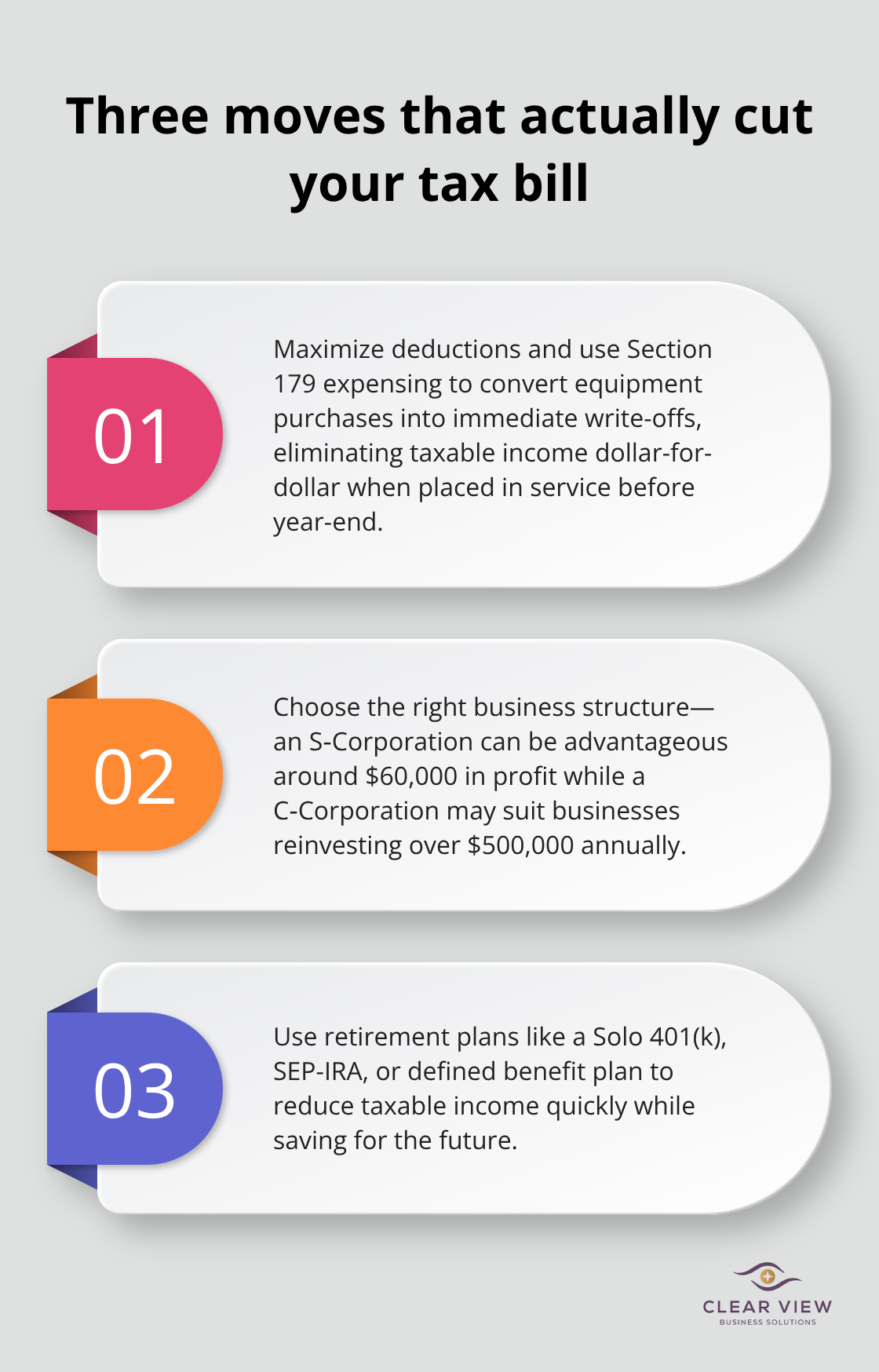
- S Corporations: By electing S Corporation status via Form 2553, eligible businesses allow net income to pass through to shareholders without triggering self-employment taxes on the entirety of earnings. Owners who work in the business must pay themselves a "reasonable salary" subject to standard payroll taxes, while remaining profits can be distributed as dividend-style distributions exempt from Medicare and Social Security taxes.
- C Corporations: Governed by Subchapter C, these entities are distinct legal entities subject to corporate tax rates. While C Corporations face potential "double taxation"—where profits are taxed at the corporate level and again as personal dividends when distributed—they provide access to unique fringe benefits, flexible fiscal year planning, and preferred funding structures for high-growth firms seeking venture capital.
Leveraging the Section 199A Qualified Business Income (QBI) Deduction
Established under the Tax Cuts and Jobs Act, the Section 199A deduction allows eligible pass-through business owners to deduct up to 20% of their Qualified Business Income (QBI) from their taxable personal income.
To qualify fully, an owner's taxable income must fall below designated annual threshold limits established by the Internal Revenue Service (IRS). For taxpayers exceeding these limits, the deduction may be capped based on W-2 wages paid by the business or the unadjusted basis immediately after acquisition (UBIA) of qualified property. Furthermore, owners operating in Specified Service Trades or Businesses (SSTBs)—such as law, health, consulting, accounting, financial services, and performing arts—face complete phase-outs of the QBI deduction above upper income thresholds.
2. Year-Round Timing Strategies for Income and Expenses
Tax planning requires controlling when revenue is recognized and when deductions are claimed. Strategic timing allows business owners to manage their marginal tax brackets across tax years.
Cash-Basis vs. Accrual Tax Timing
- Cash Basis:
- Income recognized when cash/payment is received.
- Expenses recognized when payment is sent/cleared.
- Accrual Basis:
- Income recognized when earned (invoice sent/work done).
- Expenses recognized when incurred (bill received).
Deferring Income and Accelerating Expenses
For cash-basis taxpayers, deferring income to the following tax year and accelerating deductible expenses into the current year can lower current-year taxable income:
- Delaying Billing: Issuing customer invoices near the very end of the tax year ensures payments are received and counted as income in the subsequent financial year.
- Prepaying Expenses: Paying vendor bills, utility services, insurance premiums, or commercial leases prior to year-end allows cash-basis businesses to claim deductions in the current tax period, provided the prepayments meet IRS 12-month rule guidelines.
- Purchasing Inventory and Supplies: Replenishing essential business supplies before the close of the fiscal year creates immediate deduction opportunities under applicable accounting standards.
Capital Expenditure and Asset Depreciation Rules
When small businesses invest in heavy equipment, machinery, technology infrastructure, or facility upgrades, tax laws dictate how those capital expenditures are written off over time.
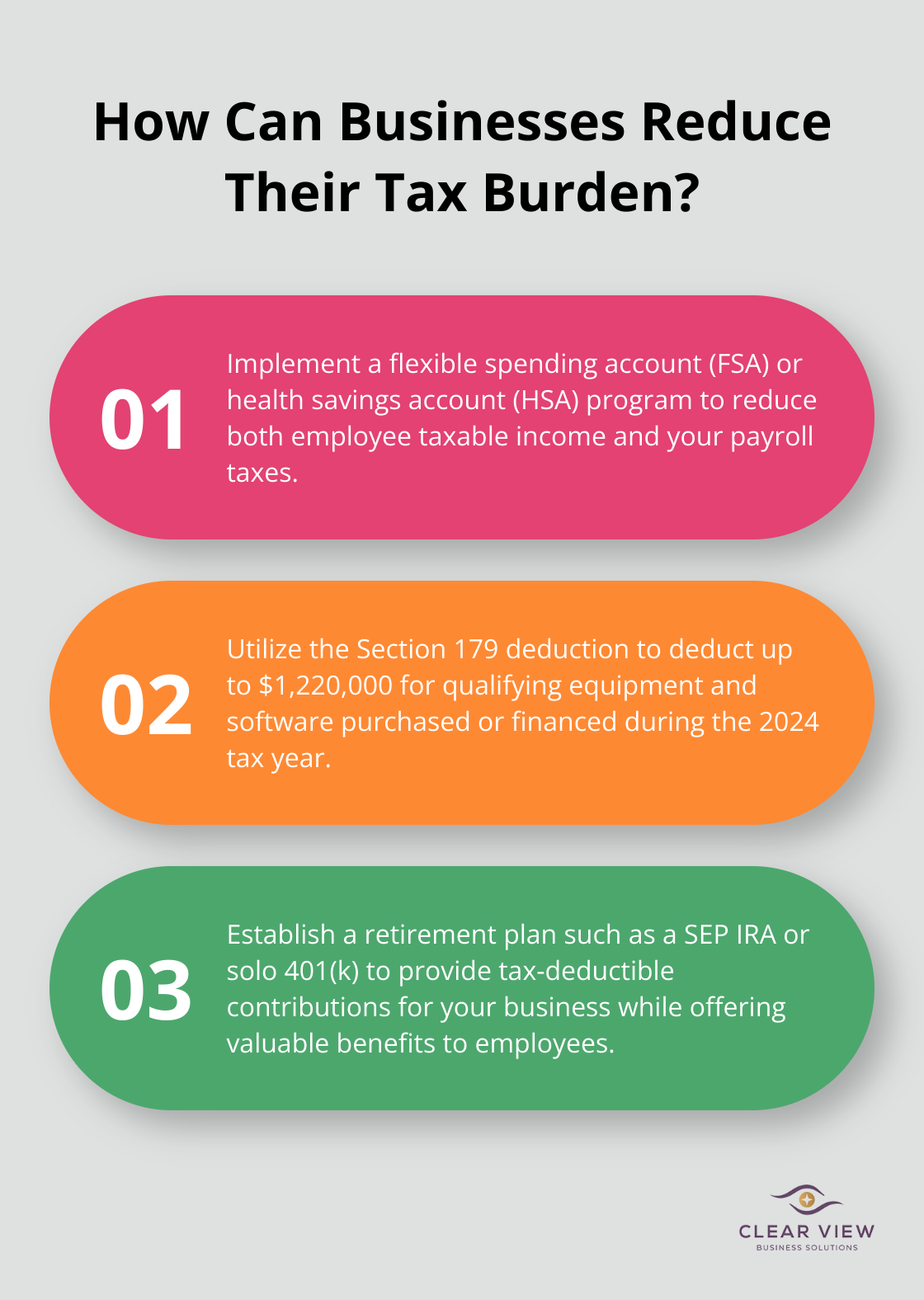
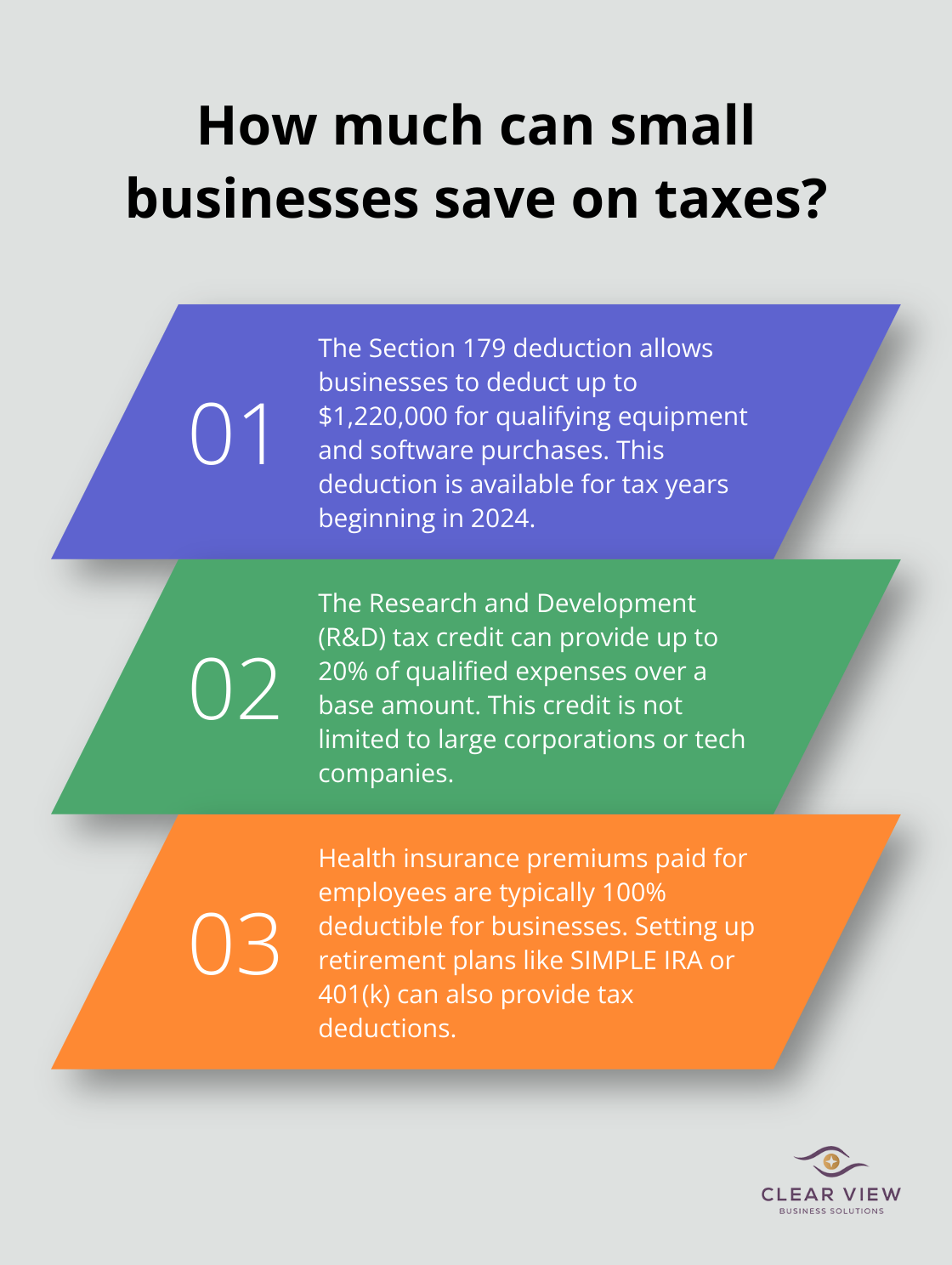
- Section 179 Expensing: Under Section 179 of the Internal Revenue Code, businesses can write off the full purchase price of eligible new or used equipment and software during the tax year it is placed in service, subject to annual dollar limitations and investment phase-out thresholds. Detailed rules and annual adjustments can be reviewed through official resources on the IRS Section 179 Deduction Statement.
- Bonus Depreciation: Bonus depreciation provides an additional method to accelerate asset write-offs. Owners must calculate the interaction between Section 179 limits and statutory bonus depreciation percentages to structure major asset acquisitions for maximum tax efficiency.
3. High-Value Tax Deductions and Business Credits
Maximizing statutory deductions and claiming eligible tax credits directly lowers net tax obligations. Deductions reduce taxable income, whereas tax credits provide a dollar-for-dollar reduction of net tax liability.
Essential Deductions for Small Businesses
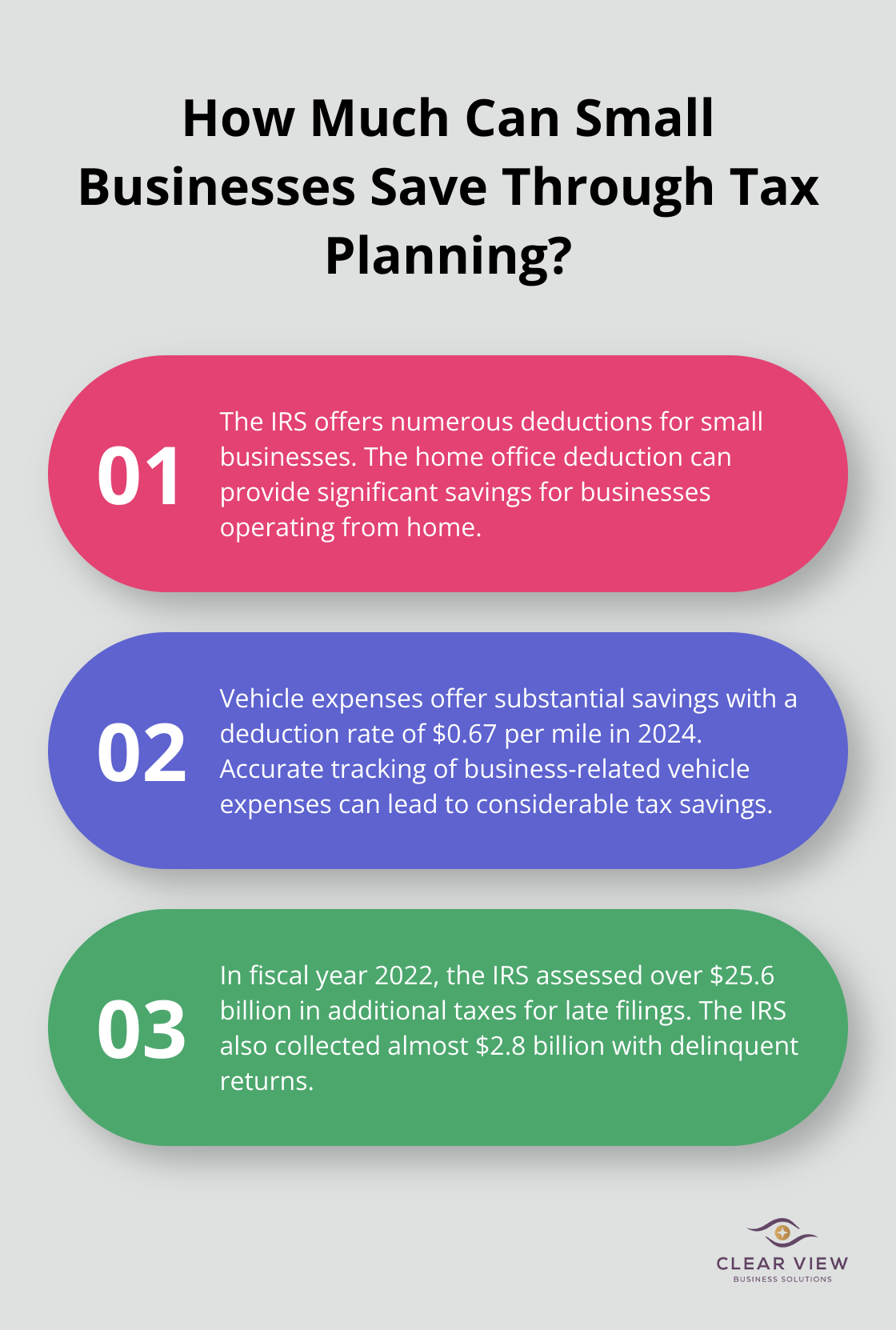
- Home Office Deduction: Business owners operating from a dedicated home workspace can deduct a proportional share of housing expenses (mortgage interest, property taxes, utilities, insurance, and maintenance). The IRS allows either the simplified method ($5 per square foot up to 300 square feet) or the regular method based on actual itemized expenses allocated by square footage percentage.
- Vehicle Expenses: Business-related travel can be written off using either the standard mileage rate set annually by the IRS or the actual expense method (gas, repairs, depreciation, insurance, and lease payments multiplied by the percentage of business usage). Keeping an accurate, contemporaneous mileage log is mandatory under IRS audit guidelines.
- Employee Salaries and Benefits: Wages paid to employees, bonuses, health insurance premiums, and contribution matches for employee retirement plans are fully deductible operational expenses.
- Professional Fees and Services: Payments made to legal counsel, bookkeepers, CPAs, IT consultants, and marketing agencies represent direct deductible business expenses.
Strategic Tax Credits
Tax credits directly offset dollar-for-dollar tax liabilities and are far more valuable than standard deductions:
- Credit for Increasing Research Activities (R&D Tax Credit): Small businesses developing new software, manufacturing processes, formulas, or hardware products may qualify for federal and state R&D tax credits. Eligible startups can apply a portion of their R&D credit against employer payroll taxes (FICA) if they do not yet have income tax liability.
- Small Business Health Care Tax Credit: Qualified small employers that purchase health insurance coverage through the Small Business Health Options Program (SHOP) and pay at least 50% of employee premium costs can receive a tax credit of up to 50% of premiums paid.
- Work Opportunity Tax Credit (WOTC): Employers hiring individuals from targeted groups who face significant barriers to employment (such as qualified veterans, long-term unemployed individuals, or recipients of specific assistance programs) can claim valuable federal tax credits per qualified hire.
4. Entity-Level Tax Strategy Comparison
The following table summarizes key structural parameters, tax features, and administrative obligations across the primary small business entity types:
| Entity Type | Tax Treatment | Self-Employment Tax Impact | Key Advantages | Primary Compliance Deadlines |
|---|---|---|---|---|
| Sole Proprietorship | Pass-through on Schedule C (Form 1040) | Subject to 15.3% SE tax on 100% of net profit | Minimal administrative overhead; direct reporting | April 15 (Form 1040) |
| Partnership / LLC | Pass-through on Form 1065 / Schedule K-1 | General partners pay 15.3% SE tax on income allocations | Flexible profit allocation; multi-owner capital pooling | March 15 (Form 1065) |
| S Corporation | Pass-through on Form 1120-S / Schedule K-1 | SE tax applies only to reasonable W-2 salary, not distributions | Significant SE tax savings potential on higher revenues | March 15 (Form 1120-S) |
| C Corporation | Corporate level (Form 1120) + Personal dividends | Salary subject to payroll tax; dividends subject to capital gains | Flat corporate rate; preferred for venture equity funding | April 15 (Form 1120) |
5. Tax-Advantaged Retirement Plans for Business Owners
Establishing a qualified retirement plan serves a dual purpose: it builds personal retirement wealth while generating substantial immediate tax deductions for the business.
Small Business Retirement Plan Comparison
- SEP-IRA:
- High contribution limits (up to 25% of net self-employment earnings)
- Easy setup; flexible annual funding requirements.
- SIMPLE IRA:
- Ideal for small firms with employees.
- Mandatory employer match (up to 3%) or non-elective contribution.
- Solo 401(k):
- Maximizes contributions for owner-only businesses (or with spouse).
- Allows dual contributions: as employee AND as employer.
SEP-IRA (Simplified Employee Pension)
A SEP-IRA allows self-employed individuals and business owners to contribute a fixed percentage of net income annually.
- Contributions: Employer-only contributions up to 25% of compensation or statutory annual maximum limits.
- Flexibility: Contributions are not mandated every year, offering financial flexibility during lean operational periods.
- Employer Rules: If an owner contributes to their own SEP-IRA, they must contribute an equal percentage of salary for all eligible employees.
SIMPLE IRA (Savings Incentive Match Plan for Employees)
Designed specifically for businesses with 100 or fewer employees, a SIMPLE IRA features lower administrative costs than standard 401(k) plans.
- Structure: Employees make elective salary deferrals, and employers are required to match employee contributions dollar-for-dollar up to 3% of compensation, or make a 2% non-elective contribution for all eligible employees.
- Setup Deadlines: Must generally be established by October 1 of the tax year for which contributions begin.
Solo 401(k) / Individual 401(k)
For self-employed individuals and business owners with no full-time employees other than a spouse, the Solo 401(k) provides the highest contribution potential.
- Dual Role Contributions: The business owner can contribute as an employee (elective deferral up to annual limits) and as an employer (profit-sharing contribution up to 25% of net self-employment earnings).
- Roth Option: Allows for Roth contributions, giving business owners the ability to generate tax-free income growth and future withdrawals.
6. Quarter-by-Quarter Tax Compliance Timeline
Failing to meet tax deadlines leads to severe penalties and interest charges from federal and state authorities. Small business owners must maintain a strict calendar for estimated quarterly tax payments and annual informational returns.
Quarterly Estimated Tax Schedule
- Q1: Due April 15 (Covers Jan 1 - Mar 31)
- Q2: Due June 15 (Covers Apr 1 - May 31)
- Q3: Due Sept 15 (Covers Jun 1 - Aug 31)
- Q4: Due Jan 15* (Covers Sep 1 - Dec 31 of prior year)
*Next calendar year. If deadline falls on a weekend/holiday, due next business day.
Estimated Tax Payment Rules
Because the U.S. tax system operates on a pay-as-you-go model, sole proprietors, partners, S corporation shareholders, and C corporations are required to make estimated tax payments throughout the year if they expect to owe $1,000 or more in federal tax.
To avoid safe-harbor underpayment penalties, taxpayers must pay either:
- 90% of the current year’s total tax liability, or
- 100% of the prior year’s tax liability (increased to 110% if adjusted gross income exceeds statutory limits for higher earners).
Business owners can review payment procedures and filing software tools directly on the official IRS Tax Information for Businesses portal.
7. Common Tax Planning Mistakes Small Businesses Must Avoid
Navigating corporate taxation requires strict adherence to statutory rules. Avoiding common pitfalls protects businesses from costly audits, fines, and disallowances.
Commingling Personal and Business Funds
Mixing personal finances with business operations is a primary trigger for IRS audits and can invalidate the legal liability protection provided by LLCs and corporations (known as "piercing the corporate veil").
- Solution: Maintain dedicated business checking accounts, corporate credit cards, and clear accounting ledgers for all business transactions. Never pay personal expenses directly from corporate accounts.
Worker Misclassification (Contractors vs. Employees)
Misclassifying workers as independent contractors (Form 1099-NEC) rather than W-2 employees to avoid payroll taxes, workers' compensation insurance, and benefit coverage attracts strict enforcement from state labor boards and the IRS.
- Evaluation Metrics: Courts and regulatory agencies analyze financial control, behavioral control, and the nature of the working relationship to determine classification. Misclassification can lead to severe retroactive payroll tax liabilities, interest, and legal fines.
Ignoring State and Local Tax Obligations (SALT)
Focusing solely on federal tax obligations leaves small businesses exposed to state and municipal tax compliance risks:
- Economic Nexus: State regulations (post-South Dakota v. Wayfair) require businesses selling products or services across state lines to collect and remit state sales taxes once revenue or transaction thresholds are reached.
- Pass-Through Entity Tax (PTET) Elections: Many states allow pass-through businesses to pay state income tax at the entity level rather than the individual owner level. This strategy acts as a legal workaround to the federal cap on State and Local Tax (SALT) itemized deductions, reducing overall federal taxable income for owners.
Frequently Asked Questions
What is the difference between tax preparation and tax planning?
Tax preparation is a reactive process focused on accurately completing and filing annual tax returns based on past financial activities. Tax planning is a proactive, year-round strategy designed to structure ongoing business decisions, timing, asset purchases, and entity choices to minimize overall tax liability before the tax year closes.
How do I know if my business should elect S Corporation tax status?
An S Corporation election generally becomes financially beneficial when a business generates sufficient net profit to pay the owner a fair market W-2 wage while leaving substantial residual profits that can be distributed as dividend distributions. Because S Corporations involve additional payroll setup, corporate compliance, and separate tax filing costs, business owners usually consider this transition when net annual earnings reach an operational threshold where payroll tax savings outweigh administrative expenses.
What recordkeeping standards does the IRS require for business deductions?
The IRS requires taxpayers to maintain documentary evidence, such as receipts, canceled checks, bank statements, invoices, and bills, for all claimed business deductions. For travel, vehicle use, meals, and entertainment expenses, business owners must keep contemporaneous logs detailing the dollar amount, date, location, business purpose, and professional relationship of individuals involved.
Can a small business deduct 100% of business meals?
Standard business meals with clients, prospects, or employees for business discussions are generally 50% deductible, provided the expense is reasonable and not lavish under the circumstances. Fully deductible (100%) meals are typically restricted to company-wide social events, such as annual holiday parties or staff picnics.
What happens if I miss an estimated quarterly tax payment deadline?
If you miss a quarterly estimated tax deadline, the IRS calculates an underpayment penalty based on the shortfall amount and the number of days payment is late. To minimize penalty accumulation, business owners should submit the missing payment as quickly as possible rather than waiting until the next quarterly payment due date.
Strategic Action Steps for Small Business Owners
To implement a successful tax planning framework, small business owners should follow these clear steps:
- Conduct Mid-Year and Q4 Tax Reviews: Meet with a licensed CPA or tax advisor during the third and fourth quarters to project net annual taxable income, evaluate marginal tax brackets, and adjust estimated tax payments.
- Optimize Entity Structure: Analyze whether your existing legal structure (Sole Proprietorship, LLC, S Corp, C Corp) remains alignment-optimized for your current gross revenue and profit distribution goals.
- Formalize Year-End Expense Timing: Review planned capital purchases, equipment upgrades, software investments, and retirement contributions prior to December 31 to maximize current-year statutory deductions.
- Establish Tax-Advantaged Retirement Accounts: Select and fund an appropriate business retirement plan (SEP-IRA, SIMPLE IRA, or Solo 401k) to build personal wealth while capturing immediate entity-level deductions.
- Maintain Automated Bookkeeping Infrastructure: Implement robust, dedicated accounting software integrated with business-only banking accounts to preserve clean audit trails and maintain full tax compliance.
Image Gallery