Understanding the Missouri Workers’ Compensation Guidelines: A Complete Guide for 2026
Missouri workers’ compensation guidelines require most employers with five or more employees—and construction employers with one or more—to provide insurance coverage for work-related injuries. This no-fault system ensures employees re...
Missouri workers’ compensation guidelines require most employers with five or more employees—and construction employers with one or more—to provide insurance coverage for work-related injuries. This no-fault system ensures employees receive medical care and wage replacement for on-the-job accidents or occupational diseases, while protecting employers from costly negligence-based litigation.
Contents
The Legal Framework of Missouri Workers’ Compensation
The Missouri Workers’ Compensation Law, contained in Chapter 287 of the Missouri Revised Statutes (RSMo), serves as the primary regulatory framework for workplace safety and injury compensation. As of 2026, the core objective remains the "exclusive remedy" doctrine. This legal principle prevents employees from suing their employers for negligence in exchange for guaranteed, albeit defined, benefits.
The Missouri Division of Workers’ Compensation (DWC), a branch of the Department of Labor and Industrial Relations, oversees the administration of these guidelines. They handle dispute resolution through Administrative Law Judges (ALJs), manage the Second Injury Fund, and ensure insurance carriers comply with state-mandated benefit disbursements.
Employer Coverage Requirements
In Missouri, the threshold for mandatory coverage is strictly defined by the number of employees and the nature of the industry:
- General Businesses: Any employer with five or more employees, whether full-time or part-time, must carry workers' compensation insurance.
- Construction Industry: Due to the higher risk profile, any employer in the construction industry with one or more employees must be insured.
- Exemptions: Certain classes of workers, such as domestic servants, farm laborers, and certain real estate agents, are generally exempt, though employers may choose to provide coverage voluntarily.
Reporting and Initial Claim Procedures
The efficiency of a workers' compensation claim in Missouri depends heavily on adhering to strict reporting timelines. Failure to follow these procedural guidelines can lead to a denial of benefits or a reduction in the compensation amount.
The 30-Day Reporting Rule
An injured worker must notify their employer, preferably in writing, within 30 days of the accident. This notice should include the date, time, and location of the incident, along with a description of the injury. If the injury is an occupational disease (like carpal tunnel or respiratory issues from chemical exposure), the 30-day window typically begins once the employee is diagnosed and informed that the condition is work-related.
Employer Responsibilities Post-Injury
Once notified, the employer or their insurance carrier has a legal obligation to:
- File a First Report of Injury: The employer must report the injury to the DWC within five days of learning about it if the injury requires medical treatment beyond first aid or results in lost time from work.
- Authorize Medical Care: Missouri is an "employer-choice" state, meaning the employer or the insurer has the right to select the treating physician.
Medical Benefits and the Choice of Physician
One of the most critical aspects of the Missouri guidelines is the control over medical treatment. Unlike some states where workers can see their family doctor, Missouri law grants the employer the authority to designate the healthcare provider.
Authorized Treatment
The employer must provide all medical, surgical, and hospital treatment, including nursing, ambulance services, and orthopedic devices, that may be reasonably required to cure or relieve the effects of the injury. If an employee seeks treatment from an unauthorized doctor, the employer is generally not responsible for those bills, and the employee may be forced to pay out-of-pocket.
Mileage Reimbursement
If the authorized medical treatment is located outside the local metropolitan area (defined as more than 250 miles round trip in some contexts, though generally applied to any significant travel), the injured worker is entitled to mileage reimbursement. As of 2026, these rates are adjusted annually based on state travel regulations.
Disability and Wage Replacement Benefits
When an injury results in lost wages or permanent impairment, Missouri guidelines provide several tiers of disability benefits. These are typically calculated as 66 2/3% of the employee’s average weekly wage (AWW), subject to maximum caps set by the state each year.
Temporary Total Disability (TTD)
If a doctor determines an employee cannot work at all while recovering, they are eligible for TTD benefits.
- Waiting Period: There is a three-day waiting period. If the disability lasts more than 14 days, the employee is retroactively paid for those first three days.
- Duration: Benefits continue until the employee is released to return to work or reaches Maximum Medical Improvement (MMI).
Permanent Partial Disability (PPD)
PPD applies when a worker has reached MMI but is left with a permanent impairment (e.g., loss of range of motion in a shoulder or a finger amputation). Compensation is determined by:
- The Scheduled Loss: The law assigns a specific number of "weeks" of compensation to specific body parts (e.g., 232 weeks for an arm at the shoulder).
- Body as a Whole: For injuries to the back, neck, or internal organs, the "body as a whole" rating is used, capped at 400 weeks.
Permanent Total Disability (PTD)
If an injury is so severe that the worker can no longer compete in the open labor market, they may be eligible for PTD benefits for life. These cases are often complex and frequently involve the Second Injury Fund, which provides additional compensation if a current work injury combines with a pre-existing disability to create a total disability.
| Benefit Type | Calculation Basis | Maximum Duration | Key Limitation |
|---|---|---|---|
| Medical | 100% of authorized costs | Until MMI | Employer chooses doctor |
| TTD | 66 2/3% of AWW | Recovery period | Subject to state weekly cap |
| PPD | 66 2/3% of AWW | Per Statutory Schedule | Based on disability percentage |
| PTD | 66 2/3% of AWW | Lifetime | Must be unable to work entirely |
| Death Benefits | 66 2/3% of AWW | Varies (Spouse/Children) | Includes burial expenses |
Occupational Diseases and Repetitive Trauma
Missouri guidelines recognize that not all injuries result from a single "accident." Occupational diseases caused by toxic exposure (e.g., asbestosis, silicosis) or repetitive motion (e.g., carpal tunnel syndrome) are compensable if the employment was the prevailing factor in causing the condition.
The "prevailing factor" is defined as the primary cause of the condition, accounting for more than 50% of the cause when compared to all other factors combined. This is a rigorous standard that often requires expert medical testimony to prove. In 2026, Missouri continues to use specialized dockets for complex occupational disease claims, particularly those involving toxic exposure.
Resolving Disputes: The Role of the ALJ
Disputes are common in workers' compensation, ranging from the denial of a claim to disagreements over the percentage of permanent disability. Missouri utilizes an administrative law system rather than a jury trial system for these matters.
- Mediation: Often the first step, where a DWC mediator helps the parties reach a voluntary settlement.
- Hardship Hearing: An expedited hearing held when the employer denies medical treatment or TTD benefits while the worker is still recovering.
- Final Hearing: A formal trial before an Administrative Law Judge (ALJ). The ALJ reviews medical records, hears testimony, and issues an "Award."
- Appeals: Either party can appeal an ALJ’s decision to the Labor and Industrial Relations Commission, and subsequently to the Missouri Court of Appeals.
Common Mistakes and Troubleshooting
Navigating the Missouri guidelines is prone to errors that can jeopardize a claim. Awareness of these pitfalls is essential for both employees and employers.
- Waiting too long to report: Even if an injury seems minor, reporting it immediately preserves the right to benefits if the condition worsens.
- Inconsistent medical history: It is vital to tell the doctor exactly how the injury happened at work. Inconsistencies between the accident report and medical records are the leading cause of claim denials.
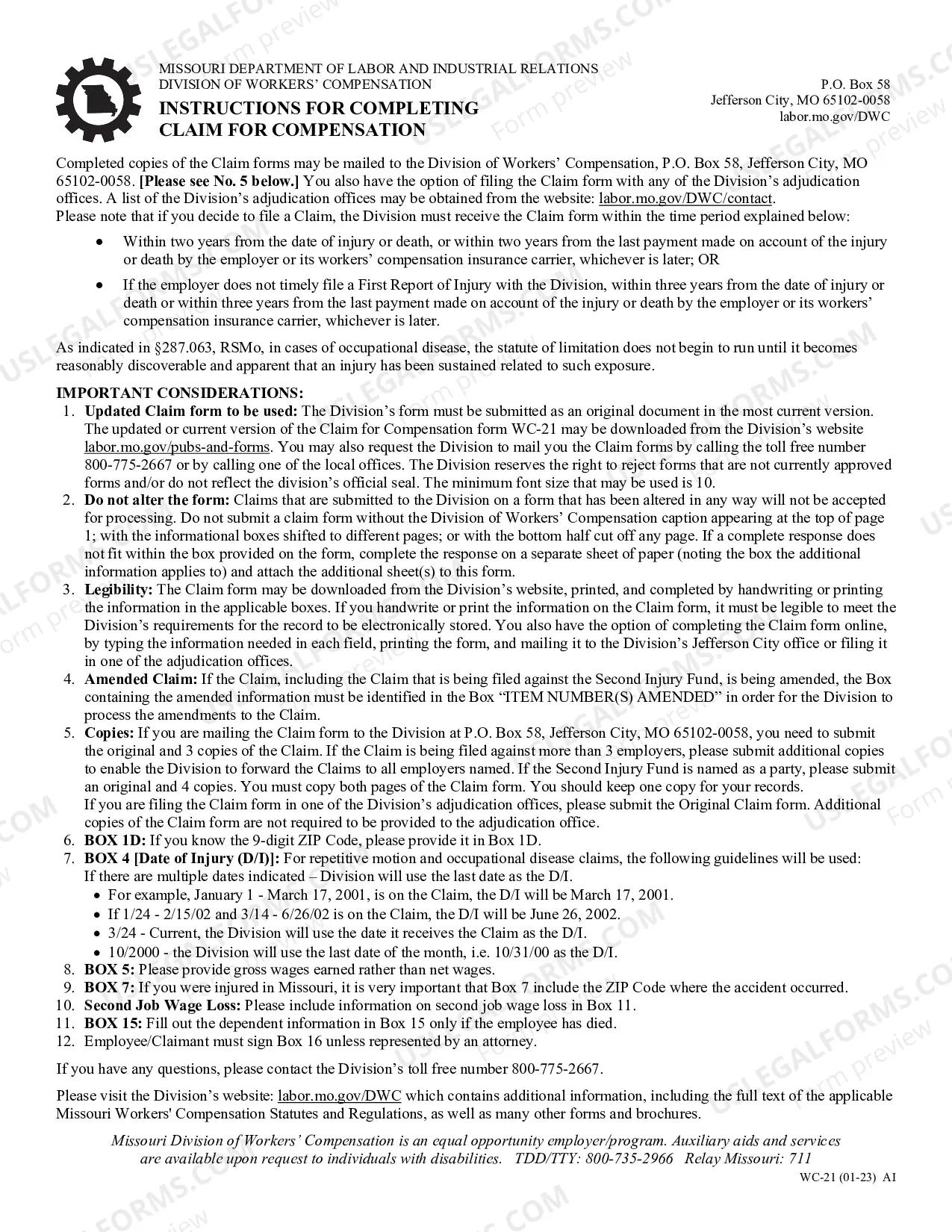
- Missing the Statute of Limitations: Generally, a Claim for Compensation must be filed with the DWC within two years of the injury or the last payment of benefits. In some cases, this can be extended to three years if the employer failed to file the First Report of Injury timely.
- Returning to work too early: If an employee returns to light-duty work, they must strictly follow the doctor’s restrictions. Doing work beyond these restrictions can exacerbate the injury and potentially disqualify the worker from future TTD benefits.
Frequently Asked Questions
Can I be fired for filing a workers' compensation claim in Missouri?
Missouri law prohibits employers from discriminating or retaliating against an employee for exercising their rights under the Workers’ Compensation Law. However, Missouri is an "at-will" employment state, meaning an employer may terminate an employee for other legitimate business reasons, such as a reduction in force or unrelated performance issues, even while a claim is pending.
What if my employer doesn't have insurance?
If an employer is legally required to carry insurance but fails to do so, they may be subject to stiff penalties, including class A misdemeanors and fines. Furthermore, the injured worker may be able to sue the employer in civil court, where the employer is barred from using certain common-law defenses (like the employee’s own negligence).
Does Missouri cover mental health injuries?
Mental stress or psychological injuries are compensable only if they result from a physical injury or if the stress was "extraordinary and unusual" compared to the stresses of other employees in similar positions. The standards for "mental-mental" claims (stress without physical trauma) are exceptionally high in Missouri.
Are independent contractors eligible for benefits?
Generally, no. However, Missouri uses a "statutory employee" test to prevent employers from misclassifying workers to avoid paying insurance. If a worker is performing work that is a regular part of the employer’s business on the employer's premises, they may be deemed a statutory employee and entitled to benefits regardless of their contractor status.
Can I get a second medical opinion?
Under Missouri guidelines, you have the right to see your own doctor, but you must pay for it yourself. This "outside" opinion is often used as evidence in a legal dispute but does not obligate the insurance company to follow the outside doctor’s treatment plan or pay for the visit.
Practical Recommendation for 2026
If you are injured on the job in Missouri, the most important action you can take is to document everything. Keep a personal log of who you spoke to at the company, the dates of all medical appointments, and copies of any work status slips provided by the doctor. Because the employer controls the medical treatment, having a clear paper trail is your best defense against a premature termination of benefits or a dispute regarding the severity of your injury. If a claim is denied or if you are facing a permanent disability, consulting with a qualified workers' compensation attorney is highly recommended to ensure you receive the full statutory value of your claim.
Image Gallery