Why Your Back Hurts During Ab Workouts: Causes and Solutions
Back pain during abdominal exercises is typically caused by the hip flexors overpowering the core muscles, which forces the lower back to arch and take the brunt of the load. When the abdominal wall is too weak to maintain a neutral sp...
Back pain during abdominal exercises is typically caused by the hip flexors overpowering the core muscles, which forces the lower back to arch and take the brunt of the load. When the abdominal wall is too weak to maintain a neutral spine, the lumbar vertebrae experience excessive shearing forces and compression.
Contents
If you have ever finished a set of leg raises or sit-ups only to find your lower back is throbbing rather than your "six-pack" burning, you are not alone. This is one of the most common complaints in both functional fitness and traditional bodybuilding. In 2026, as sedentary lifestyles and "desk posture" remain prevalent, the biomechanical compensations that lead to back pain during core training have become even more pronounced. Understanding the interplay between the pelvis, the spine, and the deep core muscles is the first step toward pain-free training.
The Biomechanics of Core Training: Why the Back Takes Over
To understand why your back hurts, you must first understand the relationship between the rectus abdominis (the "six-pack" muscle), the transverse abdominis (your internal weight belt), and the iliopsoas (the primary hip flexors).
The primary function of the core is not just to flex the spine (as in a crunch), but to stabilize it against external forces. When you perform an abdominal exercise, your core is tasked with keeping your spine in a safe, neutral position. However, many popular ab exercises involve moving the legs. Because the hip flexors—specifically the psoas major—attach directly to the lumbar spine (the lower back), they exert a powerful forward pull on your vertebrae.
If your abdominals are not strong enough to counteract this pull by keeping your pelvis tucked, your back will arch. This is known as anterior pelvic tilt. In this position, the facet joints of your spine are compressed, and the muscles of the lower back (the erector spinae) must contract intensely to keep you from "breaking" in the middle. The result is a back ache that masks any benefit to your abs.
Common Reasons for Lower Back Pain During Ab Workouts
Identifying the specific cause of your discomfort requires looking at your movement patterns and your physiological baseline. Most cases of exercise-induced back pain stem from one of the following four areas.
1. Hip Flexor Dominance
The hip flexors are a group of muscles near the top of your thighs that connect your upper leg to your trunk. In many ab exercises, such as leg raises, "bicycles," or mountain climbers, the hip flexors do the bulk of the work. If these muscles are tight or overactive—a common result of prolonged sitting—they will "hijack" the movement. Because the psoas muscle originates at the T12-L4 vertebrae, an overactive hip flexor literally yanks the lower spine forward, causing that characteristic arching and subsequent pain.
2. Lack of Transverse Abdominis Engagement
While the rectus abdominis is the most visible muscle, the transverse abdominis (TvA) is the most important for back safety. The TvA acts as a corset, wrapping around your midsection to create intra-abdominal pressure. Many lifters focus on "crunching" their ribs toward their hips but fail to "brace" their midsection. Without TvA engagement, the spine lacks the internal support needed to stay stable under the weight of your moving limbs.
3. Progressive Fatigue and "Form Creep"
Back pain often sets in toward the end of a set. As the primary movers (the abs) fatigue, the body instinctively looks for other muscles to help complete the repetition. This usually means the lower back muscles and the hip flexors take over. If you find your back only hurts on the 12th or 15th rep, it is a sign that your core endurance is lower than your mental drive to finish the set.
4. Excessive Lumbar Extension
Exercises like the "Superman" or even poorly executed planks can lead to excessive lumbar extension. In a plank, if the hips sag toward the floor, the spine enters a state of hyperextension. This puts massive pressure on the intervertebral discs and the posterior elements of the spine.
Comparison of Common Ab Exercises and Pain Triggers
The following table outlines popular exercises, why they frequently cause back pain, and the necessary technical adjustment to fix the issue.
| Exercise | Common Pain Trigger | The Technical Fix |
|---|---|---|
| Leg Raises | Legs drop too low, causing the lower back to "pop" off the floor. | Only lower legs as far as you can while keeping your lower back glued to the mat. |
| Planks | Hips sagging (gravity pulling the lumbar spine into extension). | Squeeze glutes and "tuck" the tailbone to maintain a flat back. |
| Sit-ups | Using momentum and pulling on the neck; hip flexors doing the work. | Focus on "curling" the spine one vertebra at a time; keep feet unanchored if possible. |
| Russian Twists | Excessive lumbar rotation with a rounded back. | Keep the spine tall and rotate from the upper back (thoracic spine), not the lower back. |
| Flutter Kicks | Rapid leg movement without a stabilized pelvis. | Place hands under the glutes to assist in a posterior pelvic tilt and slow down the tempo. |
How to Fix Your Form: The "Hollow Body" Principle
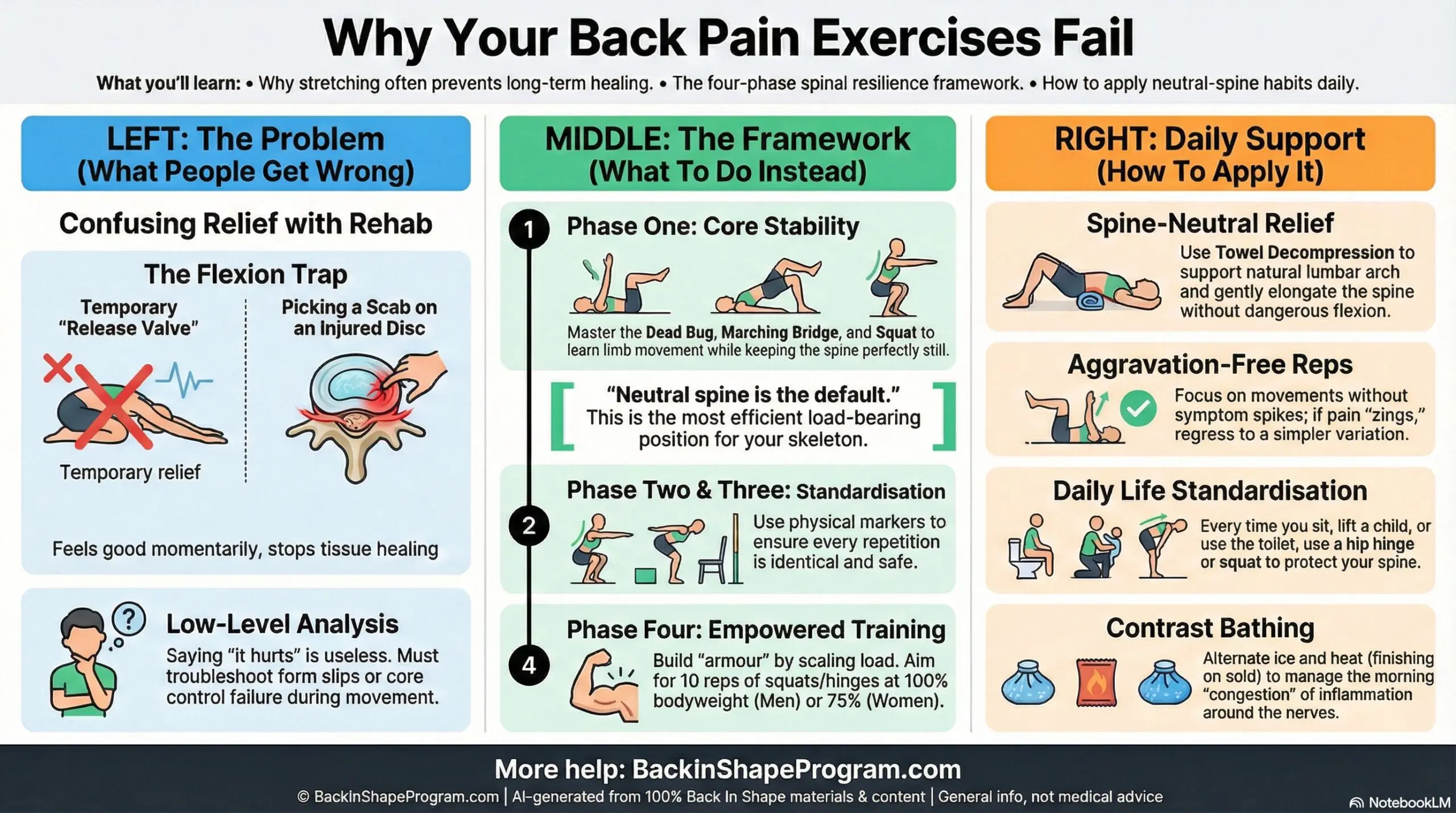
The most effective way to eliminate back pain during core training is to master the Posterior Pelvic Tilt (PPT). This is the opposite of the "butt-out" posture. By tucking your tailbone between your legs and pulling your belly button toward your spine, you flatten your lower back against the floor.
In gymnastics, this is referred to as the Hollow Body position. To practice this:
- Lie flat on your back with your legs bent and feet on the floor.
- Try to slide your hand under the small of your back. There is likely a gap.
- Use your abs to press your lower back down so that your hand is crushed against the floor.
- Maintain this "pressed" position while slowly straightening one leg at a time.
If you cannot maintain this flat-back position while moving your legs, the exercise is currently too difficult for your core strength. You must regress the movement (e.g., keep your knees bent) until your strength catches up to the mechanical demand.
Recommended Corrective Routine
If you are currently experiencing back pain, stop performing high-leverage movements like full leg raises or V-ups. Instead, incorporate these "spine-safe" core exercises that prioritize stability over flexion.
- Dead Bugs: This is the gold standard for back-safe core training. Lie on your back with arms and legs in the air (knees bent at 90 degrees). Slowly lower the opposite arm and opposite leg while keeping your lower back perfectly flat on the ground.
- Bird-Dogs: On all fours, extend the opposite arm and leg. This teaches the core to stabilize the spine against the forces of gravity without the compression found in crunches.
- Pallof Presses: Using a resistance band or cable, stand perpendicular to the anchor point and hold the handle at your chest. Press the handle forward and resist the band’s attempt to rotate your torso. This is "anti-rotation" training, which is incredibly protective for the lower back.
Professional Advice and Limits
Disclaimer: This information is for educational purposes and does not replace professional medical advice. If you experience sharp, shooting pain, numbness in your legs, or pain that persists for more than 48 hours after exercise, consult a physical therapist or sports medicine physician to rule out disc herniations or other structural issues.
As of 2026, clinical guidelines from organizations like the American Council on Exercise (ACE) emphasize that "core" training should be functional and multi-planar. If an exercise causes pain, it is not "working"; it is failing to meet the goal of spinal support.
Frequently Asked Questions
Why does my back hurt during planks even though I’m staying still?
Back pain during planks is usually caused by iliopsoas fatigue and gravity. When your abs tire, your hips sink, and your psoas muscle tries to hold you up by pulling on your lumbar spine. To fix this, focus on a "protracting" your shoulder blades (pushing the floor away) and squeezing your glutes as hard as possible to keep your pelvis in a neutral or slightly posterior tilt.
Should I stop doing sit-ups entirely?
Not necessarily, but traditional sit-ups are high-risk for individuals with existing back issues. Research has shown that sit-ups place high compressive loads on the lumbar discs. If you choose to do them, ensure you are not anchoring your feet under heavy weights, as this forces the hip flexors to take over, which increases the pull on your lower back.
How can I tell the difference between "good" muscle soreness and "bad" back pain?
"Good" soreness (Delayed Onset Muscle Soreness or DOMS) usually feels like a dull ache within the muscle belly (the abs) and typically appears 24–48 hours after a workout. "Bad" pain is often sharp, localized to the spine or the very bottom of the back, and occurs during or immediately after the movement. If the pain makes you wince or change your movement pattern, it is "bad" pain.
Does a weak core cause back pain in daily life too?
Yes. The core's job is to protect the spine during every movement, from picking up groceries to sitting at a computer. If the deep stabilizing muscles (TvA and multifidus) are weak, the spinal segments have less support, leading to chronic wear and tear. Ab workouts that hurt your back are often a symptom of a core that isn't functioning correctly in daily life either.
Can tight hamstrings cause my back to hurt during ab workouts?
Indirectly, yes. Tight hamstrings can pull on the sit-bones (ischial tuberosity), affecting your pelvic tilt. However, tight hip flexors are a much more direct cause of back pain during core exercises because of their direct anatomical attachment to the lumbar vertebrae.
Final Recommendation
To stop back pain during ab workouts, you must shift your focus from "how many reps can I do" to "can I maintain a neutral spine throughout the movement." Start your next session with 3 sets of 10 Dead Bugs, focusing exclusively on keeping your lower back pressed into the floor. If you feel your back arching during any exercise, stop immediately, regress to a simpler version (like bending your knees), and rebuild your strength from a foundation of stability rather than strain.
Image Gallery