The "I Shouldn't Be Alive" Life Raft: Real Survival Cases, Key Equipment, and Ocean Survival Lessons
The life raft episodes of the docudrama series I Shouldn't Be Alive showcase the brutal realities of ocean survival following catastrophic vessel losses. These real-life accounts—most notably the 1982 sinking of the yacht Trashman—high...
The life raft episodes of the docudrama series I Shouldn't Be Alive showcase the brutal realities of ocean survival following catastrophic vessel losses. These real-life accounts—most notably the 1982 sinking of the yacht Trashman—highlight how equipment performance, marine biology, and human psychology dictate survival when stranded offshore.
Contents
Famous Life Raft Incidents Featured in I Shouldn't Be Alive
The television series I Shouldn't Be Alive (produced by Darlow Smithson Productions) documented numerous extraordinary accounts of human endurance. Among its most compelling episodes are those centered on castaways stranded in the open ocean aboard inflatable life rafts. Examining these events reveals the extreme physical and psychological factors that separate survival from tragedy.
1982 TRASHMAN SINKING TIMELINE
- Day 1: Yacht founders off Cape Hatteras in gale force winds. 5 crew members board 11-ft raft.
- Day 2: Loss of fresh water supplies; ocean water contamination of raft interior begins.
- Day 3: Hypernatremia & hallucinations set in. Two crew drink seawater and enter the ocean.
- Day 4: Fatal wound infection claims third crew member.
- Day 5: Remaining survivors (Kiley & Cavanagh) rescued by Soviet freighter Subir.
The 1982 Trashman Yacht Sinking ("Shark Survivor")
The premiere episode of the series, titled "Shark Survivor," detailed the October 1982 sinking of the 58-foot sailing yacht Trashman. Sailing from Maine to Florida, the vessel encountered an unexpected gale off the coast of Cape Hatteras, North Carolina. Massive 30-foot seas destroyed the boat's rigging and hull, forcing five crew members—Deborah Kiley, Brad Cavanagh, Mark Adams, John Lippoth, and Meg Mooney—to abandon ship into an unballasted, 11-foot inflatable life raft.
The crew faced immediate crises:
- Loss of Supplies: The fast-sinking yacht gave the crew no time to gather survival rations, fresh water, or signaling devices.
- Lack of Ballast: The primitive life raft lacked bottom ballast pockets, causing it to capsize repeatedly in gale-force seas.
- Environmental Exposure: Searing heat during the day gave way to cold ocean winds at night, accelerating hypothermia and dehydration.
- Predatory Threat: The raft was continuously stalked by oceanic whitetip sharks (Carcharhinus longimanus), which aggressive behavior prevented survivors from dangling limbs in the water to cool off.
The tragedy escalated when two crew members, suffering from severe dehydration, drank seawater. The resulting extreme hypernatremia triggered intense hallucinations and psychosis, causing both individuals to step off the raft directly into the shark-infested waters. A third crew member succumbed to infected lacerations sustained during the shipwreck. Only Deborah Kiley and Brad Cavanagh survived until their rescue by the Soviet freighter Subir on their fifth day adrift.
Ocean Drift and Prolonged Exposure Cases
Other maritime episodes across the show's seasons emphasize the distinct physical demands of long-term ocean drift. In these scenarios, castaways did not just fight acute dehydration; they battled severe skin erosion from constant exposure to saltwater (saltwater sores), muscle atrophy, and deep psychological fatigue.
Whether stranded on personal watercraft, rubber dinghies, or life rafts, survivors survived by establishing strict discipline regarding solar protection, resource rationing, and signal readiness.
Anatomy of a Survival Life Raft: How Modern Systems Function
The catastrophic failure modes depicted in I Shouldn't Be Alive highlight why modern marine safety equipment must meet strict manufacturing standards. Today, international regulations governed by the International Maritime Organization (IMO) through the Safety of Life at Sea (SOLAS) convention mandate rigorous design requirements for commercial and offshore recreational life rafts.
Structural Integrity and Buoyancy Chambers
A modern ocean-going life raft relies on multi-chambered inflatable tubes made from heavy-duty polyurethane or chlorosulfonated polyethylene (CSPE/Hypalon) coated fabrics.
- Dual Buoyancy Tubes: SOLAS-approved rafts feature two independent upper and lower inflation tubes stacked vertically. If one chamber is punctured by marine debris or shark bites, the remaining tube retains sufficient buoyancy to keep the full rated capacity of passengers afloat.
- Automatic Inflation Systems: High-pressure carbon dioxide ($CO_2$) and nitrogen cylinders inflate the raft automatically within 30 to 60 seconds upon activation of the painter line or immersion via a hydrostatic release unit (HRU).
- Inflatable Boarding Ramps: Newer designs incorporate weighted or inflatable ramps to assist exhausted, hypothermic survivors in climbing aboard out of the water.
Hydrodynamic Stability: Drogues and Ballast Pockets
The primary vulnerability of early inflatable rafts—such as the one used by the Trashman crew—was capsizing. Modern survival rafts counteract wind and wave action through two structural mechanisms:
- Weighted Water Ballast Pockets: Located beneath the floor of the raft, large flexible pockets rapidly fill with sea water upon deployment. By adding hundreds of kilograms of ballast below the waterline, these pockets drastically lower the center of gravity and prevent the raft from flipping in high winds.
- Sea Anchor (Drogue): A cone-shaped fabric chute deployed on a long line from the bow of the raft. The drogue creates hydrodynamic drag, keeping the raft pointed directly into oncoming waves to prevent broadside capsizing, while simultaneously slowing down wind-driven drift to keep survivors closer to the initial Search and Rescue (SAR) area.
- CANOPY (Thermal & UV Protection)
- UPPER BUOYANCY TUBE
- LOWER BUOYANCY TUBE
- INSULATED DOUBLE FLOOR
- WATER BALLAST POCKETS
- DROGUE / SEA ANCHOR
- INSULATED DOUBLE FLOOR
Canopy Protection and Thermal Regulation
Hypothermia can occur even in tropical waters, as saltwater constantly strips heat from the human body. Conversely, hyperthermia and blistering sunburns pose immediate threats in calm equatorial seas.
Modern rafts feature double-layered insulated canopies in high-visibility orange or yellow. These canopies insulate against extreme temperatures, collect rainwater through exterior drainage gutters, and feature radar-reflective materials to assist search aircraft.
Critical Survival Lessons from I Shouldn't Be Alive
The harrowing incidents portrayed in the series offer clear operational lessons for sailors, offshore anglers, and outdoor enthusiasts.
The Fatal Danger of Drinking Saltwater (Saltwater Delirium)
The most notable lesson from the Trashman incident is the lethal consequence of ingesting seawater. When a person drinks ocean water, the high concentration of sodium chloride forces the kidneys to excrete more water than was ingested to process the salt.
This accelerates dehydration and causes severe hypernatremia:
- High blood sodium levels cause water to shift out of brain cells, leading to severe cellular shrinkage.
- This neurological breakdown manifests as extreme confusion, vivid hallucinations, irrational behavior, violent outbursts, and loss of motor control.
- In a life raft environment, saltwater-induced psychosis frequently leads victims to enter the ocean, mistaking the sea for dry land, freshwater streams, or home.
MECHANISM OF HYPERNATREMIA
- Seawater Ingestion (~3.5% Salinity)
- Kidneys Excrete Water to Flush Excess Sodium
- Rapid Net Loss of Intracellular Fluid
- Acute Neurological Shrinkage
- Saltwater Psychosis / Hallucinations / Delirium
Managing Wound Care and Infection in Marine Environments
Open wounds exposed to warm ocean water carry a severe risk of infection from marine bacteria such as Vibrio vulnificus. In the 1982 incident, survivor Meg Mooney suffered deep cuts while abandoning the ship.
Without clean water or antiseptic supplies, bacteria spread rapidly, leading to sepsis and delirium within days. Modern survival protocols require immediate cleansing of open wounds with sterile water or saline solution, followed by dry dressing and application of topical broad-spectrum antibiotics contained in standard marine medical kits.
Signaling and Location Tracking
Visual searches for a tiny life raft in an expanse of ocean are notoriously difficult for rescue crews. In I Shouldn't Be Alive, survivors repeatedly watched ships pass by on the horizon without being spotted.
Modern safety protocols rely on electronic signaling devices to eliminate reliance on visual spotting alone:
- Emergency Position Indicating Radio Beacons (EPIRBs): Transmit a 406 MHz distress signal directly to the Cospas-Sarsat satellite system, broadcasting precise GPS coordinates to Maritime Rescue Coordination Centers (MRCC).
- Personal Locator Beacons (PLBs): Compact, body-worn units that function similarly to EPIRBs for individual crew members.
- Search and Rescue Transponders (SART): Radar-compatible devices that interact with surrounding ships' X-band radar screens, displaying a distinctive line of dots pointing directly toward the raft's position.
- Pyrotechnics: Red hand-held flares, orange smoke canisters, and parachute rocket flares remain critical for close-range visual guidance once rescue vessels or aircraft enter the area.
Life Raft Specifications & Pack Comparison
Selecting the correct life raft depends on distance from shore, expected rescue response times, and sea conditions. The table below outlines standard categories for inflatable life rafts based on international maritime guidelines.
| Feature / Category | Coastal Life Raft | Offshore / ISO 9650-1 | SOLAS A (Commercial Marine) |
|---|---|---|---|
| Typical Operating Range | Within 10–20 miles of shore | Unlimited offshore / ocean crossing | International ocean voyages |
| Primary Deployment | Coastal waters, mild seas | Severe weather, open ocean | Global commercial shipping, deep-sea vessels |
| Buoyancy Tube System | Single or light dual tube | Dual independent tubes | Heavy-duty dual independent tubes |
| Ballast Capacity | Small pockets (100–200L total) | Large weighted pockets (200–400L) | Deep weighted pockets (>400L) |
| Thermal Protection | Single-layer canopy or open raft | Double-layer insulated canopy & floor | Insulated floor, high-vis dual canopy |
| Emergency Equipment Pack | Basic (Hand pump, bailer, paddles) | ISO Pack 2 or SOLAS B (<24hr survival kit) | SOLAS A (Full >24hr pack with food/water) |
| Drinking Water Included | None | Optional / minimal | 1.5 Liters per person minimum |
| Food Rations Included | None | Optional | 10,000 kJ per person minimum |
| Pyrotechnics Pack | 2-3 Red hand flares | 3 Red flares, 2 Orange smoke | 4 Parachute rockets, 6 Hand flares, 2 Smoke |
Pre-Voyage Inspection and Maintenance Protocols
Equipment failure during an emergency can prove fatal. Maintaining life rafts and personal protective equipment according to statutory schedules ensures operational readiness when abandoning ship.
ROUTINE MAINTENANCE CHECKLIST
- Hydrostatic Release Unit (HRU) Expiration Date (Replace every 2 years)
- Professional Inspection Certificate (Recertify every 1–3 years per manufacturer)
- Painter Line Attachment & Routing (Ensure clear path to weak link on vessel deck)
- EPIRB Battery & Hydrostatic Release Dates (Test 406 MHz self-test signal monthly)
- Ditch Bag Contents (Verify hand-desalination pump, flares, rations)
Recertification Cycles
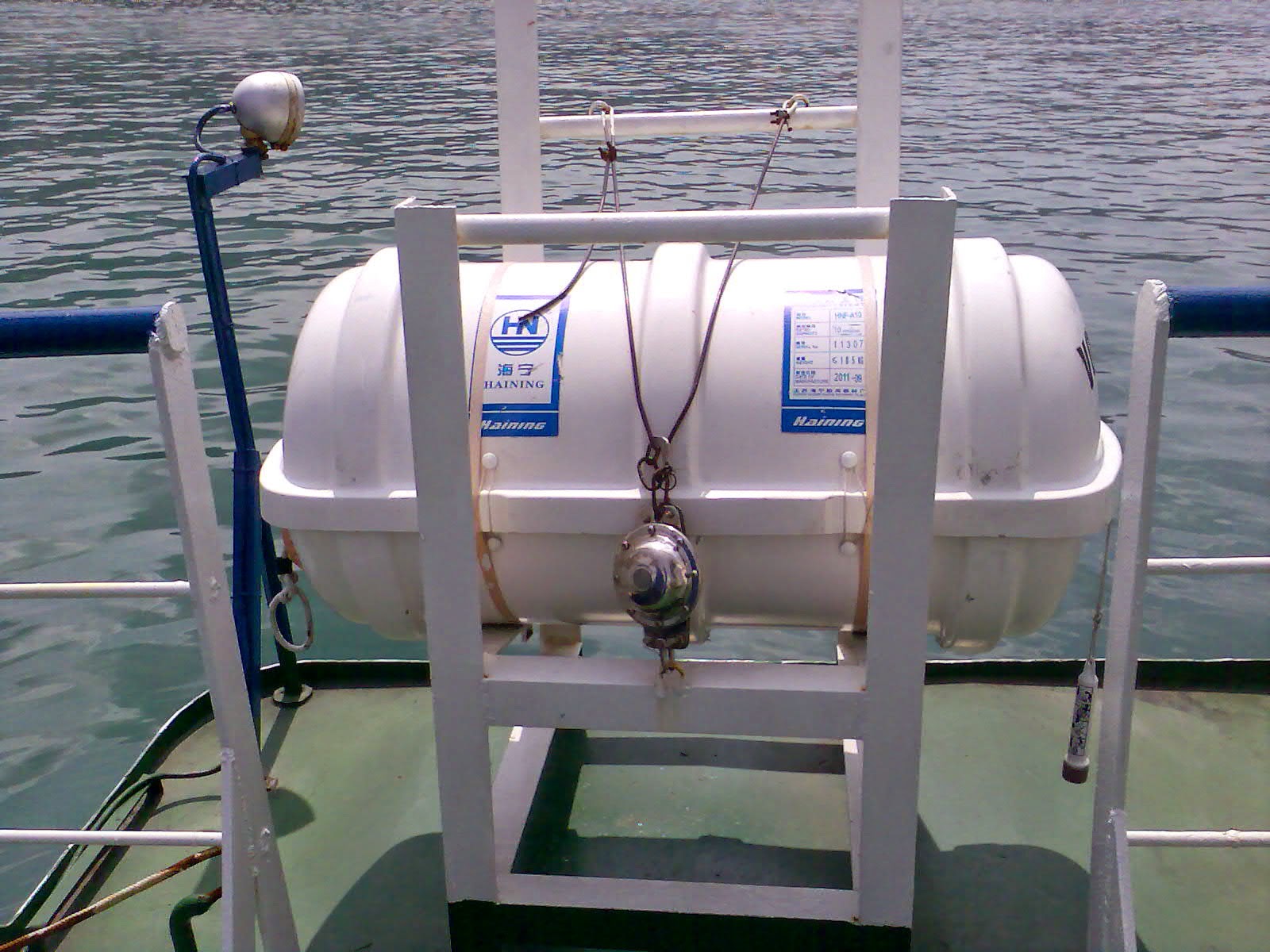
Inflatable life rafts are vacuum-sealed inside durable fiberglass canisters or heavy-duty fabric valises. Over time, friction, ambient moisture, high temperatures, and salt air can degrade fabric seams, sealants, and gas inflation valves.
Owners must submit rafts to authorized service stations at manufacturer-specified intervals—typically every one to three years. Technicians perform overpressure tests, verify cylinder weights, check valve integrity, and replace expired food, water, medical supplies, and pyrotechnics.
Hydrostatic Release Units (HRU)
When a vessel sinks rapidly, crew members may not have time to manually deploy the life raft. A Hydrostatic Release Unit (HRU) is a water-pressure-activated mechanism mounted between the life raft canister deck cradle and the vessel structure.
- Mechanism of Action: When submerged to a depth of 1.5 to 4.0 meters (5 to 13 feet), water pressure causes an internal spring-driven blade to sever a retaining rod or rope loop.
- Auto-Deployment: The buoyancy of the canister causes it to float free toward the surface, pulling the long painter line tied to the ship.
- Weak Link Breakage: Once the painter line reaches its full length, it trips the internal $CO_2$ inflation valve. As the raft inflates and gains massive positive buoyancy, it snaps a calibrated "weak link" line, separating the inflated raft completely from the sinking vessel.
HRUs have strict service lives—typically two years from installation—and must be replaced immediately upon reaching their expiration date.
Frequently Asked Questions
What caused the yacht Trashman to sink in the I Shouldn't Be Alive episode?
The 58-foot sailing yacht Trashman encountered an unexpected, un-forecasted gale off the coast of Cape Hatteras, North Carolina, in October 1982. Sustained winds exceeding 60 knots and waves over 30 feet tore away the boat's rigging, damaged the hull structure, and flooded the engine room, causing the vessel to founder rapidly.
Why did the survivors in "Shark Survivor" hallucinate and enter the ocean?
Two crew members experienced severe hypernatremia after consuming seawater due to extreme dehydration. Consuming salt water forces the body to flush out fluid to process the salt, leading to rapid intracellular brain dehydration. This triggers profound delirium, severe spatial disorientation, and vivid hallucinations, causing victims to believe they are walking onto dry land or drinking from freshwater springs.
What is the difference between a SOLAS A and SOLAS B life raft emergency pack?
A SOLAS A pack is designed for commercial vessels operating on long international ocean voyages. It includes emergency fresh water (1.5L per person), food rations, thermal protective aids, extensive first-aid kits, and smoke/parachute pyrotechnics. A SOLAS B pack is designed for passenger vessels operating on shorter coastal routes; it omits food rations and half the water requirement, focusing primarily on immediate signaling and short-term thermal protection.
How do modern life rafts prevent capsizing in severe ocean storms?
Modern ocean life rafts utilize deep, high-capacity water ballast bags beneath the floor that automatically fill with seawater upon inflation, lowering the raft's center of gravity. Additionally, deployment of a drogue (sea anchor) off the bow creates hydrodynamic resistance, keeping the raft aligned into the faces of oncoming waves to prevent broadside rollover.
Can sharks bite through modern inflatable life rafts?
While rare, puncture risks from large marine predators do exist. Modern life rafts are built using multi-layer tear-resistant synthetic fabrics (such as heavy-gauge Hypalon or Polyurethane) welded at the seams to withstand abrasion. Furthermore, life rafts feature dual independent buoyancy tubes; if one tube is punctured or damaged by marine life, the remaining tube retains sufficient buoyancy to support all passengers.
Practical Marine Safety Guidance
To avoid the life-threatening mistakes shown in extreme survival docudramas, ocean mariners should establish strict vessel safety protocols long before leaving port:
- Equip a Dedicated "Ditch Bag": Never rely solely on the emergency pack packed inside the life raft canister. Prepare an accessible, buoyant watertight bag containing a personal 406 MHz EPIRB or PLB, a hand-powered reverse-osmosis desalinator (such as a Katadyn Survivor 06), handheld marine VHF radios, satellite messaging devices, extra visual flares, and prescription medications.
- Mount Rafts with Unobstructed HRUs: Ensure deck-mounted life raft canisters are not tied down with non-approved lines, canvas covers, or gear that prevents free floatation. Verify that the Hydrostatic Release Unit (HRU) is installed correctly with the painter line attached to the specified weak link.
- Conduct Regular Abandon-Ship Drills: Ensure all crew members and passengers know how to deploy the life raft manually, understand the critical necessity of staying inside the raft during a emergency, and recognize the absolute danger of drinking seawater under any circumstance.
- Maintain Vessel Tracking and Communication: Always file a detailed float plan with a coast guard auxiliary or reliable shore contact, and maintain continuous automated position tracking using satellite transponders (such as AIS or Garmin inReach) during offshore passages.
Image Gallery