All Time Leaders in Points: The Definitive Historical Scoring Analysis
The all-time leaders in points represent the absolute pinnacle of individual scoring achievement, offensive longevity, and tactical adaptation in professional basketball. Tracking these historic benchmarks requires examining career tot...
The all-time leaders in points represent the absolute pinnacle of individual scoring achievement, offensive longevity, and tactical adaptation in professional basketball. Tracking these historic benchmarks requires examining career totals across regular-season performances, scoring efficiency metrics, and the sustained durability needed to dominate multiple eras of the sport.
Contents
Defining the All-Time Scoring Elite
Scoring at the highest level of professional basketball demands a rare intersection of physical durability, elite skill acquisition, and tactical versatility. The all-time leaders in points have consistently reinvented how offenses are constructed, forcing opposing defenses to completely alter their strategic blueprints over decades of competition.
When evaluating these historic scoring milestones, analysts examine not just the raw point totals, but the contextual factors that enable such sustained production. Players must navigate changing pace-of-play eras, shifting defensive schemes (such as the evolution from illegal defense rules to modern hybrid zone schemes), and the physical toll of an 82-game regular season schedule compounded by deep playoff runs.
Historical Evolution of Scoring Records
The benchmark for career scoring leadership has transitioned through several distinct legendary figures, each establishing a new paradigm of offensive output. Understanding how these records evolved provides essential context for modern achievements.
- Early Pioneers: Early decades of professional play established baseline scoring thresholds, where players relied heavily on set shots, inside dominance, and shorter career spans due to league economics and travel demands.
- The Mid-Century Ascendancy: As the game accelerated in the 1960s and 1970s, legendary centers and high-volume shooters pushed single-season and career ceilings significantly higher, establishing standards that stood for generations.
- The Modern Longevity Era: Contemporary basketball science, advanced load management protocols, and specialized training regimens have allowed elite athletes to extend their prime scoring years well into their late thirties, redefining what is possible in career cumulative totals.
Statistical Breakdown of Career Scoring Leaders
To understand the magnitude of these scoring achievements, it is necessary to analyze the statistical profiles of the top career leaders. The following comparison table outlines the key metrics associated with the benchmark figures in professional basketball history.
| Rank | Player Name | Career Points (Approximate) | Games Played | Points Per Game Average | Primary Scoring Methodologies |
|---|---|---|---|---|---|
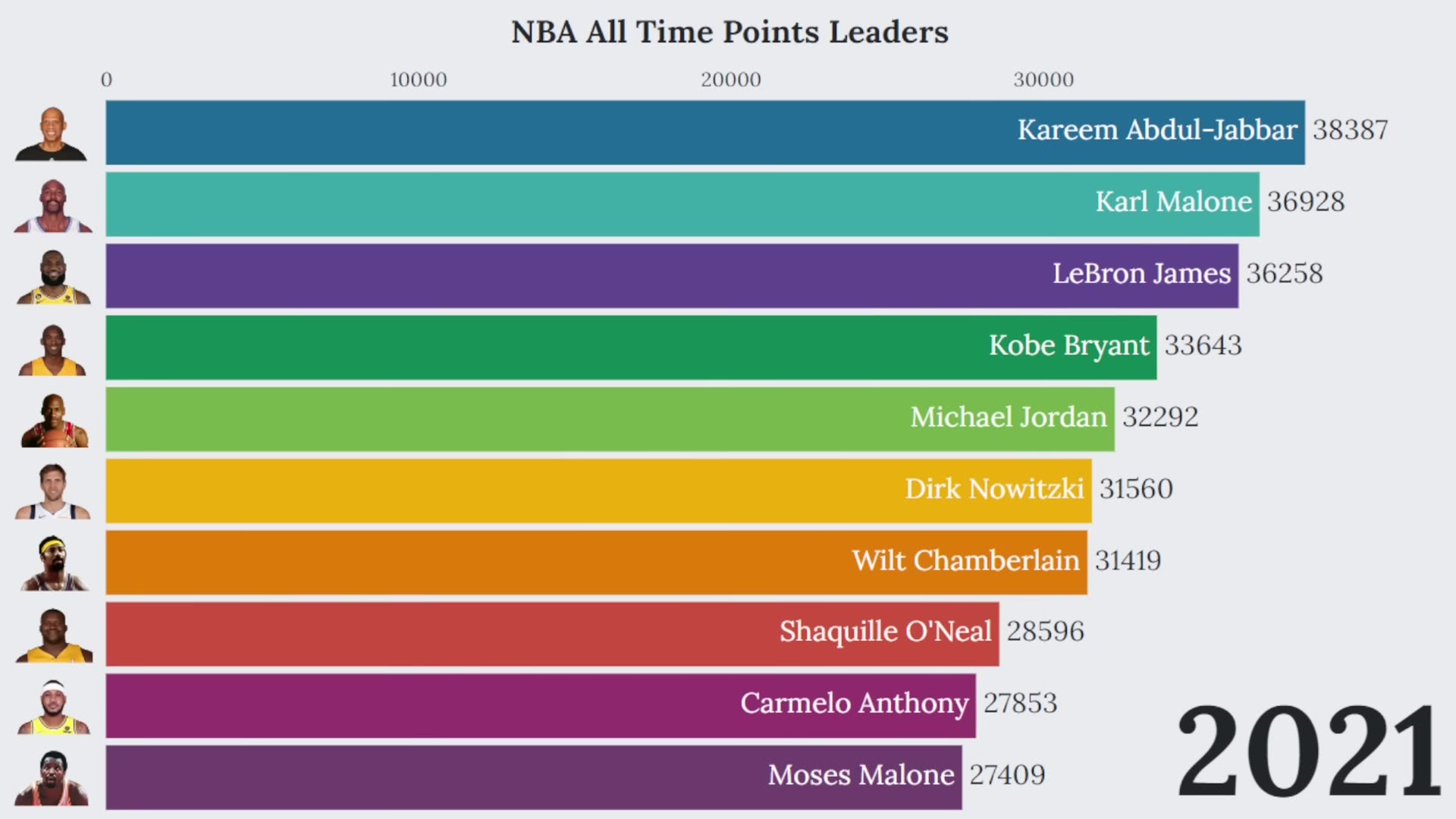
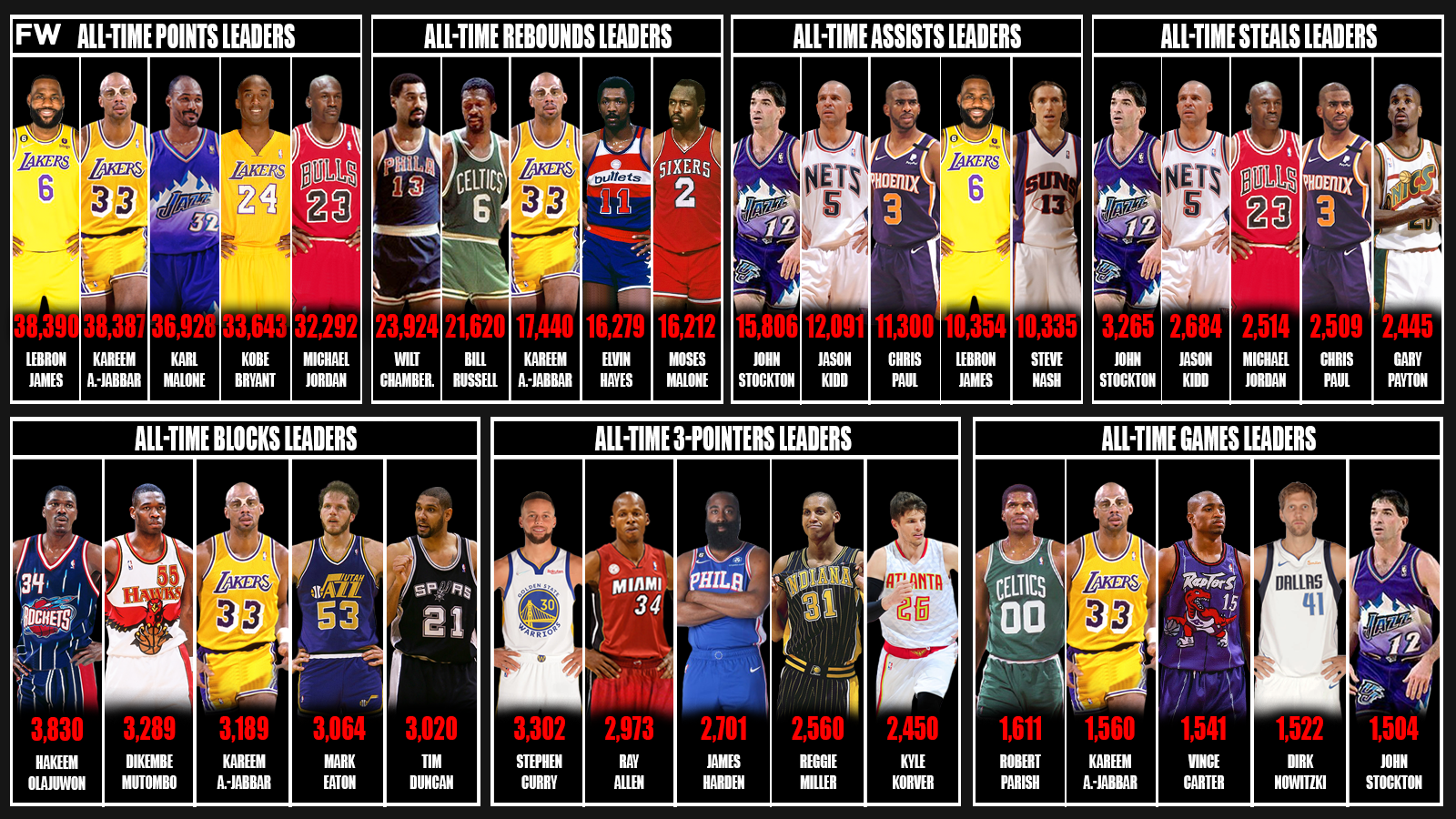
| 1 | LeBron James | 40,000+ | 1,500+ | 27.1+ | Transition drives, post-ups, perimeter shooting |
| 2 | Kareem Abdul-Jabbar | 38,387 | 1,560 | 24.6 | Skyhook, low-post footwork, transition |
| 3 | Karl Malone | 36,928 | 1,476 | 25.0 | Pick-and-roll, mid-range jumper, physical drives |
| 4 | Kobe Bryant | 33,643 | 1,346 | 25.0 | Isolation scoring, pull-up jumpers, deep range |
| 5 | Michael Jordan | 32,292 | 1,072 | 30.1 | Mid-range fadeaway, elite penetration, free throws |
Key Drivers of Sustained Scoring Longevity
Reaching the summit of the all-time scoring list requires far more than scoring bursts or elite shooting seasons. It demands a systemic approach to career management.
Durability and Injury Prevention
The primary barrier to breaking or challenging career scoring records is physical attrition. Players who occupy the upper tiers of the all-time scoring list share a remarkable baseline of durability, routinely missing minimal games across fifteen to twenty-plus professional seasons. Modern athletes utilize advanced biomechanical monitoring, cryotherapy, and customized nutrition plans to mitigate chronic wear and tear.
Offensive Versatility and Scheme Adaptation
Defenses evolve constantly, utilizing complex switching schemes, double-team traps, and analytical shot-selection suppression. Scoring leaders must evolve their offensive repertoire to remain elite threats. A player who relies solely on raw athleticism will experience a sharp decline in production during their later years; conversely, those who develop a reliable perimeter jumper, elite court vision, and high-IQ off-ball movement maintain high efficiency well into the twilight of their careers.
Comparing Era-Adjusted Scoring Metrics
Evaluating players across different eras presents unique analytical challenges. The table below provides a comparative framework illustrating how pacing, three-point volume, and officiating trends have impacted scoring environments historically.
| Era / Decade | Average Pace (Possessions) | Average Team Points Per Game | Primary Tactical Focus | Impact on Career Totals |
|---|---|---|---|---|
| 1960s - 1970s | Extremely High (115+) | 110 - 120 | Fast breaks, paint domination, high shot volume | Inflated raw possession counts, though shorter schedules offset totals |
| 1980s - 1990s | Moderate to High (100+) | 105 - 110 | Isolation sets, post-up gravity, physical defense | Balanced scoring efficiency against heavy physical contact |
| 2000s - 2010s | Low to Moderate (90 - 95) | 95 - 100 | Half-court execution, slow-paced grinding defense | Depressed raw point totals due to slower game tempos |
| Modern Era (2020+) | High (100+) | 115 - 120 | Pace-and-space, high three-point volume, early clock shooting | Accelerated cumulative totals driven by offensive rule interpretations and spacing |
Frequently Asked Questions About All-Time Scoring Records
Who holds the record for the most career points in professional basketball history?
LeBron James holds the all-time record for career regular-season points, surpassing Kareem Abdul-Jabbar's long-standing benchmark during the 2023 season and continuing to extend the record in subsequent years. His unprecedented combination of elite scoring average and sustained multi-decade longevity enabled this historic milestone.
How many players have surpassed the 30,000 career points threshold?
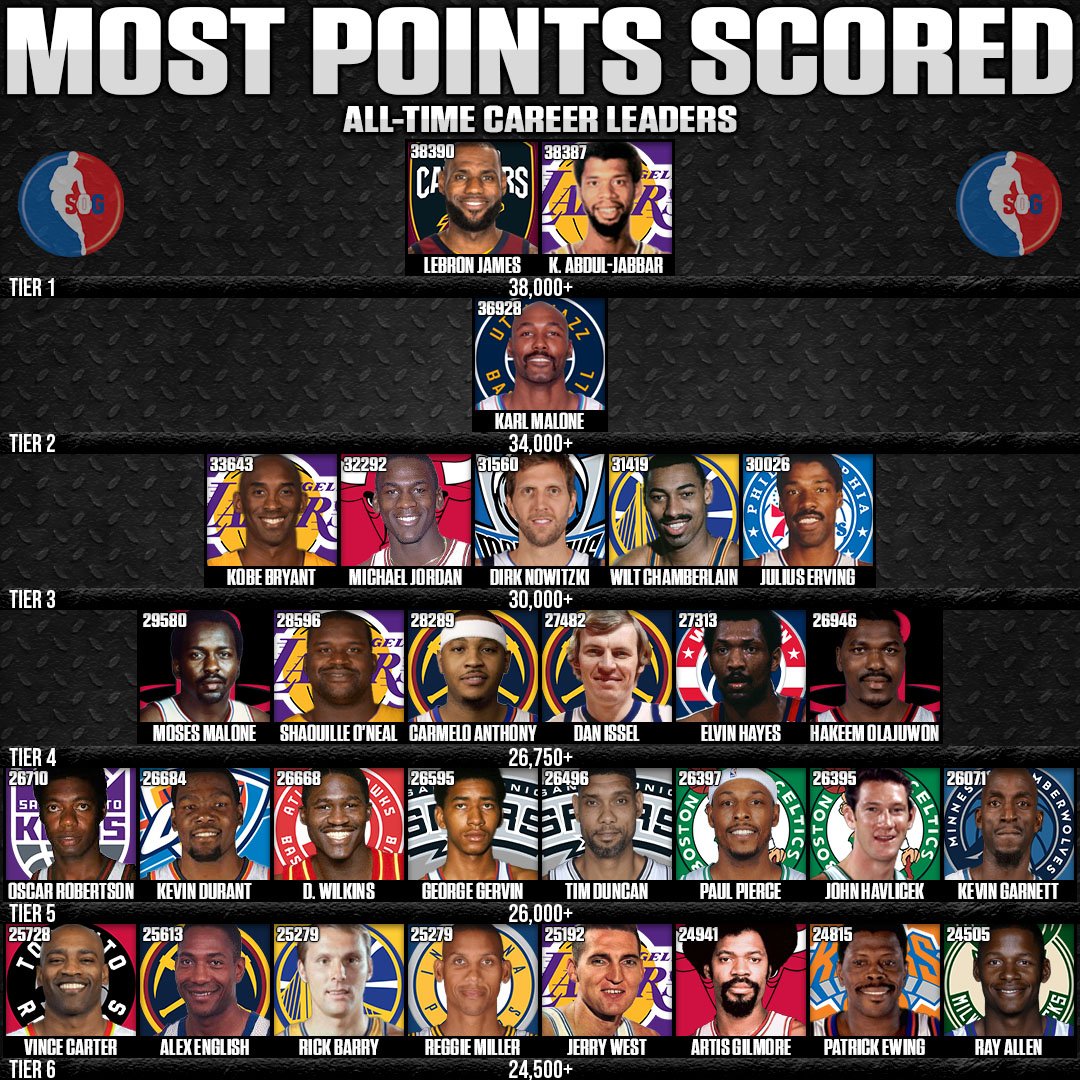
Only a select group of legendary players have crossed the exclusive 30,000 career points threshold in professional history. This elite club features icons such as LeBron James, Kareem Abdul-Jabbar, Karl Malone, Kobe Bryant, Michael Jordan, and Dirk Nowitzki, representing the ultimate standard of offensive endurance.
Does the all-time points list include playoff scoring statistics?
Official career scoring leaderboards typically track regular-season statistics exclusively to maintain historical consistency across varying career lengths and playoff opportunities. When combined regular-season and postseason totals are evaluated, the hierarchy reflects even greater cumulative output for players with extensive championship runs.
What is the significance of points per game (PPG) versus total career points?
While points per game measures a player's peak scoring dominance and efficiency on a nightly basis, total career points measures endurance, availability, and sustained excellence over a long timeline. A player with a slightly lower career scoring average who plays twenty elite seasons will frequently surpass a high-volume scorer whose career was shortened by injuries.
How has the modern three-point shot impacted all-time scoring lists?
The modern emphasis on three-point shooting has transformed floor spacing, allowing high-volume perimeter players to generate efficient points at an unprecedented rate. While historical leaders often relied heavily on interior scoring or mid-range mastery, contemporary and future scorers benefit from the mathematical advantage of the three-point arc.
Strategic Outlook on Future Scoring Chasers
As the game continues to evolve through analytical optimization and athletic development, future generations of players will challenge existing career benchmarks. Tracking these milestones requires monitoring annual games-played thresholds, scoring efficiency percentages, and the ongoing adaptation of defensive strategies against hyper-efficient offensive systems. Maintaining perspective on historical contexts ensures that modern achievements are properly evaluated against the foundational legends who built the sport's scoring legacy.
Image Gallery