Comprehensive Guide to Using CHF ICD-10-CM Codes in Practice (2026 Update)
Using Congestive Heart Failure (CHF) ICD-10-CM codes in practice requires identifying the specific type (systolic, diastolic, or combined) and the acuity (acute, chronic, or acute on chronic). Clinicians and coders must navigate catego...
Using Congestive Heart Failure (CHF) ICD-10-CM codes in practice requires identifying the specific type (systolic, diastolic, or combined) and the acuity (acute, chronic, or acute on chronic). Clinicians and coders must navigate category I50, ensuring documentation supports the highest level of specificity to satisfy medical necessity and accurate reimbursement.
Contents
In the 2026 clinical landscape, Heart Failure (HF) remains one of the most frequent diagnoses in inpatient and outpatient settings. However, "CHF" is often used as a generic term in clinical notes, which translates poorly to the highly granular ICD-10-CM (International Classification of Diseases, 10th Revision, Clinical Modification) system. Precise coding is not merely an administrative task; it directly impacts Risk Adjustment Factor (RAF) scores, Hierarchical Condition Categories (HCC) coding, and the quality of patient care tracking.
Understanding the Hierarchy of the I50 Category
The ICD-10-CM system organizes heart failure under category I50. This category is further divided into subcategories that define the functional nature of the failure and the clinical timeframe. To code accurately, a practitioner must look beyond the general "CHF" label and identify the underlying physiological impairment.
The Significance of Heart Failure Specificity
When a provider documents only "CHF," the default code is I50.9 (Heart failure, unspecified). In 2026, using unspecified codes is increasingly scrutinized by payers and can lead to claim denials or lower-than-appropriate reimbursement. To move beyond I50.9, documentation must specify the following:
- Acuity: Is the condition acute, chronic, or an acute exacerbation of a chronic condition?
- Type: Is it systolic failure (reduced ejection fraction), diastolic failure (preserved ejection fraction), or a combination of both?
- Laterality and Involvement: Does it involve the left ventricle, the right ventricle, or both (biventricular)?
Coding by Acuity: Acute, Chronic, and Acute on Chronic
The clinical status of the patient at the time of the encounter dictates the fourth or fifth character of the ICD-10-CM code. This distinction is critical for capturing the severity of the illness.
Acute Heart Failure
Acute heart failure refers to the rapid onset or worsening of symptoms, often requiring urgent intervention or hospitalization. In the coding manual, "acute" codes (e.g., I50.21 for acute systolic heart failure) represent a higher level of resource consumption and medical complexity.
Chronic Heart Failure
Chronic heart failure represents the patient’s baseline state. While the patient has a permanent cardiac dysfunction, it is currently "compensated" or stable under medical management. Chronic codes (e.g., I50.32 for chronic diastolic heart failure) are essential for long-term care management and chronic disease registries.
Acute on Chronic Heart Failure
This is used when a patient with known chronic heart failure experiences a sudden "decompensation" or flare-up. Coding I50.43 (Acute on chronic combined systolic and diastolic heart failure), for example, tells the story of a patient with a baseline condition who is currently in a state of crisis. This is frequently seen in emergency department visits and inpatient admissions.
Decoding Systolic, Diastolic, and Combined Failure
The most significant shift in CHF coding over the last decade has been the move toward functional definitions based on Ejection Fraction (EF).
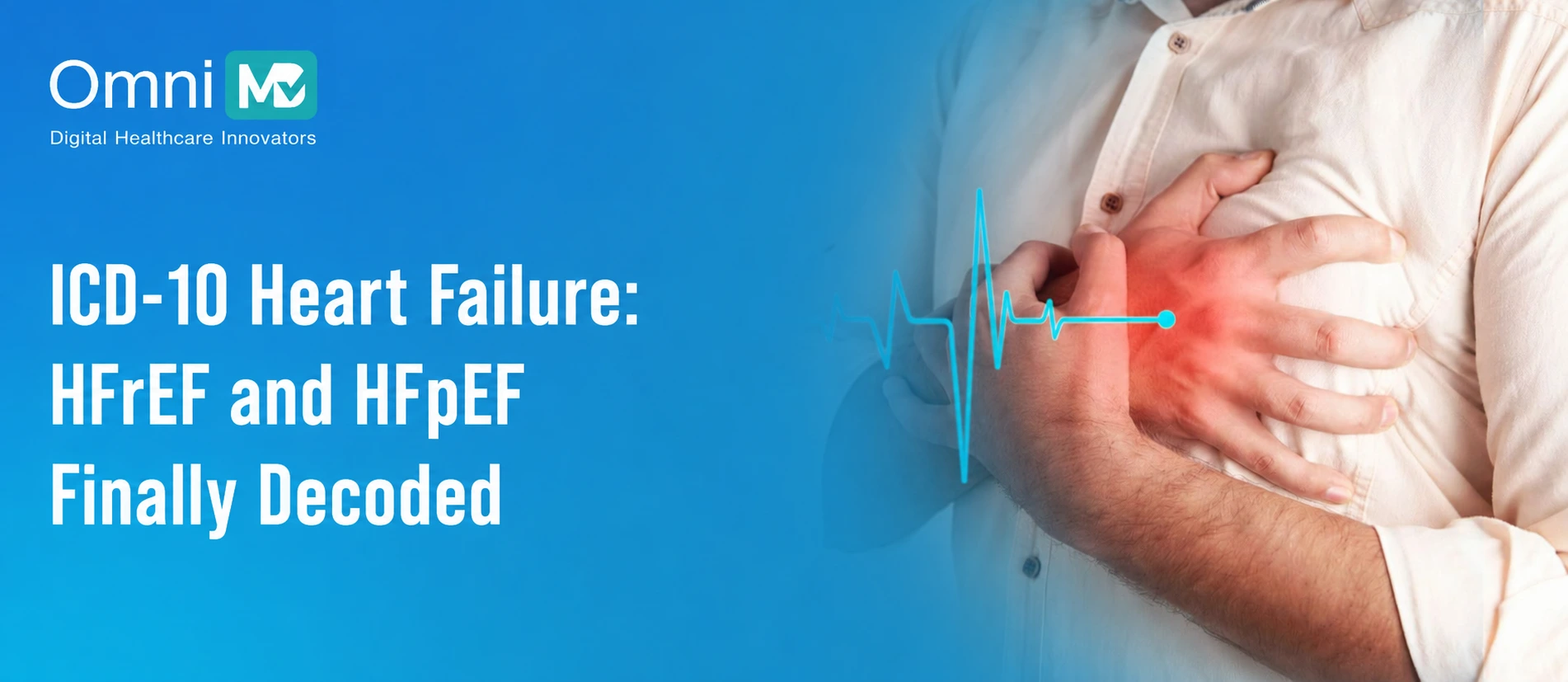
Systolic Heart Failure (HFrEF)
Heart Failure with Reduced Ejection Fraction (HFrEF) occurs when the heart muscle cannot contract strongly enough to pump sufficient blood. In ICD-10-CM, this is classified under subcategory I50.2.
- I50.21: Acute systolic heart failure.
- I50.22: Chronic systolic heart failure.
- I50.23: Acute on chronic systolic heart failure.
Diastolic Heart Failure (HFpEF)
Heart Failure with Preserved Ejection Fraction (HFpEF) occurs when the heart muscle becomes stiff and cannot relax properly to fill with blood. This is classified under subcategory I50.3.
- I50.31: Acute diastolic heart failure.
- I50.32: Chronic diastolic heart failure.
- I50.33: Acute on chronic diastolic heart failure.
Combined Heart Failure
Many patients exhibit elements of both systolic and diastolic dysfunction. When both are documented, the I50.4 series is used. It is a common mistake to code both I50.2- and I50.3- separately; instead, the combined code must be used to represent the clinical picture accurately.
Hypertensive Heart Disease and Sequencing Rules
One of the most complex areas of CHF coding involves its relationship with hypertension (HTN). The 2026 ICD-10-CM Official Guidelines for Coding and Reporting maintain a "presumed causal relationship" between hypertension and heart failure.
The I11.0 and I50.- Linkage
When a patient has both hypertension and heart failure, the codes are linked. According to the guidelines, you must use code I11.0 (Hypertensive heart disease with heart failure) as the primary code. An additional code from category I50 must then be assigned to identify the type of heart failure.
Hypertensive Chronic Kidney Disease (CKD) and Heart Failure
If the patient has the "triple threat" of hypertension, heart failure, and CKD, the coding becomes more specialized.
- I13.0: Hypertensive heart and chronic kidney disease with heart failure and stage 1 through stage 4 chronic kidney disease, or unspecified chronic kidney disease.
- I13.2: Hypertensive heart and chronic kidney disease with heart failure and with stage 5 chronic kidney disease, or end-stage renal disease (ESRD).
- Secondary Code: Always include the specific I50 code to define the heart failure type and the N18 code to define the CKD stage.
| Heart Failure Type | Acute Code | Chronic Code | Acute on Chronic Code |
|---|---|---|---|
| Systolic (HFrEF) | I50.21 | I50.22 | I50.23 |
| Diastolic (HFpEF) | I50.31 | I50.32 | I50.33 |
| Combined | I50.41 | I50.42 | I50.43 |
| Right Heart Failure | I50.811 | I50.812 | I50.813 |
| Biventricular | I50.82 | I50.82 | I50.82 |
Specialized Coding: Right Heart, Biventricular, and End-Stage
As of 2026, coders must be familiar with subcategories that go beyond the left ventricle. Right-sided heart failure and biventricular failure have their own specificities.
Right Heart Failure (I50.81-)
This is often secondary to left-sided failure or pulmonary hypertension.
- I50.811: Acute right heart failure.
- I50.812: Chronic right heart failure.
- I50.814: Right heart failure due to left heart failure (Note: This is a critical code for showing the progression of the disease).
Biventricular Heart Failure (I50.82)
This code is used when the provider specifically documents that both the left and right sides of the heart are failing. It is a more severe diagnosis than isolated left or right failure and often carries higher weight in risk-adjustment models.
End-Stage Heart Failure (I50.84)
This code was introduced to capture patients who have reached the final stages of the disease, often those being evaluated for heart transplants or managed with palliative care/hospice. It should be used in conjunction with the codes for the specific type of heart failure (systolic/diastolic).
Clinical Documentation Improvement (CDI) Strategies
To ensure that the codes accurately reflect the patient’s condition, Clinical Documentation Improvement (CDI) specialists focus on bridging the gap between clinical language and coding requirements.
- Avoid "CHF" in Isolation: Encourage providers to specify "Chronic Systolic Heart Failure" rather than just "CHF" or "Heart Failure."
- Linkage with Underlying Causes: Ensure that the relationship between heart failure and conditions like Valvular Disease (I34-I38) or Coronary Artery Disease (I25.1-) is clearly stated.
- Ejection Fraction Clarification: While a coder cannot assign a code based solely on an Echo report, they can use the report to query the physician. If the Echo shows an EF of 25%, the coder should ask the physician to document "systolic heart failure" in the progress notes.
- Acuity during Transitions: When a patient is admitted for an exacerbation, the documentation must reflect "acute on chronic" to justify the inpatient stay and the intensity of treatment (e.g., IV diuretics).
Common Pitfalls and Troubleshooting
Practitioners often encounter "grey areas" where the coding path is not immediately clear.
Sequencing Errors
A common error is sequencing the heart failure code (I50) before the hypertensive heart disease code (I11.0). Official guidelines state that the hypertensive heart disease code must come first.
Conflicting Documentation
If one consultant documents "systolic failure" and another documents "diastolic failure," the coder cannot choose one over the other. The "Combined" code (I50.4-) is often the most appropriate solution, or a query must be sent to the attending physician to resolve the discrepancy.
Coding from Diagnostic Reports
As mentioned previously, coders are prohibited from extracting a diagnosis from an ancillary report (like an EKG or Echocardiogram) if the physician has not documented it in the body of the medical record. If the report says "Severely depressed LV function" but the physician writes "CHF," the code remains I50.9 until the physician updates their note.
Frequently Asked Questions
Can I code I50.9 if the physician documents "Congestive Heart Failure"?
Yes, I50.9 (Heart failure, unspecified) is the correct code for "Congestive Heart Failure" without further specification. However, this code is considered low-specificity and may be flagged by insurance companies or result in lower reimbursement for the facility.
How do I code heart failure when the patient also has CAD?
Heart failure and Coronary Artery Disease (CAD) do not have a presumed causal relationship in the same way hypertension and heart failure do. You should code both conditions separately (e.g., I25.10 for CAD and I50.32 for chronic diastolic heart failure) unless the physician explicitly links them as "Ischemic Cardiomyopathy" (I25.5).
What is the difference between I50.84 and I50.9?
I50.84 is for "End-stage heart failure," which is a highly specific terminal stage of the disease. I50.9 is "Unspecified," meaning the physician has not provided enough information to determine the type or stage. These are at opposite ends of the specificity spectrum.
If a patient has compensated CHF, should I code it as "Chronic"?
Yes. Even if the patient is currently asymptomatic due to successful medication management (compensated), the underlying condition is still present. You should code it as Chronic (e.g., I50.22 or I50.32) to reflect the ongoing clinical management required.
Is "Heart Failure with Preserved Ejection Fraction" (HFpEF) always Diastolic?
For coding purposes, yes. ICD-10-CM guidelines and the American Hospital Association (AHA) Coding Clinic have clarified that HFpEF is equivalent to diastolic heart failure (I50.3-) and HFrEF is equivalent to systolic heart failure (I50.2-).
Final Recommendations for Practice
To excel in heart failure coding in 2026, healthcare organizations should prioritize provider education on the importance of specificity. Moving away from the generic "CHF" acronym to more descriptive terms like "Acute on Chronic HFrEF" ensures that the medical record is both clinically accurate and administratively robust. Regular audits of I50-category claims can help identify patterns of under-coding or unspecified coding, allowing for targeted training that improves both data quality and financial health.
Image Gallery